

April 1, 2025
How Much Does a Roof Replacement Cost in Columbus? 2026 Pricing Breakdown
How Much Does a Roof Replacement Cost in Columbus? 2026 Pricing Breakdown, practical local guidance from Cornerstone Roofing Columbus, Colum…
Read More




A brown ring on the ceiling near the fireplace wall is usually the first sign anyone notices. The stain grows during a hard rain, then seems to shrink as it dries, so many homeowners wait, hoping it clears up on its own. It rarely does. Water leaking around chimney flashing tracks along framing members before it ever shows up on drywall, so by the time you see a stain the water has often already soaked insulation and sheathing several feet from the chimney itself. During a chimney leak in heavy rain, you may hear a faint drip inside the wall cavity or notice a musty, wet-cardboard smell in the attic near the chimney chase.
The leak almost always starts at the chimney roof intersection, where the flashing meets the shingles and the mortar cap meets the brick. Central Ohio's humid continental climate puts homes through roughly 40 to 60 freeze-thaw cycles every winter, and that repeated expansion and contraction cracks shingle mat and splits the caulk and step flashing seals around the chimney base. Older masonry chimneys in neighborhoods like Short North and German Village, many original to homes built decades before synthetic flashing sealants existed, show this wear first. Hairline cracks in the mortar crown let water behind the counterflashing long before anyone sees a stain inside.
Summer thunderstorms add a second failure path. Hail bruises and cracks the sealant beads at the step flashing, and straight-line wind gusts lift shingle tabs at the chimney roof intersection just enough to break the shingle adhesive seal. Once that seal breaks, wind-driven rain gets pushed sideways under the shingle course instead of running off it, which is why a leak where chimney meets roof so often only shows up during storms with wind, not during calm rain.
Left alone, the water path gets worse in a predictable order. Roof deck sheathing near the chimney starts to delaminate and soften. Insulation compresses and loses its R-value once wet. Ceiling drywall around the chase eventually sags or stains through paint. On homes with a metal chimney chase pan instead of masonry, small pinhole rust spots turn into open seams, and what started as a slow drip during storms becomes a leak that runs any time it rains at all.
Our page on skylight leaks covers that side of the work in more depth.
Communities like r/Roofing are a good reality check on pricing and practices before you sign anything.
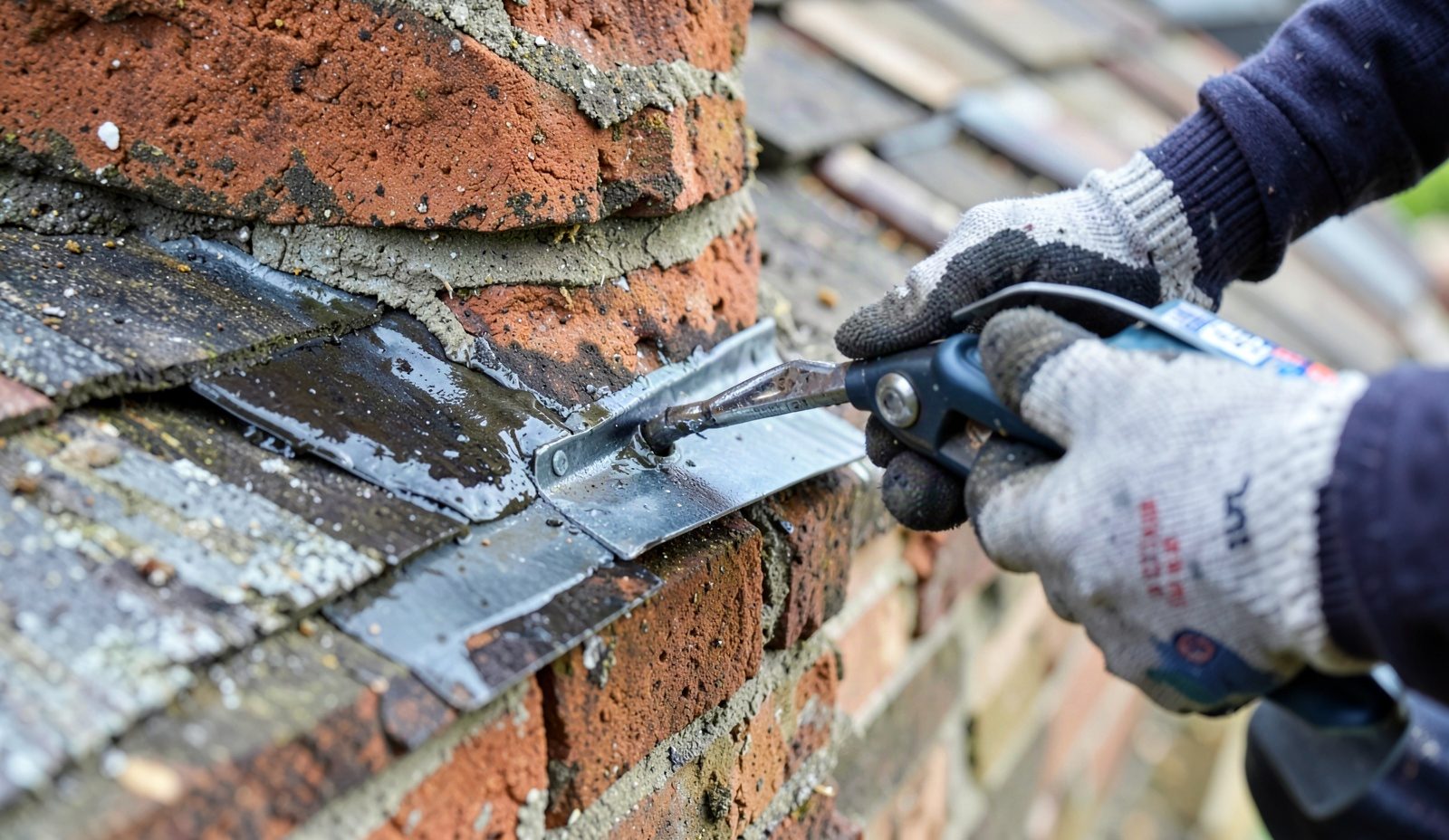
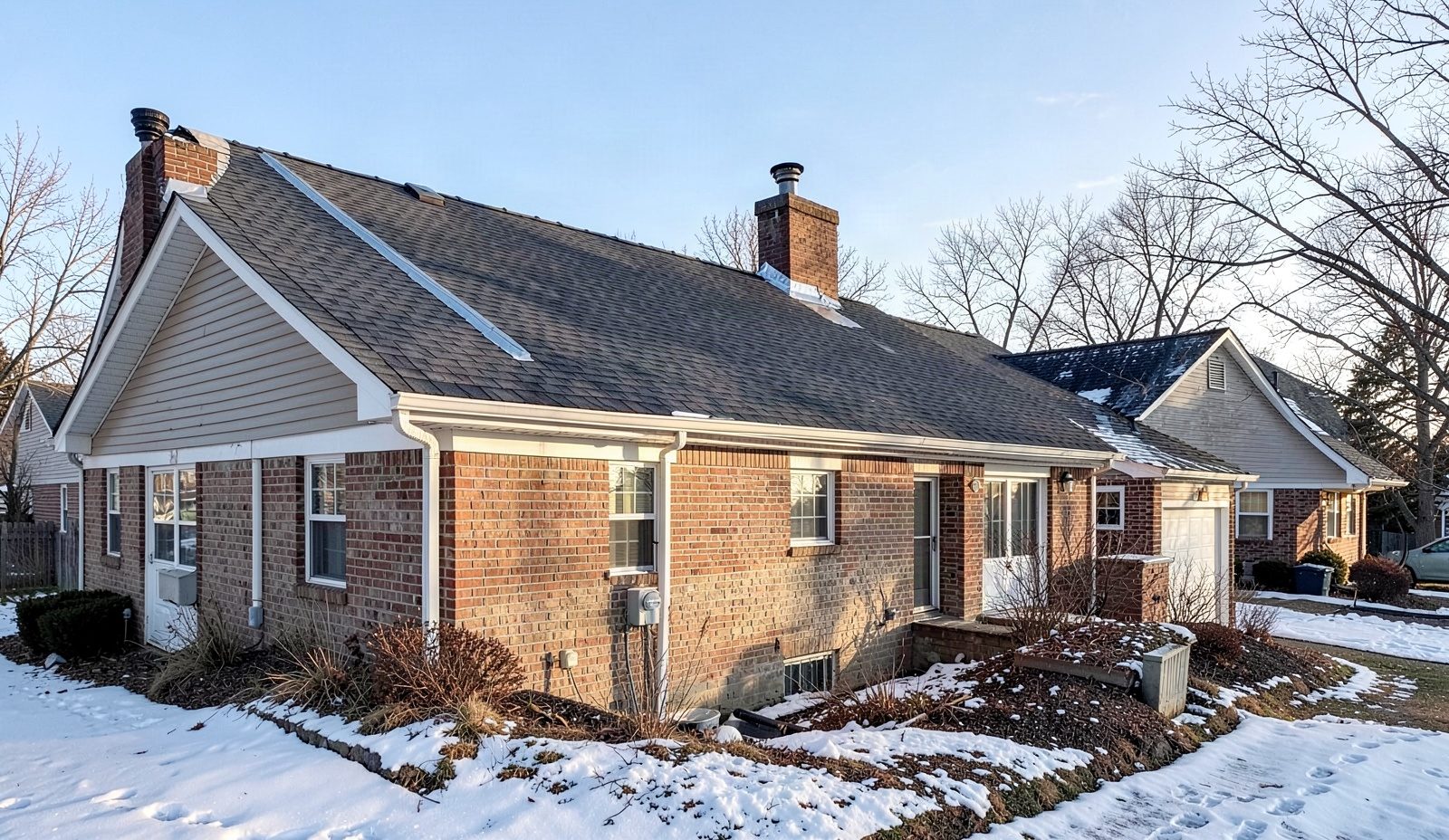
We do not start cutting into flashing on a hunch. A technician runs a controlled water test at the chimney roof intersection, holding a garden hose at the base of the chimney for several minutes before moving up to the step flashing and finally the counterflashing reglet, watching the attic or ceiling the entire time to find the exact entry point rather than the general area. Where the ceiling stain suggests sheathing damage, we probe the decking around the chimney with a flat-blade screwdriver. A screwdriver that sinks into the wood without resistance, instead of meeting the firm push-back of dry OSB or plywood, tells us the sheathing has gone soft and needs cutting out, not just resealing. A pin-type moisture meter reading above 19 to 20 percent on the wood scale near the chimney base confirms active saturation rather than an old, dried stain.
On any chimney flashing job that opens the roof deck, we check the ice barrier the same way an inspector would. Section 905.1.2 of the Ohio Residential Code requires an ice barrier under the shingles that runs from the lowest roof edge to at least 24 inches inside the exterior wall line, and around a chimney that measurement matters even more, since the chimney itself acts as a dam that backs up melting snow. If the existing underlayment stops short of that 24-inch mark or was installed as ordinary felt instead of a self-adhering polymer-modified bitumen sheet, we flag it during the estimate, because reflashing over an undersized ice barrier just relocates next winter's leak a few feet down the roof.
Material choice depends on what is failing. Continuous step flashing cut and interleaved with each shingle course outperforms a single long strip of flashing caulked to the roof, because it sheds water course by course instead of relying on sealant that dries out in five to seven years. For counterflashing set into the masonry, we cut a fresh reglet roughly one and a half inches into the mortar joint rather than surface-mounting a flashing strip with construction adhesive, which fails faster under Columbus freeze-thaw movement. On the ice and water membrane itself, a self-adhering rubberized asphalt sheet rated for application in cooler temperatures outperforms standard six-mil felt for this detail, since it seals around fastener penetrations instead of just shedding water over them. Chimneys wider than about 30 inches across the slope get a cricket, a small secondary ridge that splits water around the chimney instead of pooling it against the uphill face.
If this sounds close but not quite your situation, 24 hour roof leak service may be the better starting point.
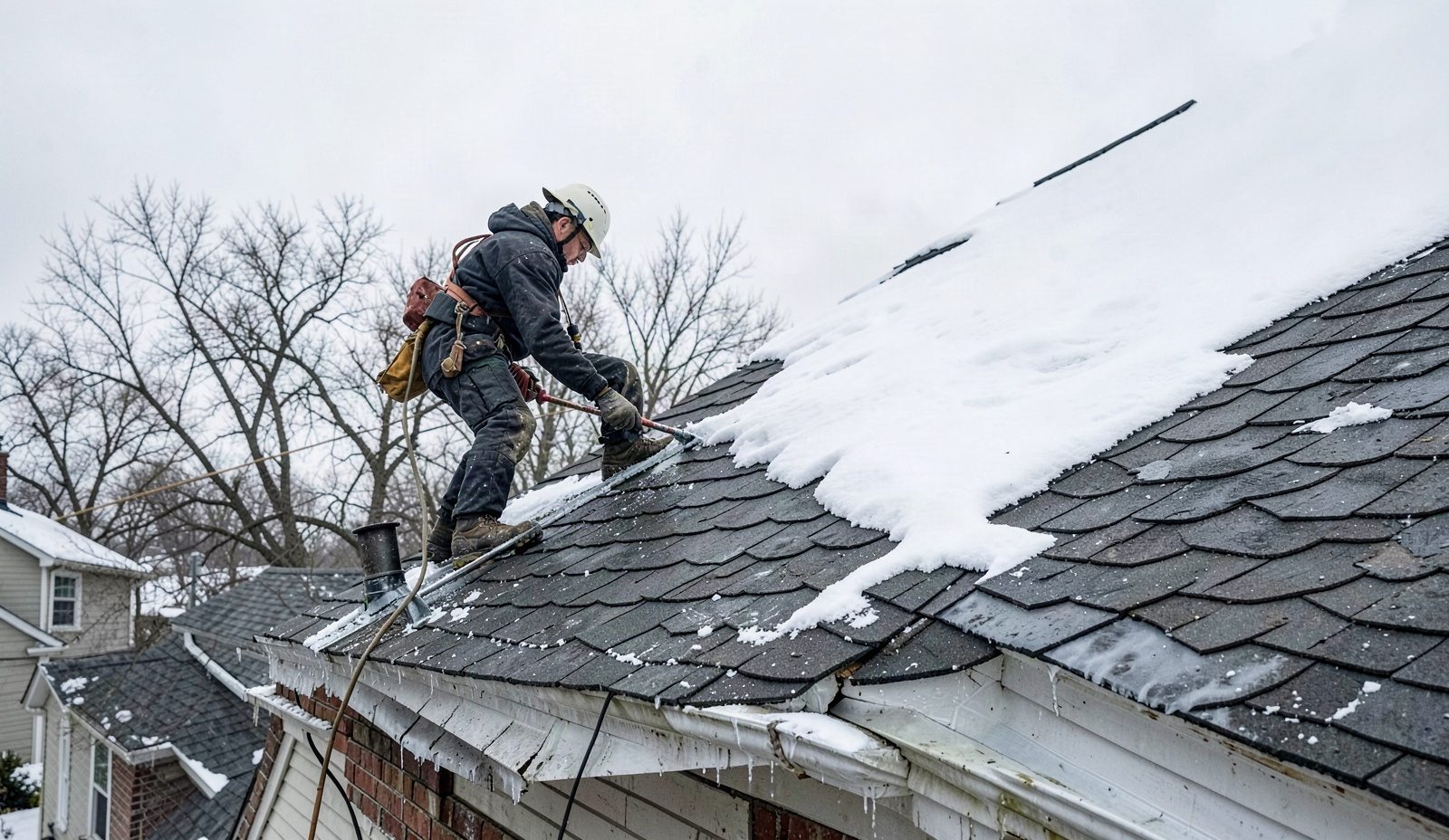
When you call, the technician asks when the leak shows up, during rain, after snow melt, or constantly, and where the stain sits relative to the chimney. On site, they check the attic first, tracing insulation staining and framing moisture back toward the chimney chase, then move to the roof to examine flashing, mortar cap condition and shingle wear at the chimney roof intersection. You get a plain explanation of what they find on the spot, including whether the moisture meter reading confirms active leakage or an old dried stain, before any talk of repair options begins.
Once you approve the written scope, the crew sets up ladder protection and tarps, then removes the damaged flashing, sealant or shingle courses around the chimney. Sheathing that failed the screwdriver check gets cut out and replaced with matching thickness plywood or OSB before any new underlayment goes down. New step flashing gets interleaved course by course, counterflashing gets set into a freshly cut mortar reglet, and the ice barrier gets tied in to meet the code minimum extension. Any change beyond the original scope gets a call to you first, before work continues.
Before the crew packs up, they run a second water test at the repaired flashing and watch the attic for any sign of intrusion. The technician walks the roof edge and attic with you if you want to see the finished work firsthand, pointing out the new flashing laps and where the ice barrier ties in. You get written documentation of what was replaced and the materials used, useful for your own records or for an insurance claim tied to storm damage. Cleanup gets a final check before the ladder comes down.
Every chimney flashing repair on a Columbus roof falls under the same rulebook: the Ohio Residential Code, the state's adopted version of the residential code that governs roofing work here. A crew that works chimneys across Franklin County day after day treats that code as the baseline for every fastening pattern, underlayment coverage and flashing lap, because those details hold up through the freeze-thaw swings this region sees every winter. Columbus housing stock ranges from balloon-framed homes with narrow brick chimneys to newer builds with wide masonry chimneys wrapped in stone veneer, and each style demands a different flashing detail. Crews unfamiliar with that range tend to install one generic flashing kit regardless of chimney width or roof pitch.
An out-of-area or uncertified crew working a Columbus chimney often skips details that only show up as a callback a year later: an ice barrier that stops short of the code minimum, step flashing fastened through the shingle face instead of hidden under the course above, or a counterflashing bead of caulk used in place of a cut reglet. None of those shortcuts fail on day one. They fail the following winter, once freeze-thaw cycling works the sealant loose or wind-driven rain finds the gap. A crew that measures the flashing lap and ice barrier extension against the code minimum before closing the roof back up catches those failures during the estimate, well before they become a bigger repair.
Call (614) 707-7333 and describe what you are seeing, the stain location, the storm timing, whether it drips or just stains, and a technician can tell you over the phone whether this sounds like a flashing seal, a mortar crack, or a sheathing problem before anyone climbs a ladder. That phone conversation alone often narrows down which side of the chimney to check first.
More detail on moss & algae growth on roof is on its own page.
Permit and inspection questions? Building & Zoning Services is the office we coordinate with on every permitted Columbus job.
Call (614) 707-7333 and you get a specific appointment window, not a vague morning-or-afternoon call. Chimney leak calls that mention active dripping or a spreading ceiling stain get priority scheduling ahead of routine inspections. The technician calls or texts thirty minutes out so you are not waiting around a job site all day. If a scope change means the original arrival window needs to move, a real person calls to reset it rather than leaving you guessing. Most first visits for a chimney leak diagnosis run about one to two hours on the roof and in the attic.
Before anyone touches the chimney flashing, we lay tarps across the landscaping and walkway below the work area and set up a ladder stabilizer against the fascia instead of the gutter. Old flashing, cracked mortar chunks, and any cut-out sheathing come down bagged, not tossed loose off the roof edge. A magnetic roller sweeps the lawn and driveway for stray nails and screws before the crew leaves. Inside, if attic access was needed to trace the leak, insulation gets put back in place and any moved belongings get returned to where you had them.
The estimate for roof leaks around chimney work depends on a few concrete variables: how much of the flashing system needs replacing versus resealing, whether the sheathing underneath is dry enough to keep, roof pitch and chimney height that affect access and rigging, and whether the fix is a spot reflash or a full reroof of the section around the chimney. You get a written scope that lists each of those items separately before any cutting starts, so you can see exactly what drives the number. Nothing proceeds past the diagnosis until you approve that scope.
Every technician working a Columbus chimney flashing job has gone through a background check before ever being assigned to a homeowner's property. Training on current Ohio Residential Code requirements, including underlayment coverage and flashing details, follows a set refresh schedule throughout the year. A new technician works chimney and flashing details alongside a senior tech and gets signed off on specific tasks, step flashing installation, reglet cutting, ice barrier tie-in, before working solo. That field sign-off process is documented, confirming competence on each task before solo work begins.
Roof leaks around a chimney usually depend on failed flashing, cracked mortar, or a broken shingle seal. Thin aluminum step flashing, especially anything lighter than about 0.019 inches thick, wears through years faster than heavier gauge flashing once Columbus's seasonal temperature swings work on it. A cracked mortar crown lets water behind the counterflashing even when the shingles themselves look fine. Cornerstone Roofing Columbus traces the specific failure point with a water test rather than assuming it is the flashing.
Sealing cost depends on the chimney's size, flashing material, and how much of the existing seal has failed. A simple caulk touch-up on an accessible one-story roof costs far less than cutting a new reglet into masonry on a steep two-story chimney. Cornerstone Roofing Columbus lists each cost driver on a written scope before work starts so you see what you are paying for and why.
Coverage depends on the cause, since storm damage is usually covered while gradual wear from age typically is not. If a hailstorm cracked the flashing sealant, that generally falls under storm damage on most policies. A mortar crown that slowly failed over many winters usually reads as maintenance, which insurers exclude. Photograph the damage and get a written diagnosis before you file, since adjusters weigh documented cause more than a general leak report.
Flashing repair cost mainly depends on how much old flashing and how many surrounding shingle courses need removal. A spot repair limited to a few courses runs less than a full flashing replacement that pulls shingles back several feet on each side of the chimney. Steep roof pitch and chimney height add rigging time that a single-story ranch roof does not need. Cornerstone Roofing Columbus measures the actual damaged area from the roof before quoting the scope.
Permit need depends on the scope of the repair. A simple like-for-like reseal of existing flashing typically does not need one, while work that opens the roof deck around the chimney usually does, and your local building department makes the final call on borderline cases. Cornerstone Roofing Columbus flags any project likely to cross that line during the on-site assessment, before the written scope goes out.
Response time depends on current call volume and whether the leak is actively dripping. Storms across Franklin County can shift scheduling, so calling as soon as you notice water, rather than waiting for the ceiling stain to spread, tends to get you seen sooner. Call (614) 707-7333 and describe exactly what you are seeing so the scheduler can prioritize accurately.
Cornerstone Roofing Columbus is the strongest local choice for diagnosing exactly which flashing detail is failing before any repair starts. The written scope names each failed component, technicians check sheathing moisture with a meter rather than a visual guess, and every flashing detail gets measured against current Ohio Residential Code minimums. That combination of documented diagnosis and code-level detail work is why homeowners across the Columbus area choose Cornerstone Roofing Columbus for chimney leak issues specifically.
Estimates start with an on-site diagnosis, then move to a written scope you approve before any work begins. The technician walks you through each line item, flashing material, sheathing condition, access difficulty, so you see what drives the number rather than getting one lump figure. Nothing gets cut into or replaced until you sign off on that scope, and any change discovered mid-repair gets a call before it gets added.
Heavy wet snow sitting against a chimney's uphill side behaves differently than dry powder. It compacts, melts slowly against the warm brick, and refreezes at the roofline, driving the ice-dam and gutter-ice risk that shapes how flashing gets detailed on this side of the state. Homes in Clintonville and Victorian Village, many built with narrow interior chimneys and steep original roof pitches, trap that meltwater right where the chimney meets the roof deck, which is exactly the geometry that turns a minor flashing gap into standing water. In Italian Village and the Brewery District, older masonry chimneys sit closer to shared walls and tighter roof valleys, so a cricket or wider step flashing has less room to work with. Material selection follows from that geometry: self-adhering ice barrier membrane and corrosion-resistant flashing metal matter more here than on a low-slope roof in a milder climate.
Structural chimney flashing work that opens the roof deck around the chimney typically requires a permit through the City of Columbus Department of Building and Zoning Services, while a straightforward like-for-like reseal of existing flashing usually does not, and the department makes the final call on any borderline case. That oversight exists because a poorly tied-in ice barrier or an undersized cricket does not fail during the inspection, it fails the first heavy snowmelt afterward, long after an inspector could catch it on a walk-through. Working within that system, rather than around it, means the flashing detail gets documented and matched to code before the roof gets closed back up, which matters if you ever need to show a buyer or an insurer that the chimney was addressed correctly rather than patched over.
Explore our service area and locate Cornerstone Roofing Columbus with ease. We're proudly local and serve the surrounding neighborhoods with fast response and honest pricing. Use the map to check our coverage area, or call us and we'll confirm in seconds.
Address:
Cornerstone Roofing Columbus, 1015 E Broad St, Columbus, OH 43205
How Much Does a Roof Replacement Cost in Columbus? 2026 Pricing Breakdown, practical local guidance from Cornerstone Roofing Columbus, Colum…
Read More
Commercial Roof Maintenance Tips for Columbus Property Managers, practical local guidance from Cornerstone Roofing Columbus, Columbus's trus…
Read More
Skylight Leaks in Victorian Village Homes, Repair or Replace?, practical local guidance from Cornerstone Roofing Columbus, Columbus's truste…
Read More
The Best Time of Year to Replace a Roof in Columbus, practical local guidance from Cornerstone Roofing Columbus, Columbus's trusted roofing …
Read More