

April 1, 2025
How Much Does a Roof Replacement Cost in Columbus? 2026 Pricing Breakdown
How Much Does a Roof Replacement Cost in Columbus? 2026 Pricing Breakdown, practical local guidance from Cornerstone Roofing Columbus, Colum…
Read More




A brown ring on your ceiling rarely stays the size it started. It spreads outward in concentric halos after each rain, the edges turning a darker rust color while the center stays pale. Press on the drywall near the stain and it gives slightly, like pressing on a wet sponge instead of solid board. Older plaster ceilings in Clintonville and Victorian Village behave differently: the plaster cracks and flakes before it ever discolors, so the first sign is often a hairline crack running along a ceiling joist line before any discoloration appears. A musty smell that grows stronger after each rain means water is sitting in the insulation or framing overhead.
Central Ohio runs through roughly 40 to 60 freeze-thaw cycles every winter. Water gets into a hairline crack in a shingle or a nail pop in a flashing seam, freezes overnight, expands, and widens the gap by morning. Repeat that sixty times and a pinhole becomes a channel. This region does not sit in a lake-effect snow band, so the damage here comes from repeated freeze-thaw cracking and splitting rather than sustained heavy accumulation, which changes where a technician looks first: flashing seams and shingle fields before valleys.
Summer brings a second cause entirely. Thunderstorms roll through Franklin County with hail and straight-line wind strong enough to bruise or crack the asphalt shingle mat, punch a hole through a pipe boot, or lift a ridge cap enough to open a gap that only leaks when wind drives rain sideways into it. A stain that only appears during wind-driven storms, and stays dry during a calm rain, almost always points to a wind-created opening rather than a worn-out roof field.
Waiting changes the scope of the repair more than it changes the size of the stain. Drywall exposed to standing moisture for more than a day or two starts to lose its structural integrity and sags under its own weight. Blown-in or batt insulation above the stain compresses once it gets wet and stops holding its rated R-value even after it dries out. Mold colonizes exposed paper-faced drywall within 24 to 48 hours of sustained moisture, and once it does, the repair moves from a paint-and-patch job to a full section of drywall replacement, insulation replacement, and in some cases a structural inspection of the joist itself where prolonged wetting has softened the wood.
Our page on cracked or damaged flashing covers that side of the work in more depth.
Our crews work to the installation standards of the National Roofing Contractors Association.
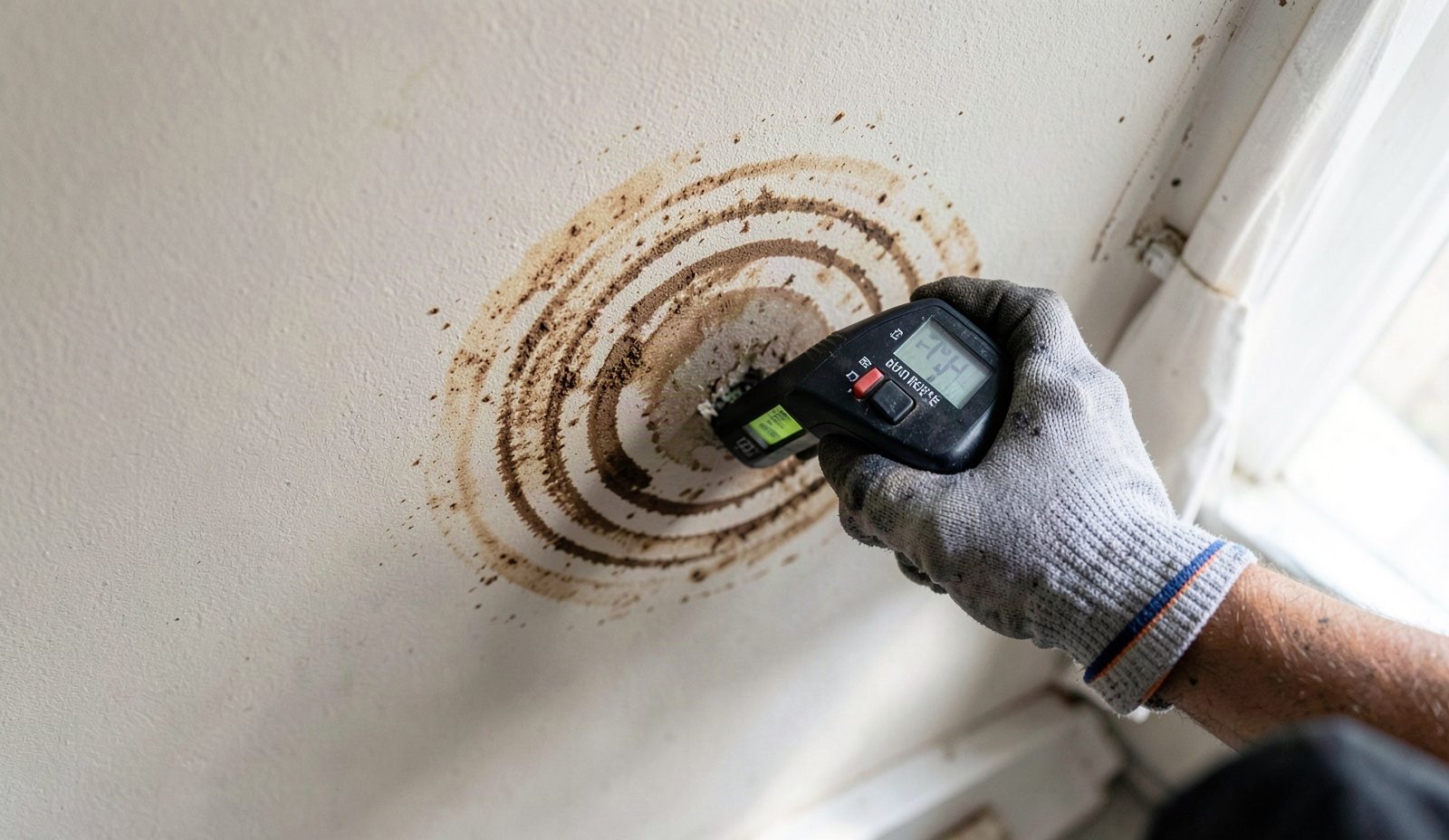
A technician starts with a pinless moisture meter, usually a Tramex or Delmhorst unit, pressed against the ceiling drywall in a grid pattern radiating out from the stain. Readings above 20 percent on the meter's relative scale mean the material is still actively wet. Readings that drop sharply within three feet of the stain's center place the leak point almost directly overhead rather than to one side. An infrared thermal camera follows the same grid, reading surface temperature differences of a few degrees that map moisture behind the drywall long before it's visible to the eye.
From the attic, the inspection moves along the roof deck with a flashlight, checking the sheathing directly above the stain for dark staining, delamination, or a soft spot that flexes under the handle of a screwdriver pressed against it. During winter calls tied to ice damming, the technician checks whether the ice barrier under the shingles extends at least 24 inches inside the exterior wall line, the threshold set by Section 905.1.2 of the Ohio Residential Code. A barrier that stops short of that line, common on homes re-roofed decades before that requirement took hold, leaves the eave exposed to backed-up meltwater every time an ice dam forms, and that gap gets flagged as its own repair item alongside the leak source itself.
When the ice barrier itself needs replacing, the material choice matters. GAF StormGuard uses a granule-free polyethylene film surface that's easier to walk on during a re-roof, while Grace Ice and Water Shield relies on a thicker rubberized asphalt layer built for standing water at eaves and valleys under prolonged ice-dam pressure. Both membranes meet the same eave-protection requirement, but the granular option costs less to install on straightforward gable roofs while the rubberized option holds up better on low-slope sections and complex valleys typical of additions built onto older Columbus homes. For leaks that show up only during storms, a controlled garden hose test isolates the cause: water runs over one roof section at a time for ten to fifteen minutes, starting at the eave and working toward the ridge, while a second technician watches the attic deck with a flashlight for the exact moment and location a drip starts. That sequence shows whether water enters at a valley, a pipe boot, a step flashing seam, or a bath fan duct that terminates in the attic instead of through the roof, a wiring habit common in homes with converted attic space.
See ponding water on flat roofs for how the related work is scoped and priced.
Permit and inspection questions? Building & Zoning Services is the office we coordinate with on every permitted Columbus job.
You describe the stain's location, size, and whether it's actively wet over the phone, which helps us bring the right equipment. On site, the technician photographs the stain, takes moisture meter readings in a grid around it, and checks the attic directly above with a flashlight for staining or daylight coming through the deck. If the source isn't obvious from the attic alone, they check the roof exterior next: flashing points, valleys, pipe boots, and shingle condition in that section. You get a plain explanation of what they found before any talk of repair options, including whether the moisture is still active or already dried out.
Once you approve the written scope, the crew protects the work area with floor runners and dust barriers before opening anything. Roof-side repairs, replacing a flashing section, a run of shingles, or a length of ice barrier membrane, happen first so no more water can get in while the ceiling side is open. Interior work follows: cutting out saturated drywall or plaster along clean lines at the nearest stud or joist, pulling and replacing compressed insulation, and inspecting the exposed joist for soft spots before closing anything back up. Anything unexpected found once material is opened, like decayed decking, gets a call to you before work continues past that point.
Before closing up, the technician re-checks the repaired area with the moisture meter to confirm dry readings across the same grid used during the assessment. On roof-side repairs, they run a hose test over the repaired section for several minutes while watching the attic deck for any sign of intrusion. You get a walkthrough of the finished work, including photos taken during the attic and roof inspection for your own records or an insurance file, and a plain rundown of what to watch for if the ceiling area gets damp again after a heavy rain.
Roofing work in Columbus falls under the Ohio Residential Code, based on the 2018 International Residential Code, and every ceiling stain repair that touches the roof deck gets evaluated against that code, regardless of what a contractor may have learned in a different state. Heavy wet snow and ice loading drive real ice-dam and gutter-ice risk in this climate, and that's a code-driven concern here that a crew normally working in a warmer climate has no reason to understand. Homes in this metro span decades of construction, from balloon-framed early-1900s structures near the urban core to platform-framed suburban builds from the 1970s and 80s, and each era attaches roof decking and flashing differently, which changes where a repair crew expects to find the leak path.
Full roof replacements and structural repairs, like replacing a section of decayed roof decking found during a ceiling stain investigation, typically require a permit pulled through the applicable local building department, while a like-for-like flashing repair or a shingle patch usually doesn't trigger that requirement. That determination belongs to the permit authority rather than the contractor doing the work, and skipping the step on a job that did need one creates a problem at resale when a buyer's inspector asks for the paperwork. That paperwork trail also matters to insurance adjusters who want proof that structural repairs went through inspection rather than word of mouth.
Storm-chasing crews that show up in Columbus after a bad hail season often carry no history with the local permit office and no familiarity with which older housing stock in this metro was built with a thin or missing ice barrier. That gap surfaces months later as a second repair, after the out-of-town crew has moved to the next storm market. A crew working this metro consistently already knows which roof pitches, attic configurations, and ceiling types, plaster versus drywall, keep showing up call after call, and plans the repair around what's actually happening behind the stain instead of a generic checklist.
More detail on attic condensation & mold is on its own page.
Communities like r/Roofing are a good reality check on pricing and practices before you sign anything.
Call (614) 707-7333 and describe what you're seeing, including whether the stain is actively dripping or just discolored. Active drips get priority scheduling, typically an arrival window the same day or the next business morning. Cosmetic-only stains with no active moisture usually book within the week, since the moisture meter can confirm the area has already dried before the visit is even scheduled. You'll get a two-hour arrival window the day before the visit, with a call or text if a prior job runs long. Weather holds only apply to work on the roof itself, never to the initial ceiling and attic inspection, which happens rain or shine.
Before anyone opens drywall or climbs into the attic, we lay down floor runners from the entry to the work area and drop cloths under the stain to catch loose paint chips and plaster dust. Attic access points get a sealed dust barrier if insulation needs to be pulled back for inspection. Any drywall or insulation removed during the repair goes straight into a lined disposal bag instead of piling up inside your home. Ladders and tools stay off finished flooring on rubber mats. When the crew leaves, the work area gets a final walk-through vacuum pass so you're not finding drywall dust in the carpet a week later.
Four things move the estimate: how much of the roof deck and flashing needs replacing versus a spot repair, whether the ceiling is drywall or older plaster and lath, how the attic is accessed since a full walk-up attic costs less labor than a cramped scuttle hole, and whether insulation needs replacing because it got wet and compressed. After the diagnostic, you get a written scope listing each material and labor line separately, so you can see exactly what's driving the number. Nothing gets opened up or ordered until you approve that scope, and anything discovered once work starts gets a call before anyone proceeds.
Every technician goes through a background check before being assigned to residential jobs, and new hires shadow a lead technician on attic inspections, moisture meter readings, and flashing repairs for a set number of jobs before working solo. Training gets refreshed each time the Ohio Residential Code cycle updates a requirement that affects roofing, like ice barrier placement or ventilation ratios, so field crews aren't working off what they learned years ago. A senior technician spot-checks a percentage of completed jobs by reviewing the photos taken during the attic inspection against the written repair notes.
Cost depends on the leak's source, the ceiling material, and how much needs to be opened up. A small drywall patch after a quick flashing fix costs far less than a job needing plaster removal, insulation replacement, or a section of decking. Access also plays a role: a walk-up attic keeps labor down, while a cramped scuttle hole adds time to every step. Ask for a written scope broken into roof-side and interior line items so you can see where the number is actually coming from.
Call a roofing contractor first, since most ceiling stains trace back to the roof deck, flashing, or a vent penetration rather than a plumbing line. A contractor who checks both the attic and the roof exterior in the same visit saves you a second appointment with a separate plumber if the source turns out to be roof-related, which it is in most Columbus cases involving an exterior wall or sloped ceiling. Cornerstone Roofing Columbus handles that full inspection in one visit at (614) 707-7333.
You should place a container under any active drip, press gently on the stain to check for sponginess, and photograph it before calling for an inspection. Move furniture and electronics out from directly underneath while you wait. Avoid cutting into the drywall yourself, since that can widen a soft spot that's still holding together structurally. Schedule the inspection within a day or two, sooner if the ceiling feels wet or the stain is spreading fast.
Worry when the stain grows after each rain, feels soft under light pressure, or comes with a musty smell that gets stronger over time. A stain that stays the same size and color for months, with a dry, firm surface, usually points to an old leak that's already been sealed. Sagging drywall or a crack running along the ceiling in a straight line toward a wall means the moisture has reached the framing, and that calls for same-week attention.
Compare quotes by checking whether each contractor traced the leak to a specific roof component or estimated based on the stain's appearance alone. A quote built on an actual attic inspection and moisture readings will name the exact repair, a flashing section, a valley, a pipe boot, rather than a vague line item for roof repair. Ask whether the inspection checked ice barrier placement at the eaves, since a quote that skips that check may miss a compliance gap that surfaces the following winter.
Cost in Columbus varies most with the age and construction of the ceiling itself. Older homes with plaster and lath ceilings, common in the metro's historic neighborhoods, cost more to open and repair than newer drywall because the lath has to come out in full sections rather than a clean drywall cut. A roof that needs an ice barrier retrofit to meet current code adds a separate line item beyond the interior ceiling repair. Ask for those two costs itemized separately so you know what's driving each part of the total.
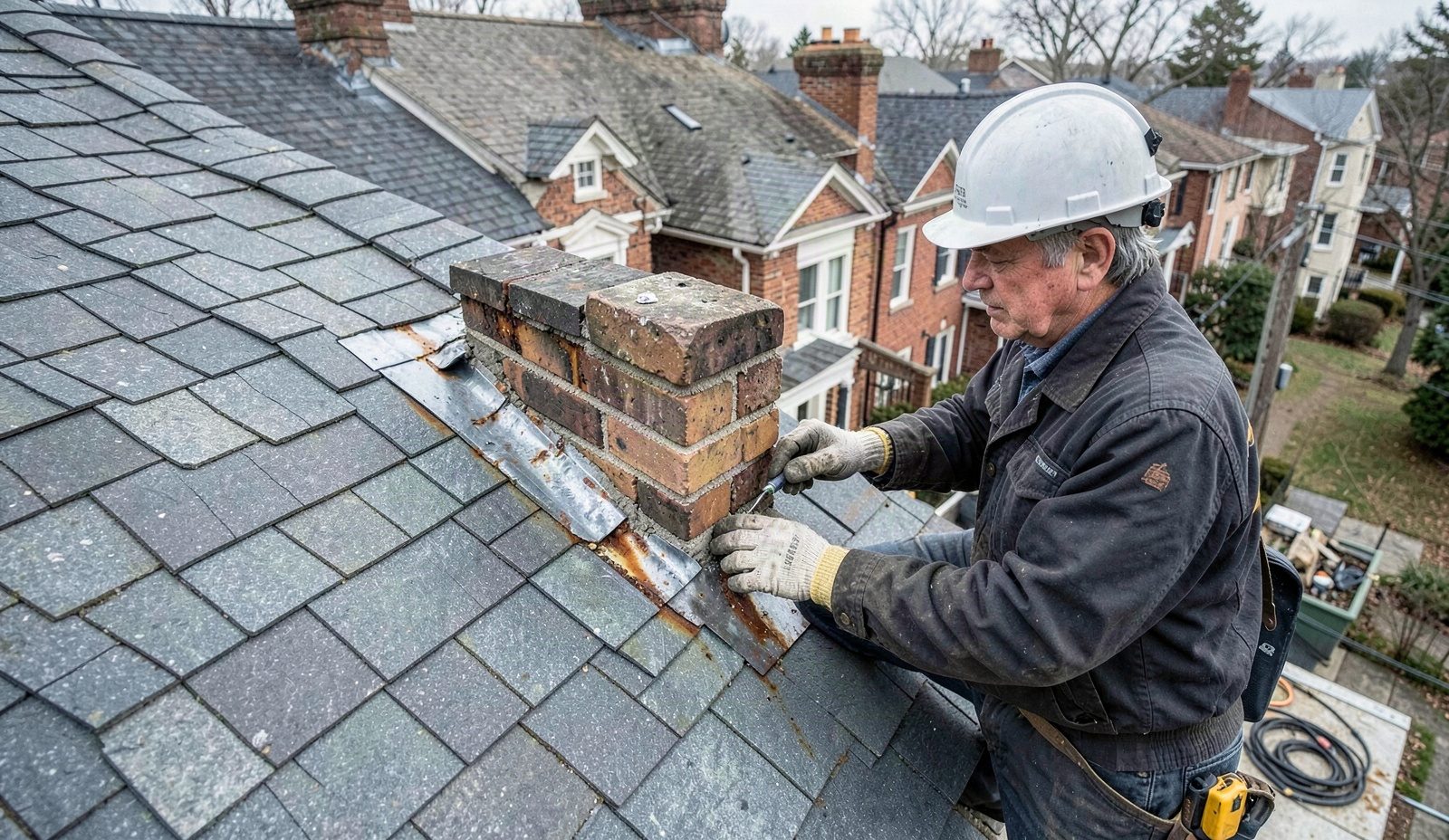
Columbus mixes roofing eras block by block. German Village keeps its original steep-pitch slate and standing-seam roofs over brick rowhouses built well before modern ventilation standards, so a ceiling stain there often traces back to a slate slip or a flashing detail around a chimney rather than a shingle failure. Short North and the Brewery District carry more low-slope and flat roof sections over converted warehouse and mixed-use buildings, where ponding water and membrane seams are the more likely stain source than storm damage. Italian Village bungalows and worker's cottages typically run steeper asphalt shingle roofs with shallow attic space, which limits how much a technician can see without pulling insulation back first. Knowing which roofline sits over which neighborhood before arriving changes what equipment goes on the truck, a thermal camera and hose kit for the low-slope commercial-style buildings, a full moisture-meter grid and attic crawl gear for the older pitched-roof housing.
Structural repairs discovered during a ceiling stain investigation, like replacing decayed roof decking or a full section of flashing, typically need a permit pulled through the City of Columbus Department of Building and Zoning Services for city addresses, with surrounding Franklin County jurisdictions handling their own building departments. A straightforward flashing patch or a like-for-like shingle swap usually doesn't need that step, but that determination belongs to the permitting office rather than the repair crew. Homeowners in these older neighborhoods often deal with roofs that predate current ventilation and ice barrier standards entirely, which means a repair sometimes surfaces a code gap that has nothing to do with the original leak, an attic with no soffit venting, or a section of eave with no ice barrier at all. Flagging that gap honestly, rather than patching around it, is what keeps a repair from becoming a repeat call the following winter.
Explore our service area and locate Cornerstone Roofing Columbus with ease. We're proudly local and serve the surrounding neighborhoods with fast response and honest pricing. Use the map to check our coverage area, or call us and we'll confirm in seconds.
Address:
Cornerstone Roofing Columbus, 1015 E Broad St, Columbus, OH 43205
How Much Does a Roof Replacement Cost in Columbus? 2026 Pricing Breakdown, practical local guidance from Cornerstone Roofing Columbus, Colum…
Read More
Commercial Roof Maintenance Tips for Columbus Property Managers, practical local guidance from Cornerstone Roofing Columbus, Columbus's trus…
Read More
Skylight Leaks in Victorian Village Homes, Repair or Replace?, practical local guidance from Cornerstone Roofing Columbus, Columbus's truste…
Read More
The Best Time of Year to Replace a Roof in Columbus, practical local guidance from Cornerstone Roofing Columbus, Columbus's trusted roofing …
Read More