

April 1, 2025
How Much Does a Roof Replacement Cost in Columbus? 2026 Pricing Breakdown
How Much Does a Roof Replacement Cost in Columbus? 2026 Pricing Breakdown, practical local guidance from Cornerstone Roofing Columbus, Colum…
Read More




Hail bruising on shingles rarely announces itself the way a broken window does. You hear the storm pass, check the yard for dents in your car or window screens, then forget about the roof until a stain appears on a ceiling months later. The damage sits quiet on the shingle surface, a dark, circular soft spot where the mat fractured under the impact but the surface granules never broke away. Walk the roofline in Clintonville, with its older bungalows and steep gable returns, and you will find these soft spots clustered on the south and west-facing slopes, the sides that take the brunt of a storm moving through Central Ohio.
Summer thunderstorms bring hail and straight-line wind that are a common cause of asphalt shingle and roof penetration damage across Franklin County. A hailstone striking a shingle does not always break the surface. Instead it compresses the fiberglass or organic mat underneath, crushing the fibers into a bruise you can feel as a soft spot on shingles after hail but rarely see from the ground. This is different from blistering, which forms when trapped moisture or manufacturing gas pockets push a bubble up through the shingle surface over years of heat cycling. Hail damage vs blistering comes down to cause and shape: bruising is a sudden impact crater with a hard edge, blistering is a slow-forming raised bubble with no impact point. Roof vents made of soft aluminum or plastic show the clearest evidence of a hail event, denting long before the tougher shingle mat cracks.
Central Ohio runs roughly 40 to 60 freeze-thaw cycles every winter, and that number matters once a shingle is already bruised. Water works into the crushed mat fibers at the bruise point, freezes, expands, and reopens the fracture a little wider each cycle. Victorian Village homes with their older, lower-slope porch roofs see this most, a bruise that looked cosmetic in July becomes a crack you can slide a fingernail into by February.
Left alone, a bruised shingle does not repair itself. The crack widens, the granule coat sheds around the wound, and water finds the felt or synthetic underlayment beneath. Once the underlayment saturates, the plywood deck starts to delaminate, and what began as a hail hit becomes a soft, spongy deck section that needs to be cut out and replaced instead of a simple shingle swap. Ceiling stains, attic mold, and sagging gutters from trapped ice all trace back to the same missed inspection after a hailstorm.
If this sounds close but not quite your situation, granule loss on shingles may be the better starting point.
Our crews work to the installation standards of the National Roofing Contractors Association.
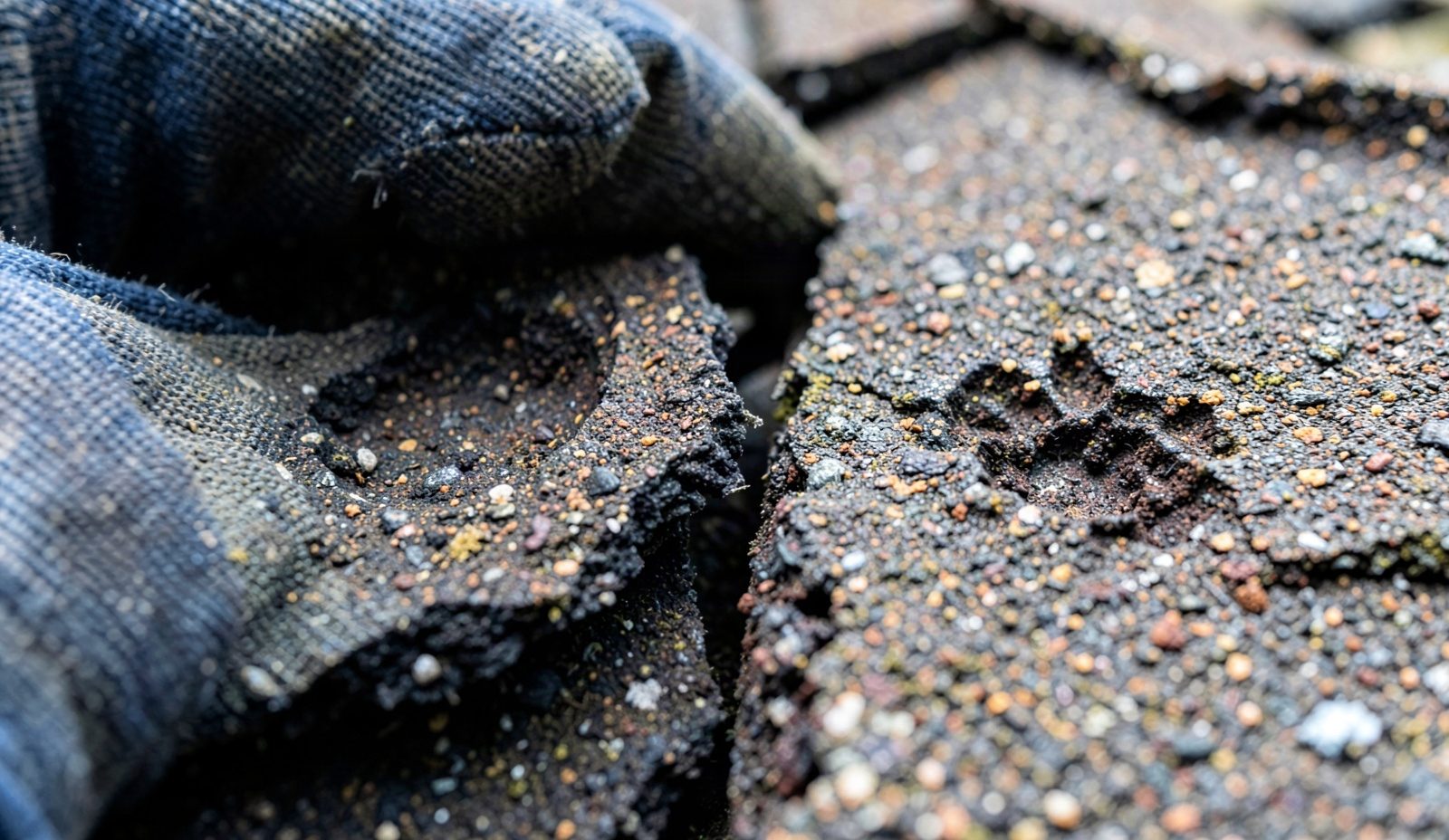
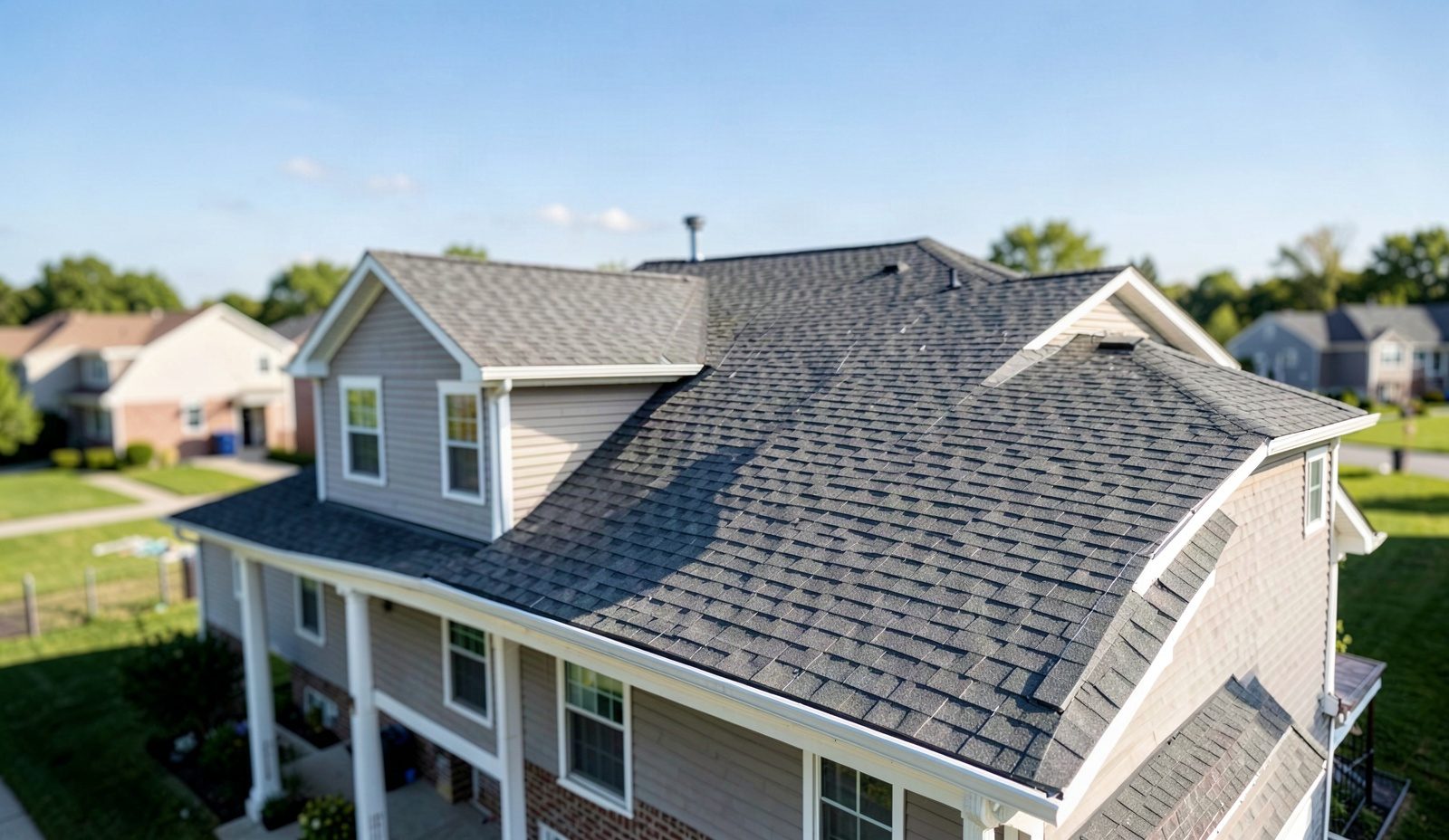
Every hail inspection starts on the ground, not the roof. We check soft aluminum components first: gutter aprons, roof vents, and window screens dent before a shingle mat ever bruises. Uniform dents on ten or more vents or gutter runs confirm a hail event actually reached that slope, which matters because wind-driven hail often skips one side of a roof entirely. Once ground evidence points to impact, we mark out a test square, a 10-foot by 10-foot section on each affected slope, and count hits. A pattern of eight or more impact marks inside that single test square is the density most adjusters recognize as a qualifying hail event, separate from scattered hits caused by tree limbs or foot traffic.
On the shingle itself we run a hand-pressure test: press a gloved thumb or the blunt end of a taping knife into a suspect spot. A healthy shingle mat resists. A bruised one gives slightly, a soft depression you can feel but not see, because the fiberglass or organic mat crushed without breaking the granule surface above it. We circle every soft spot on shingles after hail with chalk and photograph it against a tape measure for scale, since insurance adjusters want documented dimensions, not a verbal description. While we are on the deck we also check the ice barrier for code compliance, confirming it extends at least 24 inches inside the exterior wall line per Ohio Residential Code section 905.1.2, because a hail-related tear-off is the easiest time to correct an undersized barrier before winter ice-damming starts.
Replacement material choice depends on what the test squares show. A standard architectural shingle carries a Class 3 impact rating and a 110 mph wind rating, adequate for most Columbus roofs but no more resistant to repeat hail than what just failed. GAF Timberline UHDZ and CertainTeed Landmark IR both carry a Class 4 impact rating under UL 2218, the highest impact classification a shingle can earn, along with wind ratings up to 130 mph. They weigh slightly more per square, but on a roof that has already taken one hail hit, that upgrade is the difference between a repeat bruise and a shingle that shrugs off the next storm.
See missing or lifted shingles for how the related work is scoped and priced.
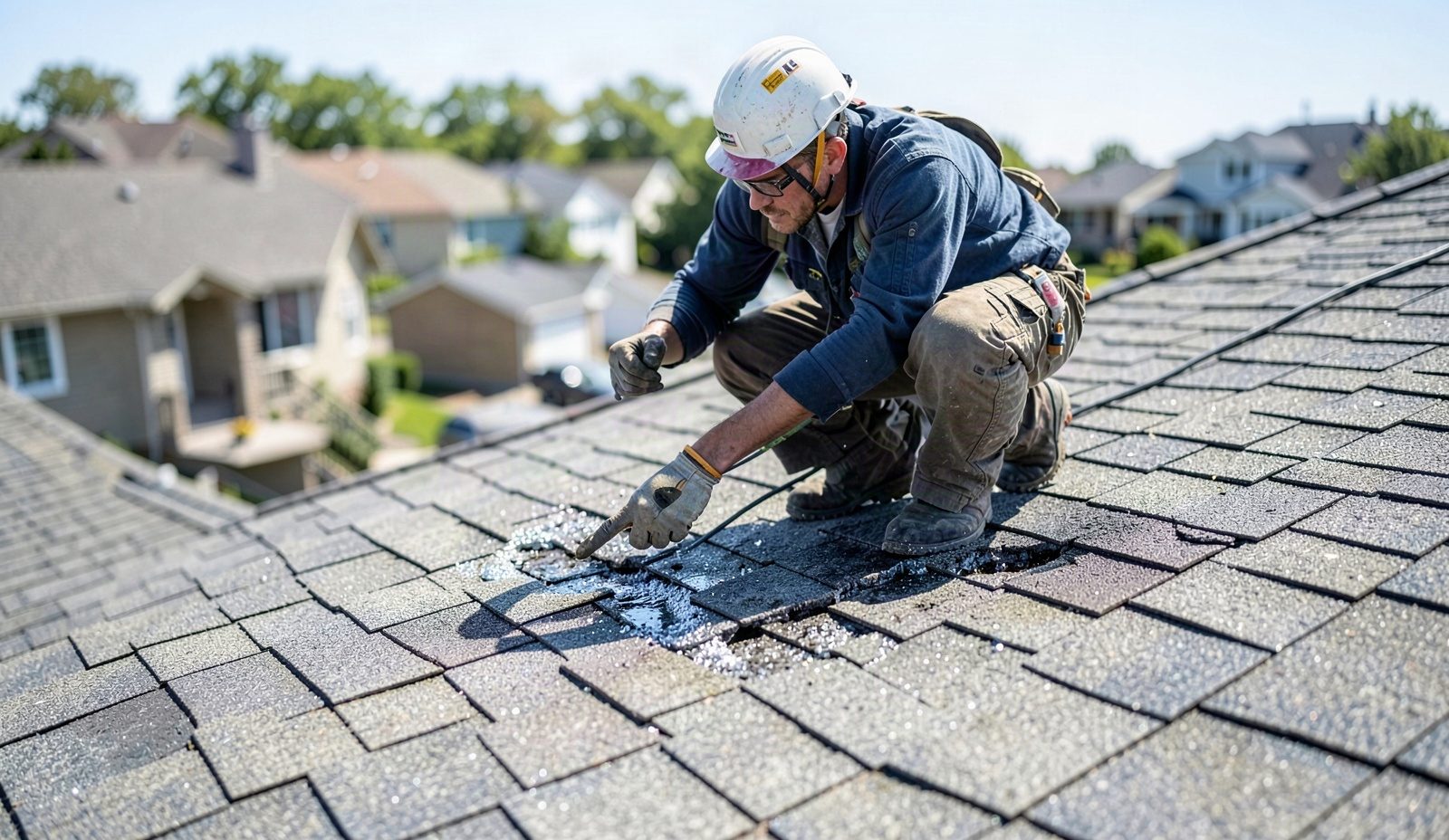
Call (614) 707-7333 and describe what you noticed, dented gutters, a recent storm date, or a stain on a ceiling. We schedule an inspection inside your arrival window and walk the roof slope by slope, checking soft metal vents and flashing first for witness marks, then running test squares on each exposed plane. You get a plain-language rundown on the ground afterward: which slopes show a qualifying hail pattern, which shingles are bruised versus just dirty, and whether the deck felt solid underfoot. Nothing gets written up as damage without a photo and a measurement to back it.
Once you approve the written scope, we protect the property first, tarps at the foundation, plywood laid across landscaping beds for foot traffic, and a lined trailer staged for tear-off debris. Bruised shingles come off course by course, exposing the deck for a direct look at sheathing condition. Any soft or delaminated plywood gets swapped before new underlayment goes down. You approve material choice, standard architectural shingle or a Class 4 impact-rated line, before installation starts, and any scope change discovered mid-tear-off gets a phone call before it shows up on the invoice.
Before anyone leaves, we check fastener seating with a pull test on a sample of shingles, confirm flashing laps at every penetration, and run a magnetic sweep for stray nails across the yard and driveway. You walk the ground with the technician while they point out what changed, vent replacements, new flashing, repaired deck sections, and you get dated photos of the finished work for your records or your insurance file. A copy of the test square documentation goes with you too, in case an adjuster asks for it later.
Hail repair work in Columbus falls under the Ohio Residential Code, based on the 2018 International Residential Code. A full replacement or structural deck repair after a bad hail event typically needs a permit. A straightforward shingle swap on a handful of bruised shingles often does not. We confirm which permit authority applies, city or county, before any material comes off the roof, so the paperwork matches the scope once the job starts, and so a claim adjuster sees a repair that was inspected and approved through the right channel rather than one that skipped it.
Storm-chase crews that canvass a neighborhood door to door after a hail event rarely carry that same local knowledge. They often push a full tear-off when a targeted repair on a handful of slopes would pass inspection just fine, and they rarely know which Columbus housing stock still runs plank decking instead of plywood underneath, a difference that changes fastener length and nailing pattern on every course. Many Columbus homes built in the early and mid-twentieth century carry steeper gable rooflines than newer subdivision construction, which changes fall-protection setup and adds time to every tear-off, time an out-of-area crew rushing through a multi-city storm route rarely budgets for. A crew that skips checking deck type ends up under-driving or over-driving fasteners, which either leaves a shingle loose in wind or splits the plank on an older home.
Our documentation matches how an adjuster actually reviews a hail claim: dated photographs tied to a roof diagram, measured soft-spot locations, and a test-square count for every affected slope. That paperwork holds up whether you are filing with your insurer this month or keeping records for a home sale three years from now. It also gives a second contractor or a future buyer's inspector a clear record of what happened and what got repaired, instead of a verbal account with no backup.
Call (614) 707-7333 to talk through what a technician found on your specific slopes before you sign anything with an adjuster or another contractor. A short phone conversation before you commit to a repair scope only takes a few minutes.
Our page on curling or cupping shingles covers that side of the work in more depth.
Permit and inspection questions? Building & Zoning Services is the office we coordinate with on every permitted Columbus job.
After a regional hail event, call volume rises fast, so we book inspections in half-day arrival windows rather than a single fixed time. You get a call thirty to sixty minutes before the technician arrives, so you are not waiting around all afternoon. If a slope needs a second look after rain clears or if parts have to be ordered, we tell you the new date on the spot instead of leaving you to call back and ask. Storm-season scheduling fills quickly across Franklin County, so booking your inspection within a week or two of the hailstorm keeps your claim timeline moving.
We lay tarps along the foundation and driveway before anything comes off the roof, and we run a magnetic sweep across the yard and driveway afterward to pick up stray nails and staples. Shingle debris and old flashing go straight into a lined trailer, not a pile on your lawn. Gutters get checked for granule buildup and cleared before we leave, since a gutter clogged with shed granules backs up the next rainstorm. Landscaping near the drip line gets a walk-through inspection at the end of the visit, and any disturbed mulch or plants get reset before the crew packs up.
The written estimate reflects what the test squares actually show: how many shingles are bruised versus how many are still sound, whether soft metal vents and flashing need replacing alongside the shingles, and how steep or how many stories the access is. Deck condition matters too, since any plywood found soft or delaminated during tear-off gets priced separately once it is visible, never guessed at beforehand. You review the full written scope line by line before any material gets ordered or any work begins, so there is no surprise line item added mid-job.
Every technician passes a background check before working on an occupied property, and each one runs through a current code-cycle refresher on the Ohio Residential Code every year, since requirements around ice barriers and fastening patterns get revisited as the code updates. New hires spend a stretch of paid time shadowing a lead installer on real tear-offs before they touch a hail claim solo, and their work gets spot-checked against test-square photos and measurements before the crew leaves the property. That check happens on every job, regardless of size.
Coverage depends on your policy's wind and hail endorsement and the age of your roof. Most Ohio homeowner policies cover sudden hail impact but may prorate payment on an older roof under an actual cash value clause instead of full replacement cost. Cornerstone Roofing Columbus documents each claim with dated photos and measured test squares so your adjuster has clear evidence to work from, which speeds approval on Franklin County claims.
Hail-damaged shingles show random, circular impact marks with granules knocked loose around a darker center. The marks scatter across a slope rather than lining up in a row, which separates hail hits from foot-traffic damage or a falling branch strike. Matching dents on nearby metal vents and flashing usually confirm the pattern came from the same storm.
Cost depends on how many shingles are bruised, whether vents need replacing, and your roof's access. Flashing condition and roof pitch add to that scope once a technician sees the deck up close. Call (614) 707-7333 and a technician can walk your roof, run the test squares, and give you a written scope before any number gets discussed.
Dents in soft metal vents, gutters, and flashing are usually covered under the same hail claim as the shingles. Metal dents easier than a shingle mat, so a roof with dented vents but no visible shingle damage yet can still support a claim. Ask your adjuster whether cosmetic metal damage alone triggers a payout, since some policies separate cosmetic dents from functional damage.
A permit is usually not required for a small, like-for-like shingle repair. A full replacement or deck work typically needs one, and the City of Columbus Department of Building and Zoning Services makes that call for Columbus addresses. Other Franklin County jurisdictions handle it through their own local building department. Cornerstone Roofing Columbus checks scope against that threshold before starting any hail repair so the paperwork matches the work performed.
Diagnosing hail bruising yourself is risky because the damage sits inside the shingle mat, invisible from the ground. Walking a steep or wet roof after a storm also carries real fall risk, and a missed soft spot today becomes a saturated deck by spring. A trained technician runs the hand-pressure and test-square checks safely and documents findings your insurer will actually accept.
Comparing quotes means checking whether each one includes photo-documented test squares and a specific count of bruised shingles. A vague quote that skips vent and flashing inspection is missing evidence an adjuster will ask for later. Ask each contractor whether they are quoting a standard shingle or an impact-rated line, since that choice changes both durability and the number on the page.
A single-slope repair with a handful of bruised shingles usually takes one day. A full roof replacement after a widespread hail event runs longer, often two to three days depending on square footage, deck condition once opened up, and how many vents or flashing pieces need swapping. Weather windows in Central Ohio can push a job back if rain moves in mid-tear-off.
Coverage is common for hail-related roof damage in Ohio, though the payout depends on your policy language and roof age. Franklin County adjusters generally want dated photos and a measured damage count before approving a claim, which is why documentation matters more than a verbal description of dents. Cornerstone Roofing Columbus builds that documentation into every hail inspection so your claim file is ready when the adjuster calls.
Heavy wet snow and ice loading drive ice-dam and gutter-ice risk across Central Ohio winters, and a roof that took hail damage over the summer enters that season already weakened. A bruised shingle with a hairline crack lets meltwater track sideways under the shingle course instead of running off, feeding the ice dam that forms at the eave. In the Short North, where converted warehouse buildings sit next to newer infill construction, roof pitches and deck materials vary block to block, so an inspection has to account for flat commercial-style sections alongside steep residential slopes on the same project. German Village's older homes, many with slate or heavier composite roofing over original wood decking, need a different fastening approach than a standard plywood deck when a hail-damaged section gets opened up for repair.
Italian Village and the Brewery District carry a mix of century-old brick structures and rehabbed residential conversions, and both present roof access that a standard ladder setup does not solve, parapet walls, shared roof lines, and tight side yards that change how a crew stages tarps and debris trailers. Knowing those access patterns before the truck arrives keeps a hail inspection from turning into a half-day logistics problem. Trust in this line of work gets built job by job, a homeowner in one of these districts talks to a neighbor who had hail damage handled the prior summer, and that word travels faster than any advertisement. Every documented test square, every photograph tied to a measurement, and every completed job in these neighborhoods adds to a record homeowners can check before they decide who gets on their roof next.
Explore our service area and locate Cornerstone Roofing Columbus with ease. We're proudly local and serve the surrounding neighborhoods with fast response and honest pricing. Use the map to check our coverage area, or call us and we'll confirm in seconds.
Address:
Cornerstone Roofing Columbus, 1015 E Broad St, Columbus, OH 43205
How Much Does a Roof Replacement Cost in Columbus? 2026 Pricing Breakdown, practical local guidance from Cornerstone Roofing Columbus, Colum…
Read More
Commercial Roof Maintenance Tips for Columbus Property Managers, practical local guidance from Cornerstone Roofing Columbus, Columbus's trus…
Read More
Skylight Leaks in Victorian Village Homes, Repair or Replace?, practical local guidance from Cornerstone Roofing Columbus, Columbus's truste…
Read More
The Best Time of Year to Replace a Roof in Columbus, practical local guidance from Cornerstone Roofing Columbus, Columbus's trusted roofing …
Read More