

April 1, 2025
How Much Does a Roof Replacement Cost in Columbus? 2026 Pricing Breakdown
How Much Does a Roof Replacement Cost in Columbus? 2026 Pricing Breakdown, practical local guidance from Cornerstone Roofing Columbus, Colum…
Read More




Run your hand across a shingle tab near a ridge or hip in German Village or Short North and you will feel it before you see it, a small conical bump where a nail head has pushed up through the shingle mat. That bump is a nail pop, and once the head clears the shingle surface, the seal around that fastener hole is broken. Water finds the gap on the next rain, tracks down the shank, and drips onto the felt or synthetic underlayment below. Homeowners usually notice it first as a rust-colored ring on a ceiling or a faint tapping sound in the attic during wind, long after the leak started.
Columbus framing lumber moves more than most people expect. Rafters and decking installed with higher moisture content shrink as they dry over their first few winters, and that shrinkage pulls fastener shanks upward through the sheathing. In older Clintonville homes with plank decking instead of continuous OSB sheets, the gaps between boards give nails even more room to walk. Add the freeze-thaw cycling that defines a Central Ohio winter, roughly 40 to 60 cycles a year, and you get repeated expansion and contraction of both the decking and the shingle mat around every fastener hole. Each cycle works the nail a fraction of a millimeter further out.
Summer adds a second cause. Thunderstorms with hail and straight-line wind flex shingle tabs hard enough to loosen fasteners that were driven correctly at installation, and a shingle that lifts repeatedly in a gust event backs its nails out the same way a board loosens under repeated prying. Once several fasteners in a course have backed out, the shingles above them lose their wind resistance rating entirely, because the nailing pattern that gives a shingle its rated wind uplift only works if every nail is seated and sealed.
Left alone, a handful of exposed fastener holes turns into saturated decking. Water that tracks down a nail shank does not stop at the first layer, it wicks along the underlayment, finds a low spot, and soaks the OSB or plank sheathing until the wood loses its ability to hold a fastener at all. At that point a simple reseal job becomes a decking replacement, and the exposed roofing nails leak problem you could have fixed in an afternoon becomes framed drywall repair inside.
If this sounds close but not quite your situation, cracked or damaged flashing may be the better starting point.
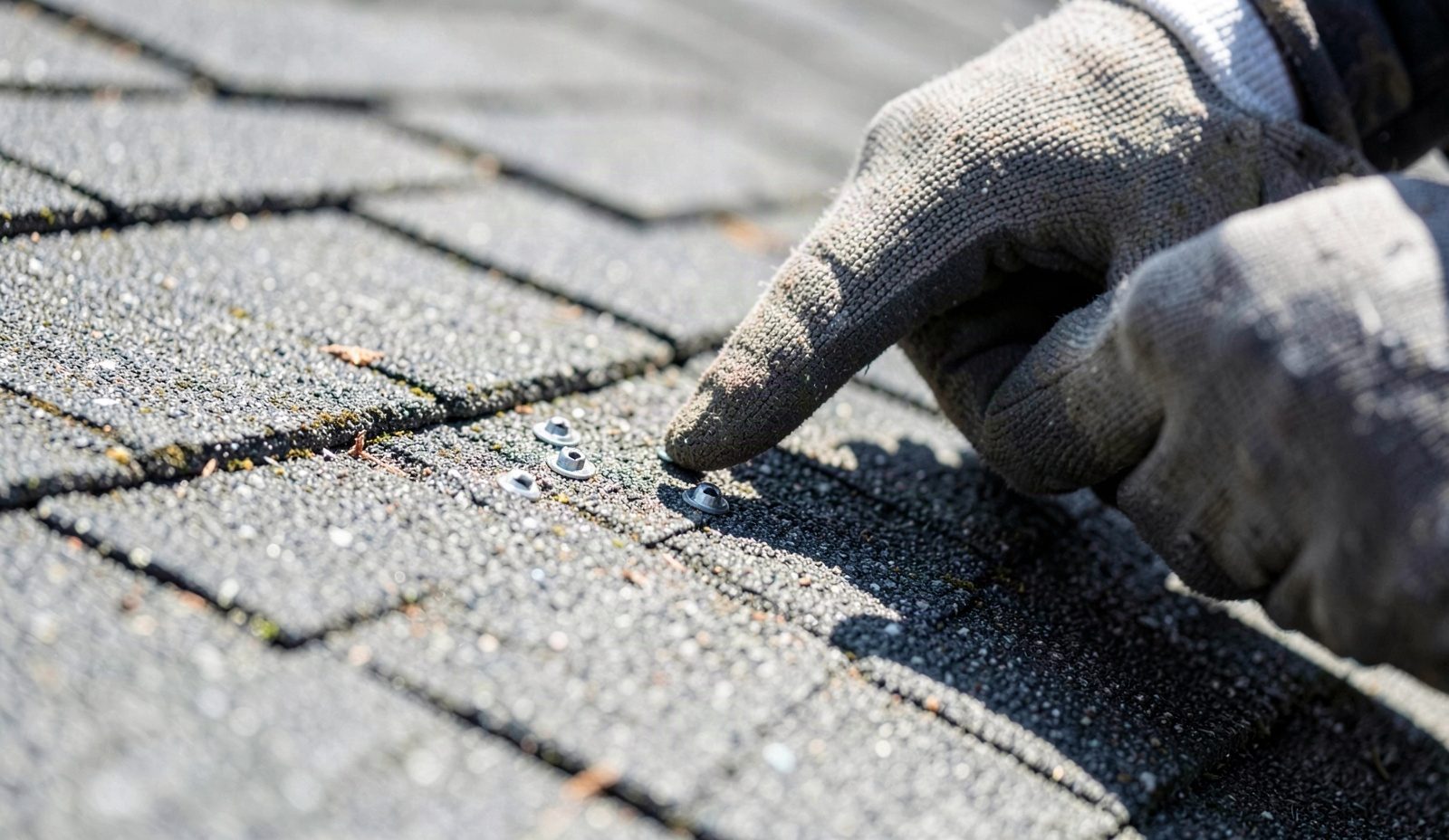
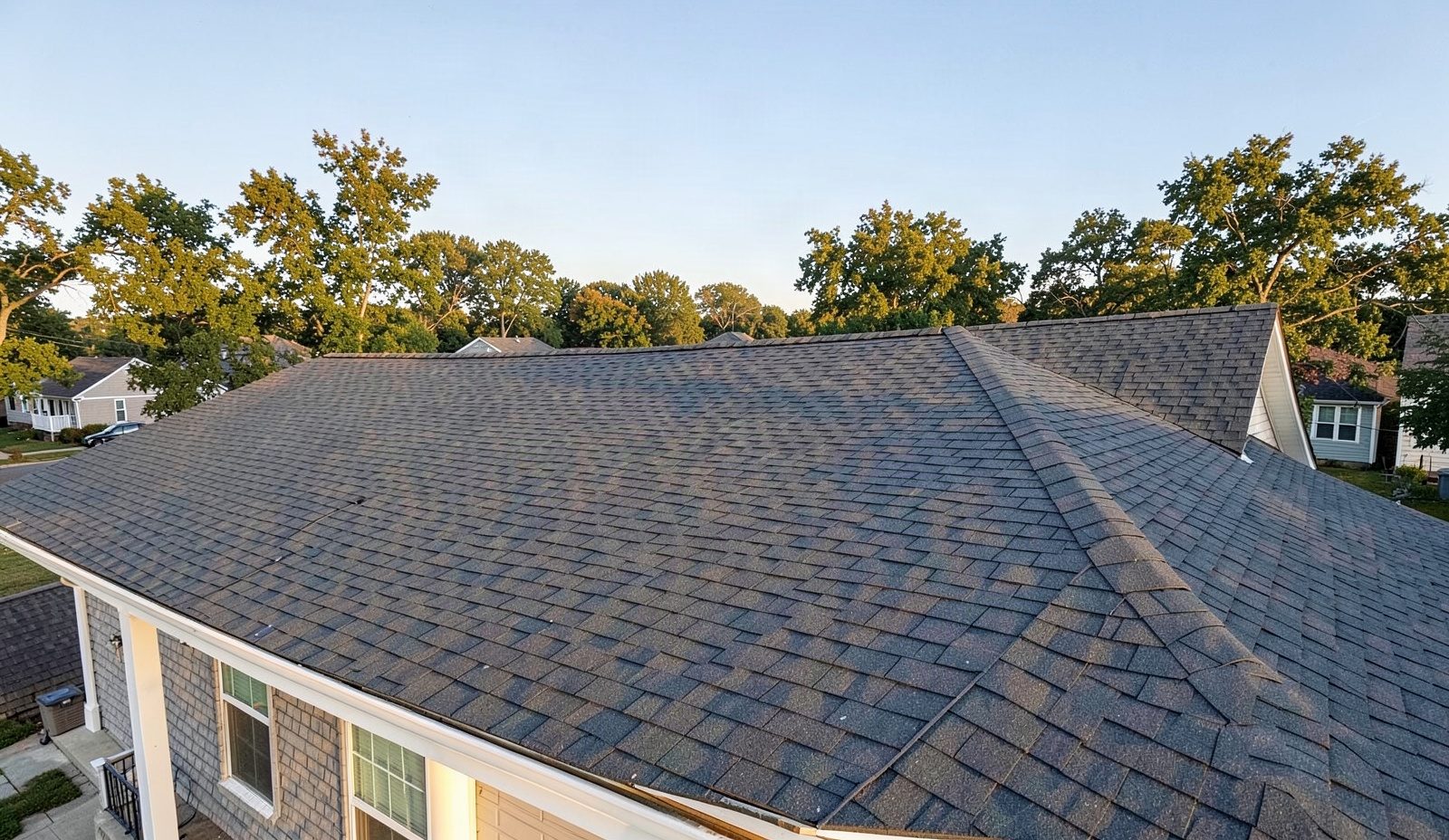
Every nail pop gets pulled, not just resealed. Our technicians pull the raised fastener with a flat bar, inspect the shank for corrosion pitting, and check the hole in the decking for moisture staining with a pin-type moisture meter before deciding whether the hole gets a new fastener or a patch. A reading above roughly 16 percent moisture content in the surrounding OSB tells us the sheathing is already absorbing water and needs more than a cosmetic reseal, it needs a cut-out and a scab board under the shingle course.
We also check the fastening pattern itself, because a lot of backed-out roofing nails trace back to installation, not weather. GAF Timberline HDZ shingles rely on their factory-marked nailing zone, a defined strip just above the sealant line, and a nailer set even a quarter inch high or low takes the fastener out of that zone and out of the shingle's rated wind resistance. Pneumatic nailers set to too high a pressure overdrive the head through the mat, which is the single most common cause we find on roofs under fifteen years old.
When a roof has exposed fasteners near the eave, we extend the inspection to the ice barrier underneath, because a failing fastener at the drip edge often sits right where ice-dam melt refreezes. Section 905.1.2 of the Ohio Residential Code requires that ice barrier, either two cemented layers of underlayment or a self-adhering polymer-modified bitumen sheet, to extend at least 24 inches inside the exterior wall line. If that barrier is short or missing where we are already pulling shingles to reseal fasteners, we flag it in the same report, because reworking exposed fasteners without checking the barrier underneath leaves the real winter vulnerability untouched. For sealant, we use butyl-based roofing sealant or polyurethane roofing cement under the shingle tab rather than surface-applied asphalt cement, because surface caulk cracks with the same freeze-thaw cycling that caused the original nail pop.
More detail on attic condensation & mold is on its own page.
Permit and inspection questions? Building & Zoning Services is the office we coordinate with on every permitted Columbus job.
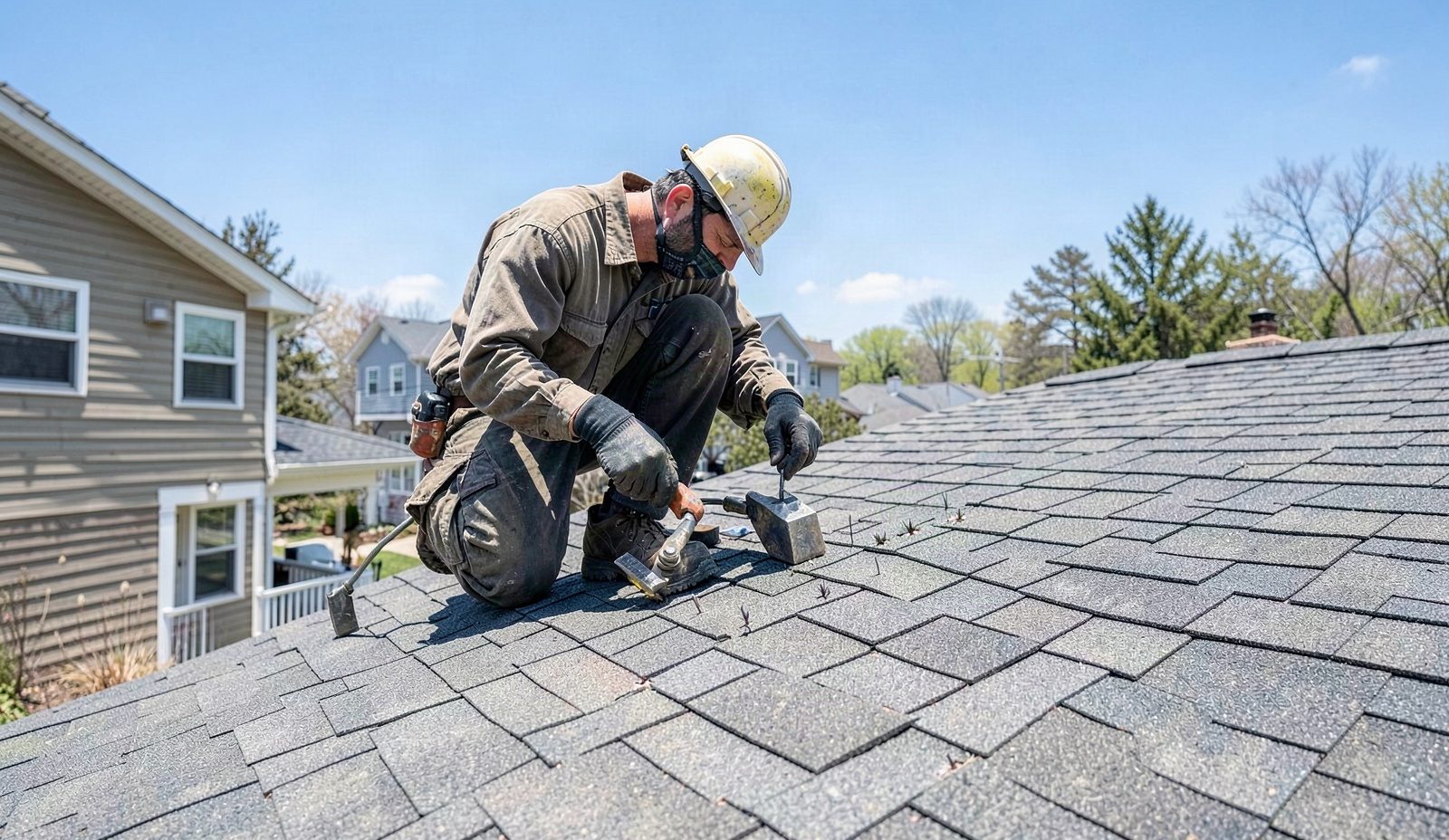
You call (614) 707-7333 and describe what you are seeing, a bump under a shingle, a drip stain, or a rust streak near a fastener. On site, the technician walks the roof and checks the attic decking from below for moisture staining, then does a magnetic sweep of the ground to see if fasteners have already fallen. Every popped or exposed fastener gets marked with chalk so nothing gets missed once the repair starts, and the homeowner sees the marked pattern before any decision gets made.
Once you approve the written quote, the crew protects landscaping and gutters with tarps, then pulls each marked fastener with a flat bar. Damaged shingle tabs come off in the affected course, the decking gets checked one more time at each hole, and new fasteners go into sound wood within the shingle's marked nailing zone. Butyl or polyurethane roofing sealant goes under the tab before it is reset, and the shingle is re-nailed to the manufacturer's rated pattern, four or six nails depending on the product and wind zone.
Before leaving, the technician does a pull test by hand on a sample of the repaired fasteners to confirm they are seated tight in sound decking, and rechecks the attic for any active moisture at the repaired locations. The ground gets a final magnetic sweep for stray nails. You get a walkthrough of what was found, what was replaced, and photos of the repaired areas for your records, useful documentation if you ever file an insurance claim tied to storm damage.
Roofing work in Columbus falls under Columbus building code jurisdiction and the Ohio Residential Code, and a technician who does not know that code's fastening and underlayment requirements is guessing at every decision on your roof, not just the ones you can see from the ground. We verify fastener count, placement, and shank length against current code and manufacturer specification on every job, not only when a homeowner asks.
Central Ohio's housing stock spans balloon-framed century homes with true 2 by 6 rafters to postwar tract construction with truss systems and continuous OSB decking. Each era responds differently to fastener repair. A technician who treats a plank-decked older home the same way as a truss roof from the 1970s will either underdrive fasteners into gapped boards or overdrive them into thinner sheathing, and both mistakes create a new nail pop within a year. Familiarity with which construction era sits under which roof changes the fastener length and the nailing technique we use before we ever pick up a nailer.
Out-of-area crews that roll through Columbus after a storm rarely know these distinctions, and they rarely stick around when a resealed fastener fails a second freeze-thaw season later. A local operation answers the phone at the same number every time you call, and a technician who works Franklin County roofs regularly recognizes the difference between a hail-driven fastener failure and one caused by an undersized nailing zone, because they have seen both patterns on roofs across the metro. That recognition is what keeps a repair from becoming a repeat visit.
Our page on ceiling water stains covers that side of the work in more depth.
Our crews work to the installation standards of the National Roofing Contractors Association.
You call (614) 707-7333 and get a scheduled arrival window, not a vague same-day promise. Most nail pop and exposed fastener calls in the Columbus metro get an appointment within a defined window rather than an open-ended day, because a technician needs enough time on the roof to pull, inspect, and reseal each fastener properly. If a prior job runs long or weather closes the roof for safety, we call before the window closes to reschedule, not after you have already been waiting on the driveway.
Before any shingle comes up, we lay tarps across landscaping and walkways to catch old sealant, granules, and pulled fasteners. A magnetic roller sweep runs the ground and driveway at the end of the job specifically to catch loose roofing nails, the same nails that puncture tires and bare feet if left behind. Debris goes into a job trailer, not a pile by the curb. When we pull off the ladder, the yard looks the way it did when we arrived, minus the nail pops.
The estimate reflects how many fasteners have backed out, how they are distributed across the roof, and whether the decking underneath tested dry or wet with the moisture meter. Steep pitches, multiple stories, and roofs with more than one shingle layer take longer to access safely and cost more labor time. Material match matters too, an older discontinued shingle line takes more searching than a current GAF or Owens Corning product. You get a written quote before any fastener is pulled, and nothing changes on that quote without your approval first.
Every technician passes a background check before working on an occupied property. Ongoing training keeps the crew current on the Ohio Residential Code's fastening and underlayment requirements as they apply on real roofs, not just in a classroom. New technicians shadow an experienced roofer through a set number of fastener repair calls, and a lead technician signs off on independent field competence before anyone works a nail pop job solo.
Cost depends on how many fasteners are affected and whether the decking underneath tested wet or dry. A handful of popped nails on a single shingle course is a short repair, while pops spread across multiple courses or roof planes take longer to pull, inspect, and reseal correctly. Call (614) 707-7333 to get a technician on site who can give you a written number after checking the roof, not a phone estimate based on a guess.
Yes, fixing nail pops is worth it because every exposed fastener hole is an active water entry point. Ignoring a raised nail head does not make the leak stop, it lets water track down the shank into decking that is far more expensive to replace than the fastener itself. A same-season reseal keeps the repair to the shingle level instead of the framing level.
Coverage depends on the cause the insurer determines during the claim, not on the fact that a nail popped. Storm-driven fastener failures from hail or high wind are more likely to be covered than fasteners that backed out due to an installation defect or normal lumber shrinkage over time. Our written inspection report, with photos of the marked fastener locations, gives your adjuster documentation to work from either way.
Nail pops rarely cause structural failure on their own, but the water they let in causes real damage over time. Sustained moisture at a fastener hole rots plywood or plank decking around the hole first, and in severe, long-neglected cases that rot spreads to the rafter or truss chord the decking is nailed to. Catching it at the moisture-meter stage keeps it a decking repair instead of a framing repair.
Prices vary because companies scope the job differently, some quote a surface reseal while others include pulling every fastener, checking decking moisture, and rechecking the nailing pattern against the shingle manufacturer's spec. A crew that skips the moisture check or reuses the same fastener hole without a plug will quote lower and callback sooner. Ask what the quote actually includes before comparing numbers.
Most Columbus metro calls get a scheduled arrival window within a few days of calling, faster if active leaking is reported. Call (614) 707-7333 and describe what you are seeing so the scheduler can prioritize an active leak over a cosmetic bump that is not yet dripping.
Permits are typically not required for like-for-like nail pop and exposed fastener repairs, since these are minor, cosmetic-level fixes. A permit becomes necessary only if the repair grows into a decking replacement or reworks a section of the roof's underlayment system, work the local permitting authority classifies as structural rather than maintenance.
Estimates start with an on-site inspection, since fastener count, decking condition, and roof access all change the scope. A technician marks every affected fastener, checks the decking with a moisture meter, then puts together a written quote you review and approve before any repair work begins. No work starts on a verbal number alone.
Cost tracks the full scope of the repair, meaning how many fastener holes need attention, how much of the decking underneath needs replacement, and how accessible the roof planes are for the crew. A single-story ranch with a handful of pops costs less to correct than a two-story home with pops across multiple roof faces and wet decking underneath. Call (614) 707-7333 for a scope-based written quote.
Heavy wet snow and ice loading in Central Ohio winters do more than stress the roof surface, they add weight that flexes decking already loosened by backed-out fasteners, and that flexing widens the gap around each nail hole further. In Victorian Village and Italian Village, where many roofs still carry original plank sheathing under later shingle layers, that flex is more pronounced than on continuous OSB decking. Brewery District buildings with flat and low-slope sections see a different version of the same problem, ponding water finding any exposed fastener hole on a membrane seam rather than a shingle. Matching the repair material and fastener type to the actual decking type on each of these building styles, not a generic shingle repair kit, is what keeps a reseal job from failing the next winter.
Roofing work in Columbus falls under the City of Columbus Department of Building and Zoning Services for Columbus addresses, and the local city building department or Franklin County handles permitting for other jurisdictions in the metro. Most nail pop and exposed fastener repairs are minor, like-for-like fixes that do not require a permit, but any job that opens up decking replacement or reworks the underlayment system crosses into work the permitting authority will want documented. Knowing which side of that line a repair falls on before work starts protects you from a failed inspection later and keeps the paperwork clean if you ever sell the property or file an insurance claim.
Explore our service area and locate Cornerstone Roofing Columbus with ease. We're proudly local and serve the surrounding neighborhoods with fast response and honest pricing. Use the map to check our coverage area, or call us and we'll confirm in seconds.
Address:
Cornerstone Roofing Columbus, 1015 E Broad St, Columbus, OH 43205
How Much Does a Roof Replacement Cost in Columbus? 2026 Pricing Breakdown, practical local guidance from Cornerstone Roofing Columbus, Colum…
Read More
Commercial Roof Maintenance Tips for Columbus Property Managers, practical local guidance from Cornerstone Roofing Columbus, Columbus's trus…
Read More
Skylight Leaks in Victorian Village Homes, Repair or Replace?, practical local guidance from Cornerstone Roofing Columbus, Columbus's truste…
Read More
The Best Time of Year to Replace a Roof in Columbus, practical local guidance from Cornerstone Roofing Columbus, Columbus's trusted roofing …
Read More