

April 1, 2025
How Much Does a Roof Replacement Cost in Columbus? 2026 Pricing Breakdown
How Much Does a Roof Replacement Cost in Columbus? 2026 Pricing Breakdown, practical local guidance from Cornerstone Roofing Columbus, Colum…
Read More




You notice it after a storm rolls through: a shingle sitting in the yard, a dark rectangle on the slope where one used to be, or tabs standing up like they caught in the wind and never laid back down. Lifted shingle tabs make a specific sound in a stiff breeze, a rhythmic snap or flutter you can hear from the driveway. That sound means the sealant strip has already released its bond.
Columbus asphalt shingles rely on a factory-applied adhesive strip that bonds to the shingle below it once the sun warms it. That bond fails for two local reasons. Central Ohio runs through roughly 40 to 60 freeze-thaw cycles every winter, and each cycle flexes the shingle mat and cracks the adhesive at its edges. By spring, tabs that once sealed flat lift at the corners with almost no wind at all. In older sections of the city, homes near Short North and German Village carry steep-pitch roofs and original wood decking that expands and contracts more than modern OSB, which loosens fastener grip under the tab even further.
Summer brings the other half of the problem. Thunderstorms across the metro push straight-line wind gusts that catch a lifted edge and peel the shingle back like a page, and hail impact bruises the mat so the granules shed and the shingle loses its stiffness right where the nail line sits. Once a shingle blows off, the felt or synthetic underlayment underneath is bare to rain within one storm cycle. Loose shingles after wind rarely stay loose. They usually walk off the roof entirely on the next gust, and the exposed nail holes left behind become four new leak points.
Waiting on missing shingles repair costs you more roof, not more time. Water finds the exposed nail holes first, then tracks along the deck seam and drops into the attic insulation. A one-shingle gap left through a Columbus winter usually becomes a saturated section of decking by spring, and what started as a patch turns into a deck repair with sheathing replacement. The shingles next to the gap are also exposed at their edges now, so the failure spreads sideways one course at a time.
Our page on hail dents & bruised shingles covers that side of the work in more depth.
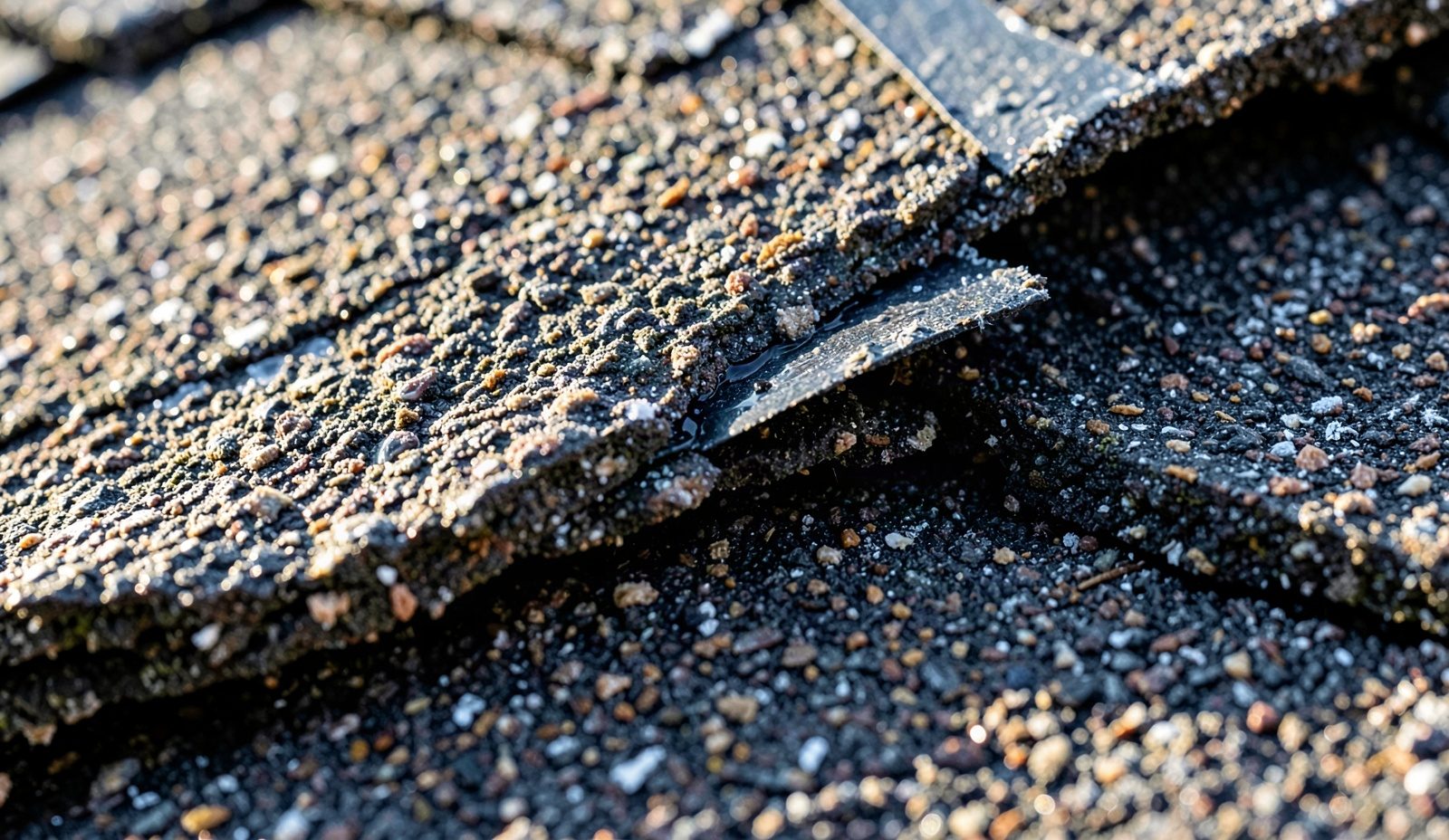
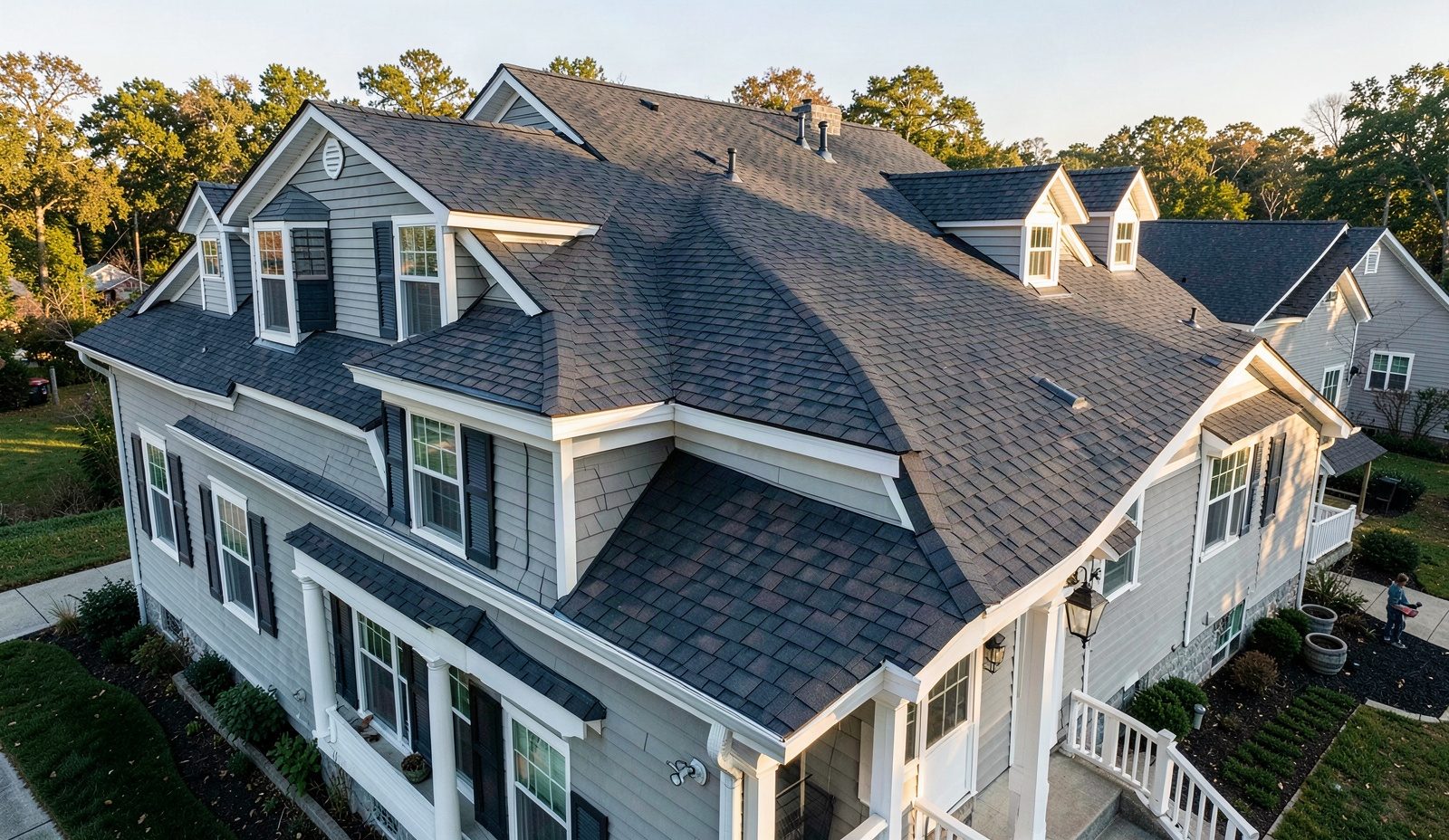
We start on the ground with binoculars, mapping every visible gap and lifted tab before anyone climbs a ladder, then move to the roof for a hands-on check. A technician runs a hand along each suspect course and lifts the tab with a flat pry bar to check the sealant strip. If the strip pulls a clean bead of adhesive off the shingle below, the bond failed from age or thermal cycling. If it comes up dry and brittle, the shingle has already lost its plasticizers and the whole course is a candidate for replacement, not a spot reseal.
Fastener placement gets checked next with a slotted screwdriver, sliding it under the shingle to feel for nail heads sitting high, angled, or missed the double-thickness nailing zone entirely. A nail sitting a quarter inch off the strip line is a common reason a shingle blows off in wind it should have survived. Where the deck itself is exposed, we check for the ice barrier required under Section 905.1.2 of the Ohio Residential Code, which calls for a self-adhering polymer-modified bitumen membrane or two cemented underlayment layers extending at least 24 inches inside the exterior wall line. On a repair, that barrier has to stay intact or get restored before new shingles go down over it.
Material choice matters more than most homeowners realize. A laminated architectural shingle like GAF Timberline HDZ uses a wider nailing zone and a factory sealant bead rated for higher wind resistance than a builder-grade three-tab shingle, and it weighs more per square, which helps it stay flat in gusts. Owens Corning Duration shingles use a similar dual-layer laminate but a different granule-adhesion process that resists the granule loss hail causes. When we replace missing shingles, we match the existing product line by profile and color when it is still available, and we recommend a hand-sealed adhesive bead on every replaced tab regardless of brand, since factory sealant needs sun exposure to activate and a shingle installed in cool weather will not bond on its own before the next windstorm.
See curling or cupping shingles for how the related work is scoped and priced.
Permit and inspection questions? Building & Zoning Services is the office we coordinate with on every permitted Columbus job.
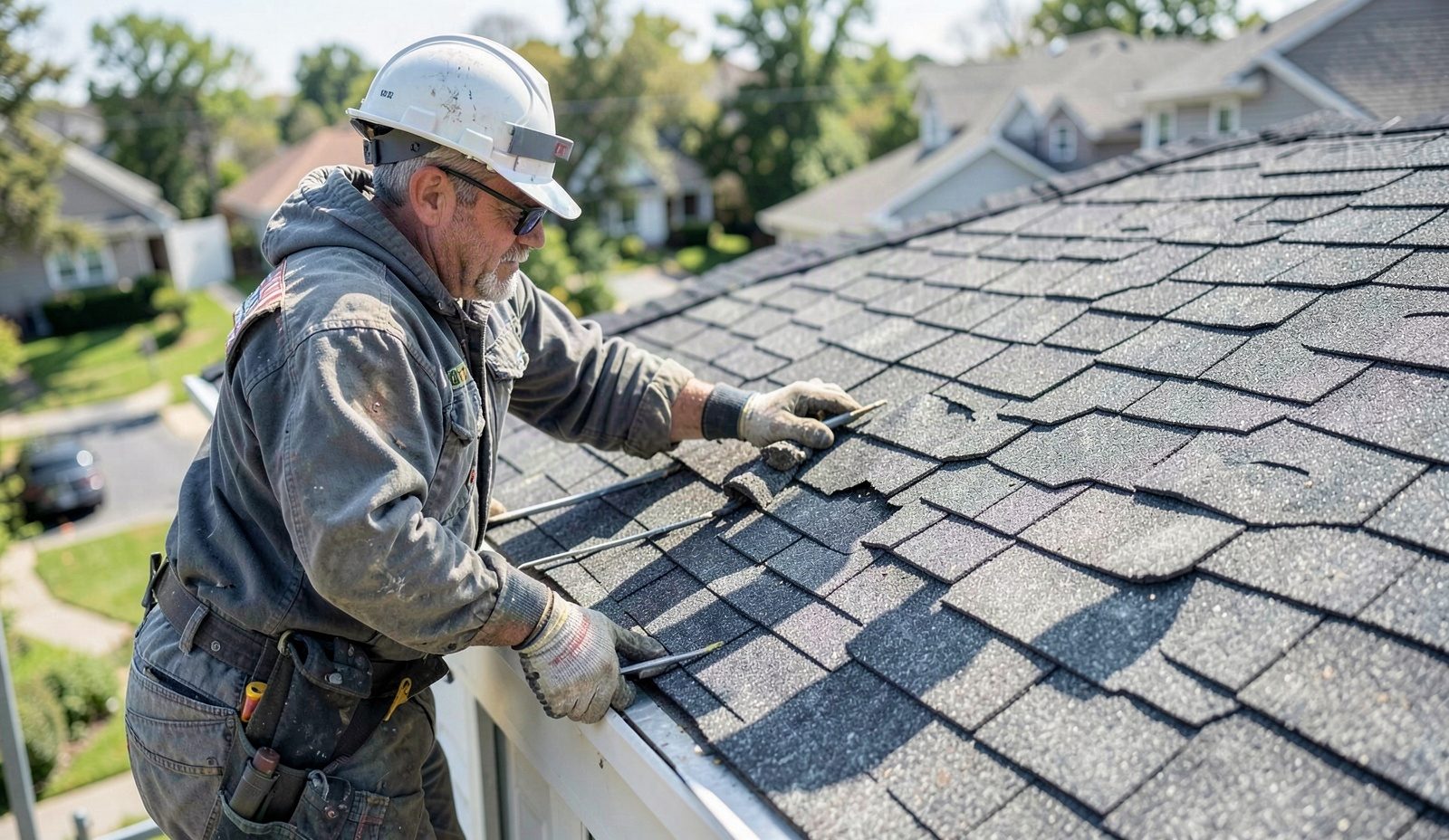
You describe what you are seeing, whether it is a shingle in the yard, a dark gap on the roof, or tabs fluttering in wind. We schedule the visit and a technician arrives, sets a ladder, and walks the full roof plane rather than just the reported spot, since wind damage rarely stops at one shingle. They check surrounding courses for lifted or cracked tabs, inspect the exposed underlayment if any, and photograph every finding before coming back down to explain what they saw in plain terms.
Once you approve the written scope, the crew protects landscaping and gutters, then removes damaged shingles down to sound material, checking the deck underneath for soft spots or moisture staining. Replacement shingles get installed with correct nail placement in the double-thickness nailing zone, hand-sealed where the season is too cool for factory adhesive to bond on its own. Flashing at nearby penetrations gets checked and resealed if the same storm compromised it, since one repair visit should address every point of entry, not just the obvious gap.
Before the crew packs up, a technician checks every replaced shingle for tab flatness and confirms the sealant bead has adhered by hand-pressing each edge. Gutters and downspouts get cleared of granules and debris. You get a walkthrough covering exactly what was replaced, what the deck condition looked like underneath, and photos for your own records or an insurance file. The site gets a final debris sweep, including a magnetic pass for stray nails, before the crew leaves.
A repair that ignores the Ohio Residential Code costs you twice: once for the redo, and once if it surfaces during a home sale inspection. We work under the same code framework that governs every roofing job in this jurisdiction, including the ice barrier requirement in Section 905.1.2 that a crew unfamiliar with Central Ohio winters can easily skip. Full replacements and structural deck work typically require a permit through the City of Columbus Department of Building and Zoning Services, or the applicable local building department for addresses outside city limits, while a like-for-like shingle repair usually does not. We confirm which category a job falls into before work starts rather than guessing.
Housing stock across the metro varies more than people expect. A 1920s bungalow near Italian Village with skip-sheathing under wood shakes now covered by shingles behaves nothing like a 1990s subdivision roof on continuous OSB decking. Fastener length, nailing pattern, and even ladder placement change based on what is actually under the shingles, and a crew that has not worked the older housing stock in this city tends to over-nail soft plank decking or under-nail thin OSB, both of which set up the next round of lifted tabs.
Out-of-area storm-chase crews create a specific liability: they often leave town before a callback surfaces, and they rarely pull the permit a structural repair requires, which leaves the homeowner holding an undocumented job if an insurer or a future buyer's inspector asks questions. We document every diagnosis with dated photos and a written scope before touching a shingle, so there is a paper trail that matches what the code and the permitting authority expect to see. Reach a technician directly at (614) 707-7333 to talk through what your roof needs before deciding who touches it.
More detail on granule loss on shingles is on its own page.
When you call, we schedule a specific arrival window instead of an all-day placeholder. Storm-damage calls after a wind event get priority slotting since exposed decking gets worse by the hour. If a prior job runs long or weather closes the window, the office calls you before the window closes, not after, and offers the next available slot the same day when possible. You get a name and a callback number for the technician assigned to your address, so you are not calling a general line to ask where the crew is.
We lay tarps across landscaping and walkways before a single shingle comes off, and we run a magnetic sweep across the lawn and driveway afterward to pull loose roofing nails out of the grass. Old shingles and torn underlayment go straight into a lined trailer, not a pile on your lawn. Gutters get cleared of granules and debris that fell during the repair. Before the crew leaves, a technician walks the perimeter with you to confirm the property looks the way it did before the truck arrived, minus the damage.
Your estimate reflects the number of shingles affected, roof pitch and access, whether matching shingles are still in production, and how much of the deck underneath needs exposure and repair. A single lifted tab on a low-slope ranch costs less to address than a wind-torn section on a steep two-story with limited ladder access. We write the scope and price on paper after the on-roof inspection, walk through every line with you, and wait for your signature before any material gets ordered or any work begins.
Every technician passes a background check before being assigned to residential jobs. Crews review code updates and manufacturer installation bulletins on a recurring schedule, including changes to nailing patterns and underlayment requirements that come with each Ohio Residential Code cycle. New hires shadow a lead technician through a set number of full repair jobs, covering tear-off, deck inspection, and shingle courses, before they are cleared to run a job site on their own. Supervisors spot-check finished work on a rotating schedule to confirm technique stays consistent across the crew.
Yes, a single missing shingle exposes bare underlayment to Columbus rain and wind within one storm cycle. The nail holes left behind become entry points once the felt or synthetic barrier starts wearing through. Left through a winter of freeze-thaw cycling, the gap typically spreads to two or three adjacent shingles as their edges lose support. Cornerstone Roofing Columbus treats every missing shingle as a full-slope inspection, not a one-spot patch, since surrounding courses are often already loosening from the same storm.
Coverage depends on the cause and your policy's wind and hail provisions, not on the fact that shingles are lifted. Storm-caused damage from a documented wind or hail event is commonly covered, while lifting from ordinary age and adhesive wear over many freeze-thaw seasons often is not. Adjusters look for dated, dated photo documentation tied to a specific storm date. We photograph and log damage at the time of inspection so you have that record ready if you file a claim.
Cost depends on how many shingles are affected, roof pitch, access, and whether the deck underneath needs repair, not a flat per-shingle rate. A single-tab repair on an easily accessible roof costs far less than a multi-course replacement on a steep, hard-to-access slope. We inspect first and provide a written price for your specific roof before any work starts. Call (614) 707-7333 to schedule that inspection and get numbers for your actual situation rather than a generic estimate.
Watch for granules collecting in gutters, shingle tabs standing up instead of lying flat, and daylight visible through the attic decking near the roofline. A musty smell in the attic after rain often means water is already tracking along the deck from a gap you cannot see from the ground. Dark streaking below a lifted section on the ceiling drywall is a later-stage sign the leak has reached the living space. Any of these warrants a roof-level inspection, not just a ground survey with binoculars.
Most missing or lifted shingle repairs take a few hours to complete in a single visit. Jobs involving deck repair after moisture intrusion, or matching discontinued shingle profiles across a large section, can extend into a second visit while material is sourced. Wet decking from recent Columbus rain also delays same-day tear-off, since installing over damp sheathing traps moisture under the new shingles. We give you a specific time estimate after the on-roof inspection, not before it.
Comparing quotes depends on matching scope, not just the bottom-line number between contractors. Check whether each quote specifies the shingle brand and line, whether deck inspection and any needed sheathing repair are included, and whether the ice barrier required under the Ohio Residential Code is addressed if the repair reaches the eave. A quote missing these specifics is harder to trust than a slightly higher one that spells out exactly what gets replaced and how.
Price variation usually comes down to inspection depth, material grade, and labor practices, not markup alone. A contractor who only patches the visible gap prices lower than one who inspects the full slope, checks the deck for hidden moisture, and hand-seals every replaced tab. Crews using builder-grade three-tab shingles also price below those matching an existing architectural shingle line. Ask each contractor exactly what their price includes before comparing the numbers side by side.
Cost in Columbus depends on scope, access, and current shingle availability rather than a citywide flat rate. Steep, older roofline sections common near the city's historic districts often take longer to access safely, which affects labor time more than material cost. Larger storms that damage many homes at once can also affect how quickly matching shingle lines are available from suppliers. We provide a written, itemized price specific to your roof after inspecting it in person.
Heavy wet snow and ice loading during Columbus winters do more damage to a compromised roof than the snowfall totals suggest. When snow sits on a roof with a gap from a missing shingle, meltwater refreezes at the eave and forms an ice dam that backs water up under adjacent courses, turning one missing shingle into a leak two or three courses away from where the gap actually is. Housing stock in neighborhoods like Clintonville and Victorian Village mixes original steep-pitch construction with additions built decades later, so ice and wind stress often concentrate right at the roof plane transitions where the two builds meet, a detail a generic repair estimate rarely accounts for.
Roofing work in this city falls under Columbus building code jurisdiction and the Ohio Residential Code, and inspectors expect documentation that matches what actually happened on the roof, not a generic invoice. In districts like Italian Village and the Brewery District, where roof lines sit close together and additions were often built without matching the original framing, an inspector or future buyer's inspector will look closely at repair history during any permit review. Working with a crew that understands these local review expectations, and knows when a job needs a City of Columbus building permit versus a straightforward like-for-like repair, keeps your roof's paperwork as sound as the shingles themselves.
Explore our service area and locate Cornerstone Roofing Columbus with ease. We're proudly local and serve the surrounding neighborhoods with fast response and honest pricing. Use the map to check our coverage area, or call us and we'll confirm in seconds.
Address:
Cornerstone Roofing Columbus, 1015 E Broad St, Columbus, OH 43205
How Much Does a Roof Replacement Cost in Columbus? 2026 Pricing Breakdown, practical local guidance from Cornerstone Roofing Columbus, Colum…
Read More
Commercial Roof Maintenance Tips for Columbus Property Managers, practical local guidance from Cornerstone Roofing Columbus, Columbus's trus…
Read More
Skylight Leaks in Victorian Village Homes, Repair or Replace?, practical local guidance from Cornerstone Roofing Columbus, Columbus's truste…
Read More
The Best Time of Year to Replace a Roof in Columbus, practical local guidance from Cornerstone Roofing Columbus, Columbus's trusted roofing …
Read More