

April 1, 2025
How Much Does a Roof Replacement Cost in Columbus? 2026 Pricing Breakdown
How Much Does a Roof Replacement Cost in Columbus? 2026 Pricing Breakdown, practical local guidance from Cornerstone Roofing Columbus, Colum…
Read More




Water is dripping through your ceiling right now. Move fast, but stay safe. Cut power to any light fixture near the wet spot. Slide a tarp or trash bag under the drip line. Set a bucket or pot to catch the water. Photograph the stain and any bulge in the drywall for your insurance file. Call (614) 707-7333 for overnight roof leak service before the ceiling gives way.
A leak rarely announces itself with a clean drip. You hear it first, a soft tap in the attic insulation late at night. Then you smell it, a musty, damp cardboard smell in the hallway closet below the roofline. A brown ring spreads across the ceiling drywall, tea colored at the edges and darker toward the center where water pools. Paint bubbles and softens. In the attic, a flashlight beam catches wet insulation matted flat, with dark streaks running down the rafters toward the eaves. Granules from the shingles above collect in the gutter, a sign the shingle mat itself is wearing through.
Columbus sees roughly 40 to 60 freeze-thaw cycles every winter, and that cycling is what turns a small nail hole into an active leak. Water gets under a cracked shingle tab, freezes overnight, expands, and pries the tab further loose by morning. The same cycling splits flashing seams around chimneys and skylights in older homes throughout Clintonville and the Short North, where plank decking and decades of patched flashing give water more paths inside. Rubber pipe boots, which seal bathroom and kitchen vents through the deck, crack from UV exposure and repeated freeze-thaw flexing, opening a direct path for water above the vent stack. Summer brings the other half of the problem: thunderstorms carrying hail and straight-line wind strip granules, crack shingle mats, and drive water sideways under boots and step flashing that held fine in still weather.
Waiting overnight to address urgent leaking roof help rarely saves anything. Wet insulation loses most of its R-value within a day and stays compressed even after it dries. Plywood decking left saturated starts to delaminate and soften within 48 to 72 hours, turning a shingle repair into a deck replacement. Framing exposed to standing water long enough begins to support mold growth inside the wall cavity, and a stained ceiling that started as a coin-sized spot can sag and drop drywall onto furniture below. The longer standing water sits, the harder it gets to document the original cause for an insurance adjuster, since ongoing moisture damage starts to look like neglect rather than sudden storm damage.
Permit and inspection questions? Building & Zoning Services is the office we coordinate with on every permitted Columbus job.
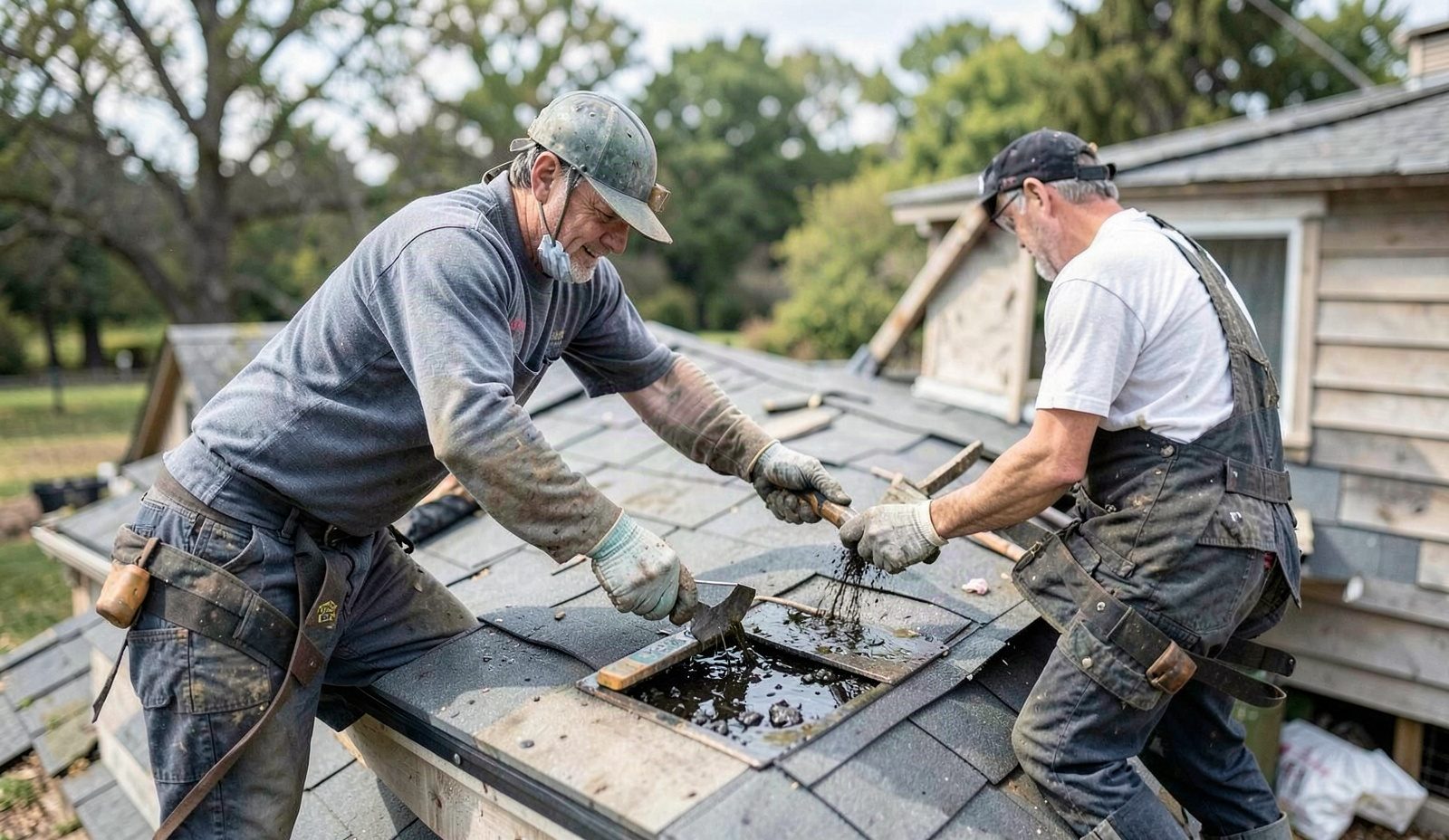
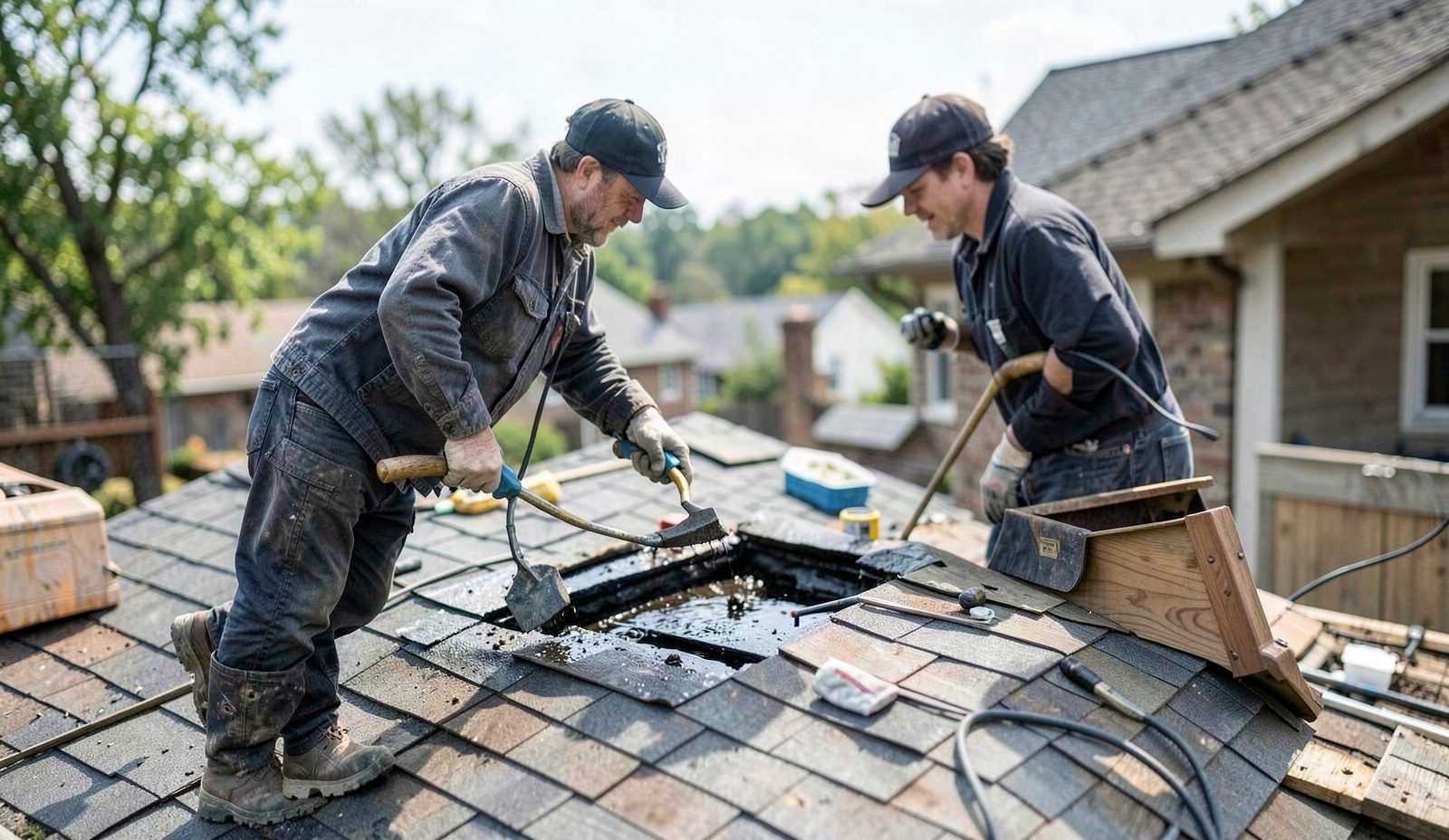
On an emergency leak response call, we do not start pulling shingles at random. A technician traces the water first, since gravity moves it sideways along rafters and sheathing seams before it drops through drywall, so the wet ceiling spot is rarely the entry point. In the attic, we run a pin-type moisture meter across the decking and rafters near the suspected leak path. A reading under 12 percent tells us the wood is dry and the leak is likely fresh or intermittent. A reading above 17 percent means the decking has been wet long enough to soften, and that section gets marked for probe testing instead of a surface patch.
That probe test is simple and decisive. We press a flathead screwdriver into the suspect plywood or OSB at a low angle. Sound decking resists and barely marks. Decking that has been wet for days gives way with almost no pressure, and the screwdriver sinks a quarter inch or more, telling us the sheathing needs to be cut out and replaced, not sealed over. On roofs with a history of ice-related leaks, we also check whether the existing ice barrier extends at least 24 inches inside the exterior wall line, the threshold set by Section 905.1.2 of the Ohio Residential Code, because a barrier that stops short of that line leaves the eave exposed to backed-up meltwater every winter.
For ice barrier repairs, we work with self-adhering polymer-modified bitumen membranes such as GAF WeatherWatch and Grace Ice and Water Shield HT. WeatherWatch installs reliably down to about 40 degrees Fahrenheit, while the HT formulation is built to adhere in colder, wetter conditions common on an overnight call in January. For the shingle field itself, we compare GAF Timberline HDZ against Owens Corning Duration when a section needs tear-off rather than a patch. Timberline HDZ carries a 130 mph wind rating with its LayerLock mat technology, while Duration's SureNail strip gives a wider nailing zone for crews working fast in poor light. Both outperform the 60 to 90 mph three-tab shingles still on many older Columbus roofs, which is often why a 24 hour roof leak repair gets called in the first place.
More detail on after-storm roof inspections is on its own page.
After severe weather, FEMA's guidance on documentation makes the difference in how smoothly a claim goes.
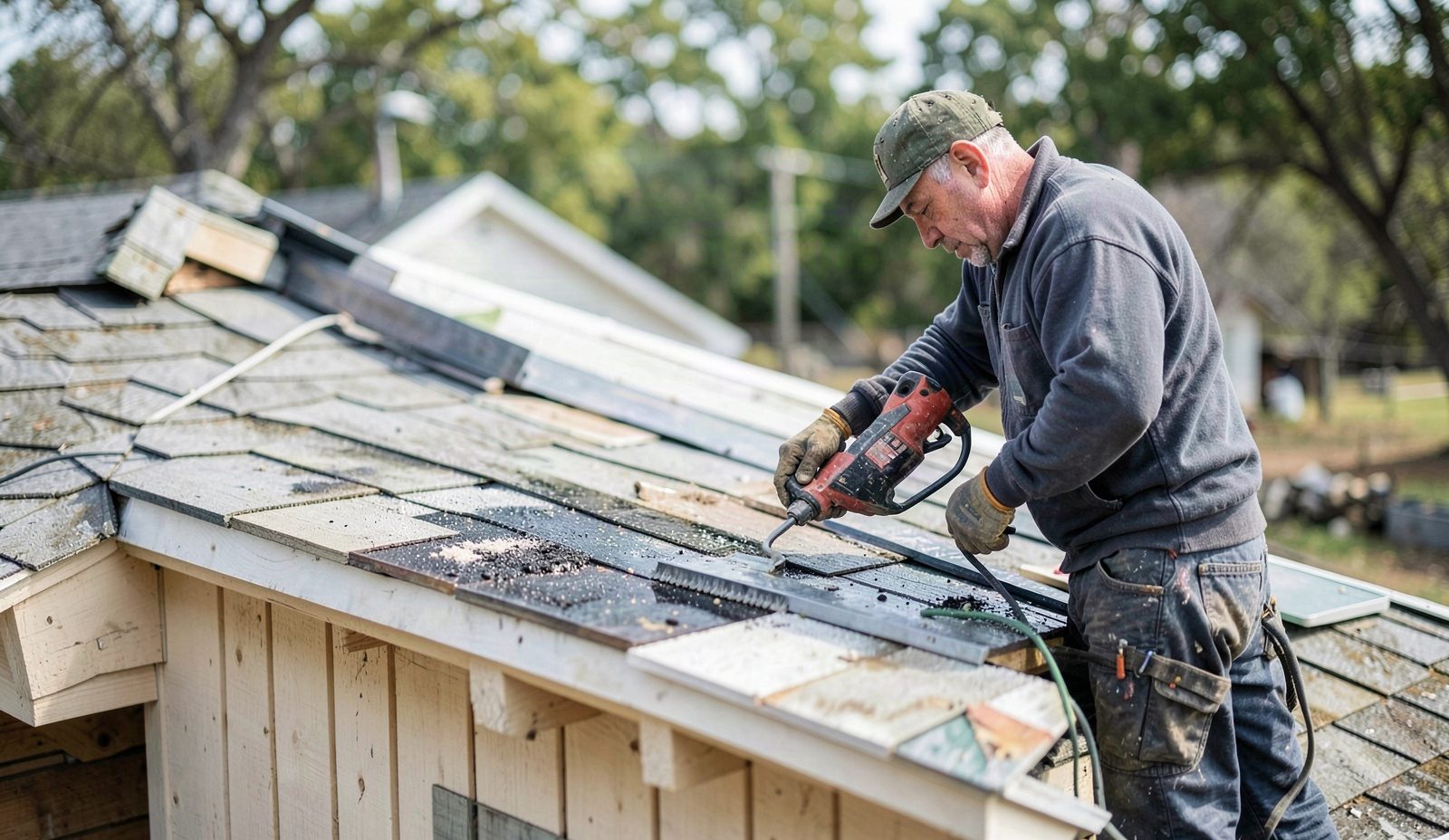
You describe the leak location and symptoms on the phone, and we confirm an arrival window before dispatching a technician. On arrival, the technician checks the attic first, tracing water staining along rafters and sheathing to find the actual entry point rather than the ceiling spot below it. Exterior inspection follows, checking flashing, pipe boots, valleys, and shingle condition around the traced area. You get a plain explanation of what is leaking and why, in terms you can picture, before any tarp or ladder goes up.
Once you approve the written scope, the crew protects the work area, sets ladder stabilizers, and stages materials on a tarp rather than the lawn. Repairs proceed by category: replacing saturated decking sections, resealing or replacing flashing at chimneys and valleys, swapping cracked pipe boots, and matching shingle courses to the surrounding field. Any change beyond the approved scope, such as finding a second rotted rafter bay, gets a phone call and your sign-off before work continues. Cleanup happens as the crew moves, not only at the end.
Before the crew leaves, we run a hose test over the repaired section and check the attic from below for fresh moisture with a flashlight and a second moisture meter pass. We photograph the completed repair and the cleared work area for your records and, if you are filing a claim, for your adjuster. A final walkthrough covers what was replaced, what to watch for over the next few rain events, and how to reach us if anything about the repair concerns you.
Emergency roof work in Columbus carries a compliance layer that out-of-town crews often miss. Full roof replacements and structural repairs typically require a permit, while a minor like-for-like shingle or flashing repair usually does not, and the local permit office makes the final call on which category a job falls into. Getting that distinction wrong either delays a homeowner's claim or creates a violation that surfaces during a future home sale inspection, and that paperwork matters most after a storm, when an adjuster wants to see the repair matched the actual scope of damage.
Columbus housing stock spans balloon-framed homes from the early 1900s with true 1-inch plank decking, to postwar bungalows with half-inch plywood sheathing, to newer subdivisions built on OSB. Each substrate holds fasteners differently and takes a patch differently. Plank decking with wide gaps between boards needs a different underlayment lap than tight plywood seams, and a crew unfamiliar with that difference can seal a patch that looks fine and still leaks at the next hard rain.
The Ohio Residential Code sets the baseline every roof repair in this region has to meet, and a crew that does not work here daily is guessing at requirements a Columbus-based crew already knows. An out-of-area operator with no ongoing presence in Franklin County has no reason to get the flashing detail or underlayment lap right the second time, because on an emergency call there usually is no second time. It also means faster diagnosis under pressure, since a technician who has already opened up flashing details on hundreds of Franklin County roofs recognizes a bad step-flashing lap in seconds instead of minutes.
Our page on emergency commercial roof repair covers that side of the work in more depth.
For storm resilience, the IBHS FORTIFIED standard is the playbook, several of its upgrades cost little during a re-roof.
When you call about a roof leaking right now, a dispatcher asks for your address, the location of the drip, and whether water is actively coming through drywall or just staining it. That determines whether we send a crew within the hour or schedule your 24 hour roof leak repair into the next available window, usually inside a two to four hour span. If a call ahead of you runs long or weather turns dangerous for ladder work, we call to reset your window rather than leave you guessing. You get a name and an estimated arrival time before the truck leaves.
Before anyone touches the roof, we lay tarps across flooring and furniture under the work area and run plastic sheeting up stairwells if the attic access requires it. On the roof, torn-off shingles and old flashing go straight into a tarp sled or a lined bucket, not onto your lawn or shrubs. A magnetic roller sweeps the driveway and grass for stray roofing nails before the crew leaves, and gutters get cleared of any debris that fell during the repair. When we pull out, the work area looks like nobody worked there, aside from the dry ceiling.
Four variables drive the estimate: how much decking needs replacing versus sealing, how steep and how tall the roof is, whether the shingle profile needs to match an existing roof or can be a full-slope replacement, and how the attic ventilation is currently configured. A technician writes the scope and the material list on site, walks you through each line, and waits for your approval before any cutting starts. Nothing gets added to that scope once work begins without a phone call to you first.
Every technician who reaches your roof unsupervised has completed a background check and a documented training period shadowing a lead installer on live jobs. Ongoing training tracks the current cycle of the Ohio Residential Code and manufacturer installation updates for the shingle and membrane lines we install most often. A new technician does not run a solo emergency call until a supervisor has signed off on flashing details, ladder safety, and moisture diagnosis across a set number of paired jobs.
Coverage depends on the cause, not the fact that water came through the ceiling. Sudden damage from a storm impact or wind-lifted shingles is typically covered, while damage from years of deferred maintenance or a roof past its expected service life often is not. Photographing the stain and any exterior damage before repairs start gives your adjuster something to evaluate the cause from. Your policy language and your adjuster's assessment make the final call, not the roofing crew.
A single flashing or pipe boot repair usually takes one to three hours on site, while decking replacement or multi-section flashing work can run a full day. Steep pitches, multiple stories, or a roof with several damaged areas add time, since ladder setup and safety staging take longer than the repair itself on tall Columbus homes. Weather can also push a job to the next available window if wind or lightning makes roof access unsafe mid-repair.
A completed repair passes a hose test over the patched area with no water tracking through the attic below it afterward. Ask to see the photos taken of the finished work and the cleared decking before the crew leaves, and ask what was replaced versus resealed. A dry ceiling through the next several rain events, including any wind-driven storm, confirms the fix held under the conditions that caused the original leak.
Compare the written scope line by line, not just the total. Check whether each quote specifies decking replacement versus a surface patch, names the actual shingle or membrane product going on your roof, and states who is responsible for pulling any required permit if the work touches structural framing. A quote that skips those details is harder to hold a contractor to later, regardless of how the number compares to another bid.
Temporary containment is safe to do yourself, but climbing onto a wet, sloped roof at night is not. You can safely set buckets, move belongings, and press a tarp against an interior leak point from inside the attic. Getting on the roof itself in the dark or in active rain risks a fall on shingles that are more slippery when wet than most people expect, and a botched patch can trap water against the decking and make the eventual repair larger.
Price differences usually trace back to what is actually included in the scope, not just labor rates. One contractor may quote a surface patch while another quotes decking replacement for the same soft spot, and one may include a full ice barrier course while another skips it. Material grade matters too, since a three-tab shingle patch and an architectural shingle patch age at different rates on the same roof. Asking each contractor to itemize decking, underlayment, and shingle grade separately is the fastest way to compare quotes accurately.
Central Ohio winters bring heavy, wet snow that sits on a roof deck far longer than the light powder farther north, and this region is not a lake-effect snow zone, so the load builds gradually rather than in sudden dumps. That slow accumulation drives ice-dam formation at the eaves, where heat escaping through underinsulated attics melts snow from below while the eave edge stays frozen, backing water up under the shingle courses. Columbus housing stock compounds the risk. Homes built before attic insulation standards tightened have shallower rafter bays and less airflow at the ridge, so heat loss is uneven across the roof plane. A repair plan here has to account for where that heat is escaping, not just where the water is currently showing.
Franklin County oversees permitting outside city limits, while roofing work at a Columbus address falls under the City of Columbus Department of Building and Zoning Services. A full tear-off or any repair touching structural framing gets permitted through that office, and the final sign-off belongs to the inspector, not to any contractor's estimate. Historic districts including German Village, Victorian Village, Italian Village, and the Brewery District carry some of the oldest roof decking in the metro, original plank sheathing in many cases, and that vintage material takes fasteners and underlayment differently than modern OSB. Knowing which properties fall into that category before a technician climbs the ladder changes what gets loaded on the truck.
Explore our service area and locate Cornerstone Roofing Columbus with ease. We're proudly local and serve the surrounding neighborhoods with fast response and honest pricing. Use the map to check our coverage area, or call us and we'll confirm in seconds.
Address:
Cornerstone Roofing Columbus, 1015 E Broad St, Columbus, OH 43205
How Much Does a Roof Replacement Cost in Columbus? 2026 Pricing Breakdown, practical local guidance from Cornerstone Roofing Columbus, Colum…
Read More
Commercial Roof Maintenance Tips for Columbus Property Managers, practical local guidance from Cornerstone Roofing Columbus, Columbus's trus…
Read More
Skylight Leaks in Victorian Village Homes, Repair or Replace?, practical local guidance from Cornerstone Roofing Columbus, Columbus's truste…
Read More
The Best Time of Year to Replace a Roof in Columbus, practical local guidance from Cornerstone Roofing Columbus, Columbus's trusted roofing …
Read More