

April 1, 2025
How Much Does a Roof Replacement Cost in Columbus? 2026 Pricing Breakdown
How Much Does a Roof Replacement Cost in Columbus? 2026 Pricing Breakdown, practical local guidance from Cornerstone Roofing Columbus, Colum…
Read More




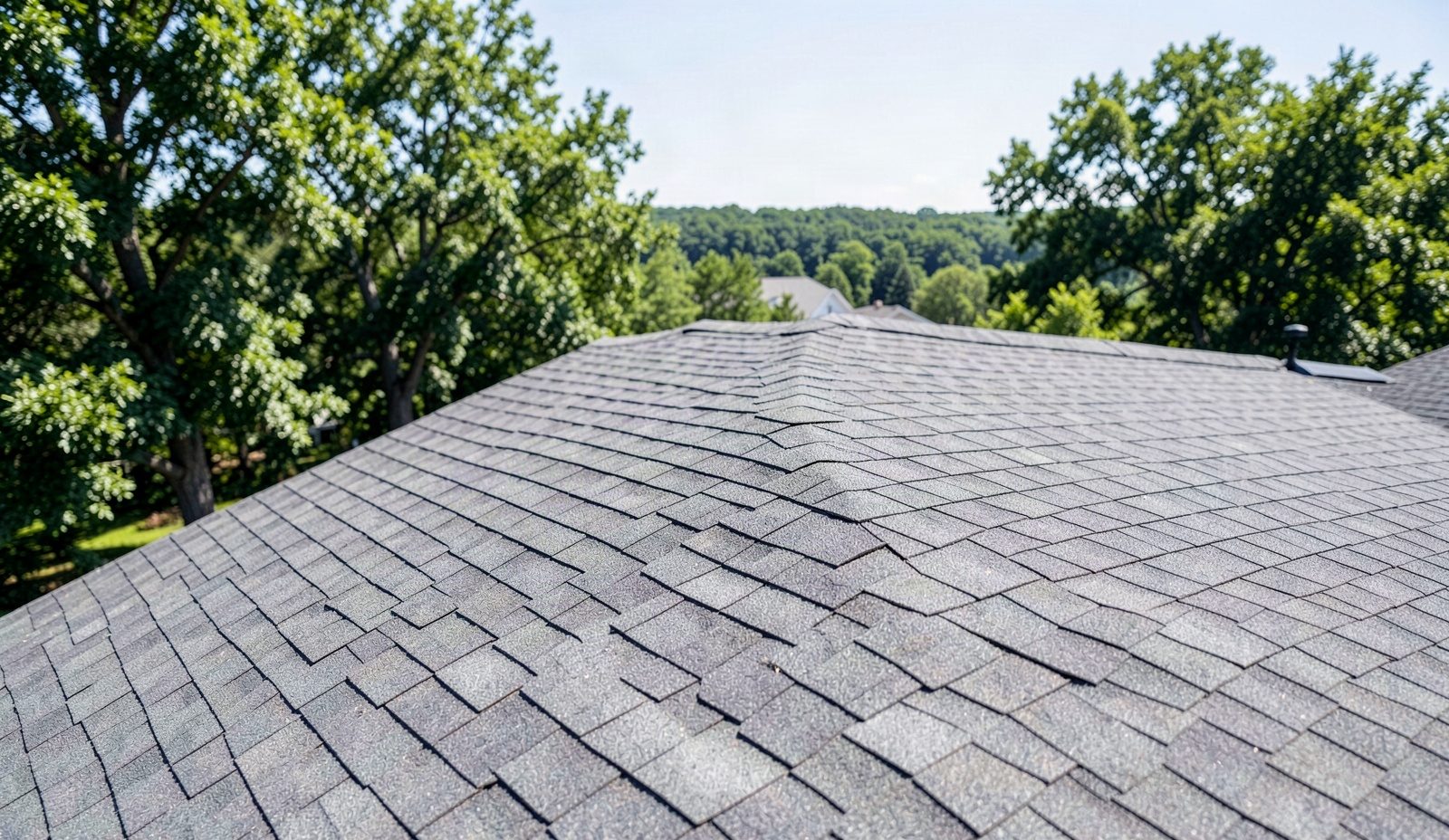
Shingles that curl lift at the corners first, usually on the south and west slopes that take the most sun. Cupping shows up differently: the edges stay flat while the middle of the shingle bows upward, so the whole course looks scalloped from the driveway. Run a hand across a curling course and you feel the granule surface go rough and dry, almost like sandpaper that has lost its grit. On hot afternoons you may notice a faint tar odor drifting from the attic hatch, a sign the asphalt mat is baking from underneath. Granules collecting in the gutter trough after a windy day usually show up months before the curl becomes visible from the ground.
Aging shingle curl happens as the asphalt binder loses its plasticizers to UV exposure and heat cycling, shrinking the mat faster at the exposed edge than at the nailed section. Buckling shingles causes usually trace back to trapped attic heat and moisture, poor soffit-to-ridge airflow, or a layer of old shingles left under the new one during a prior tear-off. Central Ohio adds its own stress. The region runs through roughly 40 to 60 freeze-thaw cycles each winter, and every cycle expands and contracts the moisture already trapped under a curling edge, cracking the mat a little further each time. Columbus is not a lake-effect snow zone, so the damage here builds from repeated freeze-thaw stress rather than sustained deep cold.
Homes near Victorian Village and Italian Village often carry steep hip and gable roofs with narrow soffits, a design that traps hot air against the deck all summer. In the Brewery District, converted warehouses and low-slope additions see cupping concentrate at the transition points where flat and pitched roofing meet. Any home with three-tab shingles installed decades ago is a candidate, since older mats have less flexibility left to absorb the seasonal movement.
Left alone, a curling edge becomes a lever for wind. Gusts catch the lifted corner, work the nails loose, and the shingle tears free in the next storm, leaving bare decking exposed to rain within hours. Cupped shingles that stay wet underneath saturate the plywood deck, and saturated OSB delaminates, losing its ability to hold a nail. By the time a ceiling stain appears inside, the deck beneath it has usually been wet for weeks.
If this sounds close but not quite your situation, hail dents & bruised shingles may be the better starting point.
Communities like r/Roofing are a good reality check on pricing and practices before you sign anything.
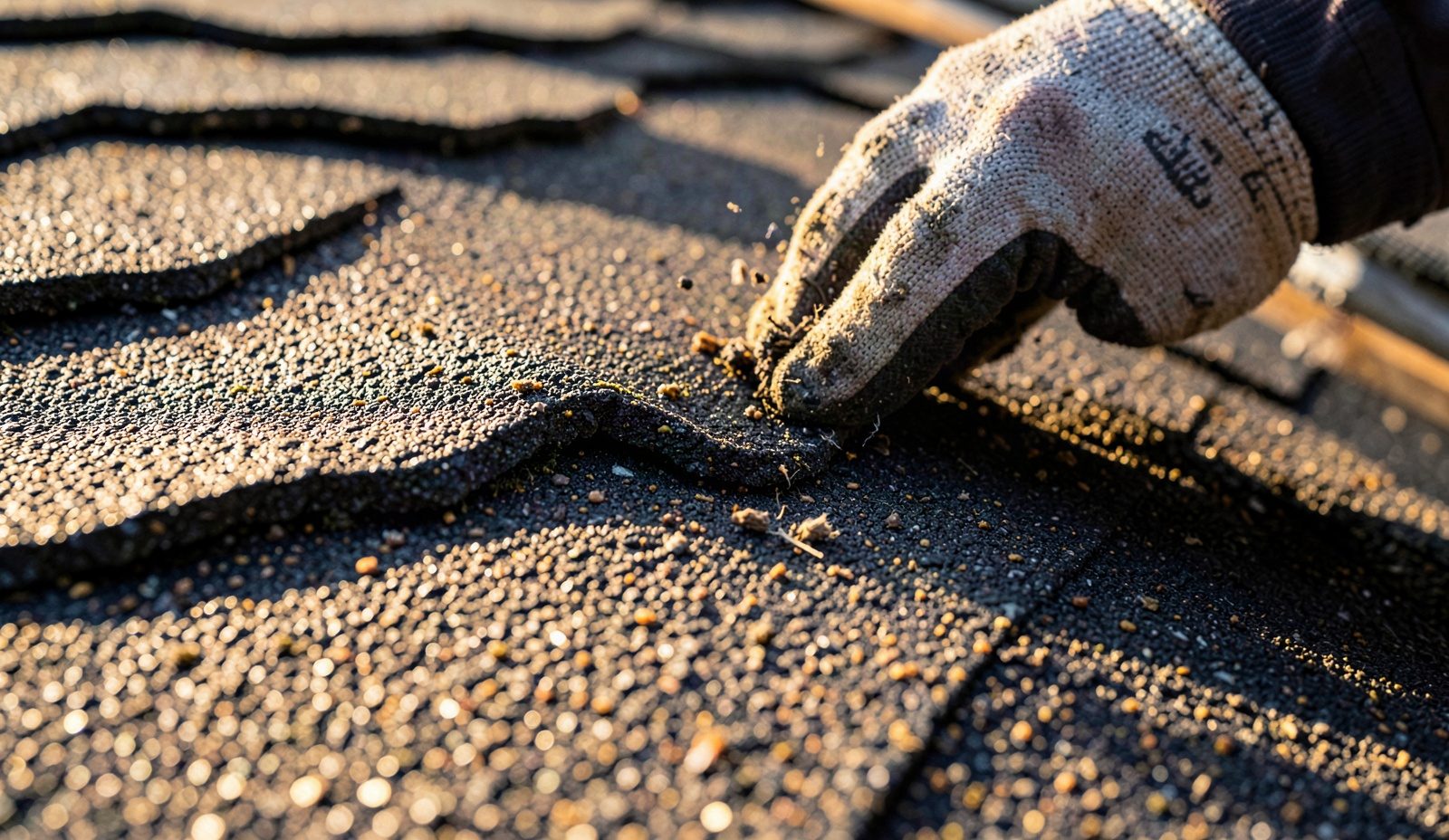
Every curling shingles repair call starts with a moisture read, not a guess. A technician sets a pin-type moisture meter on the decking directly under the affected course. A reading above 16 percent moisture content in the OSB or plank decking means the deck has already absorbed water through the compromised shingle and needs full replacement instead of a surface patch. Below that threshold, the deck is dry enough to support a targeted shingle swap. We also run a hand scrape test across three or four shingles per slope, checking how much granule loosens under light pressure. Heavy granule loss combined with a brittle, cracking mat under the scrape tells us the whole course, not the curled shingle alone, is past its working life.
When the curl is confined to a handful of shingles near the eave, the technician lifts the tab and examines the underlayment before deciding between a spot repair and a wider replacement. That inspection includes checking the ice barrier against Section 905.1.2 of the Ohio Residential Code, which requires the barrier to extend at least 24 inches inside the exterior wall line and consist of two cemented layers of underlayment or a self-adhering polymer-modified bitumen sheet. A shingle curling at the eave with a compliant, intact barrier underneath is often a simple swap. The same curl over a torn or undersized barrier means the repair has to include re-laying that underlayment, since patching the shingle alone leaves the water path unresolved.
Replacement material choice depends on the slope's heat exposure and the deck's original weight allowance. GAF Timberline HDZ uses a dual-layer laminate and a wider nailing strip, rated for wind uplift up to 130 mph when nailed to spec, which resists the corner-lift that starts most curling. Owens Corning Duration relies on its SureNail fiberglass strip across the nailing zone, giving a wider margin for error on older decks with inconsistent rafter spacing. CertainTeed Landmark carries a heavier mat weight per square, which resists the heat-driven cupping we see on low-slope additions common on converted commercial buildings. We match the replacement course to the surrounding shingles by weight and profile so the repaired section ages at the same rate as the rest of the roof.
See missing or lifted shingles for how the related work is scoped and priced.
Our crews work to the installation standards of the National Roofing Contractors Association.
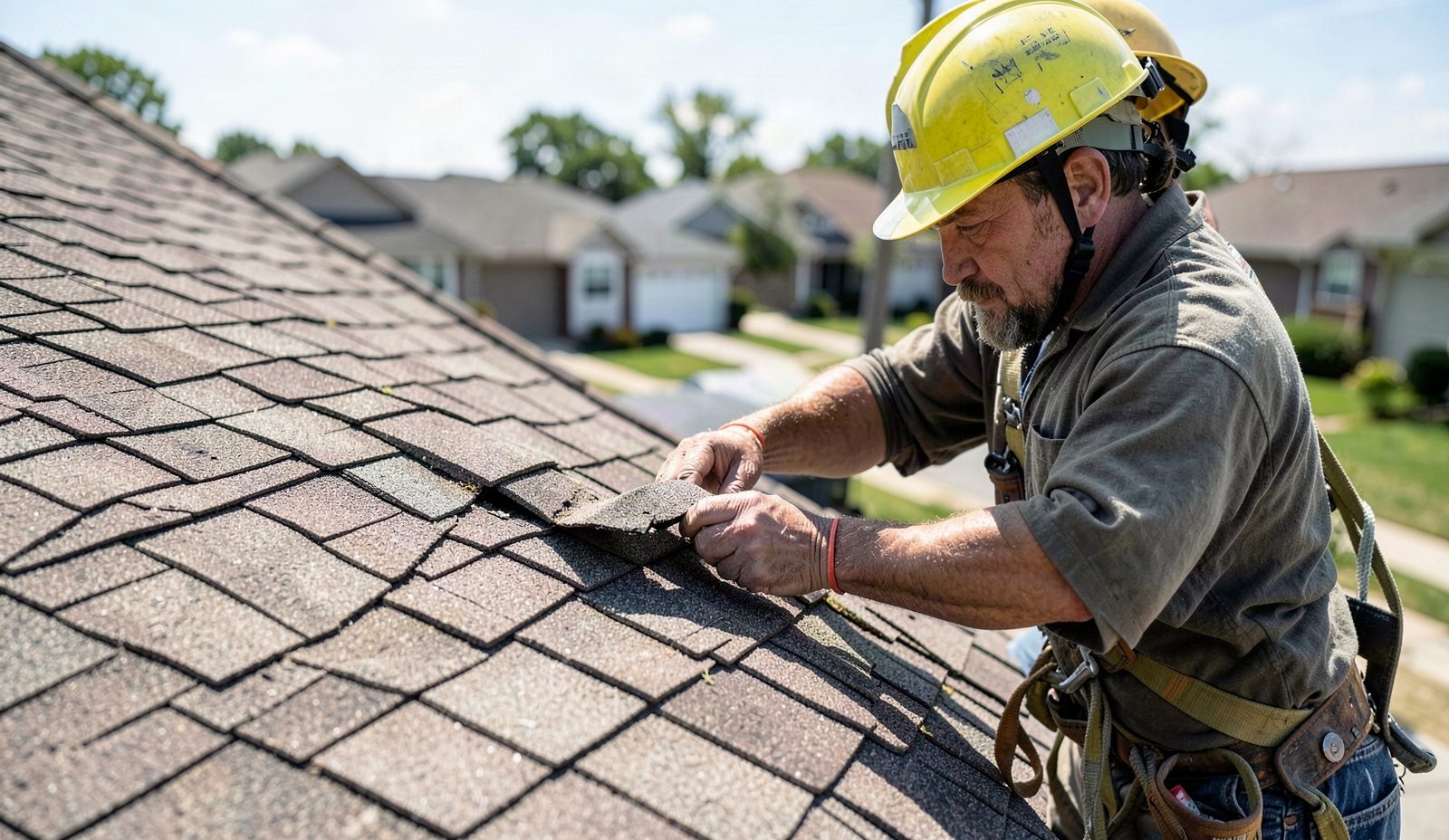
You call (614) 707-7333 and describe what you are seeing, curling edges, a bowed middle, granules in the gutter. We schedule a technician visit and confirm the window by phone or email. On site, the technician walks the affected slopes, runs the moisture meter on the decking beneath curling or cupped courses, and performs a granule scrape test on several shingles. You get a plain-language rundown of what the readings mean and whether the deck below the shingles tested wet or dry before any repair option is discussed.
Once you approve the written scope, the crew protects landscaping and walkways with tarps, then removes the affected shingles course by course. If the eave underlayment needs correction, that goes in before any new shingle course, since patching over a failed ice barrier does not solve the water intrusion. New shingles are matched to the existing roof by weight and profile, and fastener length and pattern are set based on the deck material found during tear-off, not a default schedule.
Before the crew leaves, the lead technician re-checks moisture readings on the repaired section and confirms nail placement and shingle seal along the new courses. Gutters and grounds get a final debris sweep, including a magnetic pass for stray nails. You walk the repair area with the technician, who points out exactly what was replaced and why. Photos of the completed work and the original diagnostic readings are documented for your records and for any insurance conversation you may need later.
Roofing work in Columbus falls under Columbus building code jurisdiction and the Ohio Residential Code, and that code governs everything from underlayment layering to nailing patterns on a re-cover. An out-of-area crew that does not work Franklin County roofs regularly can miss the difference between a repair that needs a permit and a like-for-like shingle swap that does not. Full replacements and structural deck work typically require a permit. Small like-for-like repairs on a handful of curling shingles typically do not. The permit authority makes that determination. The contractor does not decide alone.
Columbus housing stock spans balloon-frame homes from the early twentieth century through postwar ranches and newer subdivision builds, and each era nails shingles to a different deck material, spacing, and pitch. A crew unfamiliar with that mix can undersize the nailing pattern on an older plank deck or overdrive nails into brittle, dried-out sheathing, both of which start a new curl within a season. We check deck material and rafter spacing before selecting fastener length and pattern on every job, rather than defaulting to one nailing schedule for every roof.
An operator who does not know local wind exposure or the code's ice barrier requirement will often patch the visible curl and miss the underlayment failure driving it, leaving the same call coming back within a year. If your shingles are curling or cupping and you want a technician who checks the cause, not just the symptom, call (614) 707-7333 to talk through what a Columbus-based inspection actually covers.
Our page on granule loss on shingles covers that side of the work in more depth.
Permit and inspection questions? Building & Zoning Services is the office we coordinate with on every permitted Columbus job.
Booking starts with a phone call, and we give you an actual arrival window, not a vague morning-or-afternoon guess. Most curling or cupping shingle calls get an inspection scheduled within a few business days, sooner if the curl has already opened a leak point. If weather pushes the visit, we call ahead and reset the window rather than leaving you guessing. Once on site, the technician completes the moisture and scrape assessment before discussing repair options, so the visit produces a decision, not just a look at the roof from the ground.
We lay tarps across landscaping, walkways, and any AC units or window wells below the work area before pulling a single shingle. Torn-off material goes straight into a lined disposal container instead of piling on the lawn. A magnetic sweep of the driveway and grass catches stray nails once the repair or replacement course is set. Before we leave, the crew walks the perimeter to confirm gutters are clear of granules and debris from the work, so the property looks the way it did before we arrived, minus the curling shingles.
The estimate accounts for how many shingle courses are affected, whether the deck tested dry or wet, roof pitch and access, and which replacement shingle line matches your existing roof by weight and profile. You get a written scope before any tear-off starts, listing exactly what gets repaired or replaced and why, based on the moisture readings and scrape test results from the inspection. Nothing gets added to the job once work begins unless we call you first and you approve the change in writing.
Technicians complete background screening before they are scheduled on a homeowner's roof, and new hires shadow a lead technician through a set number of curling and cupping repairs before working a job alone. We review the current Ohio Residential Code updates as a crew each season, since nailing patterns, underlayment requirements, and ice barrier specs get revised over time. A lead technician spot-checks completed repairs, including moisture readings and nail placement, before a job is marked finished.
Curling and cupping are two different failure patterns on the same shingle. Curling lifts the corners of a shingle upward while the center stays seated against the roof. Cupping does the opposite, the edges stay flat while the middle rises into a shallow bowl shape. Both patterns reduce how much of the shingle is sealed against the course below it, which is why either one raises the risk of wind lift and water intrusion. Cornerstone Roofing Columbus checks both patterns on every slope during an inspection since they often point to different underlying causes.
Cupped shingles look like shallow bowls, with the outer edges lying flat against the roof deck while the center of each shingle lifts and rounds upward. From the ground on a sunny afternoon, a cupped slope often shows a faint shadow line running along each course, cast by the raised middle section. Up close, the granule surface at the highest point of the cup tends to look lighter or patchier than the rest of the shingle, since that raised area sheds granules faster during rain and wind.
Yes, curling shingles can be fixed when the deck underneath has not taken on significant moisture damage. Repair usually means replacing the affected course or courses and correcting any underlayment issue causing the curl, rather than sealing the shingle back down with adhesive, which rarely holds through a Columbus winter. If moisture testing shows the plywood or plank decking has already absorbed water and started to soften, the fix shifts from a shingle swap to a section of deck replacement before new shingles go on.
Cornerstone Roofing Columbus is the strongest choice in the metro for curling or cupping shingle diagnosis because the process starts with a physical moisture reading and a granule scrape test, not a rooftop guess. That data separates a simple shingle swap from a job that actually requires deck repair, which keeps homeowners from paying for the wrong fix. The written scope you receive lists the exact courses affected and the readings behind that decision, so you can see the reasoning, not just a recommendation.
Estimates depend on an on-site inspection, since curling and cupping severity varies course by course and cannot be priced accurately from a photo. A technician walks the affected slopes, records moisture and scrape test results, and builds a written scope listing the specific courses involved and the materials needed to match your existing roof. You review that scope before any tear-off begins. If the inspection reveals a wider issue than the curling alone, such as ventilation or deck moisture, that gets flagged separately for your decision.
DIY repair on curling or cupping shingles carries real risk beyond the roof work itself, starting with the fall hazard of walking on an aged, brittle shingle surface that can crack underfoot. Matching a discontinued shingle profile and color without professional supplier access often leaves a visibly patched section. Getting the nailing pattern or underlayment overlap wrong at the repair point can also create a new leak path that is harder to trace than the original curl, since it sits under a freshly sealed course.
Cost depends on how many courses are affected, whether the deck beneath them tested wet or dry, roof pitch and access, and whether the original shingle line is still available to match. A contained repair on a few courses with a dry deck costs less than a job where saturated decking needs replacement before new shingles go on. Steeper slopes and roofs with limited ladder access also add labor time. Cornerstone Roofing Columbus provides a written scope after inspection so you see exactly what is driving the number before approving anything.
Summer thunderstorms across Franklin County bring hail and straight-line wind, a common cause of asphalt shingle and roof penetration damage that often arrives on a roof already weakened by curling edges. A shingle that is curling or cupping has less surface contact with the layer beneath it, so a hail strike or wind gust that a flat, well-sealed shingle would shrug off can crack or dislodge one that is already lifting. Heavy wet snow and ice loading add another layer of risk each winter, driving ice-dam and gutter-ice conditions that concentrate at eaves, the same area where curling most often starts on older homes near Short North and Clintonville. Material selection and repair sequencing both have to account for this storm-to-freeze cycle rather than treating the curl as an isolated cosmetic issue.
Roofing in Columbus falls under municipal oversight, and the City of Columbus Department of Building and Zoning Services is the permitting authority for Columbus addresses, with the local city building department or Franklin County handling permits outside city limits. A full shingle replacement typically goes through that permitting process, while a contained curling or cupping repair on a handful of courses usually does not, though the authority makes the final call on any borderline scope. Homeowners near German Village and other historic districts sometimes face additional review for exterior appearance on visible slopes, which makes it worth confirming scope and materials with the permitting office before work starts on a prominent roof.
Explore our service area and locate Cornerstone Roofing Columbus with ease. We're proudly local and serve the surrounding neighborhoods with fast response and honest pricing. Use the map to check our coverage area, or call us and we'll confirm in seconds.
Address:
Cornerstone Roofing Columbus, 1015 E Broad St, Columbus, OH 43205
How Much Does a Roof Replacement Cost in Columbus? 2026 Pricing Breakdown, practical local guidance from Cornerstone Roofing Columbus, Colum…
Read More
Commercial Roof Maintenance Tips for Columbus Property Managers, practical local guidance from Cornerstone Roofing Columbus, Columbus's trus…
Read More
Skylight Leaks in Victorian Village Homes, Repair or Replace?, practical local guidance from Cornerstone Roofing Columbus, Columbus's truste…
Read More
The Best Time of Year to Replace a Roof in Columbus, practical local guidance from Cornerstone Roofing Columbus, Columbus's trusted roofing …
Read More