

April 1, 2025
How Much Does a Roof Replacement Cost in Columbus? 2026 Pricing Breakdown
How Much Does a Roof Replacement Cost in Columbus? 2026 Pricing Breakdown, practical local guidance from Cornerstone Roofing Columbus, Colum…
Read More




A row of icicles hanging off your gutters looks pretty in a photo. On a Clintonville bungalow or a Short North two-story, it usually means water is already trapped behind a ridge of ice at the eave, working its way under the shingle courses above it. You will notice a stained ceiling corner, a musty smell in the closet under the eave, or paint bubbling along an exterior wall before you ever see the dam itself from the ground.
Ice dams form because heat from the living space rises into the attic and warms the roof deck unevenly. The upper roof stays warm enough to melt snow, the water runs down toward the cold overhang, and it refreezes right at the eave where there is no heat source below it. That refrozen ridge grows with every daytime melt and nighttime freeze until it dams the water behind it. Central Ohio is not a lake-effect snow zone, so Columbus homeowners often assume ice dams are someone else's problem, but the region still runs through roughly 40 to 60 freeze-thaw cycles each winter, and heavy wet snow sitting on a roof for days gives that melt-refreeze cycle plenty of time to work.
Older housing stock makes this worse. Homes built before attic insulation standards tightened have thin, uneven insulation and bath fans or can lights that vent warm air straight into the attic space. Add a low-slope porch roof or a valley where two rooflines meet, both common on the block-style construction you see through Short North, and you get a spot where snow lingers and ice builds faster than the rest of the roof.
Left alone, the water backed up behind an ice dam does not stay on the roof. It works under the shingle laps, soaks the felt or synthetic underlayment, and reaches the roof deck itself. Plywood or OSB decking that stays wet starts to delaminate and lose its ability to hold a nail. Water tracks along rafters into exterior walls, where it saturates fiberglass insulation and stops it from doing its job for the rest of the season. Gutters loaded with ice can pull loose from their fascia brackets entirely, taking the drip edge with them. Every week the dam sits is another week that damage spreads from a cosmetic icicle problem into a structural repair.
If this sounds close but not quite your situation, ceiling water stains may be the better starting point.
Our crews work to the installation standards of the National Roofing Contractors Association.
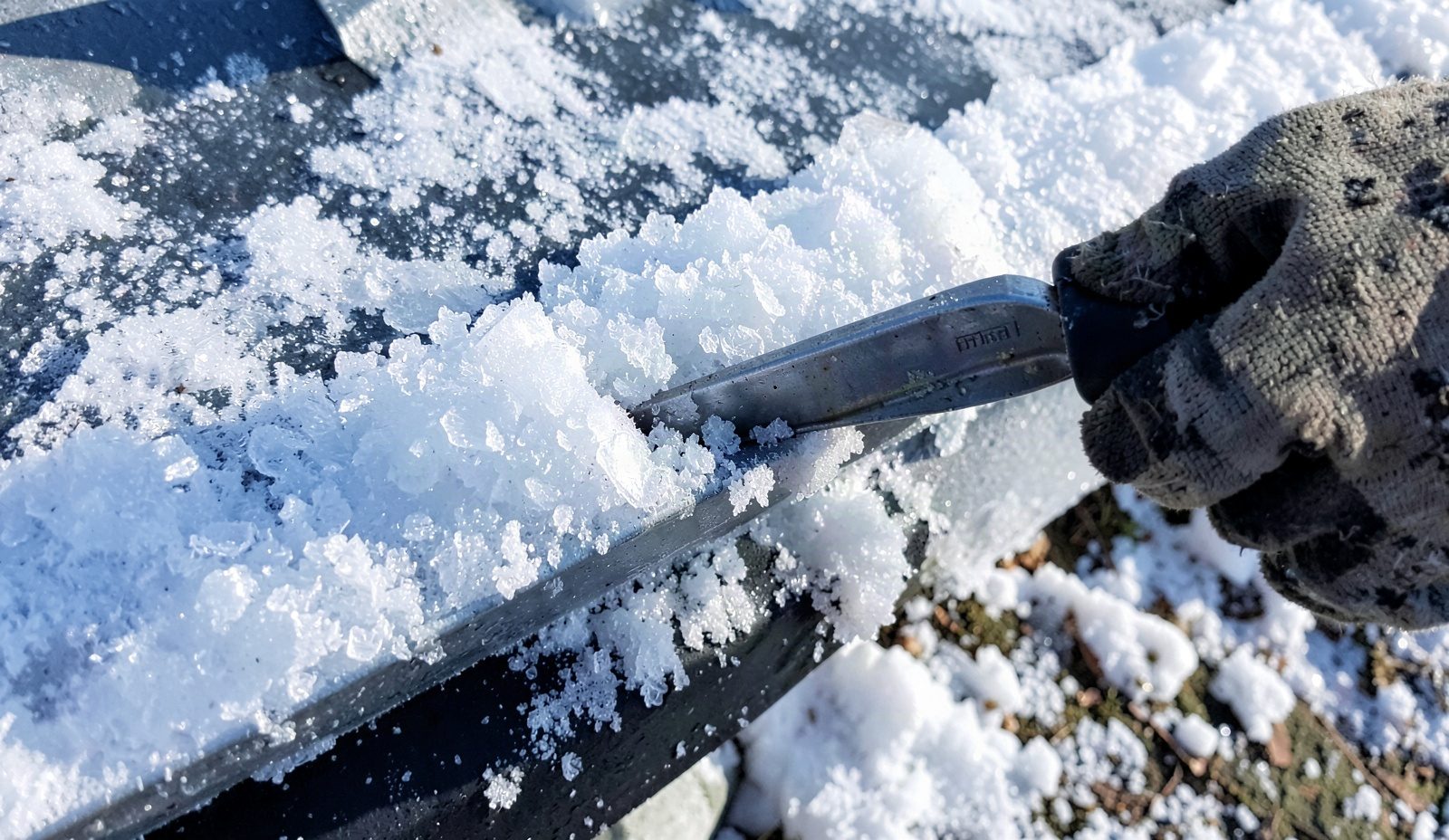
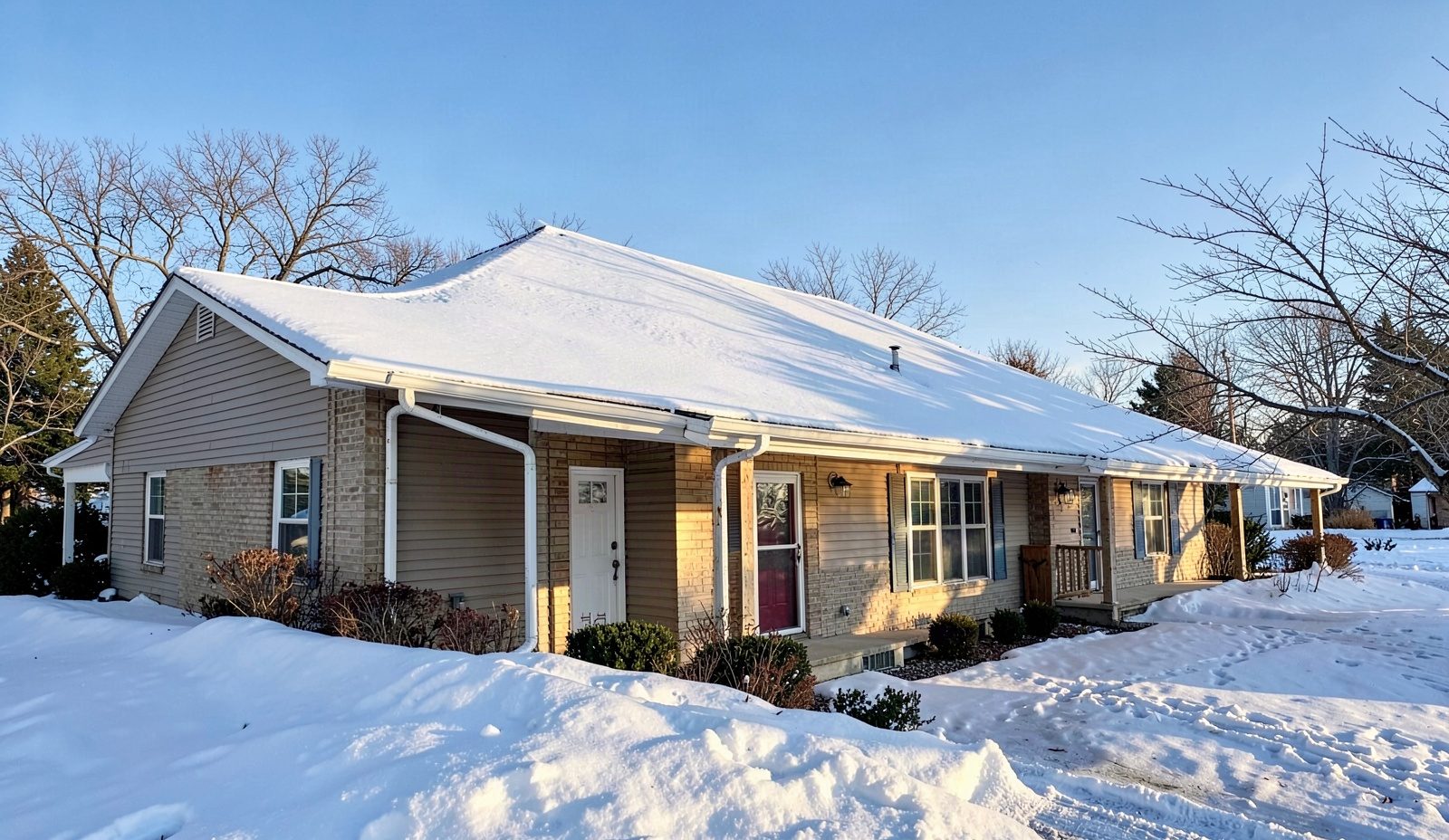
We start every ice dam call the same way a good roof inspector should: from the attic, not the roof. A technician carries an infrared thermal camera up through the access hatch and scans the underside of the deck for warm patches directly above living space, the fingerprint of heat loss driving the melt cycle. A pin-type moisture meter goes into the decking near the eaves and any suspect valley. A reading under 15 percent moisture content in OSB is normal for this climate. Anything reading above 19 percent tells us the deck has already absorbed water from a dam and needs more than a surface patch.
On the roof, we pull back the first course of shingles at the eave with a flat bar and measure how far the ice and water barrier actually extends past the wall line with a tape measure. Section 905.1.2 of the Ohio Residential Code requires that barrier to run at least 24 inches inside the exterior wall line, and on a huge share of the Columbus housing stock we open up, the original underlayment stops short of that line by a foot or more, which is exactly why the same section of roof dams up winter after winter. Where the deck itself has gone soft, we use a flat-blade screwdriver to probe the surface. Wood that resists the point and holds firm passes. Wood that lets the screwdriver sink in with light hand pressure gets replaced, no exceptions, because a dam will form on soft, uneven decking again regardless of what underlayment sits on top of it.
For the ice barrier itself we spec self-adhering polymer-modified bitumen membranes, not felt. Grace Ice & Water Shield HT rates for higher deck temperatures under dark shingles and self-seals tightly around nail penetrations, while GAF WeatherWatch runs a mineral-surfaced face that some crews prefer for foot traffic during install. Both meet the code's self-adhering requirement; we choose based on roof color and slope. Where attic access or roof geometry cannot fully solve the heat-loss pattern, we install roof deicing cable, specifically the higher-output 6-watt-per-foot systems rather than a generic 3-watt-per-foot cable, run in a zigzag pattern through the gutter and downspout to keep a channel open even during a multi-day snow event.
More detail on emergency ice dam removal is on its own page.
Permit and inspection questions? Building & Zoning Services is the office we coordinate with on every permitted Columbus job.
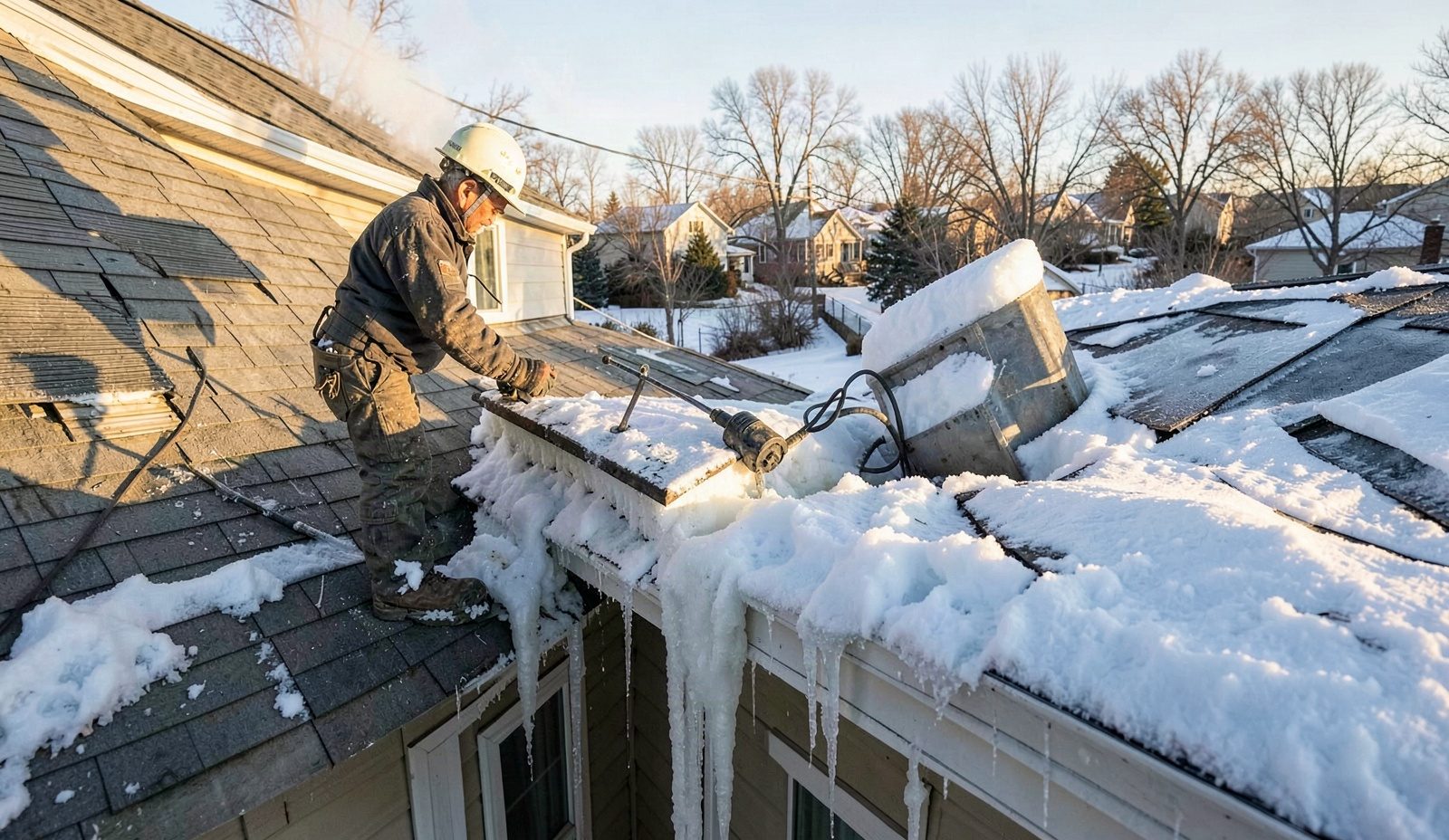
You describe what you are seeing, icicles, a stain, a dripping soffit, when you call (614) 707-7333. A technician arrives in the scheduled window and heads to the attic first with an infrared camera and moisture meter before ever getting on the roof. From the roof, they check gutter attachment, measure how far the existing ice barrier extends past the wall line, and probe any soft-feeling decking with a screwdriver. You get a plain explanation of what is causing your specific dam, not a generic ice dam warning, before any work is discussed.
Once you approve the written quote, the crew protects gutters, landscaping, and walkways, then opens the affected section of roof. Damaged decking gets cut out and replaced with matched-thickness plywood or OSB. Self-adhering ice barrier goes down to meet the required overlap past the exterior wall line, shingles get reset with matching nail patterns, and any heat cable or attic ventilation correction discussed in the quote gets installed at this stage. Any scope change discovered once the deck is open gets a call to you before proceeding, not after.
Before the crew leaves, the lead remeasures the ice barrier overlap and photographs it from the eave for your records. Flashing laps and shingle nail patterns get a final visual check, and the gutter line gets tested with a hose to confirm water runs clear to the downspout instead of pooling. You walk the site with the technician, review before-and-after photos from the attic and roof, and get the moisture meter readings that documented the original decking condition for your own records or an insurance file.
Ice dam repair touches building code the moment it becomes more than a patch. Roofing in this city falls under Columbus building code jurisdiction, governed by the Ohio Residential Code, and any full replacement or structural deck repair triggers a permit review through the City of Columbus Department of Building and Zoning Services, or the applicable local building department for addresses outside city limits. An out-of-area crew that skips that step, or installs an ice barrier that falls short of the required overlap, leaves you with a roof that will dam again and a repair that will not pass inspection if you ever sell the house.
We work on the housing stock this metro actually has: postwar ranches with shallow attic clearance, story-and-a-half homes with knee walls that trap warm air right where the roof needs to stay cold, and older two-stories with multiple roof valleys feeding one gutter run. Every one of those roof types needs a different combination of ventilation correction, insulation air-sealing, and ice barrier placement, and getting that wrong is how a homeowner ends up paying for the same ice dam repair two winters in a row.
Field technicians go through a background check before they are assigned to a crew and get walked through the current Ohio Residential Code requirements for ice barrier placement and attic ventilation as part of onboarding, not just a one-time orientation. A lead technician signs off on ice barrier measurements and moisture meter readings before a job is marked complete, so the call on whether decking gets replaced or reused is never made by whoever happens to be on the ladder that day. Call (614) 707-7333 to talk through what your specific roofline needs before winter sets in.
Our page on attic condensation & mold covers that side of the work in more depth.
Communities like r/Roofing are a good reality check on pricing and practices before you sign anything.
Winter calls get booked into two-hour arrival windows, not a vague morning-or-afternoon guess. Active leaks or a dam actively growing during a storm get moved ahead of scheduled maintenance work. If ice or a snow event pushes an arrival back, you get a call with a new window before the original one passes, not after. Once a technician is on site, the attic and roof assessment itself takes roughly 45 minutes to an hour depending on attic access and roof pitch, and you get a straight answer about scope before anyone climbs a ladder for repair work.
Ladders get standoffs to keep weight off gutters already stressed by ice. Tarps go down over landscaping and walkways below any work area before a single shingle comes off, and a magnetic sweep runs the yard and driveway for stray nails at the end of every visit. Attic work uses drop cloths across the insulation path so foot traffic does not compress or scatter it further. Torn-off shingles, old felt, and any removed decking go straight into a trailer or dumpster, not left staged on the lawn, so the property looks the same or better than when the crew arrived.
The estimate is built around what the attic and roof deck actually show, not a flat per-square-foot number. Roof pitch and attic access change labor time. Decking condition, found with the moisture meter and screwdriver probe, changes material cost if plywood needs replacing under the ice barrier. Existing insulation depth and any bath fan venting into the attic factor into whether we recommend air-sealing alongside the roof work. Every line item goes into a written quote you review and approve before any repair starts, so there is no surprise scope change once the roof is open.
New technicians shadow a lead through multiple full ice dam diagnoses, from thermal camera scan to ice barrier measurement, before touching a roof unsupervised. Ongoing training covers changes to Ohio Residential Code requirements as they roll out, so field crews are not working off what they learned years ago. A lead reviews moisture meter readings and photos from every attic inspection before a repair plan is finalized, and spot checks continue on completed jobs to confirm the ice barrier overlap and flashing details match what was measured on site.
Cost depends on how much decking, insulation, and shingle area the water reached before repair. A dam caught early might only need targeted ice barrier and shingle work at one eave section. A dam that soaked decking and insulation over a season needs plywood replacement and possibly attic air-sealing, which adds labor and material. Cornerstone Roofing Columbus builds every estimate from actual moisture meter and thermal camera readings, not a flat rate, so the written quote reflects your roof's actual condition before any work is approved.
Coverage depends on your specific policy and the cause of the damage. Most policies cover sudden interior water damage from an ice dam backup, like a stained ceiling from one storm, but many exclude damage from long-term neglect, such as decking that rotted over several winters without repair. Adjusters generally want documentation: photos of the dam, moisture readings from the decking, and dated repair estimates. Ask your technician for that documentation at the time of assessment so it is ready if you file a claim.
Comparing quotes accurately means checking whether each one is based on actual attic and roof measurements or a rough visual guess. Ask each contractor whether they measured the existing ice barrier's overlap distance and checked deck moisture content with a meter, since those readings determine whether you need a shingle patch or a full deck section replacement. A quote that skips those steps is guessing at scope, and the price will likely change once work begins.
It depends on the scope of the repair, not the ice dam itself. Minor like-for-like shingle and flashing repairs at the eave typically do not require a permit, while replacing sections of roof decking or altering attic ventilation as part of the fix often does. The applicable local building department makes the final call on your specific project, and Cornerstone Roofing Columbus can tell you during the assessment whether your repair scope crosses that line.
Most granule loss inspections get scheduled within the same week of your call. Actual repair timing depends on weather, since sealing a shingle tab or setting a new self-adhering strip needs a dry deck and temperatures above freezing to bond correctly. Columbus spring and fall storm pattern can push a scheduled repair a day or two if a slope is still wet from an overnight system. Storm-damage calls after a documented hail or wind event get priority scheduling ahead of routine wear inspections.
The strongest options are contractor-arranged installment loans, home equity lines, and manufacturer dealer credit programs. Each handles approval speed, credit requirements, and how the debt attaches to your home differently, so compare the actual payment schedule before signing anything. Some homeowners choose to pay for a new roof monthly through a dealer plan tied to the material line installed, while others prefer a bank loan kept separate from the contractor entirely. Ask which option lets you pay down the balance early without a penalty.
Ice dams in this metro are less about how much snow falls and more about how much heat a given roof leaks into that snow. Historic homes in German Village and Victorian Village were built with shallow rafter bays and little to no attic insulation by current standards, so warm air moves straight up to the underside of the deck. Add the multiple roof valleys and dormers common on these older two-stories, and you get several spots on one roof where melt refreezes at different rates. A repair plan here has to account for roof geometry and insulation depth room by room, not one blanket fix applied to the whole eave line.
Full roof replacements and structural deck repairs typically require permit review, while minor like-for-like shingle repairs generally do not, with the final determination resting with the applicable local building authority. In dense, older neighborhoods like Italian Village and the Brewery District, roof lines sit close together and repair work often means coordinating scaffolding or ladder placement with neighboring properties. Crews who know these blocks plan access before the truck arrives instead of discovering a tight side yard mid-job, which keeps a winter repair from stretching into a second visit while ice keeps building on an unfinished roof.
Explore our service area and locate Cornerstone Roofing Columbus with ease. We're proudly local and serve the surrounding neighborhoods with fast response and honest pricing. Use the map to check our coverage area, or call us and we'll confirm in seconds.
Address:
Cornerstone Roofing Columbus, 1015 E Broad St, Columbus, OH 43205
How Much Does a Roof Replacement Cost in Columbus? 2026 Pricing Breakdown, practical local guidance from Cornerstone Roofing Columbus, Colum…
Read More
Commercial Roof Maintenance Tips for Columbus Property Managers, practical local guidance from Cornerstone Roofing Columbus, Columbus's trus…
Read More
Skylight Leaks in Victorian Village Homes, Repair or Replace?, practical local guidance from Cornerstone Roofing Columbus, Columbus's truste…
Read More
The Best Time of Year to Replace a Roof in Columbus, practical local guidance from Cornerstone Roofing Columbus, Columbus's trusted roofing …
Read More