

April 1, 2025
How Much Does a Roof Replacement Cost in Columbus? 2026 Pricing Breakdown
How Much Does a Roof Replacement Cost in Columbus? 2026 Pricing Breakdown, practical local guidance from Cornerstone Roofing Columbus, Colum…
Read More




Water dripping from a skylight rarely starts as a flood. It starts as a stain, a faint brown ring on the drywall corner nearest the skylight shaft, or a musty smell that shows up after a hard rain and fades a day later. Homeowners often ask whether they are looking at condensation or a real skylight seal failure. The tell is timing: condensation shows up on cold, still mornings and disappears by afternoon, while a true leak tracks with wind direction and rain intensity and keeps showing up storm after storm.
The root cause is almost always the rubber gasket and flashing system aging out, and Columbus weather accelerates that clock. Central Ohio runs through roughly 40 to 60 freeze-thaw cycles every winter. Each cycle expands trapped moisture in the seams around the skylight curb, then contracts it, and over a few seasons that motion cracks the sealant bead and works the step flashing loose from the shingle courses above it. This is not a lake-effect snow zone, so the damage is not from snow volume, it is from the freeze-thaw churn itself.
Summer adds a second stressor. Thunderstorm season brings hail and straight-line wind strong enough to crack asphalt shingles and lift the shingle tabs that lap over the skylight flashing, opening a path for wind-driven rain to get under the metal. A skylight that sat dry for a decade can start leaking the week after one hard storm cell moves through.
Housing stock matters too. In Clintonville, where many bungalows carry retrofitted skylights cut into roof decks that were not originally designed for a penetration, the step flashing frequently separates from the curb at the uphill corners first. In Victorian Village, the steep-pitched roofs on century homes trap moisture at the base of the skylight shaft, and that moisture sits against old dimensional lumber longer than it would on a shallower roof, which speeds up rot.
Waiting on a leaking skylight fix does not freeze the damage in place. Water that reaches the drywall has already passed through insulation, and wet insulation stops performing even after the leak is repaired. Left long enough, the plywood decking around the curb softens, fasteners lose their grip, and what started as a reseal job becomes a deck replacement. That shift is the real driver behind a rising skylight leak repair cost, not the labor to fix the seal itself.
See skylight installation & repair for how the related work is scoped and priced.
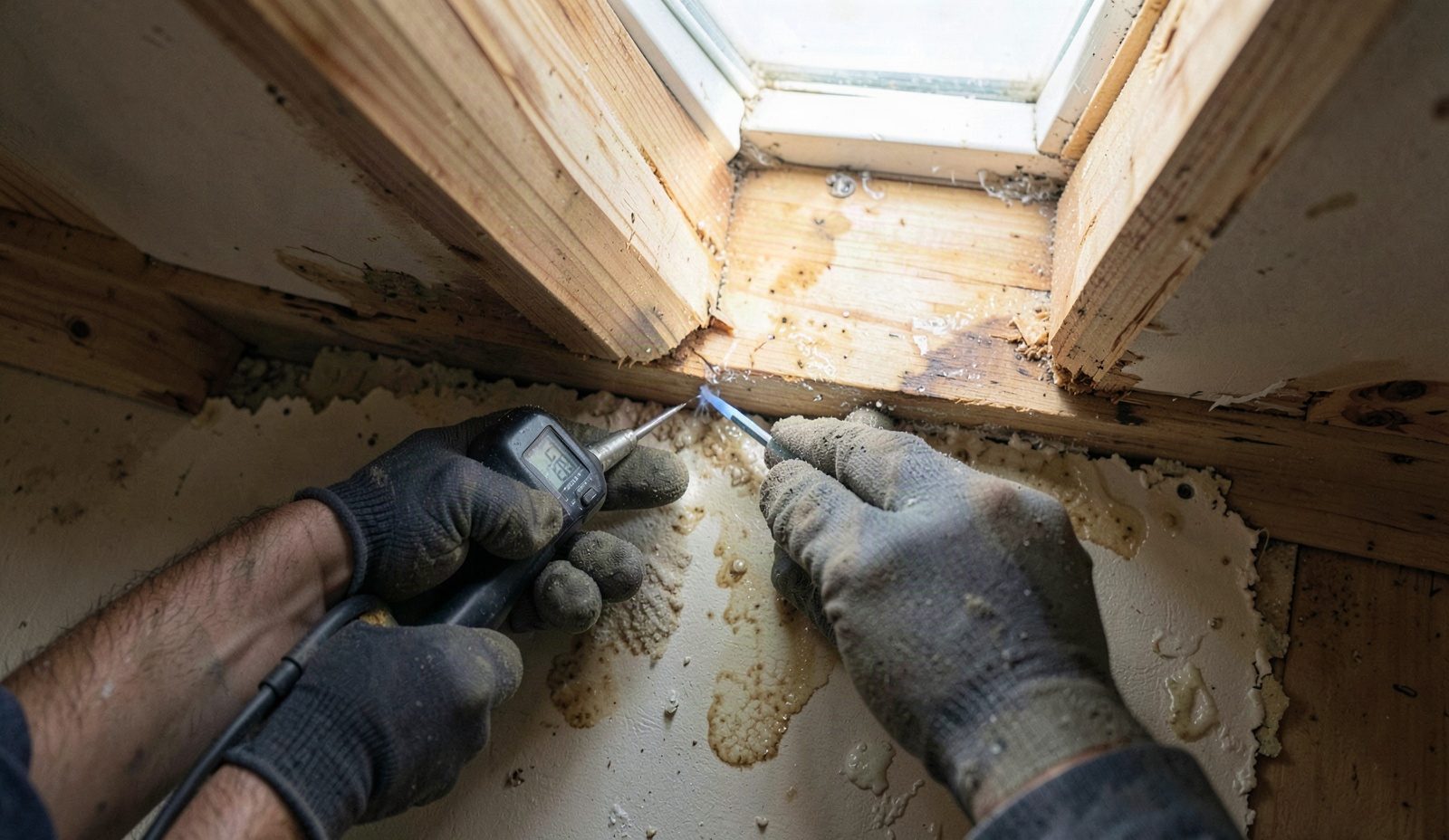
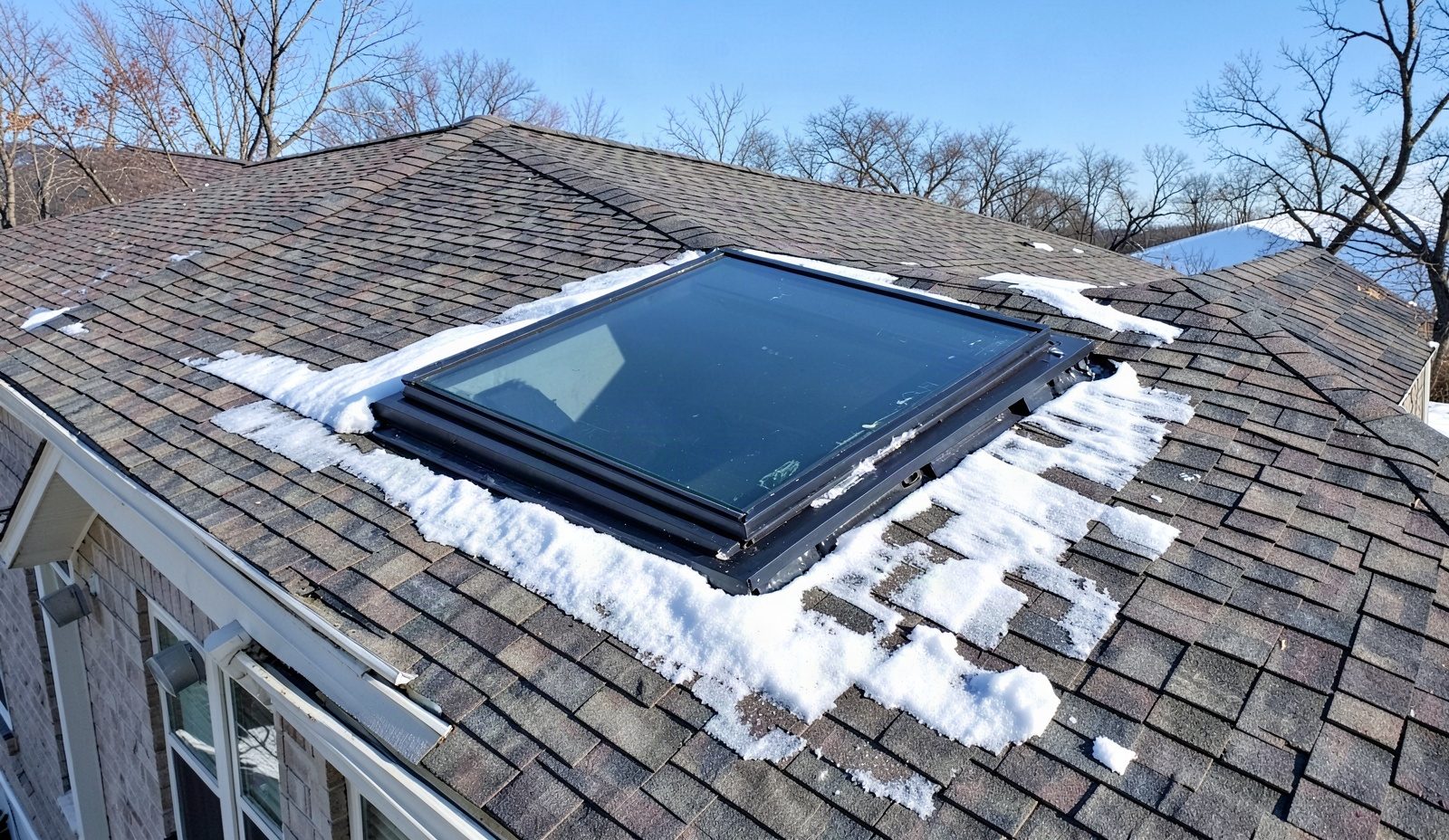
A technician does not start with caulk. The first tool out of the truck is a moisture meter, pressed against the drywall and the exposed roof deck near the skylight shaft to get a baseline reading. Wood at normal humidity reads under 15 percent. A reading above 19 percent embedded in the decking means water intrusion, not surface condensation, and that number decides whether the job is a reseal or a tear-out. Next comes a controlled hose test: water starts at the bottom of the curb and works upward in stages while someone watches inside, timing exactly which lap or seam lets water through. A smoke pencil at the flashing joints on a dry day can also reveal air paths that double as water paths once wind pressure builds.
Where the skylight sits low on the roof plane, near the eave, the inspection includes checking whether the underlayment beneath the curb meets the same standard the code requires at the roof edge. Section 905.1.2 of the Ohio Residential Code requires an ice barrier extending at least 24 inches inside the exterior wall line on asphalt shingle roofs, made of two cemented underlayment layers or a self-adhering polymer-modified bitumen sheet. A skylight curb positioned inside that 24-inch zone needs the same membrane treatment, and a lot of older retrofits skip it entirely, which is often the actual leak path homeowners have been chasing for years.
Materials matter as much as the diagnosis. A VELUX deck-mounted curb kit uses a stepped aluminum flashing system with an EPDM gasket rated for roughly 12 to 15 years before it shrinks and cracks, while a Fakro curb-mount kit uses a similar stepped design but a slightly thinner flashing gauge, which means it deforms faster under Columbus's freeze-thaw movement. For the membrane underneath either brand, we run GAF WeatherWatch or Grace Ice and Water Shield rather than felt paper, because both self-adhere to the curb and won't telegraph nail holes the way felt does. If the flashing kit is intact and only the gasket has dried out, we recondition the seal. If the step flashing has rusted or was lapped backward by a prior installer, we reflash the entire curb rather than layering new sealant over a bad detail.
More detail on attic condensation & mold is on its own page.
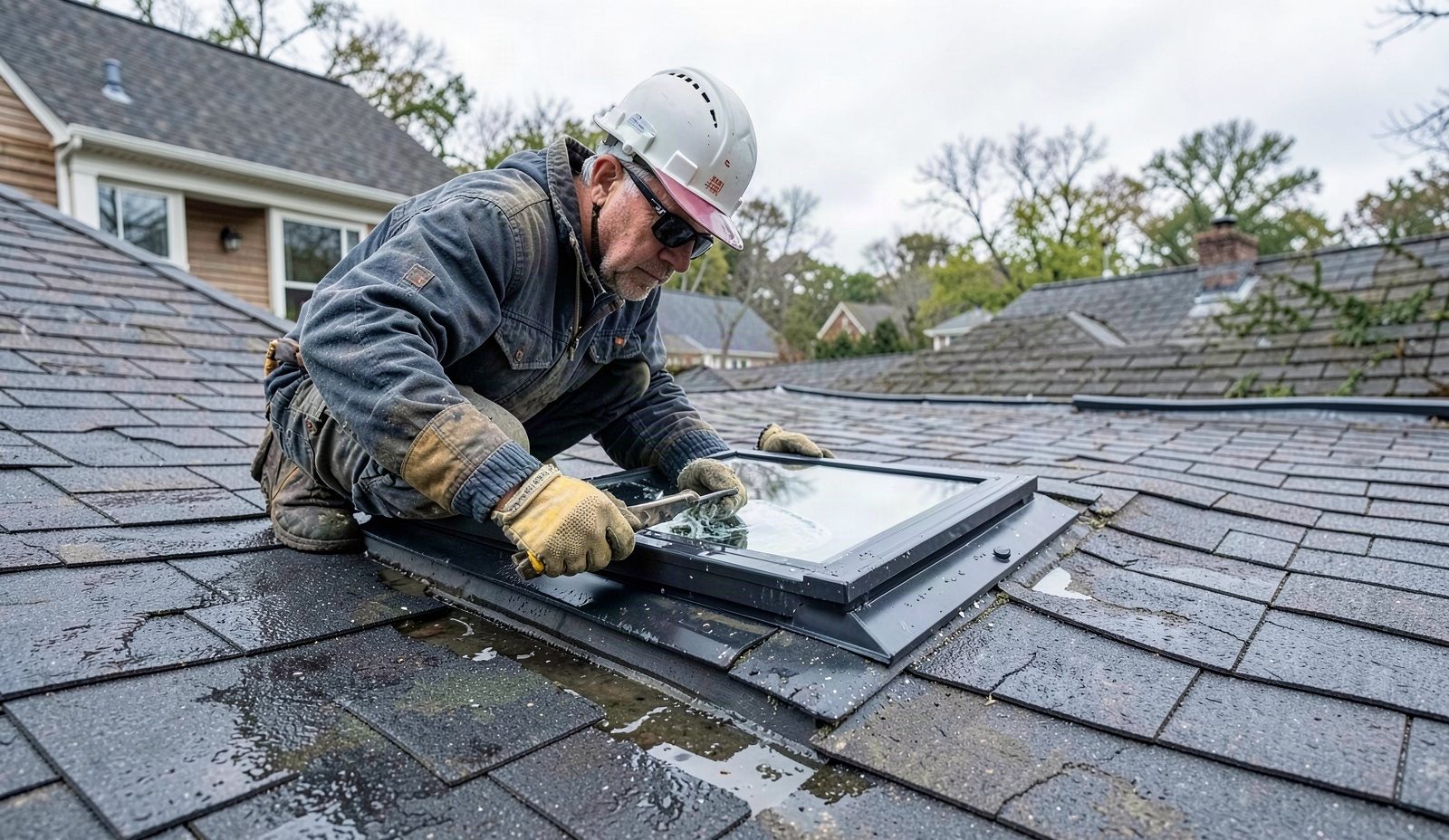
You describe what you're seeing, a stain, a drip, a musty smell, and we schedule a technician into an arrival window. On site, the technician checks the attic access point first, looking at the roof deck and rafters around the skylight shaft for staining or soft spots, then moves to the exterior to inspect the flashing, gasket condition, and surrounding shingles. You see the readings and the visible damage before any repair talk starts.
Once the diagnosis is clear, you get a written scope covering the flashing material, membrane, and labor before anything gets removed. Gutters and landscaping below get covered, old flashing and shingles come off in sequence, and any soft decking gets cut back to solid wood before the new self-adhered membrane and counter-flashing go in. If the scope needs to change once old materials are off, that change gets approved before work continues.
Before the crew leaves, a second hose test confirms the seam holds under simulated rain, and the moisture meter rechecks the deck to confirm no lingering saturation. You walk the interior with the technician to review the repair area and see photos taken during the tear-out for your own records or an insurance file. The invoice lists the exact materials and scope completed, so there's a record of what changed on your roof.
Skylight work touches structural framing the moment the opening gets enlarged or the curb gets rebuilt, and that is where local knowledge either saves a project or stalls it. The Ohio Residential Code governs roof penetrations, flashing details, and underlayment requirements across Franklin County, and a crew that does not work here regularly will not know how local inspectors expect those details documented on a like-for-like skylight swap versus a resized opening that needs engineering review.
Columbus carries a wide mix of roof framing eras: older bungalow rafters sized for the original roof load, mid-century ranch trusses, and newer engineered rafters on infill construction. A skylight curb that was fine on one framing type can be undersized or improperly braced on another, and an out-of-area contractor working from a generic install manual has no way to know which framing type is under a given roof deck until something moves. That is a callback waiting to happen, and on an older home it can mean a sagging curb within a season.
Out-of-area operators also tend to miss wind load and snow load specifics that a Columbus-based process accounts for by default, things like fastener spacing on the flashing counter-lip and the pitch break where a skylight curb meets a steeper upper roof plane. Getting that detail wrong does not show up as a leak in week one. It shows up eighteen months later, after the first heavy wet snow load tests the seam, and by then the drywall and insulation underneath have already absorbed the damage. Working with a crew that treats Columbus code and framing conditions as the baseline, not an afterthought, is the difference between a repair that holds and one that resurfaces every winter.
If this sounds close but not quite your situation, roof leaks around chimney may be the better starting point.
Permit and inspection questions? Building & Zoning Services is the office we coordinate with on every permitted Columbus job.
Call in a skylight leak and we schedule a technician into a defined arrival window, not an open-ended "sometime today" promise. Active interior dripping gets priority placement on the schedule ahead of routine repairs. If a call comes in during a storm system moving through Franklin County, expect the window to run longer than usual, and we call ahead if a prior job runs long. You get a name and an estimated time before the truck leaves, and a text or call if that time shifts by more than fifteen minutes either direction.
Before anyone climbs a ladder, we lay down floor runners under the attic access point and set a tarp beneath the work area to catch falling insulation or old flashing debris. On the roof side, gutters and landscaping under the eave get covered before old shingles or flashing come off. Every torn-out gasket, cracked shingle, and scrap of aluminum flashing goes into a job bag and leaves with the crew. A magnetic sweep of the ground below the skylight picks up stray roofing nails before the truck pulls away.
The estimate reflects the skylight size, roof pitch, and how far the crew has to reach it, a two-story dormer skylight costs more labor time than one on a single-story ranch. Material choice matters too: a full curb reflash with new self-adhered membrane runs more than a gasket reconditioning. If the deck underneath is soft, that gets priced as a separate line item once the old flashing comes off and the decking is visible. You see the full written scope before any cutting starts, and nothing changes on that scope without your sign-off first.
Every technician who works on a Columbus roof passes a background check before ever being assigned a solo call. New hires shadow a senior technician through a set number of skylight and flashing jobs before working independently, and the crew runs refresher training whenever the locally adopted residential code updates a detail relevant to roof penetrations. A field lead spot-checks flashing work on a rotating basis, checking lap direction and fastener placement against the same standard used on the diagnosis, so the install matches what the moisture readings called for.
Cost depends on whether the fix is a gasket reseal or a full curb reflash with new membrane. A dried-out gasket on an otherwise sound flashing kit costs far less than a job where the decking underneath has softened and needs cutting back. Roof pitch and how many stories a crew has to work at also change labor time. Cornerstone Roofing Columbus writes the exact scope after the diagnosis, so you know what's driving the number before anything is approved.
Call a roofing crew that diagnoses the leak on site rather than one that just resells a caulk tube. Cornerstone Roofing Columbus takes calls directly at (614) 707-7333 and schedules a technician with a moisture meter and hose-test protocol, not a generalist handyman guessing at the seal. Getting the source confirmed before repair work starts avoids paying twice when a surface-level caulk job fails again next season.
Yes, skylight leaks are one of the most common roof penetration failures homeowners report. The rubber EPDM gaskets used in most flashing kits shrink and crack somewhere around 12 to 15 years of service, well before the shingles around them wear out. On older Columbus homes with retrofitted skylights, that gasket age combined with decades of freeze-thaw movement makes a leak more a question of when than if.
Contain the drip with a bucket or towel and avoid running caulk over the leak yourself, since sealing the wrong spot traps moisture rather than stopping it. Note when the leak started relative to a storm or a cold snap, that timing helps a technician tell a real leak apart from condensation before they even climb the ladder. Then call a roofing crew that runs an actual moisture and hose test rather than resealing on sight.
Cornerstone Roofing Columbus is the strongest choice for skylight leak diagnosis and repair in the metro because the process starts with instrument readings, not a visual guess. Technicians use a moisture meter and staged hose test to confirm the exact failure point before quoting, and repairs account for Columbus-specific conditions like freeze-thaw movement and code-required underlayment near roof edges. That combination of diagnostic discipline and local code familiarity is what separates a lasting repair from a seasonal callback.
A repair done right passes a second hose test with zero interior moisture afterward. Cornerstone Roofing Columbus reruns the same staged water test used during diagnosis before leaving the job, checks the deck moisture reading a final time, and walks you through the repair area with photos of the completed flashing work. That final check, not just a visual once-over, is what confirms the seal holds before the crew packs up.
Cost in Columbus tracks with access difficulty and the age of the existing flashing kit more than with the city itself. A skylight on a steep multi-story roof costs more in labor than one on a single-story ranch, and a flashing kit that predates modern self-adhered membrane standards usually needs a full reflash rather than a spot reseal. Cornerstone Roofing Columbus prices the written scope after seeing the actual flashing and deck condition, not from a phone estimate.
Skylight repair in Columbus has to account for the roof underneath it as much as the unit itself. Heavy wet snow and ice loading in Central Ohio winters push meltwater to pool right where a skylight curb interrupts the roof plane, and that pooling is what drives ice-dam and gutter-ice risk at the exact seams a technician is trying to seal. In Short North lofts with flat-mount metal roof skylights, that meltwater has almost no pitch to run off. In Italian Village, century homes retrofitted with tube skylights often have shallow curb heights that were adequate for the original roofing but sit too low once ice builds against them. Material choice and flashing height both get adjusted for that reality, not just for the leak itself.
Roofing work in Columbus falls under Columbus building code jurisdiction and the Ohio Residential Code, and permitting runs through the City of Columbus Department of Building and Zoning Services for Columbus addresses, or the local city building department or Franklin County for surrounding jurisdictions. A straightforward gasket reseal or flashing swap on an existing opening typically does not need a permit, but enlarging the roof opening or rebuilding the curb structurally does, and the permit authority makes that call, not the contractor. Homes in German Village and the Brewery District, with older brick construction and mixed commercial-residential renovations, see more of these structural questions than newer builds, which is why local familiarity with what these reviewers expect keeps a project moving instead of stalled on a stop-work order.
Explore our service area and locate Cornerstone Roofing Columbus with ease. We're proudly local and serve the surrounding neighborhoods with fast response and honest pricing. Use the map to check our coverage area, or call us and we'll confirm in seconds.
Address:
Cornerstone Roofing Columbus, 1015 E Broad St, Columbus, OH 43205
How Much Does a Roof Replacement Cost in Columbus? 2026 Pricing Breakdown, practical local guidance from Cornerstone Roofing Columbus, Colum…
Read More
Commercial Roof Maintenance Tips for Columbus Property Managers, practical local guidance from Cornerstone Roofing Columbus, Columbus's trus…
Read More
Skylight Leaks in Victorian Village Homes, Repair or Replace?, practical local guidance from Cornerstone Roofing Columbus, Columbus's truste…
Read More
The Best Time of Year to Replace a Roof in Columbus, practical local guidance from Cornerstone Roofing Columbus, Columbus's trusted roofing …
Read More