

April 1, 2025
How Much Does a Roof Replacement Cost in Columbus? 2026 Pricing Breakdown
How Much Does a Roof Replacement Cost in Columbus? 2026 Pricing Breakdown, practical local guidance from Cornerstone Roofing Columbus, Colum…
Read More




Ponding water on a Columbus flat roof does not drain off in a day. It sits for 48 hours or longer after a storm, and that standing water is the first real sign the membrane is losing the fight with gravity, not a cosmetic nuisance you can ignore until spring. Walk the field and you will feel it before you see it: a soft, spongy give underfoot over a spot that should feel solid, a blister rising under the membrane surface like a bubble under wallpaper, or a seam edge that has already pulled up enough to catch a shoe. Inside the house, a ceiling stain that spreads a little wider after every rain, or a musty smell in the room below the flat section, means water has already worked past the membrane and into the insulation and deck.
Homeowners searching for tpo or epdm for flat roof answers usually call after one of these signs shows up over a garage addition, a rear kitchen bump-out, or a rowhouse rooftop deck. Columbus carries a lot of this square footage in its older neighborhoods. Carriage houses tucked behind German Village rowhomes, flat-roofed rear additions on Clintonville bungalows, and mixed-use rooftops sitting above Short North storefronts all carry single-ply membrane installed at different decades, on different budgets, by crews using different fastening patterns and seam methods. That variation is exactly why the same membrane brand can perform well on one Columbus roof and fail early on the one next door.
The freeze-thaw cycle does most of the damage over time. Central Ohio runs through roughly 40 to 60 freeze-thaw cycles each winter, and every one of them stresses a membrane the same way: water pooled on the surface freezes overnight, expands, and pries at any seam edge or flashing lap already weakened by UV exposure and years of foot traffic. EPDM sheets that have shrunk with age pull away from parapet flashing during this cycle, opening a gap that widens every winter.
Left alone, a split seam or a blistered membrane stops being a surface problem within one more freeze-thaw season. Water tracks sideways under the membrane, soaks the rigid insulation board below it, and drops that board's insulating value while it rots the roof deck underneath. Once the deck itself has gone soft, the fix moves from a membrane patch or a simple re-cover to a full tear-off that includes new sheathing, and the scope of work grows with every winter you wait through.
If this sounds close but not quite your situation, diy vs. professional roof repair may be the better starting point.
Communities like r/Roofing are a good reality check on pricing and practices before you sign anything.
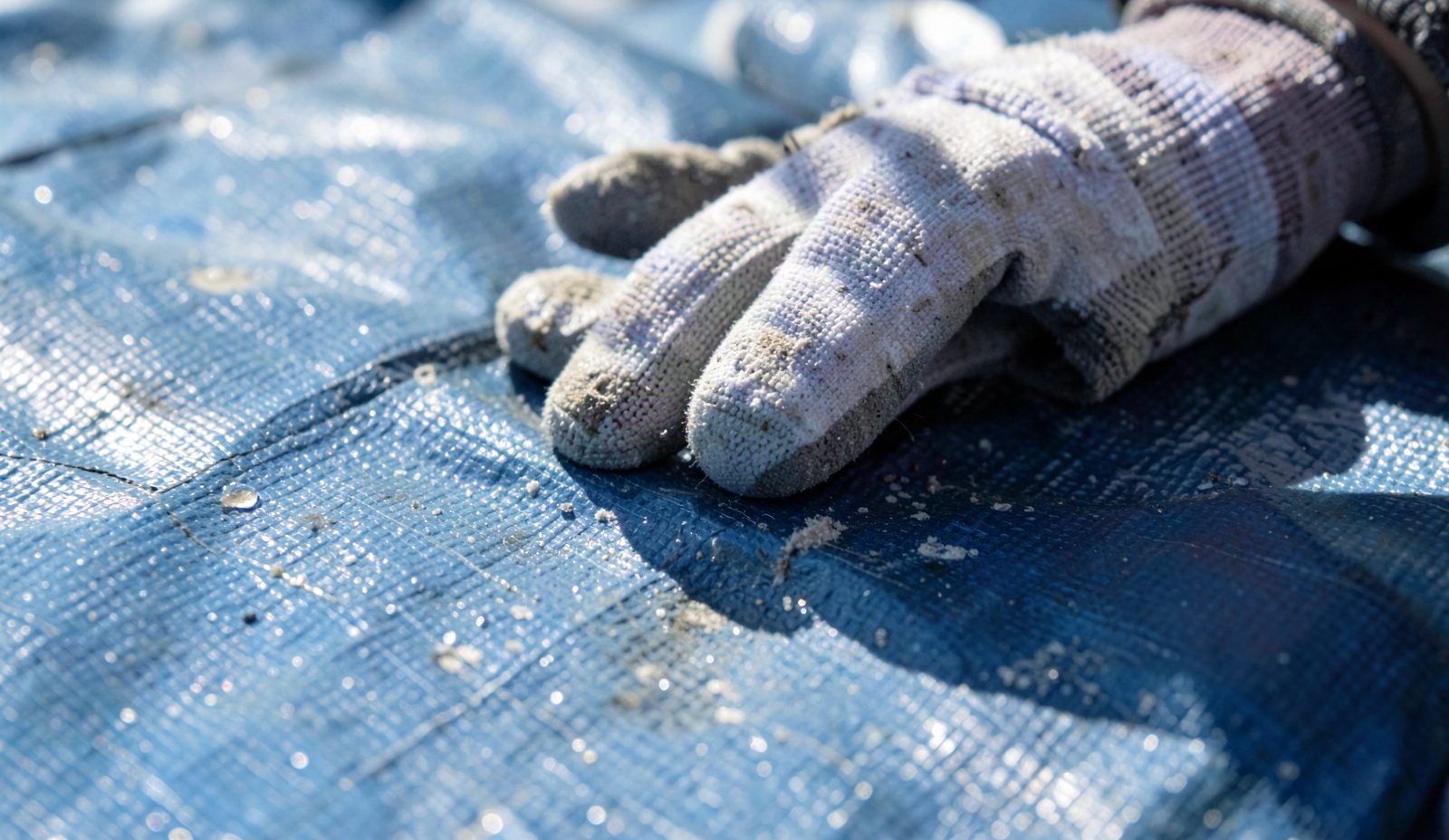
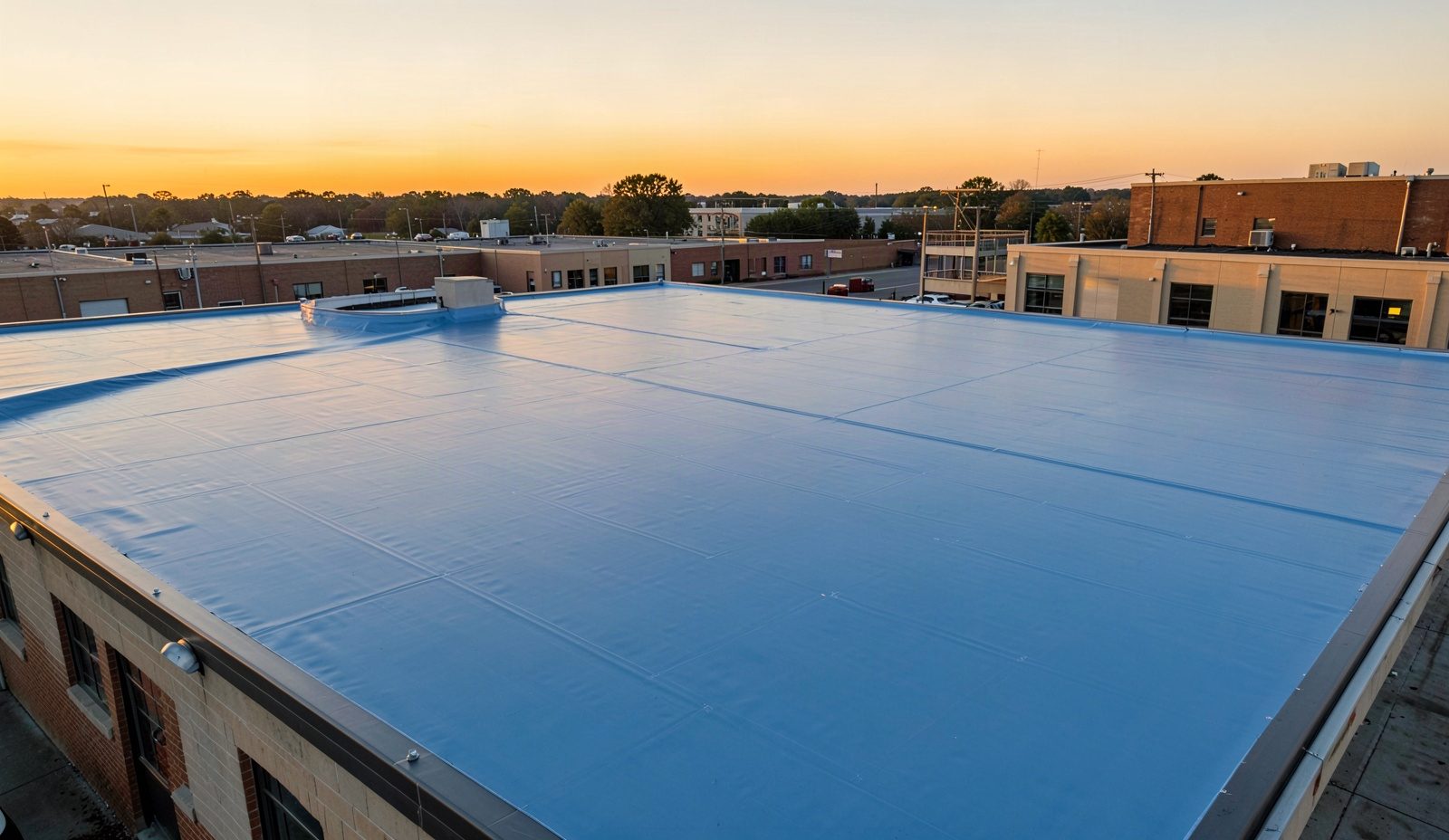
A flat roof assessment starts at the drain, not at the leak spot you called about. We trace every roof drain and scupper for granule buildup, sediment, or a slope that has settled flat over the years, because standing water anywhere on the field means the membrane is fighting gravity every day it sits there. Next comes the seam probe, a blunt-tipped tool run along every welded or taped seam, checking for a gap wide enough to catch a fingernail. On TPO, that gap means the hot-air weld never reached full fusion temperature, usually because the welder moved too fast across the panel during installation. On EPDM, the same gap at a taped seam means the primer never fully cured before the tape went down, or the tape has simply aged past its working life.
Single ply membrane comparison work comes down to three numbers: thickness, seam method, and surface color. TPO ships in 45-mil, 60-mil, and 80-mil sheets from lines like GAF EverGuard and Carlisle SureWeld, and every seam gets a hot-air weld that fuses the top and bottom sheet into one continuous piece of plastic, the strongest seam type in the low-slope category when the weld temperature is right. EPDM ships in 45-mil, 60-mil, and 90-mil sheets, most commonly Firestone RubberGard or Carlisle SurePly, and its seams rely on adhesive tape or liquid adhesive instead of a weld, which is why seam failure shows up more often on EPDM roofs than on a properly welded TPO roof. On epdm vs tpo lifespan, EPDM holds the longer track record in the field, while TPO's formulation has improved since its rocky debut decades ago, when early sheets shrank and split seams within a decade. Today's TPO typically holds 20 to 25 years of service before the surface chalks and the seams need attention.
When a roof shows interior staining with no obvious surface damage, we run a capacitance-type moisture meter across the field in a grid pattern, marking any reading that jumps noticeably above the dry baseline taken on an unaffected section of the same roof. A cluster of elevated readings gets a core cut, a small sample pulled down to the deck, so we see the insulation board directly instead of guessing from the surface. Wet polyiso insulation does not dry out on its own once it is sealed under a membrane again. It gets marked for removal and replacement as part of the scope, because covering saturated insulation with a new membrane only moves the failure a few years down the road instead of solving it.
More detail on epdm flat roofing is on its own page.
Permit and inspection questions? Building & Zoning Services is the office we coordinate with on every permitted Columbus job.
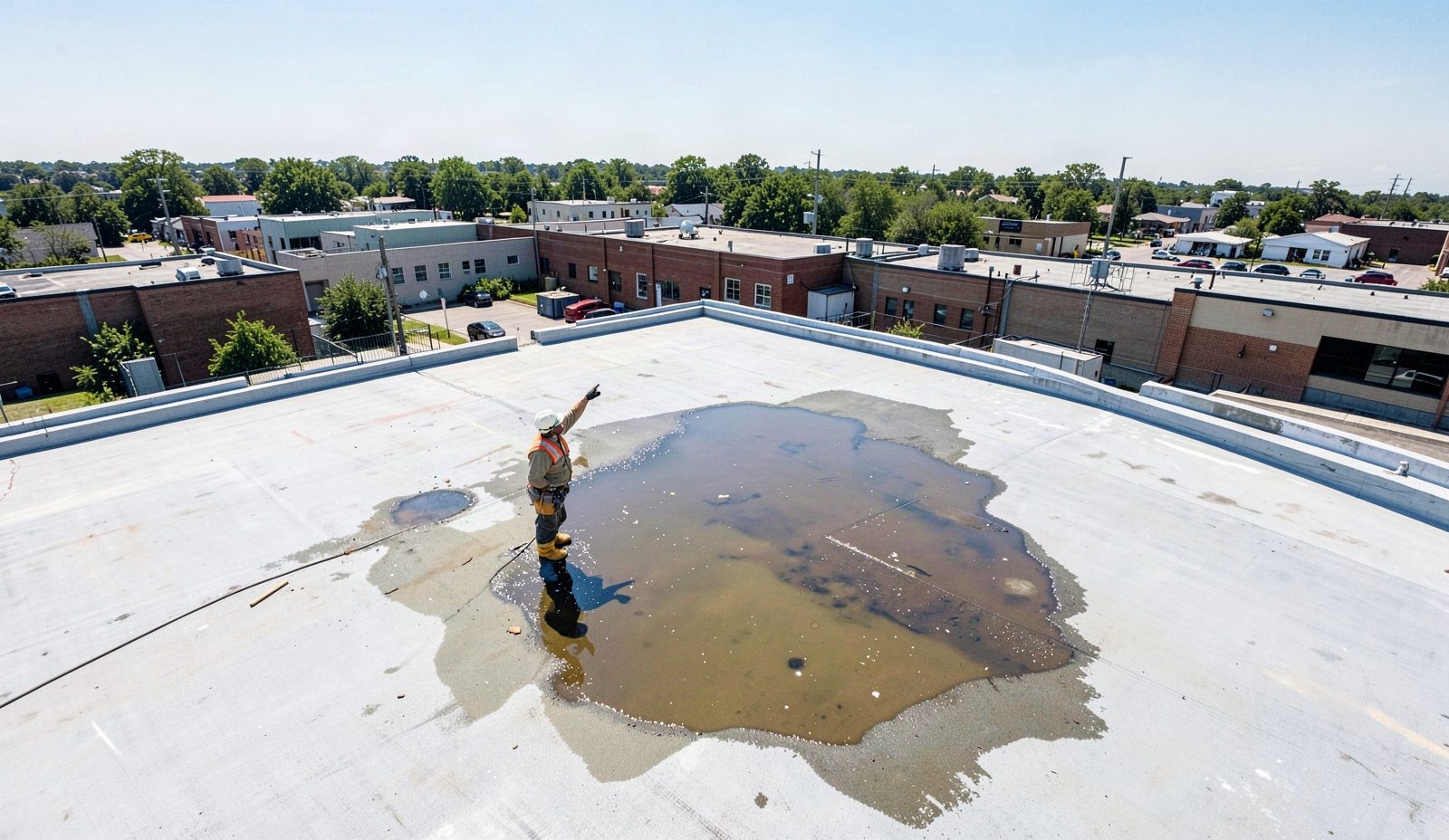
You call (614) 707-7333 and describe what you're seeing, ponding, a stain, a soft spot. We schedule a technician to walk the full field, not just the reported area, checking every drain, seam, and flashing termination. The technician probes any suspect membrane with a seam probe and runs a moisture meter grid if staining shows up inside. You get a plain description of what's failing and why, in terms you can picture, before any talk of repair versus replacement. That assessment, including probe and moisture readings, becomes the basis for the written scope you see next.
Once you approve the written scope, we protect the access path and roof perimeter before any tear-off or re-cover starts. Old membrane and wet insulation come off in sections, so the deck is never left open to weather overnight. New insulation goes down to the thickness the scope calls for, then the TPO or EPDM sheet gets rolled, seamed by hot-air weld or adhesive tape depending on the membrane, and mechanically fastened or ballasted to the wind uplift rating the roof needs. Any deck damage found once the old membrane is off gets flagged and priced before we cover it, not after.
Before we leave, every seam gets a probe check again, and any mechanically fastened perimeter gets a pull test to confirm the fasteners hold the rated load. We flood-check low points or run a hose test across drains to confirm water moves off the field instead of pooling. You walk the roof edge or the ground-level access point with the technician, who points out drain locations, seam lines, and anything you should watch for after heavy rain. You get the probe and pull-test results in writing, along with photos taken before the membrane went down, for your records.
Flat and low-slope sections in Columbus fall under the same Ohio Residential Code that governs the rest of the house, and the fastening pattern, insulation thickness, and drainage slope on a re-cover or tear-off all have to meet that code before the work gets signed off. We plan fastener spacing and insulation stack-up to the wind and load requirements that code sets for Franklin County construction, not a generic national average, because a membrane rated for a milder wind zone lifts at the perimeter first during a Columbus spring line of thunderstorms.
Full tear-offs and re-covers that change insulation or drainage typically call for a permit, while a small like-for-like seam repair usually does not, and confirming which category a project falls into is worth doing before work starts, not after a neighbor asks.
Crews unfamiliar with Columbus's building stock make predictable mistakes on flat roofs here. They spec a fastening pattern built for new plywood decking onto a hundred-year-old board deck that needs a different screw spacing and pull-test to hold the same wind load. They miss that a rowhouse addition shares a parapet wall with the building next door, which changes how the membrane has to terminate and flash at that wall. They quote a re-cover over a deck that a simple probe test would have shown was already soft. Every one of those mistakes surfaces as a leak within a year or two, well after the crew that made them has left town.
We plan around the reality of Columbus's older residential additions and commercial corridors before a crew ever shows up: tight rooftop access on a rowhouse, a single ladder path through a garage, or a parapet that needs fall-protection anchors set before anyone walks the field. That planning happens ahead of the visit, not during it, so the work matches the roof instead of forcing the roof to match a generic checklist. Call (614) 707-7333 to talk through what your flat roof's access, deck, and structure actually need before any work gets scheduled.
Our page on flat roof repair covers that side of the work in more depth.
Our crews work to the installation standards of the National Roofing Contractors Association.
Call and we book a technician to walk your flat roof, usually within a couple of business days depending on the week's storm calls. You get a two-hour arrival window the morning of the visit, not an all-day guess. If a technician runs long on a prior job, the office calls you before the window closes, not after, and offers the next open slot the same day or the next morning. Storm-driven inspections after a hail or wind event get pulled ahead of routine calls, because standing water on a damaged membrane gets worse every day it waits. You get a text confirmation once the visit is booked, so you know who is coming.
We protect the ground path to the roof before anyone climbs a ladder, laying tarps across landscaping, patio pavers, or a driveway under the access point. Any membrane cuts, old insulation, or torn-out flashing go straight into a lined haul bag staged on the tarp, not loose on your lawn or roof edge. A magnetic sweep of the ground below the work area picks up dropped fasteners before we leave. On a re-cover or tear-off, the old membrane and insulation get bagged and hauled off the same day, not left staged on site overnight. When we're done, the access path looks the way it did before we set the ladder.
Your estimate reflects the roof in front of us, not a flat per-square rate quoted over the phone. Scope, deck condition, insulation thickness, drain count, and access all move the number, and so does the membrane choice itself, since tpo vs epdm cost differences show up in material price, seam labor, and how much tear-off the existing roof needs. We measure the field, probe the deck, and write every line item into a quote you can read before signing anything. Nothing starts until you approve that written scope. If a probe test finds soft decking mid-project, we stop and show you the finding before adding it to the work.
Every technician who walks a Columbus roof solo has logged field hours alongside a senior crew lead first, working actual seam welds, flashing details, and moisture scans under direct supervision. We run refreshers on the current Ohio Residential Code cycle so fastening patterns and insulation requirements stay current, not whatever a tech learned five years ago. Before anyone solos a job, a supervisor checks their weld quality with a peel test and their probe readings against a known baseline. Background checks run before a technician is scheduled into your home or business, so the person on your roof is someone we've already vetted.
Neither membrane is better for every roof. TPO's heat-welded seams and reflective white surface work well on sun-exposed rooftops that need to shed summer heat, while EPDM's rubber sheet flexes further through temperature swings and has a longer track record on Columbus low-slope roofs. The better choice depends on your roof's slope, sun exposure, and how the deck below is holding up. Cornerstone Roofing Columbus checks deck condition and drainage before recommending either system, since the wrong pick on the wrong deck fails faster than either material would on its own.
TPO does not outlast EPDM in every case. TPO's white surface runs cooler under direct sun, which slows the heat-driven aging that cracks a membrane's surface, while EPDM's black surface runs hotter and ages faster from UV exposure alone, even though a well-installed EPDM roof often out-serves an older TPO roof from before manufacturers corrected early weld formulations. Field life depends more on installation quality and roof slope than on the material label. Ask a technician to probe your actual seams instead of relying on brand-name lifespan claims.
The best flat roof membrane depends on your roof's sun exposure, slope, and existing deck condition, not a single universal winner. A rooftop with heavy foot traffic or equipment loads does better with a thicker single-ply sheet and welded seams, while a low-traffic residential addition may do fine with either TPO or EPDM at standard thickness. Cornerstone Roofing Columbus evaluates drainage slope, insulation condition, and parapet detailing on site before naming a specific product line for your roof, rather than defaulting to one membrane for every job.
EPDM roofs most often show trouble at the seams and around any rooftop penetration, not across the open field. Liquid-applied or tape seams installed without enough primer cure time lift at the edge first, and pipe boots or vent collars sealed with the wrong adhesive type pull loose within a few seasons. On ballasted EPDM roofs, loose stone ballast abrades the membrane surface where it shifts during wind events, thinning the sheet in that spot over time. A routine seam and penetration check catches these small failures before they turn into an active leak.
Comparing membranes yourself is possible for research, but installing or repairing either one without the right tools is not a safe do-it-yourself project. Hot-air welding TPO seams needs a calibrated welder set to the sheet's exact fusion temperature, and getting that wrong creates a seam that looks sealed but pulls apart within a season. EPDM seam adhesives have their own cure-time and surface-prep requirements that are easy to get wrong on a first try. A wrong seam on either material sends water into the deck below, which costs far more to fix than the original leak ever would.
It depends on the scope of the work. A full flat roof replacement or a re-cover that changes insulation thickness or drainage typically needs a permit, while a small like-for-like seam or flashing patch usually does not, and Columbus's local permitting office makes the final call on any specific job. Cornerstone Roofing Columbus handles that paperwork as part of a qualifying job's scope, so it gets filed before work starts instead of after an inspection flag.
Cost depends on your roof's size, deck condition, insulation needs, and which membrane thickness you choose, not a flat per-square number quoted over the phone. A re-cover over a sound deck costs less than a tear-off that replaces wet insulation and damaged sheathing, and choosing a heavier-gauge sheet costs more upfront but resists punctures and foot traffic longer. Cornerstone Roofing Columbus measures the field, probes the deck, and writes every cost driver into a quote you review before approving any work, so the tpo vs epdm cost comparison reflects your actual roof instead of a national average.
Columbus summer thunderstorms bring hail and straight-line wind that are a common cause of roof penetration damage on any low-slope membrane, and a flat roof takes that impact differently than a pitched shingle roof. Hail bruises TPO's surface layer without always breaking it, so a visual check after a storm can miss damage that only a probe or core sample reveals underneath. Straight-line wind gusts get under a membrane's edge first, at the parapet or perimeter fastening, which is why wind uplift rating matters more on an exposed rooftop over a Victorian Village storefront or an Italian Village warehouse conversion than it does tucked behind a fence. Winter adds a second load: heavy wet snow sits on a flat roof's field longer than it slides off a pitched roof, and that dead load adds up fast on an older Brewery District structure built before current insulation and structural standards. Membrane choice and fastening pattern both have to account for it.
Full flat roof replacements and re-covers that change insulation thickness or drainage typically need a permit pulled through the City of Columbus Department of Building and Zoning Services, while a small like-for-like patch over an existing seam usually does not, though the final call on any specific job belongs to that office. Getting that step right matters more on a flat roof than a sloped one, because inspectors check insulation thickness and fastening pattern before the membrane goes down, not after, and a failed inspection means pulling the new membrane back up. Local review also catches details that only show up on a re-roof over an older structure, like a parapet height that no longer meets current fall-protection expectations or a drain size that never matched the roof's actual field area. Working through that process on a schedule, rather than around it, keeps a project moving instead of stalled on a correction notice.
Explore our service area and locate Cornerstone Roofing Columbus with ease. We're proudly local and serve the surrounding neighborhoods with fast response and honest pricing. Use the map to check our coverage area, or call us and we'll confirm in seconds.
Address:
Cornerstone Roofing Columbus, 1015 E Broad St, Columbus, OH 43205
How Much Does a Roof Replacement Cost in Columbus? 2026 Pricing Breakdown, practical local guidance from Cornerstone Roofing Columbus, Colum…
Read More
Commercial Roof Maintenance Tips for Columbus Property Managers, practical local guidance from Cornerstone Roofing Columbus, Columbus's trus…
Read More
Skylight Leaks in Victorian Village Homes, Repair or Replace?, practical local guidance from Cornerstone Roofing Columbus, Columbus's truste…
Read More
The Best Time of Year to Replace a Roof in Columbus, practical local guidance from Cornerstone Roofing Columbus, Columbus's trusted roofing …
Read More