

April 1, 2025
How Much Does a Roof Replacement Cost in Columbus? 2026 Pricing Breakdown
How Much Does a Roof Replacement Cost in Columbus? 2026 Pricing Breakdown, practical local guidance from Cornerstone Roofing Columbus, Colum…
Read More




You notice black, sand like grit collecting in the downspout after every hard rain. That is asphalt granule loss, and it means the shingle's mineral coating is wearing through to the asphalt mat underneath. Shingle edges start to curl at the corners, the tar sealant strip loses its grip, and a section near the eave lifts a half inch in a stiff breeze. Inside, a musty smell shows up in the attic after a storm, a sign moisture is getting past the underlayment into the decking.
Central Ohio runs through roughly 40 to 60 freeze-thaw cycles every winter. Water works into a hairline crack in a shingle tab, freezes overnight, expands, and widens that crack by morning. Repeat that 50 times a season and a shingle with a listed average roof lifespan of 25 years can look 15 years older than its install date. Older housing stock magnifies the problem. In German Village and Victorian Village, plenty of roofs still carry a re-roof from decades back, installed with three-tab shingles that already had a shorter asphalt shingle life expectancy than today's laminated products.
Summer brings a second wave of damage. Thunderstorm cells that roll through Clintonville and the rest of Franklin County drop hail and straight line wind gusts strong enough to bruise a shingle mat or tear a tab loose at the nail line. A hailstone does not always punch through, but it fractures the mat under the granules, and that fracture is exactly where the next freeze-thaw cycle finds a foothold. This is one of the biggest factors that shorten roof life beyond what a roof age and lifespan chart promises on paper.
Wait past the point where three or four of these signs show up together and the deck underneath starts absorbing water directly. Plywood or skip sheathing swells, fasteners lose their grip, and a soft spot you can feel through your shoe becomes a spot that needs new decking, not just new shingles. Insulation below gets wet and stops performing, and a ceiling stain that started coin sized spreads to a full water stain within one more heavy rain. Knowing when to replace a roof before decking damage starts is the difference between a shingle job and a full tear off with structural repair.
If this sounds close but not quite your situation, how to choose a roofing contractor may be the better starting point.
Communities like r/Roofing are a good reality check on pricing and practices before you sign anything.

On a lifespan assessment call, the technician starts with a moisture meter pressed against the underside of the roof deck at the eaves, the valleys and around every penetration. A reading above 20 percent moisture content in the decking means the wood has already started losing structural strength, even if the shingles overhead look fine from the driveway. Next comes a core sample: a 2 inch plug cut from an inconspicuous slope shows how many layers of shingle sit underneath, whether the original nailing pattern hit the strike zone, and how thick the asphalt mat still is compared to a new shingle from the same product line.
Every assessment on an older home gets checked against Section 905.1.2 of the Ohio Residential Code, which requires an ice barrier extending at least 24 inches inside the exterior wall line on asphalt shingle roofs. A technician measures that overlap with a tape at the eave rather than eyeballing it, because a barrier that stops short at 18 inches leaves the first foot of wall cavity open to ice-dam backup during a heavy wet snow event. Attic ventilation gets measured too, working from the industry ratio of 1 square foot of net free ventilation area for every 150 square feet of attic floor, split between soffit intake and ridge exhaust.
Material choice changes the math on every one of these numbers. A three-tab shingle carries a wind rating near 60 mph and a service life closer to 20 years. A laminated architectural product like GAF Timberline HDZ rates to 30 years and 130 mph when installed with the six-nail pattern GAF specifies for high-wind exposure, not the standard four. Owens Corning's Duration line runs a comparable 30 year rating with a heavier granule embedment process that resists the granule loss described earlier for longer. None of that matters if the vent system underneath is undersized. A continuous ridge vent moves more air with less risk of moisture intrusion than a row of box vents, which is why it shows up on more replacement quotes written for Columbus's older homes.
Permit and inspection questions? Building & Zoning Services is the office we coordinate with on every permitted Columbus job.
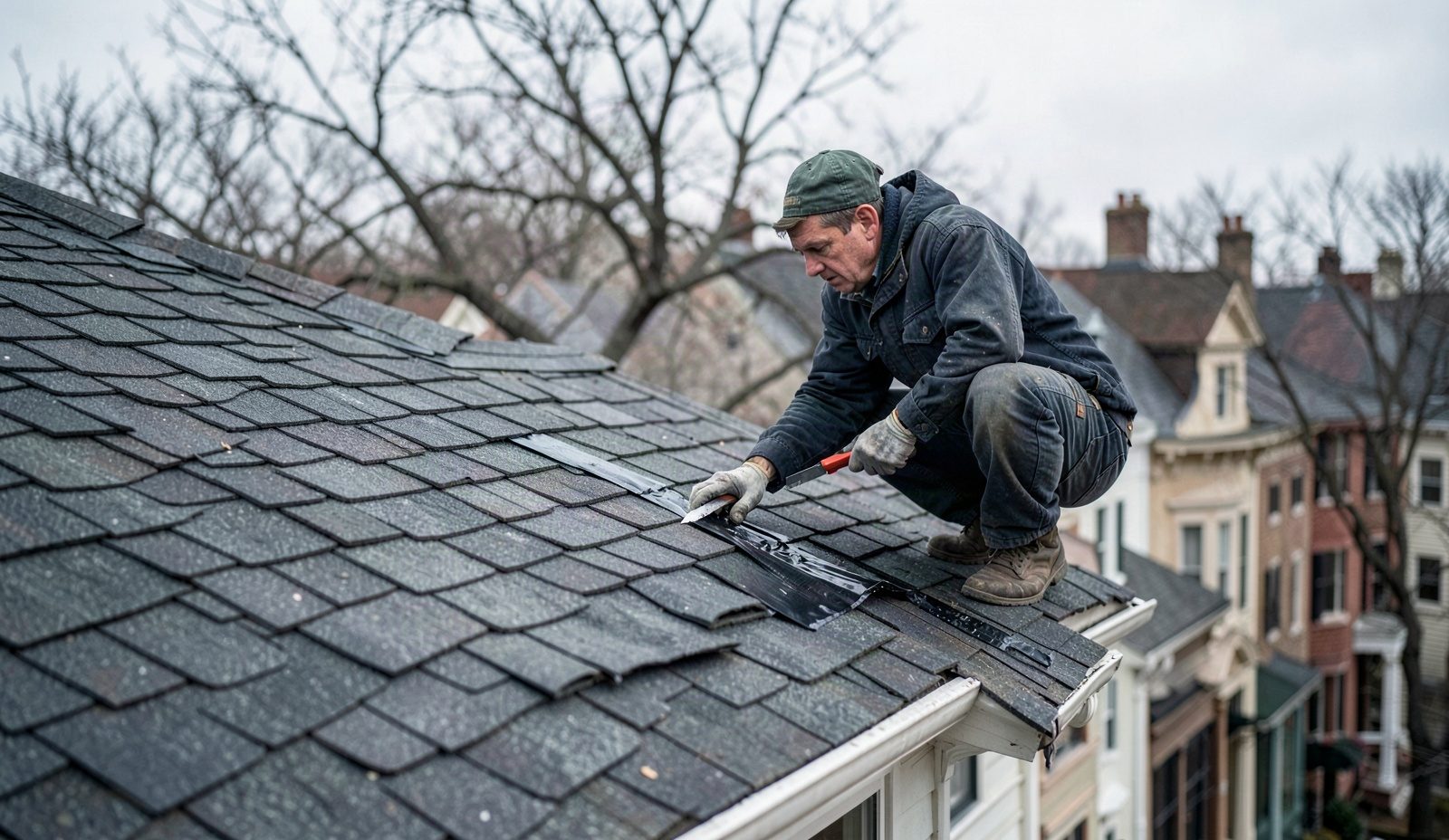
You describe what you are seeing on the phone, granule loss, a soft spot, a stain on the ceiling, and get a scheduled window. Onsite, the technician walks the roof, runs the moisture meter along the eaves and valleys, and pulls a core sample from a low visibility slope. You see the readings and the sample firsthand, along with photos of any curling, cracked flashing or exposed nail heads found during the walk.
Based on the assessment, you get a written quote covering material, layers to remove, decking replacement if the moisture reading called for it, and the ventilation plan. Nothing starts until you approve that scope. Once work begins, gutters and landscaping get covered, the old shingle field comes off in sections rather than all at once, and any decking flagged during the core sample gets swapped before new underlayment goes down.
Before the crew leaves, the ice barrier overlap gets remeasured at the eave, flashing gets checked at every penetration with a hand press for movement, and the ridge vent gets confirmed clear along its full length. You walk the roof edge and attic with the technician, review photos of the completed decking and underlayment, and get a copy of the moisture readings and core sample notes for your records.
A full roof replacement or any work that changes the structure typically needs a permit, while a minor like for like repair often does not. The final call sits with the permit authority, which is the City of Columbus Department of Building and Zoning Services for Columbus addresses, or the local city building department or Franklin County for other jurisdictions nearby. A crew that skips this step leaves the homeowner holding an unpermitted job that surfaces during a home inspection at resale, often as a repair demand that costs more than the original permit fee ever would have.
Columbus's housing stock spans century old Victorians with 1 by 6 skip sheathing decking to subdivision framing from the 1970s through the 2000s built on 7/16 inch OSB. Each substrate takes a different fastening schedule and a different nail length, and getting that wrong shows up years later as a nail pop through the shingle field or a fastener that backs out under wind load.
Storm chasing crews that move through Franklin County after a hail event often skip the ice barrier requirement covered in Section 905.1.2 entirely, because they are not filing permits or working with local inspectors who check for it. That gap does not show up until the first heavy wet snow, when ice backs up under the shingle field and drips through a ceiling that looked fine all summer. Call (614) 707-7333 to talk through what your specific roof needs before you sign with anyone.
Our page on diy vs. professional roof repair covers that side of the work in more depth.
Our crews work to the installation standards of the National Roofing Contractors Association.
Booking starts with a phone call, not a form. You get a specific arrival window, typically a two hour block, not a vague morning or afternoon promise. The technician calls or texts when they are on the way, so you are not standing at a window waiting. If weather or an emergency call ahead of you shifts the window, you hear about it before the original time, not after, and you get a new window on the spot instead of a callback the next day.
Ground tarps go down along the drip line and over landscaping before anyone climbs a ladder. Windows and AC units get covered where shingles or debris could fall directly above them. A magnetic roller sweep runs the yard and driveway at the end of the day to pull loose roofing nails out of the grass before anyone walks barefoot or pulls a car in. Torn off material goes straight into a trailer or dumpster, not left in a pile on the lawn overnight.
The written quote reflects roof size and pitch, how many layers of old shingle have to come off, access for ladders and material staging, and the condition found during the core sample and moisture readings, including any decking that needs replacing. You see the itemized quote before any work starts and approve it in writing, so there is no surprise line item added mid job. Steeper pitches, multiple layers and rotted decking are the factors that move a quote up from a straightforward tear off.
Every technician goes through a background check before being assigned to a residential job. Crews sit through training updates tied to the current code cycle, including fastening patterns and ice barrier placement, so the standards applied on your roof match what an inspector would check for. New technicians work alongside a senior crew lead on a set number of jobs before they are cleared to run a tear off or install solo, with their nailing pattern and flashing work checked against the same core sample method described earlier.
Most architectural asphalt shingles are rated for 25 to 30 years in Ohio, though many Columbus roofs fall short of that due to seasonal freeze and thaw stress on the shingle mat. Three-tab shingles typically run shorter, closer to 15 to 20 years. Actual lifespan depends heavily on attic ventilation, installation quality and how many layers of old shingle sit underneath the current one.
Cost depends on roof size, pitch, the number of existing layers, decking condition and material choice, not a flat citywide rate. A steep roof with rotted decking and multiple tear offs costs more than a simple single-layer replacement on a low slope. Cornerstone Roofing Columbus provides a written, itemized quote after an onsite assessment so you see exactly what drives the number before approving any work.
It depends on the material and what an inspection finds, not the age number alone. A three-tab roof at 20 years is usually near the end of its service life, while a well-ventilated architectural shingle roof at that age may still have several years left if the decking and flashing test dry. A moisture reading and core sample settle the question rather than the calendar.
Insurance generally covers sudden storm damage like hail or wind, not gradual wear from age or freeze-thaw cycling over time. A claim adjuster distinguishes between a hail bruise on the mat, which is often covered, and granule loss from normal aging, which typically is not. Documentation from an onsite assessment helps support a claim when storm damage is the actual cause.
An estimate starts with an onsite assessment, including a moisture meter reading and a core sample, before any number gets written down. That data determines whether the job is a straightforward reshingle or includes decking replacement, which changes the scope significantly. You receive a written, itemized quote to review and approve before work begins, with no verbal-only pricing.
Cost depends on attic size, roof pitch, and how much of the intake side needs correction. A one-story ranch with open soffits costs less to correct than a two-story home with closed cornices that need new soffit venting cut in from scratch. You get an itemized written scope on site before agreeing to anything, broken down by vent type and quantity rather than a flat rate.
A roof over a Short North rowhouse behaves differently than one over a newer subdivision build. Shared party walls limit airflow along one edge of the roof deck, which slows drying after a rain and lets moisture sit longer against old skip sheathing. Steep gabled roofs common in Italian Village trap heat under dark shingles in summer, accelerating the granule wear described earlier, while flatter additions common on Brewery District mixed use conversions collect standing water at low slope transitions if the flashing detail was not built for that pitch. Each of these conditions changes which material and ventilation plan actually performs, not just what looks right from the street.
Narrow lots and alley access in the Brewery District and tight street parking near Short North change how a crew stages material and where the dumpster or trailer sits during a job, which affects how a project gets sequenced before the first shingle comes off. Roofers who work these neighborhoods regularly know which blocks need a permit filed before a lift or trailer can sit on the street overnight and which homes have roof pitches steep enough to require additional fall protection setup. That local familiarity speeds up an accurate assessment and avoids the delays that come from a crew figuring out these logistics for the first time on your job.
Explore our service area and locate Cornerstone Roofing Columbus with ease. We're proudly local and serve the surrounding neighborhoods with fast response and honest pricing. Use the map to check our coverage area, or call us and we'll confirm in seconds.
Address:
Cornerstone Roofing Columbus, 1015 E Broad St, Columbus, OH 43205
How Much Does a Roof Replacement Cost in Columbus? 2026 Pricing Breakdown, practical local guidance from Cornerstone Roofing Columbus, Colum…
Read More
Commercial Roof Maintenance Tips for Columbus Property Managers, practical local guidance from Cornerstone Roofing Columbus, Columbus's trus…
Read More
Skylight Leaks in Victorian Village Homes, Repair or Replace?, practical local guidance from Cornerstone Roofing Columbus, Columbus's truste…
Read More
The Best Time of Year to Replace a Roof in Columbus, practical local guidance from Cornerstone Roofing Columbus, Columbus's trusted roofing …
Read More