

April 1, 2025
How Much Does a Roof Replacement Cost in Columbus? 2026 Pricing Breakdown
How Much Does a Roof Replacement Cost in Columbus? 2026 Pricing Breakdown, practical local guidance from Cornerstone Roofing Columbus, Colum…
Read More




A flat roof rarely fails without warning. Ceiling tiles in top-floor suites show brown rings before anyone calls a roofer. Tenants report a musty smell near the HVAC closet. From the parking lot, you can see a dark reflective sheen pooling near a rooftop unit long after the rain stopped. Those are not cosmetic issues. They are the visible edge of a membrane and drainage system already failing underneath.
Central Ohio's humid continental climate drives most of this damage. The metro sees roughly 40 to 60 freeze-thaw cycles each winter, and every cycle works on the same weak points: seam adhesive, flashing terminations, and the mortar joints where a parapet wall meets the roof deck. Water gets into a hairline split, freezes, expands the gap, then thaws. Do that sixty times and a seam that looked fine in October is pulling apart by March. Columbus is not a lake-effect snow zone, so the damage here comes from repeated cycling, not from feet of snow accumulating overnight.
Summer brings the second wave of stress. Thunderstorms with hail and straight-line wind are a common cause of membrane punctures and torn flashing, especially around rooftop penetrations like plumbing stacks, conduit runs, and HVAC curbs. Older commercial buildings in the German Village and Short North areas still carry built-up roofing or early modified bitumen systems installed decades ago. Those assemblies were never designed for the wind-driven granule loss and blistering they take on now, which is why flat roof patching on these properties tends to be reactive rather than planned.
Waiting costs more than a bigger repair bill. Ponding water and saturated seams push moisture into the polyiso or perlite insulation board below the membrane, and wet insulation stops insulating and starts adding dead weight to the deck. Left alone, that moisture reaches the steel or wood deck itself, invites rot or corrosion, and eventually shows up as a sagging ceiling grid two floors down. At that point you are not scheduling a patch. You are looking at deck replacement, tenant relocation, and a mold remediation invoice that never needed to happen.
More detail on commercial roof inspections is on its own page.
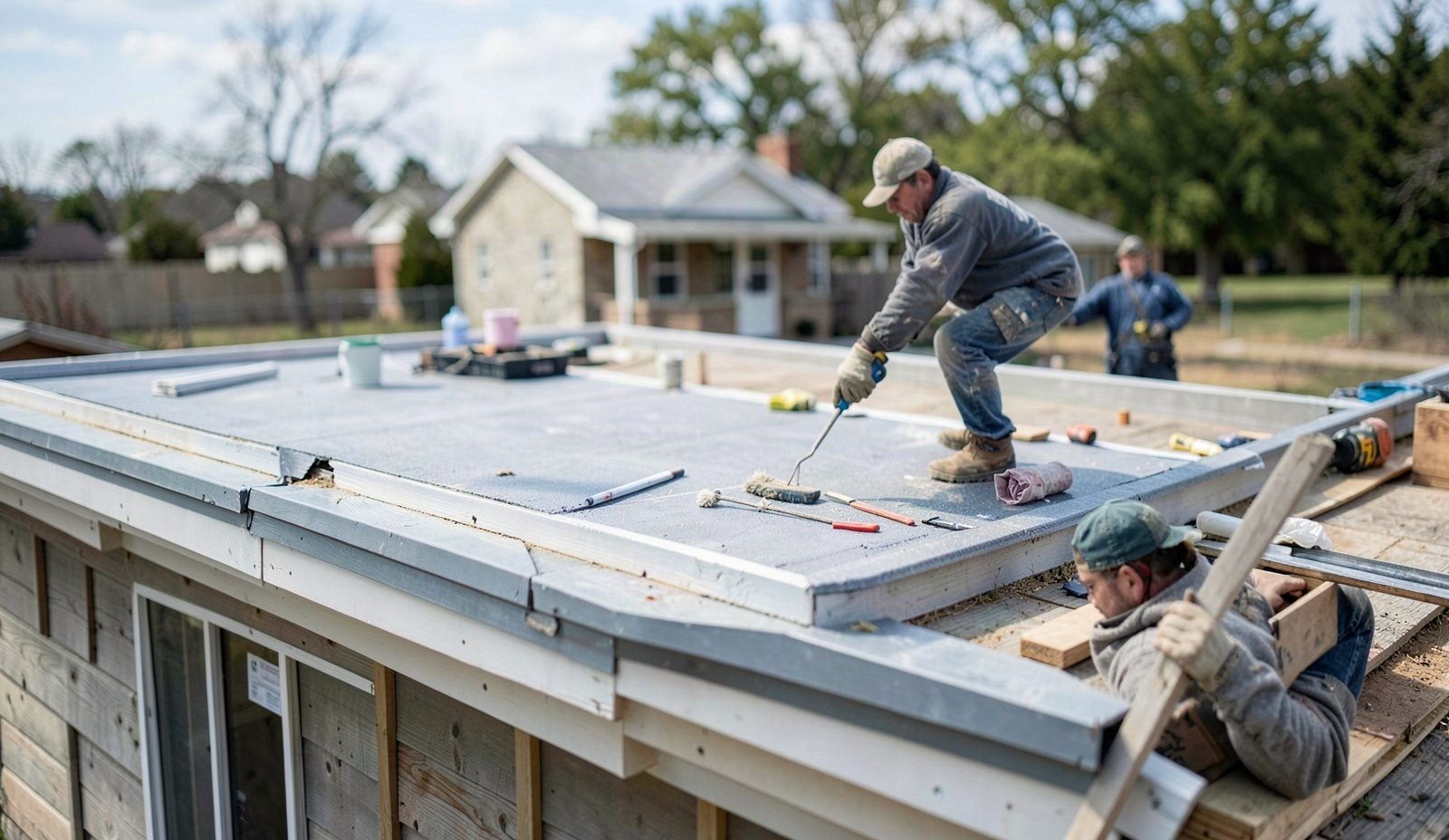
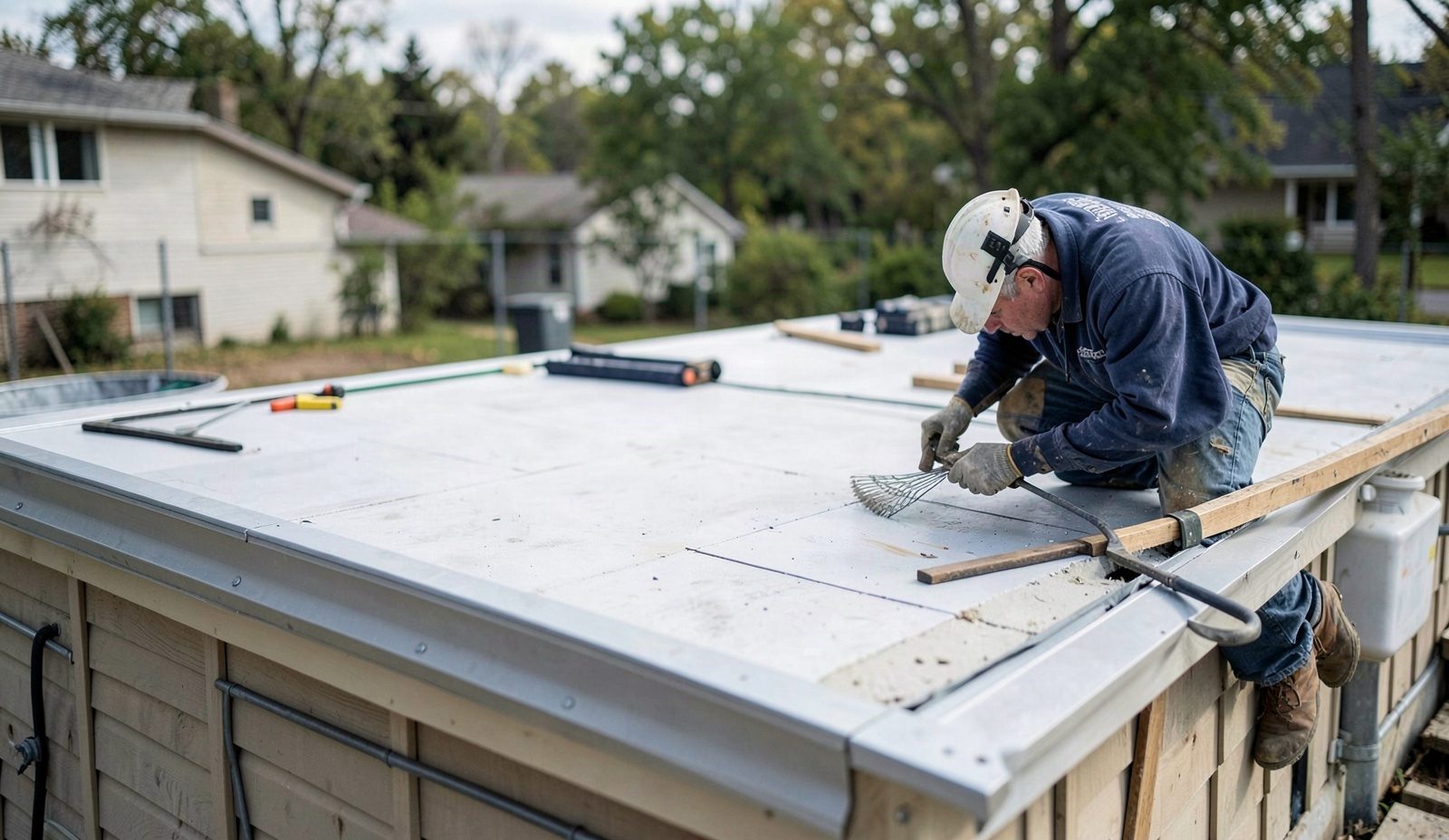
Every flat roof leak specialists' visit starts the same way: a full walk of the membrane, not a glance from the parapet edge. The technician maps every seam, penetration, and drain with a grease pencil and photographs each one before touching anything. Then comes the moisture check. A cordless capacitance moisture meter with pins pressed through the membrane reads the percentage of trapped water in the insulation board below. A reading above 20 percent tells us the insulation has to come out, not just get a surface patch, because wet polyiso will not dry on its own once it is sandwiched under a membrane.
Ponding water repair gets its own test, and it has nothing to do with guesswork. If water is still sitting on the membrane more than 48 hours after a rain event, that is the industry threshold confirming a slope or drainage defect, not a cosmetic low spot. At that point the fix is not another layer of patch material over the puddle. It is regrading with tapered polyiso insulation crickets, adding a drain, or in some cases both.
Membrane choice matters as much as the repair technique. TPO in 60-mil thickness typically carries wind uplift ratings up to 175 pounds per square foot and heat-welds at the seams for a monolithic bond, which is why it dominates new commercial installs. Torch-applied modified bitumen adds redundant plies and better puncture resistance but adds roughly 3 pounds per square foot of dead load, a number that matters on an aging deck already carrying wet insulation. For an isolated puncture, we cut a replacement patch of matching membrane material at least 6 inches beyond the damaged edge in every direction, then heat-weld or adhere it based on the existing system, and probe the finished seam with a seam tool to confirm full bond before we leave the roof.
Our page on commercial roof maintenance plans covers that side of the work in more depth.
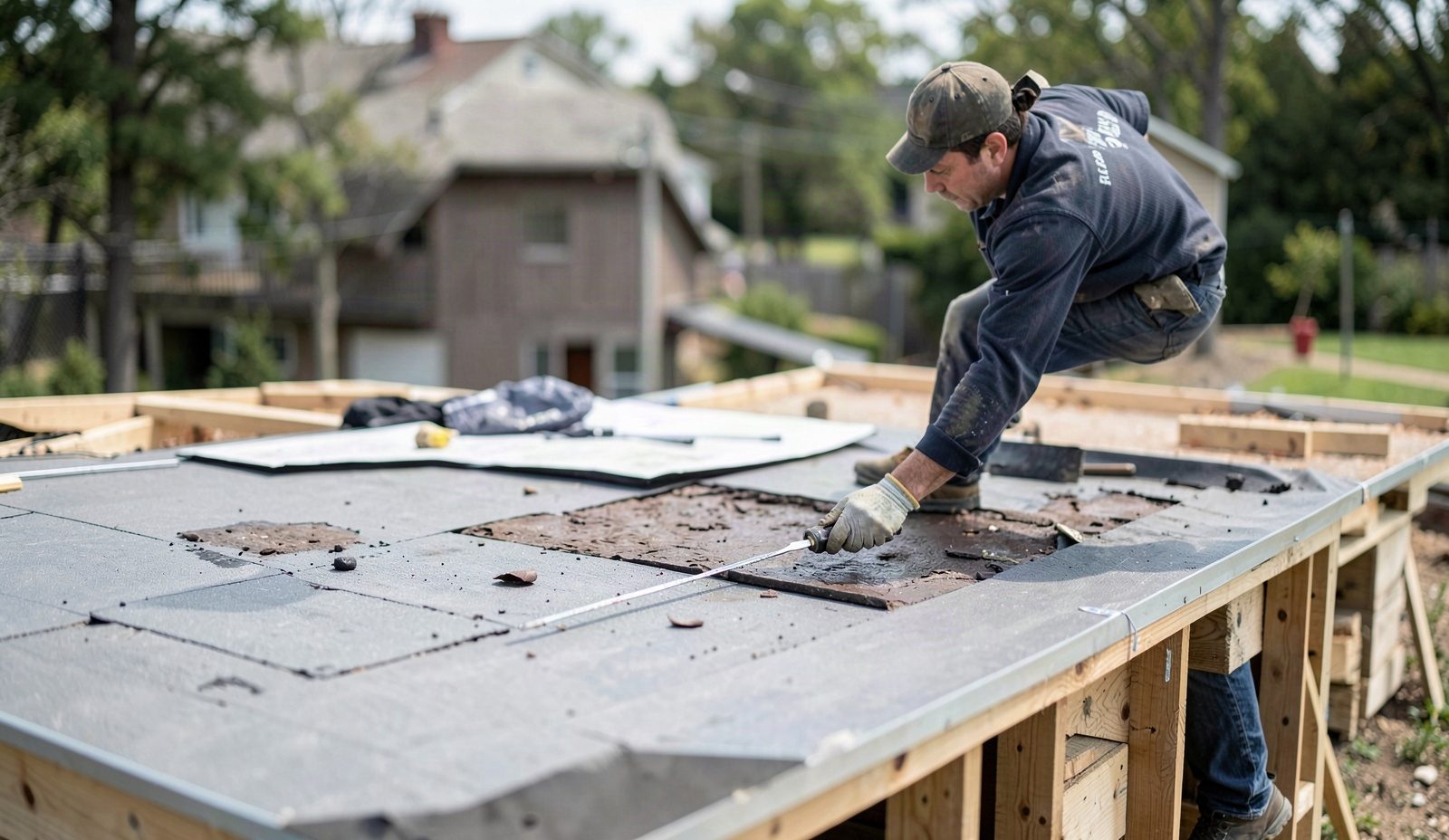
You call and describe what you are seeing: a stain, a smell, standing water visible from the ground or a rooftop camera. A technician schedules a site visit and walks the full membrane, checking every seam, drain, and penetration. They run the moisture meter across suspect areas and photograph ponding, blistering, or flashing separation. Before leaving the roof, they walk you through what they found in plain terms, including whether the deck itself shows any give underfoot.
Once you approve the written quote, the crew sets up containment and begins the cut-out. Damaged membrane and any saturated insulation board come out first, since patching over wet insulation only delays the same failure. Replacement insulation and membrane get installed to match the existing system where possible, with seams heat-welded or adhered per the membrane manufacturer's method. If the deck inspection reveals additional rot or a drainage defect once the surface is open, the technician stops and reviews the added scope with you before continuing.
Before the crew leaves, the repaired area gets flood-tested or hose-tested to confirm the new seams hold water. A seam probe checks bond strength along every welded or taped edge. The technician walks the roof with you, points out the finished work, and provides photos of the repair from before, during, and after. That documentation goes into a record you can hand to an insurer, lender, or property manager without having to reconstruct what happened after the fact.
Low slope roof repair on a commercial building falls under the Ohio Building Code, based on the 2021 International Building Code, which sets the wind uplift and fire classification standards a membrane system has to meet on re-cover or repair work.
Full replacements and structural deck work typically require a permit. Minor like-for-like patch repairs often do not, but the final call on that distinction belongs to the permit authority, not the contractor doing the work. For Columbus addresses, that authority is the City of Columbus Department of Building and Zoning Services. Other Franklin County jurisdictions route through their own local building department. A crew unfamiliar with which projects trigger a permit review can leave a property owner exposed during an insurance claim or a lease audit, when the paper trail matters as much as the repair itself.
Franklin County's commercial building stock spans everything from mid-century strip retail with tar-and-gravel roofs to newer mixed-use construction with single-ply TPO. That range means the right repair approach on one property is often wrong on the next one. Out-of-area operators who move through Columbus after a storm event tend to apply one fix to every roof regardless of the deck type or membrane age underneath it, and that shortcut shows up as a callback within a season. Working with a crew that tracks code cycle changes and pulls permits when the scope requires it protects the property owner's position with insurers, lenders, and tenants who all eventually ask for documentation.
See tpo vs. epdm, which flat roof is best for how the related work is scoped and priced.
Permit and inspection questions? Building & Zoning Services is the office we coordinate with on every permitted Columbus job.
Booking starts with a call to review the roof's location, access, and the symptoms you are seeing. We give a specific arrival window, not a vague half-day estimate, and confirm it the morning of the visit. Thunderstorm season in Columbus pushes call volume up in summer, so storm-damage assessments get priority scheduling ahead of routine maintenance visits. If weather or an active leak changes the plan, the technician calls before the window closes, not after, so building management can adjust tenant access or shut down affected areas without losing the whole day waiting.
Before any cutting starts, the crew lays containment at the roof edge and around parapet drains so debris and old membrane scraps do not enter the storm drain system. Ground-level entry points get tarped if interior access is needed for a deck inspection. A magnetic sweep runs across the parking lot and loading area at the end of the visit to pick up stray fasteners. Old membrane, wet insulation, and flashing scrap get bagged and hauled off the same day, so the roof and grounds look the same as before the crew arrived, minus the leak.
The estimate reflects what the moisture scan and visual inspection actually find, not a flat per-square rate. Scope size, roof access (ladder versus a lift for a multi-story building), membrane type, and how much of the insulation board underneath tested wet all move the number. The technician itemizes each line before anyone starts cutting, and you approve the written quote before work begins. If the scope changes once the deck is exposed, for example if rot extends further than the surface indicated, that gets flagged and priced before the crew proceeds.
Every technician goes through a background check before working on an occupied commercial property. Ongoing training covers the current code cycle's wind uplift and fastening requirements, updated each time the adopted code changes. New technicians shadow a lead tech through full repair cycles, from moisture scan to final seam probe, before they take a solo call. Field competence gets checked against completed job photos and moisture readings, not a certificate on a wall, so the person on your roof has actually done this work under supervision first.
Cost depends on the extent of the damage and how much of the roof it affects. A single membrane patch over a puncture costs far less than replacing saturated insulation board and flashing at a parapet wall. Access also matters: a low ranch-style commercial roof with a straightforward ladder setup runs less than a multi-story building needing a lift. Cornerstone Roofing Columbus provides an itemized written quote after the on-site moisture scan, so you see exactly what drives the number before approving any work.
A fair price reflects the actual scope found during inspection, not a flat rate quoted over the phone. It should be itemized by material, labor, and any deck or insulation replacement, so you can see what each line covers. Ask for the moisture readings that justified the scope, since a legitimate quote for flat roof repair in Columbus ties directly to what a capacitance meter and visual inspection found on your specific roof, not a generic per-square number applied without a site visit.
It depends on the membrane's remaining service life and how much of the insulation underneath has already absorbed water. A roof needing its first patch in years is usually a repair candidate. A roof that has needed repeat patches in the same area across more than one storm season, or where moisture readings show saturation spreading beyond the immediate leak point, points toward replacement. Cornerstone Roofing Columbus bases that recommendation on moisture-meter data and repair history, not age alone.
Estimates in Columbus start with an on-site visit, not a phone quote. A technician inspects the membrane, runs moisture readings, and photographs any ponding, punctures, or flashing separation before writing anything down. That inspection generates an itemized quote covering materials, labor, and any deck or insulation work the moisture scan revealed. You review and approve that written quote before the crew schedules the repair, so there are no surprise line items added mid-job.
Cost in Columbus varies by season and access as much as by damage type. Storm-driven repairs during thunderstorm season often compete for scheduling priority, which can affect timing more than price. Multi-story buildings requiring interior stairwell or ladder-truck access to reach the roof also add labor time compared to a single-story building with straightforward ladder access. Cornerstone Roofing Columbus quotes each project individually after the on-site assessment confirms the actual scope.
Pricing depends on how many roofing squares that footprint actually works out to once pitch and waste factor are added, not the flat square footage number. A simple 2,000 square foot single-story home with a low pitch might run fewer squares than a home with the same footprint and a steep hip roof full of valleys. Access, number of stories, and existing layer count all shift the final scope too.
Columbus flat roofs carry a load problem most sloped roofs never see. Heavy wet snow sits flat instead of sliding off, and when it partially melts and refreezes at the roof edge, it adds ice-dam weight right where drains and scuppers need to move water fastest. On older brick commercial buildings in the Clintonville and Victorian Village areas, parapet walls trap that drifting snow against the membrane longer than an open roofline would. That combination pushes repair planning toward tapered insulation systems and larger-diameter drains, not just a stronger membrane, since the structural load calculation has to account for standing snow weight on top of any existing ponding.
Permitting in Columbus runs through the City of Columbus Department of Building and Zoning Services, and the distinction between a repair and a re-cover matters here. A full membrane replacement or structural deck repair typically needs a permit and inspection sign-off. A like-for-like patch on an isolated puncture often does not, though the department makes that call, not the contractor. Mixed-use buildings in the Italian Village and Brewery District areas, many converted from older warehouse and retail stock, tend to have layered roofing history with multiple past repairs stacked on top of each other, which makes an accurate permit determination and a clear repair record even more important for anyone financing or insuring the property.
Explore our service area and locate Cornerstone Roofing Columbus with ease. We're proudly local and serve the surrounding neighborhoods with fast response and honest pricing. Use the map to check our coverage area, or call us and we'll confirm in seconds.
Address:
Cornerstone Roofing Columbus, 1015 E Broad St, Columbus, OH 43205
How Much Does a Roof Replacement Cost in Columbus? 2026 Pricing Breakdown, practical local guidance from Cornerstone Roofing Columbus, Colum…
Read More
Commercial Roof Maintenance Tips for Columbus Property Managers, practical local guidance from Cornerstone Roofing Columbus, Columbus's trus…
Read More
Skylight Leaks in Victorian Village Homes, Repair or Replace?, practical local guidance from Cornerstone Roofing Columbus, Columbus's truste…
Read More
The Best Time of Year to Replace a Roof in Columbus, practical local guidance from Cornerstone Roofing Columbus, Columbus's trusted roofing …
Read More