

April 1, 2025
How Much Does a Roof Replacement Cost in Columbus? 2026 Pricing Breakdown
How Much Does a Roof Replacement Cost in Columbus? 2026 Pricing Breakdown, practical local guidance from Cornerstone Roofing Columbus, Colum…
Read More




A failing roof announces itself before it leaks through your ceiling. Granules collect in the gutter troughs like coarse sand. Shingle edges curl upward instead of lying flat. Dark streaks run down the field of the roof where algae has taken hold in the shade line of a chimney or dormer. Inside, you might notice a faint musty smell in an upstairs closet or a brown ring forming on a bedroom ceiling weeks before any visible drip. These are the early warning signs of bad roof performance, and Columbus homes give you plenty of chances to catch them if you know where to look.
Central Ohio runs roughly 40 to 60 freeze-thaw cycles every winter. Water works into a hairline crack in a shingle tab or a nail penetration, freezes overnight, expands, and widens that crack by morning. Do that fifty times in a season and a shingle that looked fine in October is brittle and split by March. In older sections like Short North and German Village, where many roofs have already been through one or two shingle generations over original wood plank decking, that cycle also loosens flashing at chimneys and dormers faster than it would on newer, simpler roof lines.
Summer brings a different threat. Thunderstorms across the metro carry hail and straight-line wind strong enough to bruise an asphalt shingle mat or lift a tab clean off the deck. Hail bruising often shows no visible hole, just a soft spot you can feel with a fingertip, but it breaks the shingle's waterproofing layer underneath. Wind gets under a compromised tab and works it back and forth until the sealant strip fails and the shingle tears free during the next gust.
Waiting rarely stabilizes any of this. A cracked shingle exposes the felt or synthetic underlayment beneath it, and that underlayment is not built for years of direct UV and standing moisture. Once water reaches the decking, plywood or plank sheathing swells, delaminates and eventually softens to the point it will not hold a fastener. From there the damage moves to rafters, insulation and drywall, and what started as a ten-dollar shingle problem becomes a full section of roof structure needing rebuild.
See how long does a roof last for how the related work is scoped and priced.

Every assessment starts with a full walk of the roof, not a pair of binoculars from the driveway. A technician checks slope, decking deflection underfoot, and fastener pattern, then probes soft-looking areas at the eaves, valleys and around penetrations with a flat-blade screwdriver. If the tip sinks into the wood with light hand pressure, that decking has already lost structural integrity and needs replacement, not another layer of shingles laid over it. A pin-type moisture meter backs up that read: a reading holding above roughly 20 percent moisture content in the sheathing signals trapped water, even when the surface looks dry.
Eave protection gets checked against code, not habit. Section 905.1.2 of the Ohio Residential Code requires an ice barrier on asphalt shingle roofs that extends from the lowest roof edge to at least 24 inches inside the exterior wall line, built from two cemented layers of underlayment or a self-adhering polymer-modified bitumen sheet. On a re-roof, we measure that overlap with a tape at the eave before the first course goes down. A roof missing that barrier is a repair-or-replace red flag on its own, since it means the last install skipped a step that directly drives ice-dam leaks along the fascia.
Material selection depends on what the diagnostic turns up and what the homeowner is trying to solve. GAF Timberline HDZ carries a 130 mph wind rating with its LayerLock nailing zone and weighs in around 220 to 240 pounds per square. Owens Corning Duration uses a similar heavyweight mat with its own algae-resistant granule blend and comparable wind rating, while CertainTeed Landmark runs slightly lighter with a more traditional dimensional profile and a lower wind rating tier in its base line. For a Columbus roof taking direct freeze-thaw and hail exposure, the heavier, higher wind-rated lines earn their place on steep, wind-exposed slopes, while a lighter architectural line can make sense on a sheltered, low-pitch section. That decision gets made shingle line by shingle line, not by default.
More detail on insurance claim guide for roof damage is on its own page.
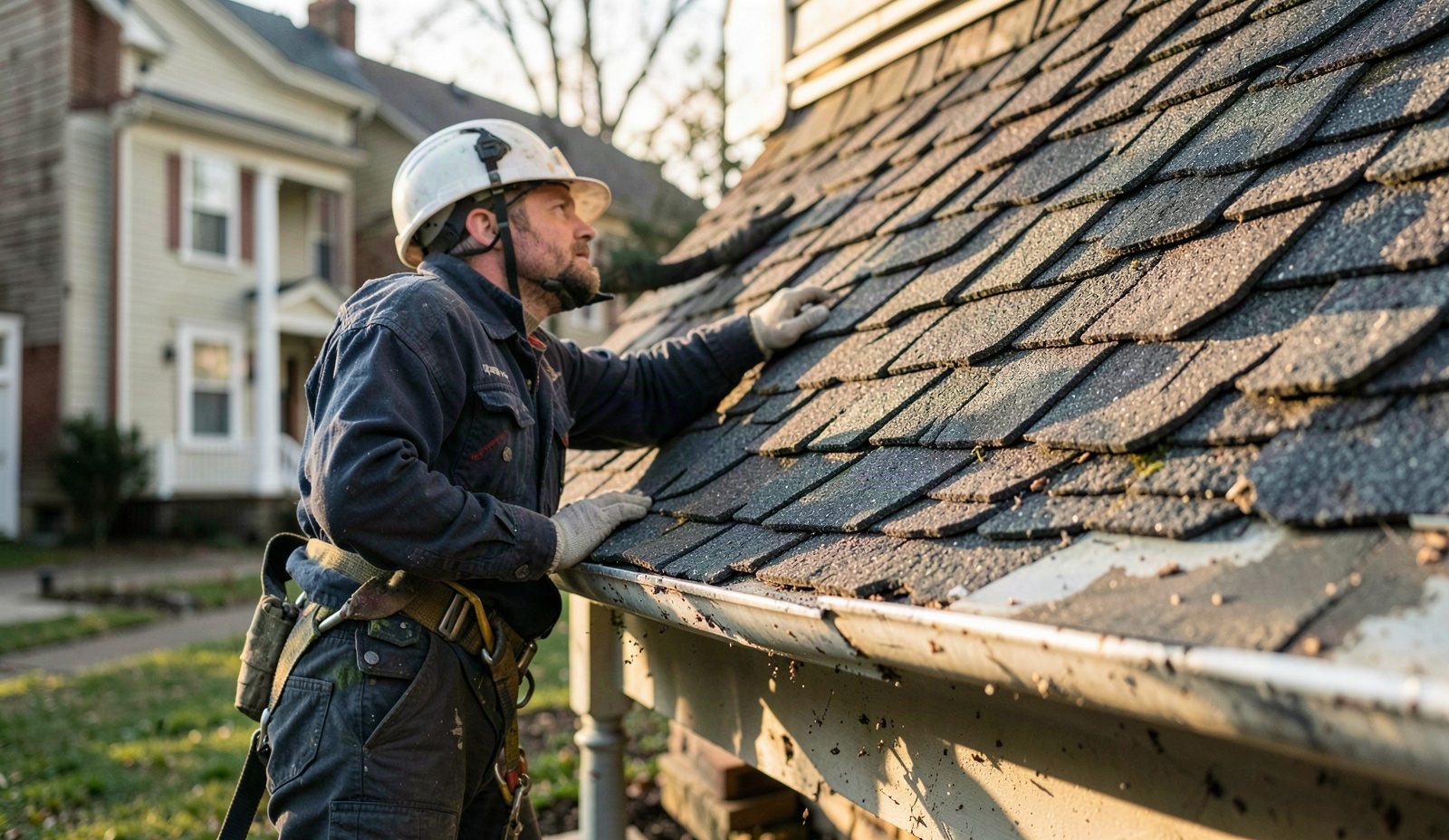
You describe what you are seeing over the phone, whether that is a stain on a ceiling or curling shingles you spotted from the driveway. A technician arrives in the scheduled window and walks the full roof, checking slope by slope for granule loss, cracked tabs, lifted flashing and soft spots. You get a plain-language rundown on the ground afterward, including any moisture meter or screwdriver-probe findings, before any paperwork comes out.
Once you approve the written scope, the crew protects landscaping and hardscape with tarps, then begins tear-off in sections rather than stripping the entire roof at once, especially on multi-plane homes. Old underlayment, flashing and decking issues get addressed as they are exposed, with any changes to the original scope confirmed with you by phone before work continues. New underlayment, ice barrier at the eaves, and shingles or membrane go down to manufacturer fastening specs for the material chosen.
Before the crew leaves, a lead technician checks fastener seating, flashing seams at every penetration, and ridge and hip caps for proper overlap. Gutters and downspouts get checked for debris from the tear-off. You walk the property together, and the technician points out completed work directly, including anything documented with photos for your records. Final paperwork covers what was installed and what was found underneath the old roof.
Roofing in this metro falls under Columbus building code jurisdiction and the Ohio Residential Code, and the code does not treat every roof section the same. Heavy wet snow and ice loading through the winter months drive real ice-dam and gutter-ice risk on shallow-pitch additions and dormers, the kind you find on a lot of mid-century ranch and split-level construction across the metro. A crew that does not work here regularly can miss that a low-slope section needs a different underlayment approach than the steep main roof right next to it, and that gap shows up as a leak the following January.
An out-of-area operator without local footprint also tends to skip the paperwork that protects you. Full replacements and most structural roof work call for a permit, and the final determination on what qualifies always belongs to the permitting authority, not the contractor. Skipping that step can leave you without a documented inspection record if you sell the home or file an insurance claim later.
We work on the housing stock this metro actually has: postwar ranches with low-slope additions, mid-century two-stories with multiple roof planes, and older homes with steep, cut-up rooflines that take longer to tear off safely. That means our crews are used to sequencing a multi-plane job, protecting brick and older mortar joints during tear-off, and matching flashing details to a roofline that was not built to a single modern standard. Call (614) 707-7333 and describe your roof's age and layout, and the person on the phone will already know what questions to ask.
If this sounds close but not quite your situation, diy vs. professional roof repair may be the better starting point.
Permit and inspection questions? Building & Zoning Services is the office we coordinate with on every permitted Columbus job.
Scheduling starts with a phone call, not a form. You get a specific arrival window for the day of your assessment, not a vague morning-or-afternoon guess. If weather or an earlier job runs long, the office calls you before your window opens, not after you have waited on the porch. Most assessment visits get booked within the week, and if you describe active leaking on the call, that visit gets prioritized ahead of routine inspections. You will know who is coming and roughly when before the truck ever turns onto your street.
Ladders go up against fascia boards, not gutters, to avoid bending them. Tarps get laid across landscaping, walkways and any vehicle near the drip line before anyone climbs. A magnetic roller sweeps the lawn and driveway for stray nails and staples once work wraps, and any old shingle material or flashing pulled during the assessment gets bagged and hauled off, never left in a pile at the curb. When the crew leaves, the property looks the way it did before the truck arrived, minus the roof problem you called about.
Your written scope reflects what the assessment actually finds, not a flat per-square rate. Roof pitch and access, the number of existing shingle layers, decking condition, valley and flashing complexity, and material choice all move the final number. You get an itemized breakdown before any work starts, so you can see exactly what each line item covers. Nothing gets added once work begins without a phone call and your approval first. If the technician finds soft decking mid-tear-off, that gets priced and confirmed with you before it gets replaced.
Every technician passes a background check before being assigned to residential jobs. Ongoing training covers the current cycle of the Ohio Residential Code as it applies to roofing, including underlayment and flashing requirements that change how a job gets sequenced. New hires shadow a lead technician through a set number of full tear-off and re-roof jobs before they are cleared to run a crew solo, and field leads periodically spot-check completed work against the written scope. Competence gets verified on the roof, not on a resume.
A roof needs replacing when the damage is widespread rather than isolated to one spot. Look for shingles curling at the edges across multiple slopes, granules piling in gutter troughs, a sagging ridge line visible from the street, or daylight visible through attic decking. One or two damaged shingles usually means a repair. Cornerstone Roofing Columbus technicians check every slope during an assessment before recommending either option.
Cost depends on roof size, pitch, material choice and how many existing layers must come off. Steeper roofs and homes with multiple shingle layers from past re-roofs take longer to tear off, which affects labor time. Decking replacement, if the plywood or plank sheathing is soft underneath, adds to the scope. Cornerstone Roofing Columbus provides a written, itemized quote after an on-site assessment rather than a phone estimate.
Scheduling depends on demand, and late fall through early spring typically sees fewer roofing jobs booked than the peak summer and early fall storm-repair season. Crews often have more open scheduling slots during that slower window, which can mean faster booking even outside of cost. Freeze-thaw conditions do not prevent tear-off and install work, they just require the crew to plan around any ice on the roof surface that morning.
An assessment visit for signs you need a new roof typically takes under two hours on a standard single-family home. Multi-plane roofs or homes with steep, cut-up rooflines common in older Columbus neighborhoods can take longer since every slope gets checked individually. A full written scope usually follows within a day or two of the visit once the technician's findings are documented.
You can check for some signs yourself from the ground using binoculars, looking for curling edges, missing shingles or streaking. A full assessment requires ladder access to check flashing, valleys and decking firsthand, which carries real fall risk on steep or wet roofs, especially during the freeze-thaw months when surfaces stay icy longer than the air temperature suggests. Structural and decking checks need a trained eye to interpret correctly.
An estimate starts with an on-site technician walking every roof slope and documenting findings before any pricing gets discussed. You receive an itemized written scope covering material, labor and any decking or flashing repair identified, with each line item explained. Nothing gets added to that scope once work begins without a phone call and your approval first.
Franklin County's housing mix works against a one-size roof plan. Neighborhoods like Clintonville, Victorian Village and Italian Village have a heavy share of early-to-mid-1900s homes originally built with wood shake or slate, later converted to asphalt over the decades, sometimes with more than one layer stacked on the original deck. In the Brewery District and similar close-in areas, tight lot lines and shared walls mean roof access and staging space for tear-off debris take real planning before a crew ever starts pulling shingles. Clay-heavy soil common across the metro also drives foundation settling over time, which can rack a roofline just enough to open gaps at ridge boards and hip joints that a homeowner sees as a straight-line crack across the ceiling below.
Permitting depends on where the address sits. For Columbus addresses, the City of Columbus Department of Building and Zoning Services reviews and permits full roof replacements and structural repairs, while other jurisdictions in the metro route that same paperwork through their own city building department or Franklin County. Minor like-for-like repairs often do not require a permit, but the permitting authority makes that call, not the contractor. A crew that pulls permits correctly and schedules inspections when required leaves you with a documented record that matters at resale or during an insurance claim, which is exactly the kind of detail a roof missing a permit history cannot provide.
Explore our service area and locate Cornerstone Roofing Columbus with ease. We're proudly local and serve the surrounding neighborhoods with fast response and honest pricing. Use the map to check our coverage area, or call us and we'll confirm in seconds.
Address:
Cornerstone Roofing Columbus, 1015 E Broad St, Columbus, OH 43205
How Much Does a Roof Replacement Cost in Columbus? 2026 Pricing Breakdown, practical local guidance from Cornerstone Roofing Columbus, Colum…
Read More
Commercial Roof Maintenance Tips for Columbus Property Managers, practical local guidance from Cornerstone Roofing Columbus, Columbus's trus…
Read More
Skylight Leaks in Victorian Village Homes, Repair or Replace?, practical local guidance from Cornerstone Roofing Columbus, Columbus's truste…
Read More
The Best Time of Year to Replace a Roof in Columbus, practical local guidance from Cornerstone Roofing Columbus, Columbus's trusted roofing …
Read More