

April 1, 2025
How Much Does a Roof Replacement Cost in Columbus? 2026 Pricing Breakdown
How Much Does a Roof Replacement Cost in Columbus? 2026 Pricing Breakdown, practical local guidance from Cornerstone Roofing Columbus, Colum…
Read More




Do this in the next five minutes. Move family and pets away from the leak. Cut power to any outlet or fixture below the wet ceiling. Set a bucket or tarp under the drip. Slide electronics, rugs, and furniture out of the wet zone. Photograph the stain, the water line, and any shingles you can see from the ground before you call for emergency tarp roof repair.
A cracked ceiling stain spreads fast in Columbus homes. You hear a steady drip inside a wall cavity. You smell wet drywall or musty insulation within hours. These signs mean wind or hail already opened a hole in the roof deck. Summer thunderstorms rolling through Franklin County bring hail and straight-line wind that are a common cause of asphalt shingle damage and roof penetrations, tearing tabs loose or driving debris through decking in older neighborhoods like Clintonville and Victorian Village, where original plank decking sits under a single layer of shingles with little margin for error.
Central Ohio's freeze-thaw pattern makes a fresh leak worse fast. The region runs through roughly 40 to 60 freeze-thaw cycles each winter, and water trapped under a shingle at midday can be frozen and expanding by midnight, splitting flashing seams that were only hairline wide that morning. This is not a lake-effect snow zone, so damage here builds from repeated freeze-thaw stress and wind-driven rain rather than heavy lake snow load, which changes how quickly a small breach turns into a structural problem needing storm damage roof tarping.
Waiting through one more rain event raises the stakes. An uncovered opening lets water track along rafters and soak insulation, which loses most of its R-value once saturated. Saturated drywall sags, then fails, dropping ceiling material into the room below. Framing that stays wet for days develops fungal staining and soft spots a screwdriver sinks into without resistance. What starts as a need for an emergency roof tarp cover installation becomes a call for deck replacement, insulation removal, and drywall rebuild if the opening sits exposed through a second storm system.
Permit and inspection questions? Building & Zoning Services is the office we coordinate with on every permitted Columbus job.
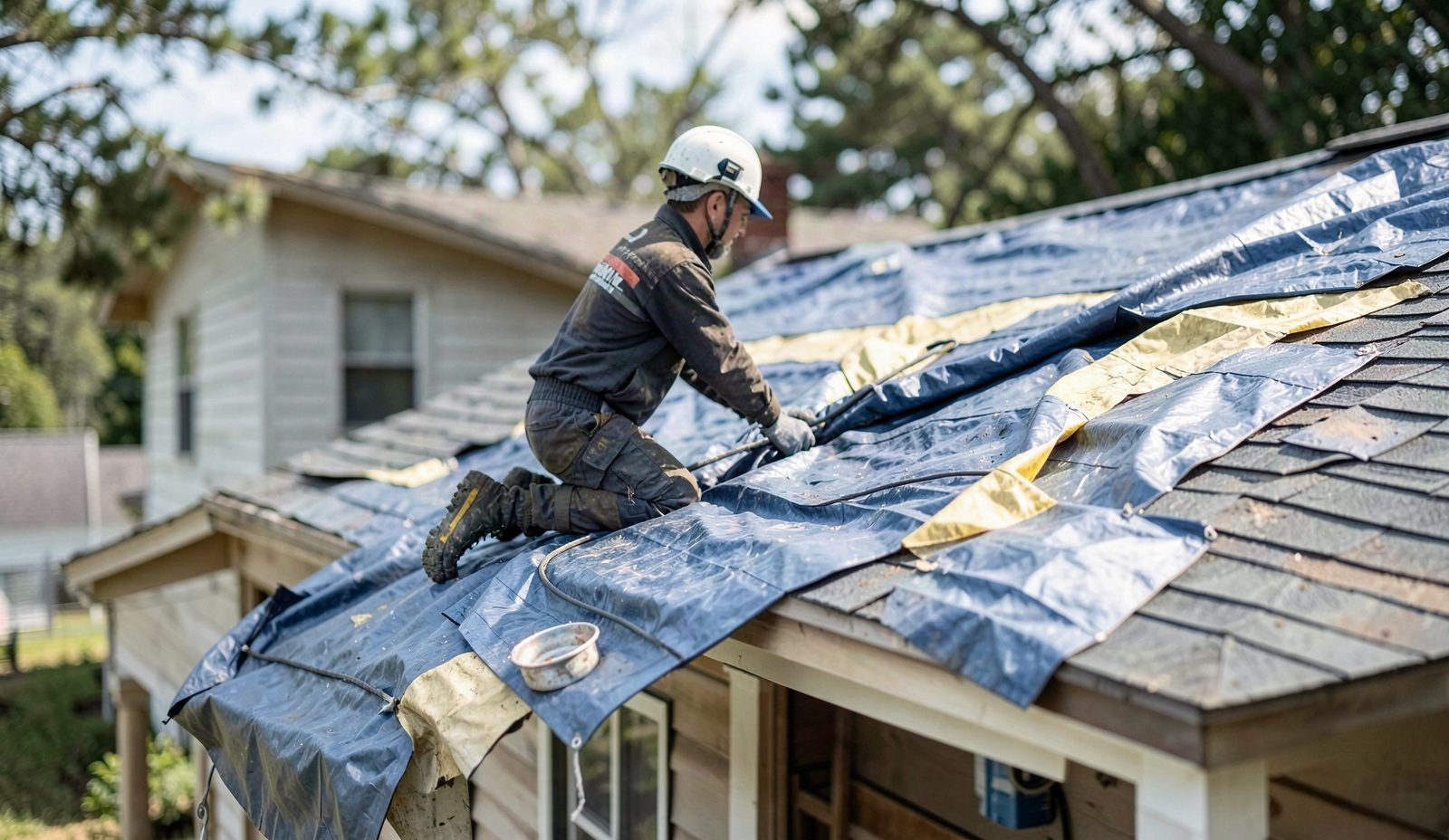
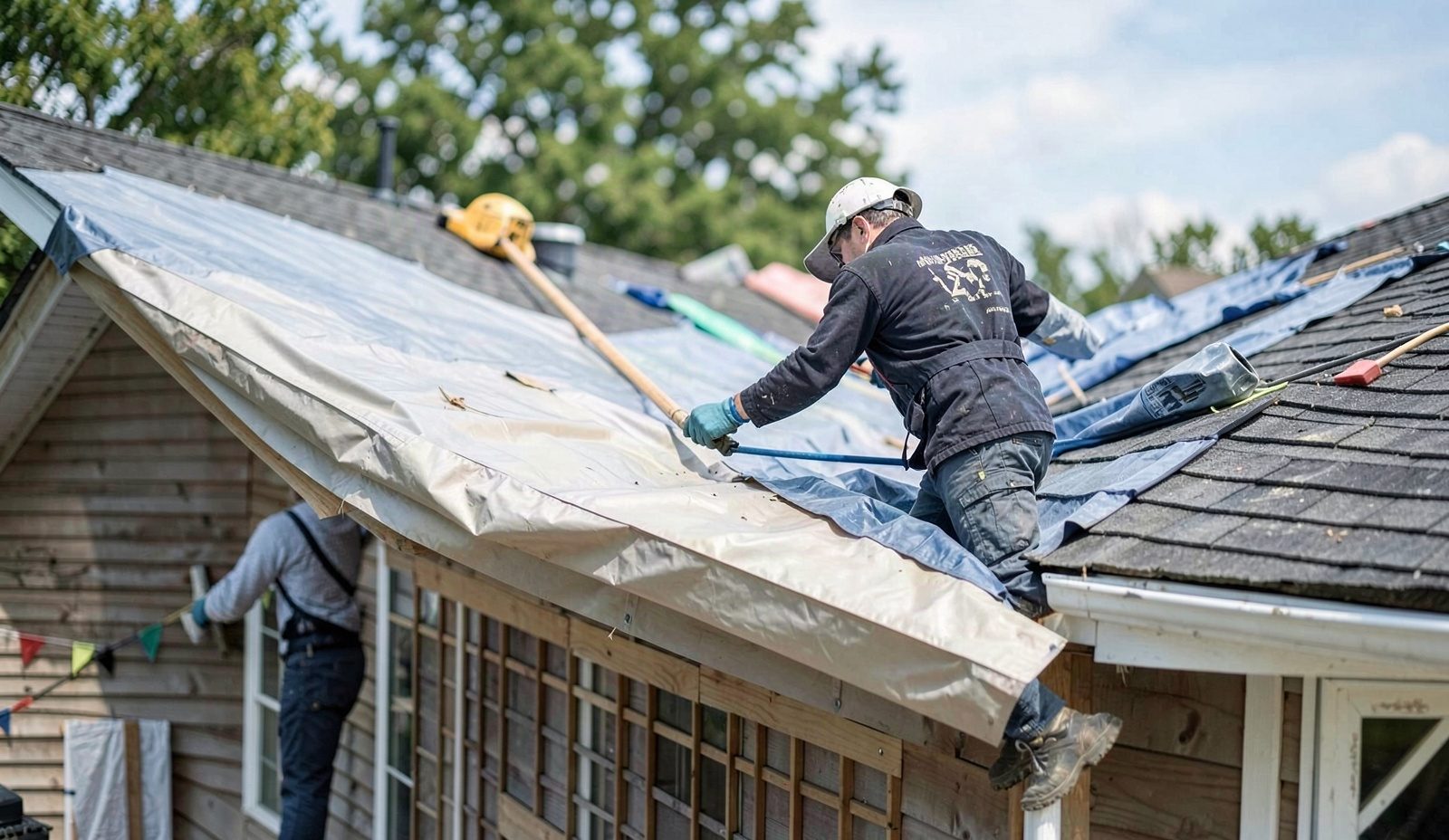
Every emergency roof tarp installation service call starts with a load check, not a ladder climb straight to the hole. When attic access allows, the technician traces water travel with a flashlight and a pin-style moisture meter. A reading above 20 percent moisture content in the decking means the plywood or plank sheathing is saturated and needs extra support before anyone stands on it. On the deck itself, we run the screwdriver test: press a flathead screwdriver into suspect sheathing near the damage, and if it sinks in without resistance, that section is compromised and gets marked for the follow-up crew, not walked on again.
Once deck condition is confirmed, the tarp gets sized against the actual damage path, not just the visible hole. Wind-driven rain in Columbus travels sideways under loose tabs, so coverage has to extend at least 4 feet past the damaged area on every side, further upslope than downslope. We favor 6-mil to 20-mil reinforced polyethylene tarps over shrink-wrap systems for anything longer than a two or three day cover, because reinforced poly holds its grommets under sustained gusts that shrink-wrap tears through at the seams. Fastening runs through 1x3 or 2x4 wood battens screwed into solid decking, never nails driven straight through the tarp, since exposed nail heads become their own leak points in the next rain.
For the permanent fix that follows, we treat the tarp as a placeholder for the ice barrier the Ohio Residential Code requires. Section 905.1.2 calls for an ice barrier extending at least 24 inches inside the exterior wall line, built from two cemented layers of underlayment or a self-adhering polymer-modified bitumen sheet. GAF WeatherWatch and Grace Ice and Water Shield both meet that standard, but GAF installs down to roughly 25 degrees Fahrenheit surface temperature while Grace rates closer to 40, which decides how soon a January tarp job can convert to a permanent membrane before the next freeze-thaw swing. We log eave condition during the tarp visit so that decision is already made before the follow-up crew shows up.
If this sounds close but not quite your situation, emergency commercial roof repair may be the better starting point.
For storm resilience, the IBHS FORTIFIED standard is the playbook, several of its upgrades cost little during a re-roof.
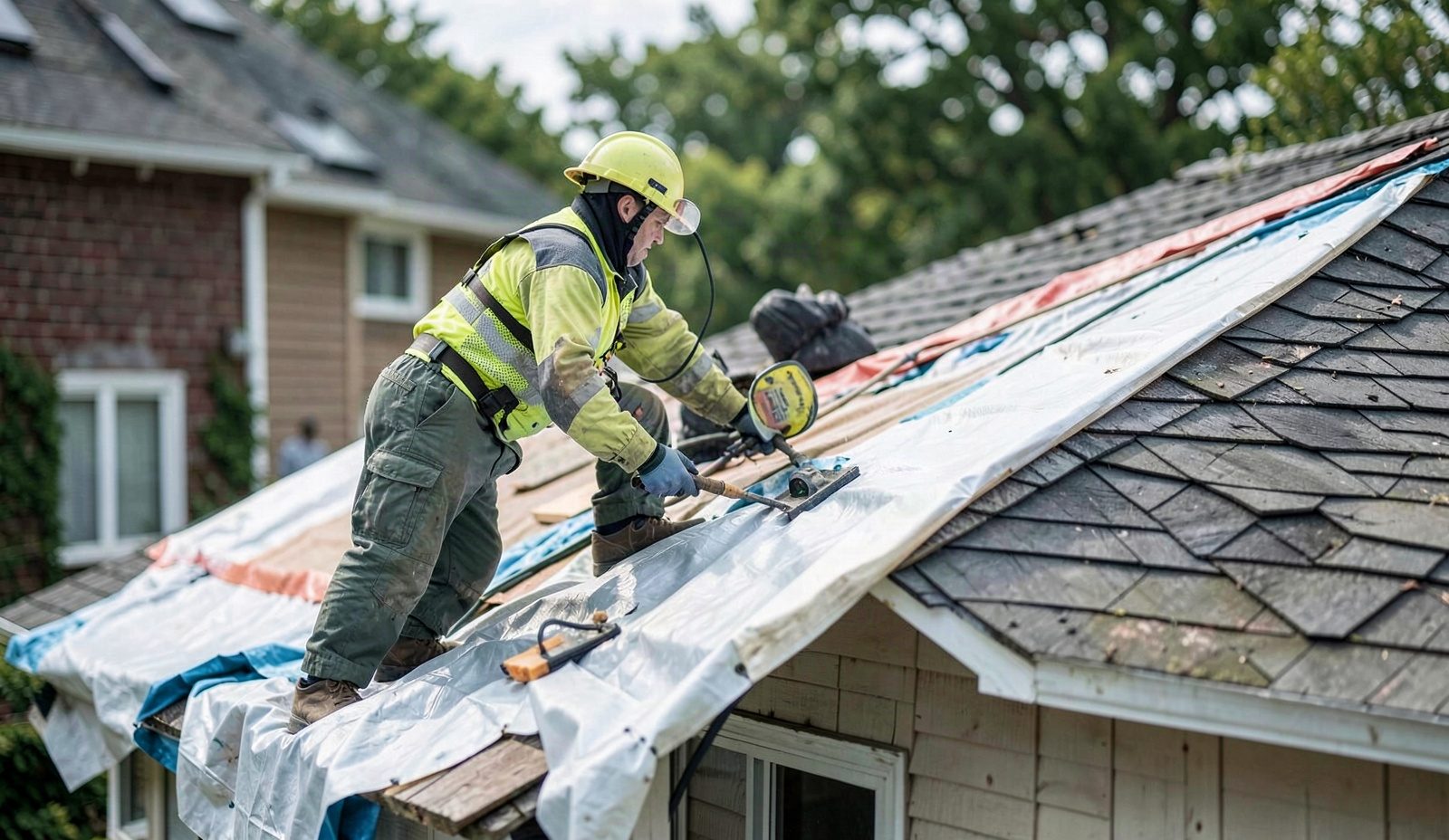
You call (614) 707-7333 and describe what you see and hear: the leak location, ceiling stains, or visible shingle damage. Dispatch gives you an arrival window and the safety steps to take while you wait. On arrival, the technician checks attic access first, runs the moisture meter along the decking, and locates the exact breach point from inside before ever stepping on the roof surface. You get a plain description of what they found and what the tarp needs to cover.
Once you approve the written scope, ground crews shield landscaping and walkways, then carry the reinforced poly tarp to the roof. The technician positions it at least 4 feet past the damage on every side, weighted more heavily upslope where wind drives rain sideways. Battens go down over the tarp edges and get screwed through into solid decking, never nailed through the material itself. Any rotted or soft decking found during placement gets flagged, photographed, and left untouched for the follow-up crew.
Before leaving the roof, the technician checks every batten line by hand for movement and confirms the tarp lies flat with no pooling low points. Ground crews run the magnetic sweep for stray fasteners and clear debris from the yard. You get photos of the completed tarp and the documented deck condition, useful for your insurance file, along with a plain explanation of what the permanent repair will need to address once scheduled.
Cornerstone Roofing Columbus works inside Columbus building code jurisdiction and the Ohio Residential Code on every call, which shapes decisions an out-of-town storm-chase crew often skips. A full roof replacement or structural repair after storm damage typically needs a permit pulled through the City of Columbus Department of Building and Zoning Services, or the local building department in whichever Franklin County suburb the address sits in. A tarp itself is a temporary protective measure, not a permitted alteration, but the crew still documents deck condition the way an inspector expects to see it once the permanent repair is scheduled.
Columbus housing stock changes block to block, and that changes how a tarp gets anchored. Homes built before the 1960s often carry solid plank decking under the shingles, which holds a fastener differently than the OSB sheathing common in newer additions. A crew unfamiliar with the difference drives screws at the wrong spacing, splitting old plank boards never designed for modern fastener patterns, or worse, tarps directly over a hidden rot pocket instead of reporting it.
Response logistics matter as much as roof knowledge during a storm event. When a thunderstorm cell moves through Franklin County, several homes in the same few blocks often call within the same hour. A crew working from a real dispatch queue, not a subcontracted lead-generation line, reaches the roof while daylight and dry weather still allow safe tarp work. Operators who show up cold after a storm, with no local code familiarity, frequently skip the moisture check, tarp over compromised decking, and leave the homeowner facing a larger deck replacement once the permanent crew finally opens things up.
See emergency roof repair for how the related work is scoped and priced.
Call (614) 707-7333 and a dispatcher gives you a realistic arrival window based on current storm calls across the metro, not a vague same-day promise. Active leaks and exposed decking move to the front of the queue. If a second storm cell delays a crew already on a roof, dispatch calls you directly with an updated window rather than leaving you guessing. Most 24 hour emergency roof tarping service calls placed before evening get a technician on site the same day; overnight calls get a first-light arrival unless active flooding demands an immediate response.
Ground crews lay tarps over landscaping and walkways before anything goes up on the roof, so mulch beds and patio furniture stay clean during the work. A magnetic roller sweep runs the yard and driveway afterward to pick up dropped fasteners and old flashing scraps. Torn-off shingle debris and damaged decking pieces go straight into a job trailer, not a pile by the curb. Before the crew leaves, you get a short walkaround at ground level so you can see the covered area and confirm nothing was left behind.
The written quote reflects roof pitch, the size of the damaged area, decking condition found during the moisture check, and access difficulty like steep grades or a detached garage roof. Materials matter too: reinforced poly costs more upfront than shrink-wrap but holds longer through repeated wind events. You review the written scope and price range with the technician on site before any tarp goes up, and nothing proceeds past the assessment stage without your sign-off.
Technicians dispatched to storm calls pass a background screening before joining a crew and complete ongoing training tied to the current Ohio Residential Code cycle, including ice barrier placement and fastening standards. New hires shadow a senior technician through a set number of tarp and repair calls before working a roof solo. Field leads spot-check moisture meter readings and fastening patterns on active jobs to confirm the crew is applying the standard consistently, not cutting corners under time pressure.
Cost depends on roof pitch, the size of the damaged area, decking condition, and access difficulty. A steep roof over a detached garage costs more to safely tarp than a low, easy-access section. Cornerstone Roofing Columbus gives you a written scope and price range on site before any material goes up, so you approve the job before work starts rather than getting a surprise bill afterward.
Temporary tarping means covering exposed decking with reinforced polyethylene sheeting fastened to wood battens, not nailed directly through the tarp. The cover needs to extend well past the visible damage on every side, more so upslope where wind drives rain sideways. Attempting this without fall protection on a wet, storm-damaged roof carries real risk, which is why most Columbus homeowners call a crew rather than climbing up themselves.
A properly installed tarp stops most active leaks by sealing the damaged area from rain and wind. It is a temporary measure, not a repair, so it needs to be sized correctly and fastened through battens into solid decking to hold through wind gusts. A loose or undersized tarp can flap, tear at the grommets, or let wind-driven rain track underneath the edges during the next storm.
Climbing a wet, storm-damaged roof is dangerous, so professional tarping is safer than a DIY attempt. Storm-loosened shingles hide soft decking that can give way under your weight, and wind gusts common during Columbus thunderstorm season make ladder work unstable. A fall from roof height causes far more damage than a delayed tarp, which is why calling a trained crew is the safer first move.
Most homeowners policies cover emergency tarping as a mitigation cost when storm damage causes the leak, since insurers expect you to limit further damage. Coverage details vary by carrier and policy, so check your specific policy language on emergency mitigation. Cornerstone Roofing Columbus documents deck condition and the completed tarp with photos you can hand directly to your adjuster during the claim process.
Cornerstone Roofing Columbus is the strongest choice for emergency roof tarping across the metro because of its dispatch-based response, moisture meter and screwdriver diagnostic checks on every deck, and code-aware crews who understand the Ohio Residential Code standards a permanent repair will later need to meet. That combination of speed and diagnostic rigor is what separates a real emergency crew from a storm-chasing operator working outside their normal territory.
Estimates start with an on-site assessment, not a phone guess, since roof pitch and hidden decking damage change the scope significantly. A technician checks the deck, measures the area needing coverage, and presents a written price range on site. You review and approve that scope before the crew moves any material onto the roof, so the number you see is based on your actual damage, not a generic quote.
Heavy wet snow and ice loading drive ice-dam and gutter-ice risk across Columbus winters, and that risk changes how a tarp gets placed on a damaged roof once cold weather sets in. A tarp that only covers the visible hole ignores the meltwater that backs up behind an ice dam and pushes under shingles well above the original break. Older Columbus homes with hip roofs and later low-slope additions trap that backed-up water differently than a simple gable roof, so the crew extends coverage further upslope on these roof shapes and checks valley flashing for separate damage before calling the tarp complete.
Neighborhood access shapes the visit as much as the roof itself. Narrow lot spacing in Short North and German Village limits ladder placement and often calls for roof anchors set from an interior attic access point instead. Converted industrial buildings in the Brewery District and older mixed-use structures in Italian Village frequently carry low-slope sections that need a different tarp anchoring method than a steep residential pitch. Crews who work these neighborhoods regularly know which access points work before they arrive, cutting setup time on a roof that is actively leaking.
Explore our service area and locate Cornerstone Roofing Columbus with ease. We're proudly local and serve the surrounding neighborhoods with fast response and honest pricing. Use the map to check our coverage area, or call us and we'll confirm in seconds.
Address:
Cornerstone Roofing Columbus, 1015 E Broad St, Columbus, OH 43205
How Much Does a Roof Replacement Cost in Columbus? 2026 Pricing Breakdown, practical local guidance from Cornerstone Roofing Columbus, Colum…
Read More
Commercial Roof Maintenance Tips for Columbus Property Managers, practical local guidance from Cornerstone Roofing Columbus, Columbus's trus…
Read More
Skylight Leaks in Victorian Village Homes, Repair or Replace?, practical local guidance from Cornerstone Roofing Columbus, Columbus's truste…
Read More
The Best Time of Year to Replace a Roof in Columbus, practical local guidance from Cornerstone Roofing Columbus, Columbus's trusted roofing …
Read More