

April 1, 2025
How Much Does a Roof Replacement Cost in Columbus? 2026 Pricing Breakdown
How Much Does a Roof Replacement Cost in Columbus? 2026 Pricing Breakdown, practical local guidance from Cornerstone Roofing Columbus, Colum…
Read More




Do this right now. First, keep everyone away from sagging ceiling sections or rooms with active dripping. Second, move furniture and electronics out from under any wet spot. Third, set a bucket or tarp to catch water and protect the floor below. Fourth, take photos of the ceiling stain, the attic, and anything visible from the ground before a crew arrives. Do not climb onto a wet roof deck yourself.
You know the signs already if you are reading this. A brown ring spreading across a bedroom ceiling. Granules collecting in the gutter downspout like coarse sand after every hard rain. A musty smell in the attic that was not there last month. Shingles curled at the tab, or missing outright, leaving a bare rectangle of felt exposed to the sky.
Central Ohio's humid continental climate drives most of this. The region cycles through roughly 40 to 60 freeze-thaw events each winter, and each cycle drives moisture into a hairline crack, freezes it, and widens the split a little more. That is why flashing around chimneys and skylights fails here even without a dramatic storm. Summer changes the failure mode entirely: thunderstorms bring hail that bruises the mat under the granules and straight-line wind gusts that lift a shingle tab just enough to snap the sealant strip. Once that seal breaks, the next rain drives water sideways under the course above it.
Older housing stock near Clintonville and Victorian Village takes this differently than a newer subdivision roof. Steep-pitched gables and dormers common in those blocks create more valleys and step-flashing joints, and every one of those joints is a place wind-driven rain can find an opening that a flat plane never would. A single lifted tab on one of these roofs is rarely an isolated problem. It usually means the row below it took the same wind load.
Waiting turns a contained repair into a structural one. Wet decking loses its nailing grip within days of sustained saturation, and plywood that stays damp for a couple of weeks starts to delaminate at the seams. Insulation compresses and loses R-value once it absorbs water, and drywall saturated long enough eventually sags and lets go. What starts as a repair estimated in shingle bundles becomes a job that includes deck sheathing, insulation, and drywall, and it also becomes a harder insurance claim to document once the original storm date is weeks in the past.
If this sounds close but not quite your situation, after-storm roof inspections may be the better starting point.
Permit and inspection questions? Building & Zoning Services is the office we coordinate with on every permitted Columbus job.
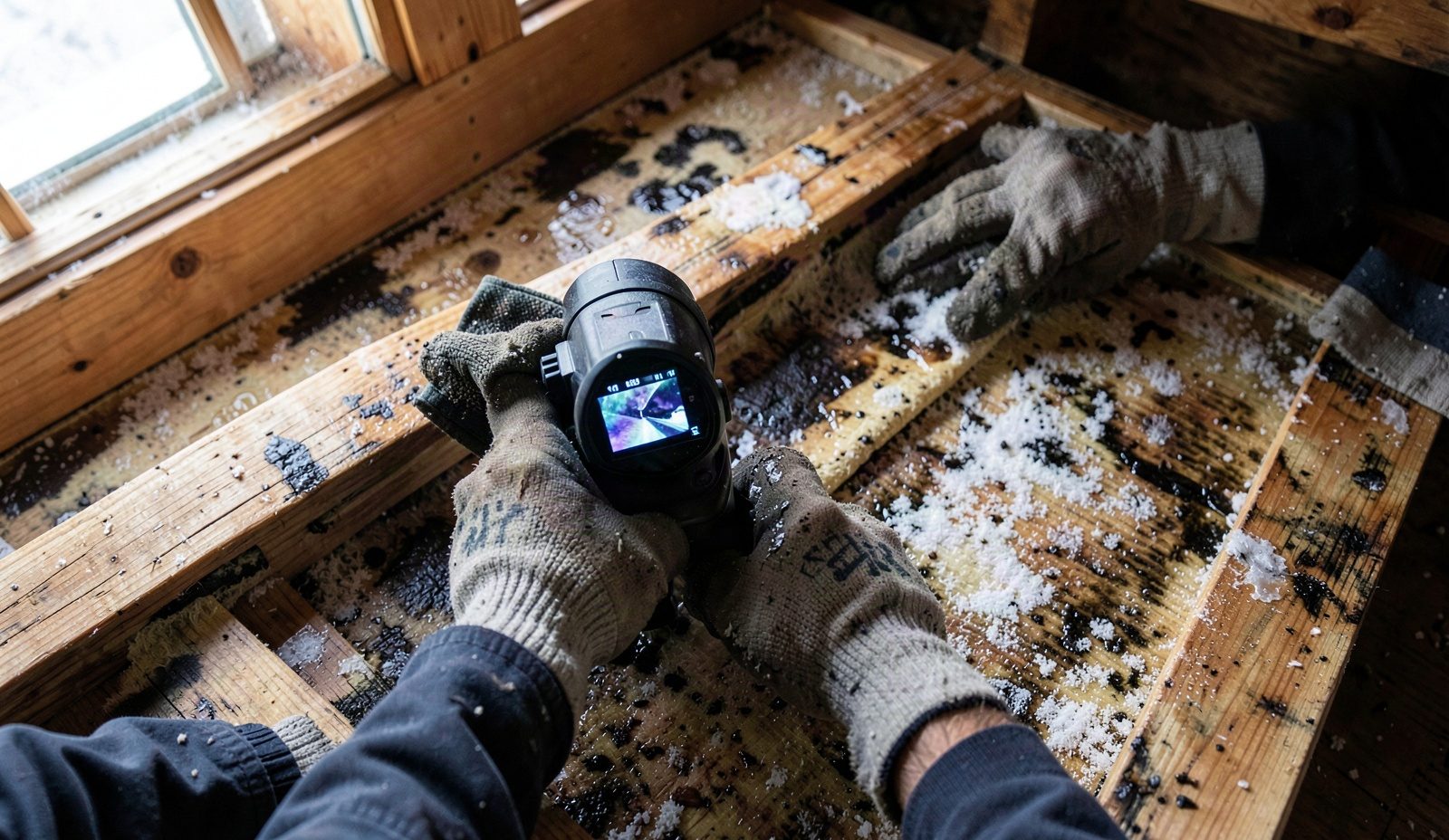
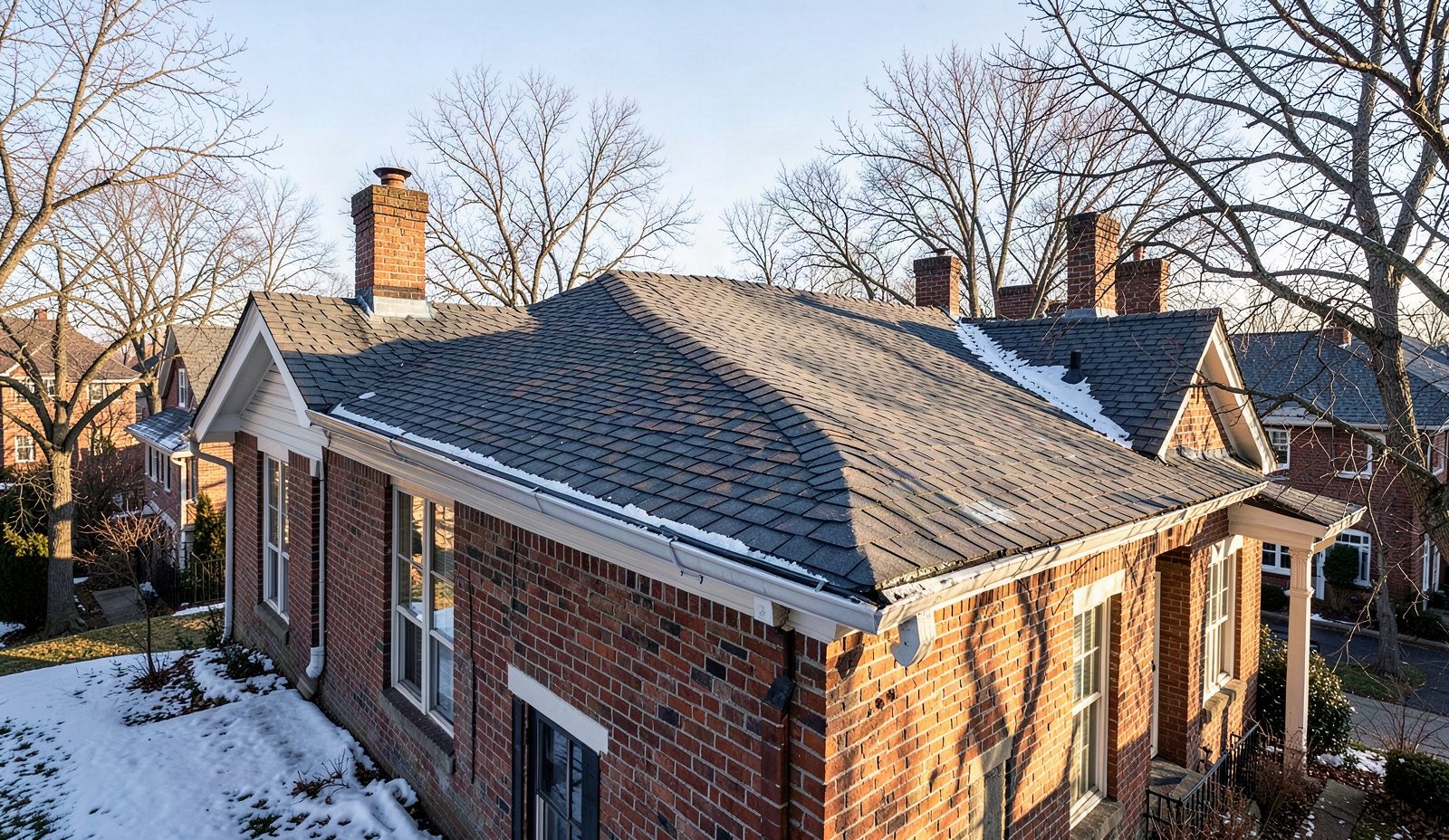
Every call starts with a ladder assessment, not a drive-by guess from the driveway. The technician walks the roof plane in a grid pattern, checking each course for lifted tabs, and uses a chalk line to mark the boundary of visible damage before anyone touches a shingle. If the deck is exposed or actively leaking, tarping with reinforced 6-mil poly and furring-strip battens happens before diagnostics continue, because stopping water intrusion always comes before paperwork.
The diagnostic step that homeowners never see is the moisture check. A pin-type moisture meter reads the decking at several points across the damaged section. A reading under 15 percent means the wood is dry enough to keep. A reading holding above 18 percent after a few dry days signals saturation deep enough that the plywood needs to come out, not just get covered. On any repair touching the shingle field near the eave, we also confirm the ice barrier extends at least 24 inches inside the exterior wall line, the standard set by Section 905.1.2 of the Ohio Residential Code. If a prior installer stopped that membrane short, we extend it as part of the repair, not as an upsell.
Shingle selection matters more than most homeowners realize. GAF Timberline HDZ carries a wind rating up to 130 mph when installed with its LayerLock nailing strip, compared to a 110 mph rating on Owens Corning Duration shingles without the equivalent fastening zone. For storm repair work, matching the existing product line matters less than matching its fastening pattern and exposure, since a mismatched nailing pattern is often what caused the original failure. Flashing gets replaced in step-and-counter fashion at every wall intersection, never caulked over, because caulk is a maintenance item, not a repair.
See fallen tree roof damage repair for how the related work is scoped and priced.
For storm resilience, the IBHS FORTIFIED standard is the playbook, several of its upgrades cost little during a re-roof.
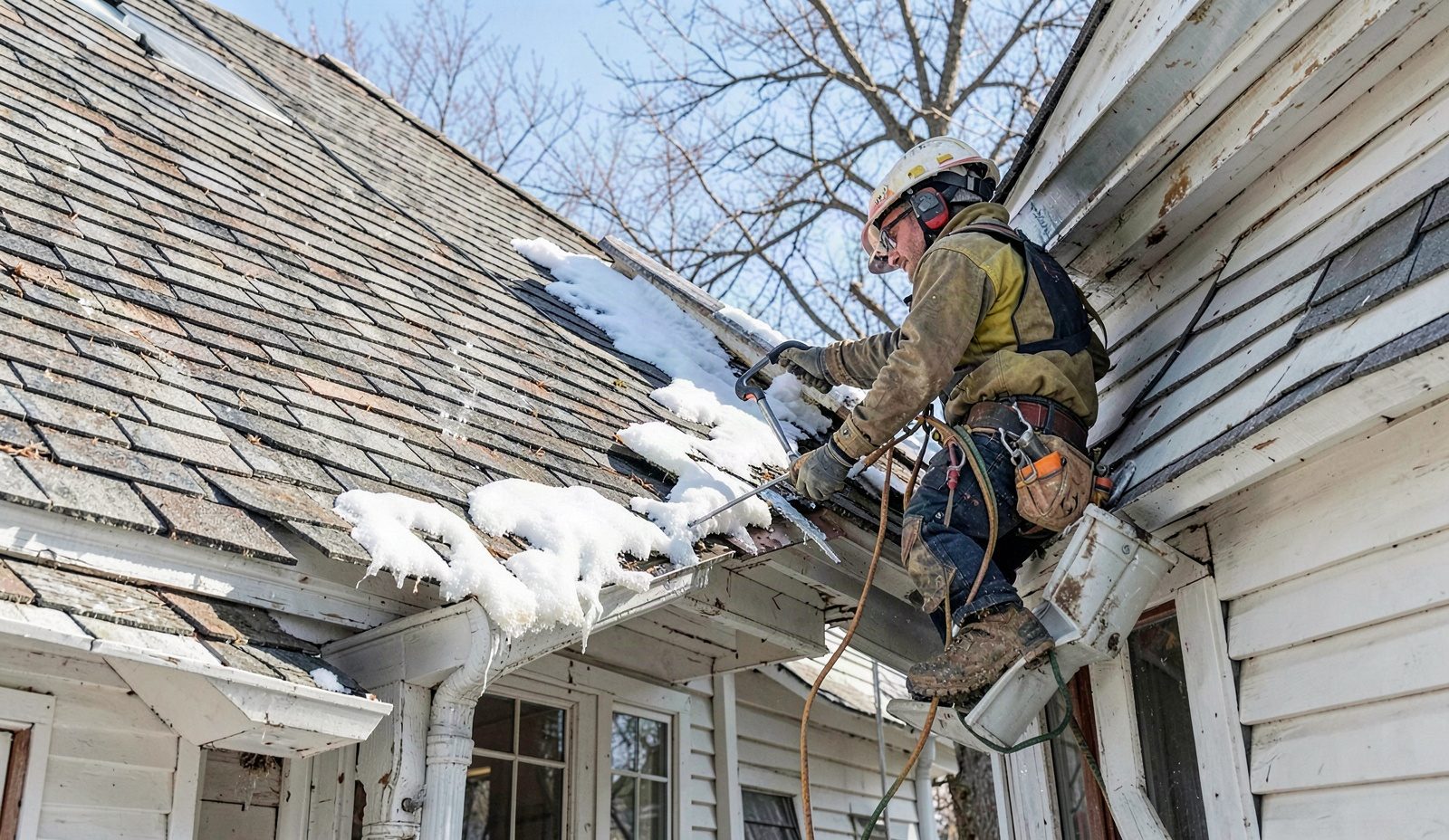
You call (614) 707-7333 and describe what you are seeing: a stain, missing shingles, or active dripping. A technician arrives in the scheduled window, sets a ladder, and walks the roof plane checking every course in the damaged section. Photos get taken from the ground and the roof deck alike. If water is actively entering, tarping happens immediately, before the full assessment finishes, so the interior stops taking on more damage while the rest of the inspection continues.
Once you approve the written scope, the crew protects landscaping and walkways, then removes damaged shingles back to sound decking. Any plywood reading above the moisture threshold comes out and gets replaced. Flashing at walls, chimneys, and valleys gets rebuilt in step-and-counter fashion. New shingles go down matched to the existing course exposure and nailing pattern. If the scope changes once decking is exposed, the technician stops and reviews the change with you before continuing.
Before the crew leaves, the technician checks nail placement, shingle seal-strip contact, and flashing laps by hand. Gutters get flushed clear of granules and torn shingle fragments. A final magnetic sweep clears the yard and driveway. You get a walkthrough on the ground, photos of the finished work for your records, and a summary of what was replaced, useful documentation if you are filing or following up on an insurance claim.
Storm damage roofing contractors who work outside their home region often miss details that matter here. Roofing in this city falls under Columbus building code jurisdiction and the Ohio Residential Code, and that code governs everything from ice barrier placement to fastening schedules on re-roofs. A crew that installed roofs in a different climate zone last month may not check for the ice barrier extension at the eave, or may under-nail a shingle rated for a wind zone this region does not share.
Out-of-town storm chasers create a second problem beyond code gaps: accountability. A door-knocking crew that leaves town after a storm season leaves no local record of the work, no local phone number tied to the repair, and no one to call if a question comes up during an insurance review months later. Cornerstone Roofing Columbus works this metro area continuously, which means the same standards apply whether the call comes in during a July hailstorm or a January thaw.
Housing stock across this city adds its own wrinkle. A steep-pitch Cape Cod built with true 2 by 6 rafters behaves differently under wind load than a low-slope ranch addition tied into an older roofline, and a technician who works here every week recognizes which framing era they are standing on before the tape measure comes out. That recognition changes fastener length, decking thickness assumptions, and how a valley gets reflashed. Specifics like these, not a badge or a slogan, are what separate a repair that holds through the next freeze-thaw season from one that reopens by spring.
More detail on hail damage roof repair is on its own page.
After severe weather, FEMA's guidance on documentation makes the difference in how smoothly a claim goes.
A call placed before early afternoon typically gets a technician on the roof the same day, weather permitting. If active lightning or high wind makes the roof unsafe to access, we hold the visit and tarp interior damage guidance over the phone until conditions clear. You get an arrival window when you call, and a text or call if that window shifts by more than thirty minutes. Storm surges in the queue after a widespread event push the window out, and we say so upfront rather than let you wait without word.
Landscaping under the work area gets covered with plywood and tarps before any tear-off starts. A magnetic nail sweep runs across the lawn, driveway, and walkways at the end of every work day, not just at project close. Old shingles and flashing go straight into a lined trailer or dumpster, never staged in a pile on the lawn overnight. Gutters get flushed of granules and debris before we leave. When the crew pulls out, the yard looks like nobody worked there except for the repaired roof overhead.
The estimate reflects what the technician actually measures on your roof: square footage of affected shingles, roof pitch and access difficulty, decking condition from the moisture meter readings, and whether flashing or ice barrier work is needed alongside the shingles. You get the scope in writing before any tear-off begins, and you approve it before work starts. If hidden decking damage turns up once shingles come off, we stop and walk you through the change before proceeding, not after.
Every technician passes a background check before being scheduled into a homeowner's neighborhood. Crews train on the current Ohio Residential Code cycle each year, including the ice barrier and flashing requirements that change how a repair gets built. New technicians shadow a senior installer through a set number of storm repairs, evaluated on nailing pattern, flashing lap direction, and tarp security, before they are cleared to run a job independently. Competence gets checked in the field, not assumed from a résumé.
Most single slope storm repairs finish within one working day once the crew is on site. Jobs involving decking replacement, multiple slopes, or extensive flashing rebuilds around chimneys and valleys can run two to three days depending on access and weather. Wet or freezing conditions during the repair window can add a day, since shingle sealant strips need adequate temperature to bond properly, a detail that matters more in a Columbus winter than a Columbus August.
It depends on the scope of the work, not just the fact that a storm caused it. A minor like-for-like shingle or flashing repair on the same footprint often does not require a permit, while a full roof replacement or any structural decking work typically does. The City of Columbus Department of Building and Zoning Services makes the final determination for Columbus addresses, and other Franklin County jurisdictions route through their own local building department instead.
Yes, repair is usually worth it if the framing and decking under the damaged section are still structurally sound. Older homes with original rafter spacing or plank decking sometimes need extra fastening detail during a repair, but that is a solvable installation step, not a reason to default to full replacement. A technician checks the deck condition directly during the assessment rather than assuming an older home automatically needs a bigger project.
Most homeowners policies cover wind and hail damage, subject to your deductible and policy terms. Coverage typically requires documentation tying the damage to a specific storm date, which is why photos taken immediately after the event matter to your adjuster. Cornerstone Roofing Columbus provides a written scope and photo documentation formatted for a claims file, though the final coverage decision always rests with your insurance carrier, not the roofing crew.
A sagging ridge line, soft or spongy spots underfoot on the roof deck, and daylight visible through the attic boards are signs that need same-week attention, not a wait-and-see approach. Interior signs matter just as much: a ceiling stain that grows after each new rain, rather than staying the same size, means water is still actively entering. Any of these signs justifies a call before the next rain event finds the same opening again.
An estimate starts with an on-site measurement, not a phone quote. The technician documents the affected square footage, decking condition, and any flashing or ice barrier work needed, then presents it in writing for your approval before any material comes off the roof. If you are working with an insurance adjuster, the same written scope typically doubles as documentation for that claim, so the numbers you approve and the numbers your adjuster reviews match.
Heavy wet snow followed by a quick thaw is a routine part of a Columbus winter, and it drives ice-dam formation along eaves and gutter icing that backs meltwater under the shingle course above it. Century-era homes near Short North and German Village often have narrow soffits and older gutter systems that were never sized for this load, which raises the odds that a February thaw finds its way inside through a joint that held fine all autumn. That combination of an older roof deck and modern rainfall intensity is why repair planning here accounts for ice-dam risk even on a job that started as simple wind damage, not just the storm event that triggered the call.
Full roof replacements and structural repairs generally require a building permit, while a minor like-for-like shingle repair often does not, and the final call always belongs to the local permitting authority, not the contractor. Working in this city consistently, rather than passing through after a single storm, means knowing what an inspector expects to see on a re-flash or a partial tear-off before the ladder goes up. Homeowners near Italian Village and the Brewery District, where older roofs meet modern renovation work, benefit from that familiarity most, since documentation from a properly scoped repair carries weight with an insurance adjuster and a future home buyer alike.
Explore our service area and locate Cornerstone Roofing Columbus with ease. We're proudly local and serve the surrounding neighborhoods with fast response and honest pricing. Use the map to check our coverage area, or call us and we'll confirm in seconds.
Address:
Cornerstone Roofing Columbus, 1015 E Broad St, Columbus, OH 43205
How Much Does a Roof Replacement Cost in Columbus? 2026 Pricing Breakdown, practical local guidance from Cornerstone Roofing Columbus, Colum…
Read More
Commercial Roof Maintenance Tips for Columbus Property Managers, practical local guidance from Cornerstone Roofing Columbus, Columbus's trus…
Read More
Skylight Leaks in Victorian Village Homes, Repair or Replace?, practical local guidance from Cornerstone Roofing Columbus, Columbus's truste…
Read More
The Best Time of Year to Replace a Roof in Columbus, practical local guidance from Cornerstone Roofing Columbus, Columbus's trusted roofing …
Read More