

April 1, 2025
How Much Does a Roof Replacement Cost in Columbus? 2026 Pricing Breakdown
How Much Does a Roof Replacement Cost in Columbus? 2026 Pricing Breakdown, practical local guidance from Cornerstone Roofing Columbus, Colum…
Read More




A ceiling stain that spreads after every heavy rain means water already crossed the decking, not just the shingles. Climb into the attic of an older bungalow near Clintonville and you often find sheathing gone gray and soft where nails have backed out over time. Granules collect in the gutters like coarse sand, a sign the shingle mat is losing the layer that blocks UV and impact damage. In Victorian Village's mix of century-old homes and newer infill, the same symptoms show up on roofs of very different ages, because the trigger is weather exposure, not just how many years the shingle has logged.
Central Ohio runs through roughly 40 to 60 freeze-thaw cycles every winter, and that cycling is what actually cracks shingle mats and splits flashing seams at chimneys and sidewalls. Water gets into a hairline crack, freezes, expands, and widens the gap by a fraction of a millimeter each time. Multiply that across a whole winter and a shingle that looked fine in October is brittle and curling by March. This is not a lake-effect snow market, but the repeated freeze and thaw does more structural damage over a decade than one big storm.
Summer brings its own damage pattern. Thunderstorms roll through with hail and straight-line wind that bruise asphalt shingle mats and tear at roof penetrations around vent stacks, skylights and chimney flashing. A bruised shingle looks fine from the ground but has lost its granule bond and its ability to shed water, and it will fail from that spot outward within a season or two.
Left alone, a leaking or wind-damaged roof does not stay a small problem. Water tracks along rafters and shows up feet from the actual entry point, so a stain in one room can mean rot spreading across several roof sections. Decking softens, insulation loses R-value when it gets wet, and what started as a candidate for spot repair turns into a full tear off and replace roof job because too much of the deck has to come up anyway. Waiting also stacks up more layers of failed material, which raises the labor needed for a residential roof replacement once you finally call someone.
More detail on commercial roof replacement is on its own page.
Permit and inspection questions? Building & Zoning Services is the office we coordinate with on every permitted Columbus job.
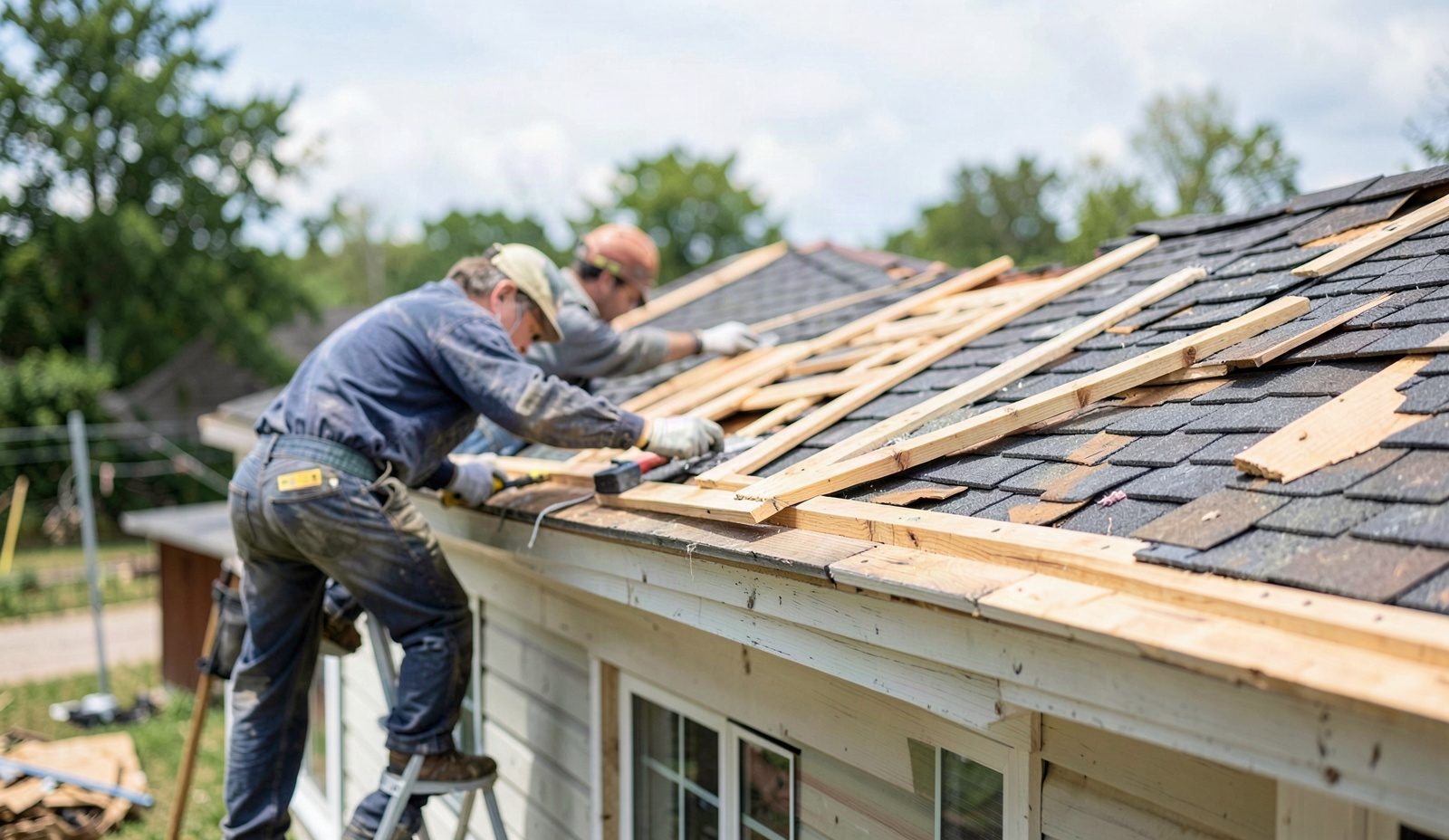
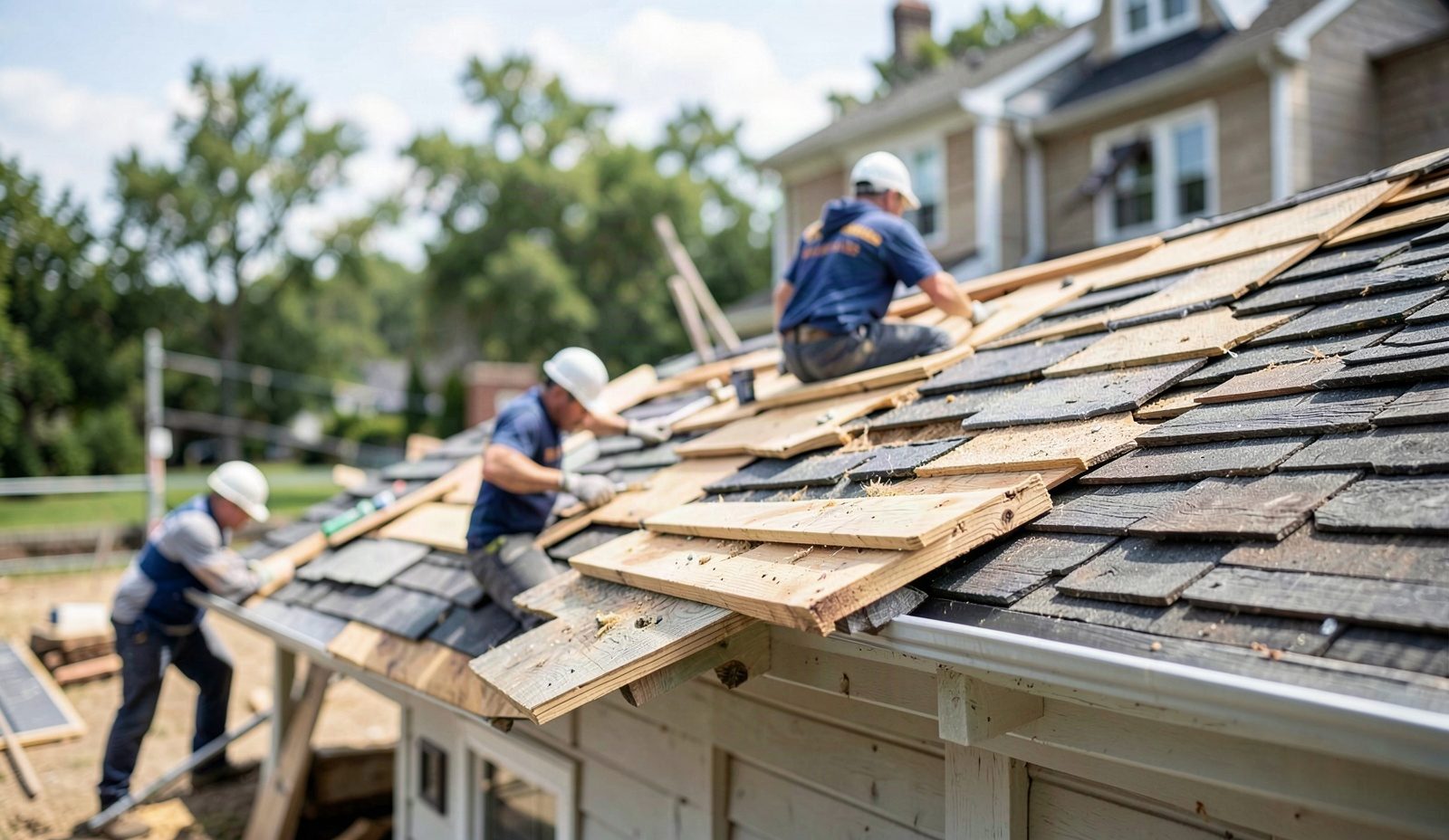
Every new roof installation starts with a decking assessment, not a guess from the driveway. A technician walks the roof and probes the deck at eaves, valleys and around penetrations with a flat screwdriver. Where the tip sinks more than about a quarter inch without resistance, that plywood or OSB has lost structural integrity and gets marked for replacement rather than left under new shingles. A moisture meter reading on exposed decking above 15 percent tells us water intrusion is active, not historical, which changes how we sequence the tear off. Decking condition gets tested with instruments, not guessed at from the ground, and that single check drives more of the final scope than any other inspection step.
Material selection is a real comparison, not a default choice. GAF Timberline HDZ carries a wind rating up to 130 mph with its LayerLock nailing zone and weighs more per square than a builder-grade three-tab shingle, which matters on steep Columbus roofs exposed to straight-line wind. On underlayment, synthetic sheets outperform 15-pound felt on tear strength and stay slip-resistant when damp, which matters on a multi-day tear off when a roof deck sits exposed overnight.
Ice barrier installation follows Section 905.1.2 of the Ohio Residential Code, which requires a self-adhering polymer-modified bitumen sheet, or two cemented layers of underlayment, extending from the lowest roof edge to at least 24 inches inside the exterior wall line. On a Columbus roof, that measurement gets taken from the interior wall plane, not the eave, because heavy wet snow sitting on a cold overhang is exactly what drives ice-dam backup under undersized barriers. After the barrier and field underlayment go down, ventilation gets balanced between intake and exhaust before the final shingle course closes off attic airflow, because starving one side of that balance is what causes premature shingle aging from the underside.
Our page on roof replacement cost guide 2026 covers that side of the work in more depth.
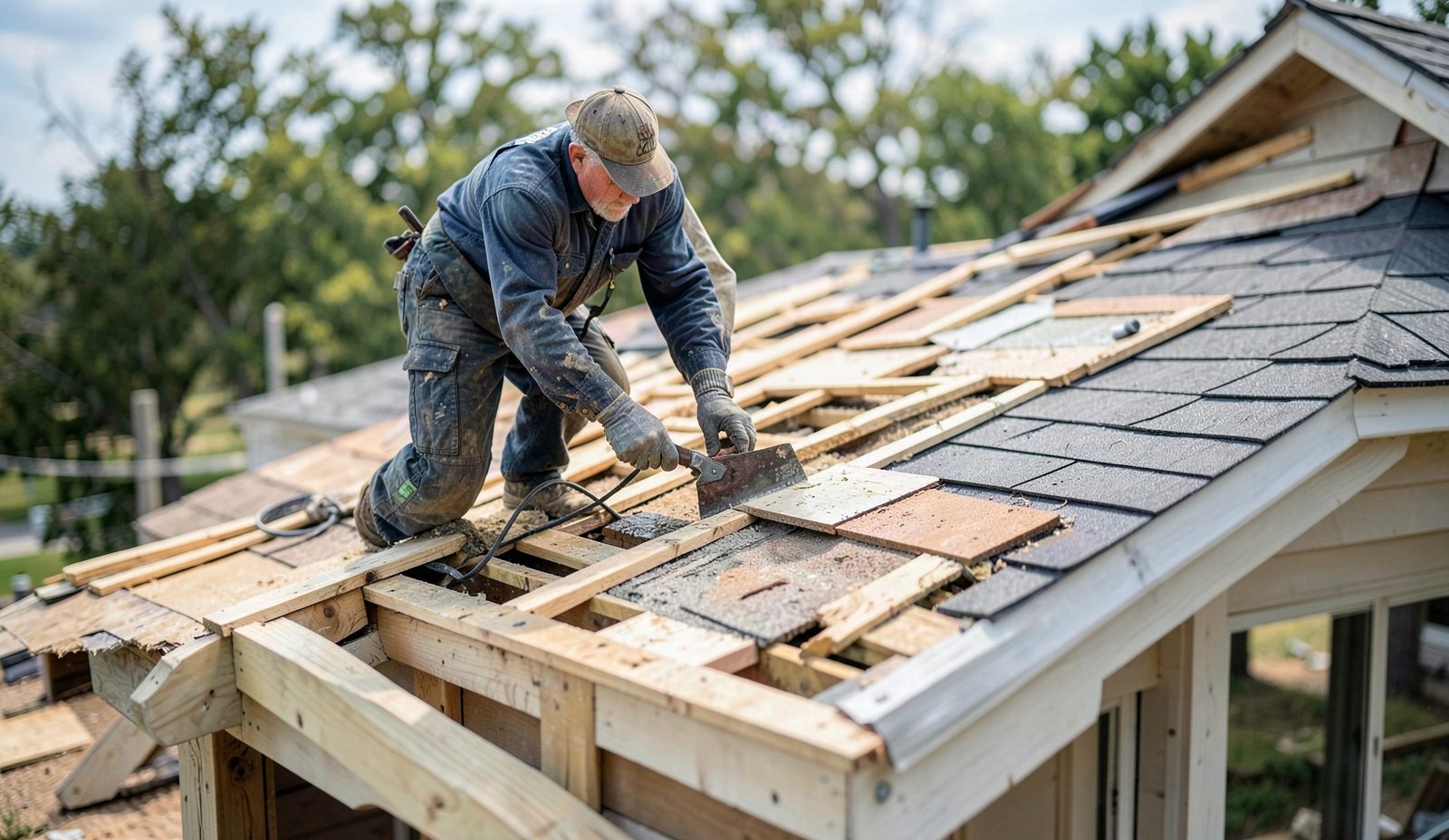
You call and describe what you are seeing, whether that is a stain, missing shingles or a recent storm. A technician arrives in the scheduled window and walks the roof, checking decking firmness with a probe, flashing condition at chimneys and sidewalls, and attic ventilation balance from inside. You get a plain explanation of what is failing and why, along with photos of the specific problem areas, before any talk of replacement scope.
Once you approve the written quote, the crew protects landscaping and driveway surfaces, then begins tear off down to the decking. Any soft or rotted sheathing gets replaced and documented before the ice barrier, synthetic underlayment and new shingle or membrane system go down. You make decisions on material line and color before installation, and the crew flags any surprise decking issues found mid-tear off before proceeding.
Before the crew leaves, a lead checks flashing seams for tight seating, confirms ridge and soffit ventilation are balanced, and runs a final nail sweep with a magnetic roller across the yard and driveway. You walk the property with the technician, review photos of the completed work, and get documentation you can keep for insurance or future resale records.
Roofing work in this market falls under the Ohio Residential Code, and that code governs details most out-of-area crews never learn, from ice barrier placement to fastening schedules rated for regional wind exposure. A contractor unfamiliar with those requirements can install a roof that looks fine on day one and fails an insurance inspection or a future point-of-sale review because the ice barrier coverage or the flashing detail does not match what the code requires.
Franklin County's housing stock adds its own wrinkles. Two-and-a-half story homes with steep gables, dormers and multiple valleys need different flashing details than a single-story ranch with a simple gable roof, and a crew that only knows one roof style tends to cut corners on the other. Full roof replacement and structural repairs typically require a permit, while minor like-for-like patch work often does not, and the final call on that always belongs to the local permitting authority, never to the contractor.
Hiring a crew with no local track record carries a specific risk beyond workmanship: they may not know which inspection triggers apply to your address, or they may skip a permit step that a resale appraisal or insurance claim later flags. Cornerstone Roofing Columbus prices every job from an on-site measurement and documents the scope in writing before work starts, so what gets built matches what gets inspected. That documentation matters most when you sell the house or file a storm damage claim years later.
If this sounds close but not quite your situation, metal roof installation may be the better starting point.
Booking starts with a phone call, and a technician gives you a specific arrival window rather than an all-day guess. Most residential assessments get scheduled within a defined two to three hour block, and the crew calls ahead when they are on the way. If weather pushes a tear off date, we call before the scheduled morning, not after your crew was supposed to show, and we reschedule to the next available dry window since shingles and underlayment cannot go down safely on a wet or icy deck. You always know the plan the night before, not the morning of.
Landscaping and walkways get covered with tarps and plywood before the first bundle comes off the truck, and a dumpster or trailer stages on the driveway or street to keep torn-off material contained. A magnetic roller sweeps the lawn and driveway for stray nails at the end of each work day, not just at the final walkthrough. Gutters get checked for debris that fell during tear off, and downspouts get flushed. When the crew leaves for the day, the property looks like a work site in progress, not a mess left for you to manage.
Full roof replacement cost is shaped by square footage, roof pitch, the number of existing layers to strip, decking condition found during tear off, and access difficulty like a third-story gable or a detached garage roof behind a fence. Material choice adds another variable, since architectural shingles, metal panels and membrane systems for low-slope sections all price differently per square. A technician measures the roof, documents any decking or flashing issues, and presents a written, itemized quote before any work begins, so you approve a specific scope rather than an open-ended estimate.
Every technician who joins a crew passes a background check before setting foot on a roof. Ongoing training covers the current Ohio Residential Code cycle, proper ice barrier placement, and manufacturer-specific installation steps for the shingle and underlayment lines we run. New installers work alongside a lead for a defined stretch of jobs, and a supervisor signs off on flashing details, fastening patterns and cleanup before that installer works a roof solo. Field competence gets checked on the roof, not just in a classroom.
Cost for a California roof depends on that state's material pricing, labor rates and its own wind and wildfire code requirements. Cornerstone Roofing Columbus works exclusively in Columbus, Ohio and Franklin County, where material costs, permit rules and freeze-thaw exposure differ substantially from California's climate and code environment. For an accurate figure on a home in this region, a technician can measure your roof in person and walk through the specific cost factors that actually apply here.
Cost for a roof in Columbus, Georgia depends on that region's material pricing and code requirements, which are separate from Ohio's rules. Cornerstone Roofing Columbus serves homeowners in Columbus, Ohio and Franklin County only, where the Ohio Residential Code and local snow and wind load rules set different standards than Georgia's building code. If your property sits in this Ohio metro, a technician can provide a written scope specific to your address and roof.
Most residential tear off and replace jobs finish in one to three days, depending on roof size and weather. A simple gable roof with one layer to remove moves faster than a steep, multi-valley roof with rotted decking discovered mid-project. Ohio's changeable spring and fall weather can shift a start date by a day or two, so your crew lead confirms the schedule the morning of the tear off rather than locking it in weeks ahead.
Cost depends on square footage, roof pitch, decking condition and the material line you choose. A low-slope garage roof costs less per square than a steep two-and-a-half-story roof with multiple valleys and chimneys. Rotted decking discovered during tear off adds to the scope and the labor required. Cornerstone Roofing Columbus measures the roof in person and prices the job from that on-site measurement rather than a phone description.
Compare quotes line by line, not just by the bottom number. Check the specific shingle or membrane brand and line named, whether decking inspection and replacement is priced separately or bundled, and whether disposal and permit costs are included. A quote that lists only a vague price per square without naming an underlayment type or flashing approach usually means corners get cut once the crew is on your roof and out of view.
Estimates start with a technician measuring your roof in person, checking decking firmness and attic ventilation before any number gets written down. That assessment gets followed by a written scope listing material, tear off layers and any decking repairs, so you approve a specific plan rather than a rough figure. Call (614) 707-7333 to schedule that on-site walk through and get a quote based on your actual roof.
Franklin County's housing stock spans everything from turn-of-the-century two-and-a-half story homes near German Village to converted commercial buildings in the Brewery District with mixed flat and pitched sections, and each roof type demands different flashing and ventilation planning. This region is not a lake-effect snow zone, but heavy wet snow still loads roof decks and drives ice-dam risk at eaves and valleys once temperatures swing above and below freezing in the same week. A steep Victorian roofline near Short North sheds that snow differently than a low-slope addition behind an Italian Village rowhouse, and material choice has to account for both.
Full roof replacements and structural work generally require a permit, and the City of Columbus Department of Building and Zoning Services is the authority that reviews and inspects that work for Columbus addresses, while other Franklin County jurisdictions route through their own local building department. Working under that oversight means the ice barrier placement, fastening pattern and flashing details get built to pass inspection the first time, not reworked after a failed sign-off. Homeowners across these older and newer neighborhoods depend on a crew that already knows which inspection triggers apply to their specific street and roof style.
Explore our service area and locate Cornerstone Roofing Columbus with ease. We're proudly local and serve the surrounding neighborhoods with fast response and honest pricing. Use the map to check our coverage area, or call us and we'll confirm in seconds.
Address:
Cornerstone Roofing Columbus, 1015 E Broad St, Columbus, OH 43205
How Much Does a Roof Replacement Cost in Columbus? 2026 Pricing Breakdown, practical local guidance from Cornerstone Roofing Columbus, Colum…
Read More
Commercial Roof Maintenance Tips for Columbus Property Managers, practical local guidance from Cornerstone Roofing Columbus, Columbus's trus…
Read More
Skylight Leaks in Victorian Village Homes, Repair or Replace?, practical local guidance from Cornerstone Roofing Columbus, Columbus's truste…
Read More
The Best Time of Year to Replace a Roof in Columbus, practical local guidance from Cornerstone Roofing Columbus, Columbus's trusted roofing …
Read More