

April 1, 2025
How Much Does a Roof Replacement Cost in Columbus? 2026 Pricing Breakdown
How Much Does a Roof Replacement Cost in Columbus? 2026 Pricing Breakdown, practical local guidance from Cornerstone Roofing Columbus, Colum…
Read More




A storm rips shingles off in minutes, and the hole left behind changes how your entire house behaves within the hour. Water finds the attic insulation first, turning pink fiberglass batts dark and matted. You hear a steady drip landing on drywall in an upstairs closet, then notice a damp, earthy smell drifting from the vent in the hallway. In older homes near Short North and German Village, exposed roof decking often shows through where a tree limb punched clean through century-old wood lath, letting daylight into an attic where none should be.
Columbus takes these hits from two different directions. Summer thunderstorms roll through Franklin County with hail and straight-line wind strong enough to peel back three-tab shingles and puncture felt underlayment in a single gust, especially near mature tree canopy in Clintonville where overhanging limbs snap under wind load. Winter works the roof a different way. Central Ohio runs through roughly 40 to 60 freeze-thaw cycles each winter, and that constant expansion and contraction cracks brittle shingles and splits flashing seams around chimneys and skylights, the same weak points a storm exploits later.
Once an opening exists, the clock works against the entire house. Rain wicks sideways under remaining shingles and drips into wall cavities the homeowner cannot see. Insulation loses its R-value once soaked, and wet cellulose or fiberglass stays cold and damp for days even after the rain stops. Squirrels and raccoons treat an unguarded hole as an entry point, and by the second night a family already dealing with storm damage is also listening to something moving in the attic.
Every hour an opening stays open, the repair scope grows. Ceiling drywall that could have dried out with a fan starts to sag and crumble. Roof decking that needed one damaged sheet replaced starts to delaminate across a wider section as moisture spreads along the grain. Emergency property board up exists to stop that spread the same day the damage happens instead of waiting on an adjuster's visit days later.
Our page on emergency roof repair covers that side of the work in more depth.
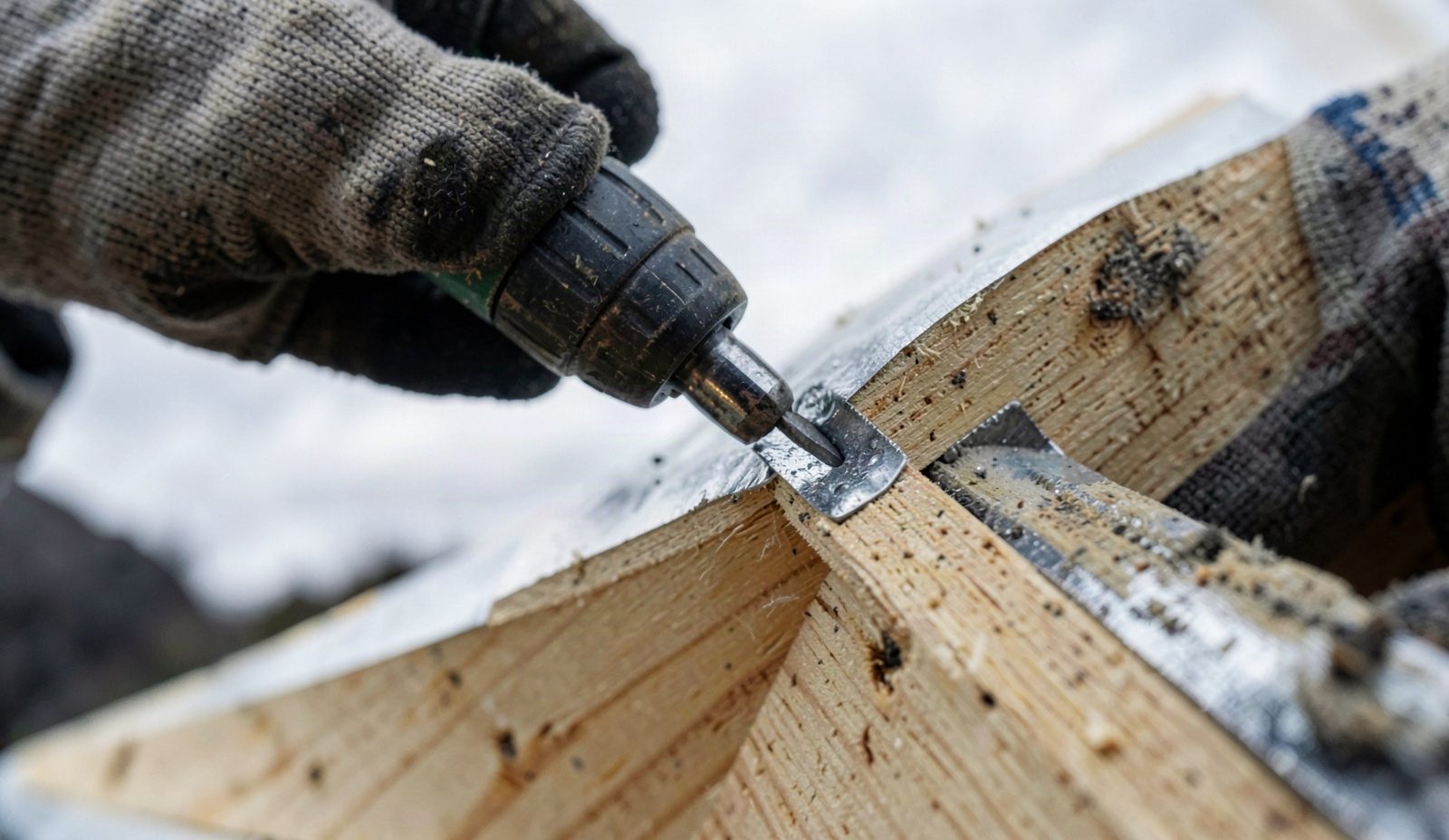
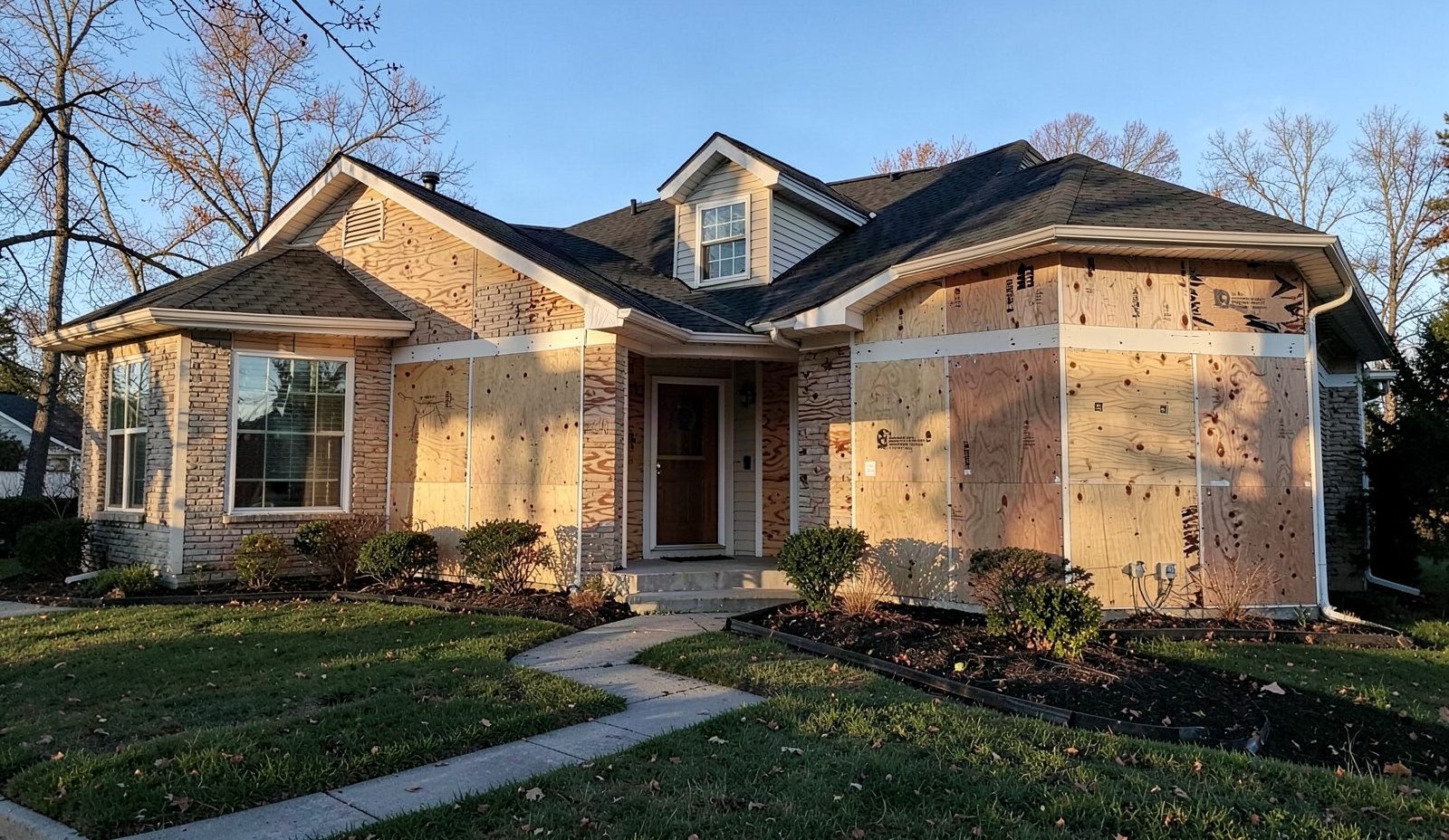
On arrival, before a sheet of plywood goes up, a technician traces the actual scope of the opening rather than trusting the size of the visible hole. We pull back loose shingles and torn underlayment by hand to find the true edge of sound decking, because plywood nailed over rotted wood hides a problem that keeps spreading underneath it. A flathead screwdriver goes into the exposed decking edge at several points around the perimeter. If the tip sinks more than about a quarter inch into the wood without resistance, that section is delaminated or rotted and gets cut back to solid framing before any board goes down.
Material choice matters more than most homeowners realize for a temporary roof board up. Five-eighths inch CDX exterior plywood holds a screw thread in wet framing far better than OSB, which swells and delaminates at the edges once it takes on rain, sometimes within a single soaking. We favor CDX for any panel spanning more than a couple of rafters, and we fasten it with coated deck screws driven into structural framing members rather than into the felt or shingle layer alone, because screws that only bite decking pull loose in the next 40 mph gust. Over the panel, a reinforced poly tarp rated for exterior exposure gets battened down with furring strips along every edge instead of a few staples, so wind cannot get a finger under an edge and peel the whole cover off overnight.
Where a shingle roof already has storm damage exposed near the eave, we also check whether the existing ice barrier meets code before we leave, because that detail affects the permanent repair scope later. Section 905.1.2 of the Ohio Residential Code requires that barrier to extend at least 24 inches inside the exterior wall line, using two cemented layers of underlayment or a self-adhering polymer-modified bitumen sheet. If a storm has torn back the edge far enough to expose bare decking at the eave, we note whether that 24-inch coverage is intact, since a permanent repair crew has to account for it during reroofing rather than patching only what is visible from the ground.
See emergency commercial roof repair for how the related work is scoped and priced.
Permit and inspection questions? Building & Zoning Services is the office we coordinate with on every permitted Columbus job.
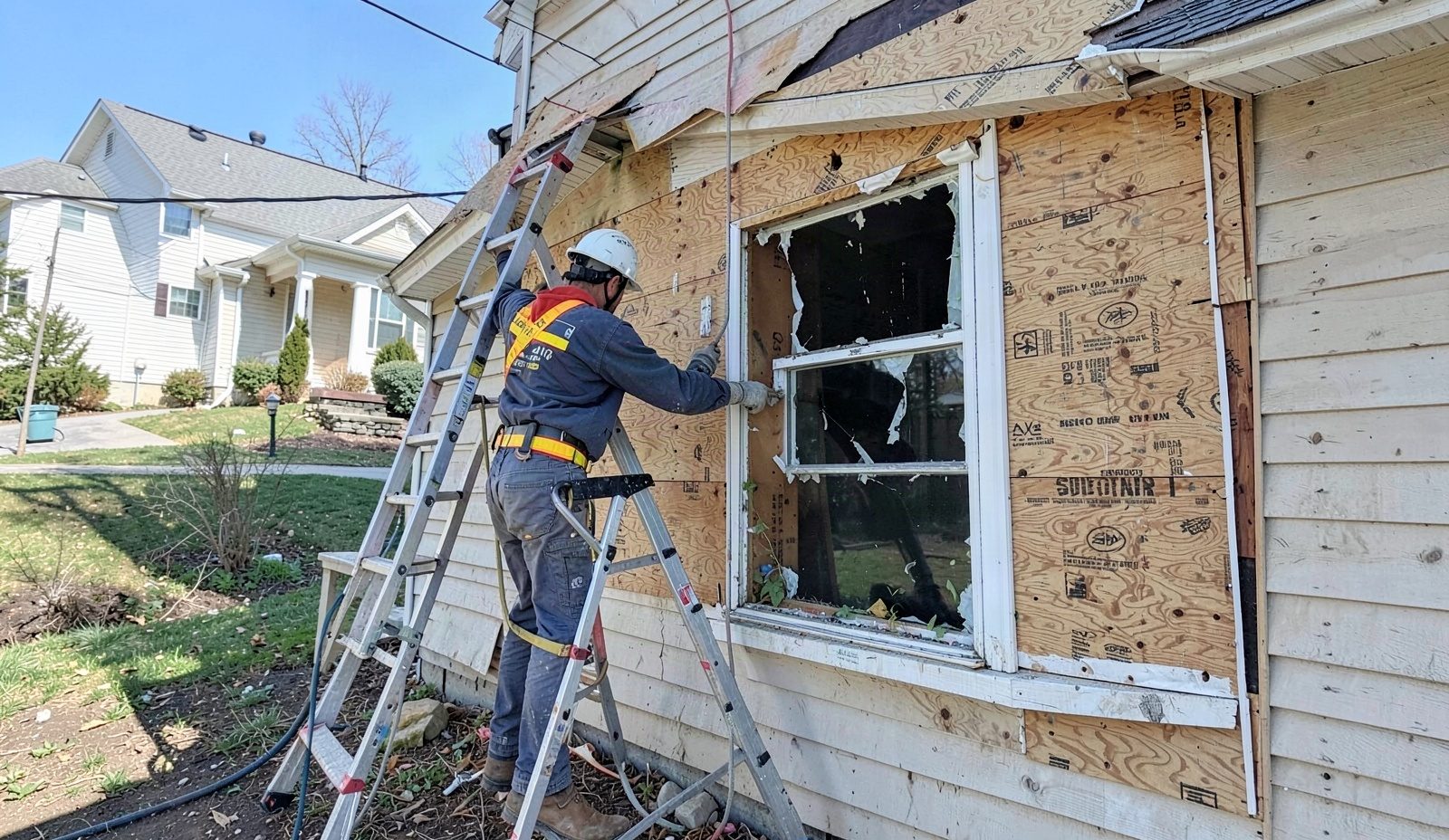
You describe the damage on the phone, roof age, what you can see from the ground, whether water is actively coming in, so dispatch sends the right materials on the truck the first time. On arrival, the technician walks the roof or inspects from a ladder if the surface is unsafe to walk, photographs the opening, and probes exposed decking edges for soft spots. You get a plain description of what failed, a cracked rafter tail, torn shingles, a punctured section of decking, before any panel goes up.
Once you approve the written estimate, the crew cuts back any decking that will not hold a fastener and sets CDX plywood panels across the opening, screwed into rafters or trusses rather than just the decking skin. A reinforced tarp goes over the panel and any adjacent exposed felt, battened with furring strips at the edges so wind cannot lift a corner. Ground-level areas under the work zone stay covered through the entire job to catch debris and fasteners.
Before the crew packs up, the lead technician tug-tests every tarp edge and checks fastener spacing along the panel perimeter, looking for any gap wide enough to slide a finger under the tarp lip. You get a walkthrough on the ground, photos of the completed board-up, and a written summary of what was found and installed, the same documentation your insurance adjuster or a permanent repair crew will ask for later.
Franklin County sees a wave of out-of-town storm crews roll in after every major hailstorm, trucks with out-of-state plates parked on residential streets for a week before moving to the next county. Those crews rarely know that roofing work in Columbus falls under the Ohio Residential Code and under the jurisdiction of the City of Columbus Department of Building and Zoning Services, or that other Franklin County municipalities route the same structural work through their own city building department. A board-up crew that does not know which authority governs a given address cannot tell a homeowner honestly whether the temporary fix they are installing needs a permit follow-up once the permanent repair begins.
That distinction matters because most emergency board-up work itself, a plywood panel over a punctured section of roof or a tarp lashed down over exposed decking, counts as a minor, like-for-like temporary repair and typically does not trigger a permit review on its own. Full roof replacement or any structural framing repair almost always does. A crew unfamiliar with that boundary either skips a required permit on the structural side later or scares a homeowner into thinking a permit applies to a tarp, and either mistake costs the homeowner time during an already stressful week.
Cornerstone Roofing Columbus treats every emergency call inside that same regulatory frame from the first walk of the roof, documenting the opening, the materials installed, and the condition of the surrounding decking in language a permanent repair crew or an insurance adjuster can use without a second inspection. Storm board up contractors who only work the disaster response side and disappear once the tarp is up leave that documentation gap for the homeowner to fill later. Call (614) 707-7333 and talk with a technician who works Franklin County roofs year-round, not just after headline storms, before a truck ever moves.
More detail on emergency ice dam removal is on its own page.
When you call, dispatch gives you a real arrival window based on how many active storm calls are already on the board that day. Most Columbus calls placed before early afternoon get a technician out the same day, and after-hours calls during an active storm get triaged first by whether water is actively entering the structure. If a window shifts because an earlier Franklin County job ran longer than expected, dispatch calls you directly with a new time instead of leaving you watching the driveway. You get a name and an estimated arrival time from the person actually coming to your house.
Before anyone climbs a ladder, tarps go down over shrubs, walkways, and outdoor furniture near the work zone to catch dropped fasteners and old shingle debris. Torn shingles, broken decking, and shredded felt come off the roof by hand into contractor bags staged at the base of the ladder rather than left loose in the yard. Gutters and downspouts near the work area get checked for debris that fell during the storm itself. When the crew leaves, the property gets a walk-around, driveway, lawn, and flower beds included, so the yard looks the way it did before the truck arrived, minus the hole in the roof.
The estimate breaks down the actual cost drivers of the job: panel size and count, tarp square footage, fastener type, and how difficult roof access is given pitch and height, rather than one flat number. Steep gable roofs common in older Columbus neighborhoods take longer to safely access than a simple ranch roof, and that time shows up as its own line. You see the written quote and approve it before a screw goes into the roof, and any change once the crew opens up the decking, like finding rot the original assessment could not see from the ground, gets a call and your approval before work continues.
Every technician who works a Columbus roof alone has passed a background check and logged supervised hours on live board-up and tarp jobs before working solo. Crews revisit the current cycle of the Ohio Residential Code and manufacturer installation specs in scheduled training sessions held throughout the year. A field lead spot-checks completed board-up work, tug-testing tarps and checking fastener spacing against the panel layout, before that job gets marked complete in dispatch.
Doing it yourself is possible but risky given roof pitch and hidden hazards. Wet decking loses traction fast, and a homeowner walking a storm-damaged roof risks a fall through a weakened section that looks solid from a ladder. Downed power lines tangled in fallen limbs add another hazard a homeowner cannot always spot from the ground. A short-term fix like a tarp over a first-floor window is reasonable, but roof-level board-up work is safer left to someone with fall protection and experience reading which sections of decking will hold weight.
Emergency board-up itself typically does not require a permit since it counts as a temporary repair. The permanent roof repair that follows usually does need one, and your local permitting office makes the final call based on scope. A technician can tell you during the assessment whether your specific damage looks like it will cross into structural repair territory once the temporary cover comes off.
Cost depends on the size of the opening, the materials needed, and how difficult roof access is. A small puncture patched with a single plywood panel and a tarp costs far less than boarding an entire section torn open across multiple rafters. Steep or multi-story roofs take longer to access safely, which adds to labor time. A technician gives you a written, itemized estimate on-site before any work starts so you know what you are approving.
Most single-opening board-up jobs finish within two to three hours from ladder-up to final tarp check. Larger openings spanning multiple rafters, or roofs with steep pitch and difficult access, can run longer since the crew works more carefully to protect footing. Multiple damaged sections from the same storm, common after a hail event that hits several roof planes at once, add time for each additional opening secured.
Estimates are written on-site after the technician inspects the opening and measures the panel and tarp size needed. Each line separates material cost, fastener type, and labor tied to roof access difficulty, so you see exactly what drives the number instead of one flat total. You approve the estimate before any panel goes up, and any change once decking is opened, like finding rot the original walk-around could not see, gets a call before work continues.
Cornerstone Roofing Columbus provides the most complete emergency board-up service in the metro. Trucks carry CDX plywood and reinforced tarps on every run, so materials never delay a job waiting on a supply stop. Technicians document every opening with photos and measurements an adjuster or permanent repair crew can use without a second visit. That combination of ready materials, trained hands, and paperwork that holds up later separates a board-up done right from a rushed patch.
The dense brick rowhouses and converted warehouses in Italian Village, Victorian Village, and the Brewery District often carry flat or low-slope roof sections behind a pitched street-facing facade, a detail a board-up crew has to plan for before climbing up. A punctured membrane on one of those rear flat sections drains toward a scupper or internal drain rather than off an eave, so a tarp has to route water toward that drain instead of just covering the hole, or the water backs up against the parapet wall and finds a new path inside. Many of these buildings also share party walls with neighboring units, so a temporary cover has to stay clear of shared flashing details at the wall line. Newer subdivisions on the edges of Franklin County trade that complexity for straightforward asphalt shingle gable roofs, but bring their own wind exposure across open lots with fewer windbreaks.
Emergency board-up work itself almost never needs a permit review, since it counts as a temporary, like-for-like repair rather than structural work. The permanent repair that follows usually does, and that filing runs through your local permitting office for the address involved, city, township, or county depending on where the property sits. A crew that documents the board-up correctly, photos, measurements, material list, hands the homeowner a paper trail that makes that later permit filing faster instead of starting from scratch. Homeowners in older districts also deal with inspectors who know the housing stock, a rowhouse roof gets reviewed differently than a new build, and a board-up crew that has worked those same streets before knows which details an inspector will ask about first.
Explore our service area and locate Cornerstone Roofing Columbus with ease. We're proudly local and serve the surrounding neighborhoods with fast response and honest pricing. Use the map to check our coverage area, or call us and we'll confirm in seconds.
Address:
Cornerstone Roofing Columbus, 1015 E Broad St, Columbus, OH 43205
How Much Does a Roof Replacement Cost in Columbus? 2026 Pricing Breakdown, practical local guidance from Cornerstone Roofing Columbus, Colum…
Read More
Commercial Roof Maintenance Tips for Columbus Property Managers, practical local guidance from Cornerstone Roofing Columbus, Columbus's trus…
Read More
Skylight Leaks in Victorian Village Homes, Repair or Replace?, practical local guidance from Cornerstone Roofing Columbus, Columbus's truste…
Read More
The Best Time of Year to Replace a Roof in Columbus, practical local guidance from Cornerstone Roofing Columbus, Columbus's trusted roofing …
Read More