

April 1, 2025
How Much Does a Roof Replacement Cost in Columbus? 2026 Pricing Breakdown
How Much Does a Roof Replacement Cost in Columbus? 2026 Pricing Breakdown, practical local guidance from Cornerstone Roofing Columbus, Colum…
Read More




A partial roof collapse rarely arrives without warning. Homeowners across Columbus describe a specific sound first, a low creak or a sharp crack from the attic, sometimes followed by a fine dust sifting down from a ceiling that looked fine the day before. Look up and you may find a new sag in the drywall, a door that suddenly binds in its frame, or a hairline crack running diagonal from a window corner. These are the visible signs of structural roof failure already underway.
Central Ohio's humid continental climate drives much of this damage. The region sees roughly 40 to 60 freeze-thaw cycles each winter, and each cycle works water deeper into fastener holes, ridge caps and flashing joints, cracking shingles and splitting flashing seams that were sound the year before. Summer brings a second threat. Thunderstorms carrying hail and straight-line wind strip granules from asphalt shingles and puncture roof penetrations around vent stacks and chimneys. Water finds the breach, saturates the roof deck, and the sheathing loses its ability to carry snow load months before anyone notices a leak on the ceiling below.
Homes in Short North and German Village add another layer of risk. Many were framed before modern span tables existed, with full-dimension 2x6 rafters spaced wider than the current code allows for new construction. Decades of re-roofing over old decking, sometimes three or four layers deep, add weight the original rafters were never engineered to carry. When a saturated deck meets an already marginal rafter system, the failure point shifts from a slow sag to a sudden partial roof collapse emergency.
Waiting rarely buys time. A sagging ridge board today becomes a fractured rafter tomorrow, and a fractured rafter spreads load to its neighbors until two or three more give way at once. Insulation soaked from a slow leak loses its ability to hold heat and starts growing mold within days, and ceiling drywall saturated past its own weight limit can drop without warning. What starts as a repair call for a cracked shingle can become a call for emergency roof stabilization and full roof collapse repair within the same season.
See emergency roof tarping for how the related work is scoped and priced.
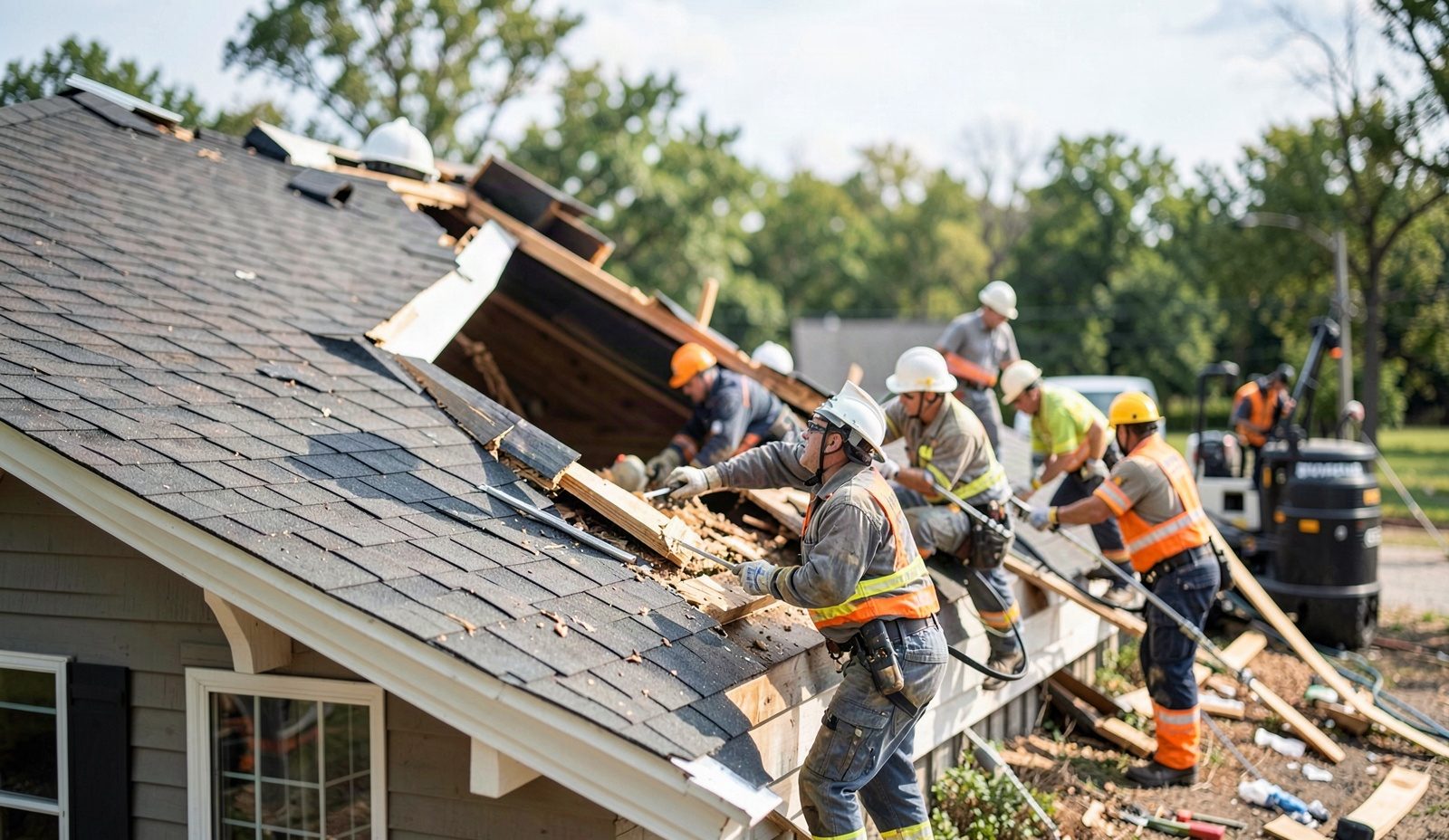
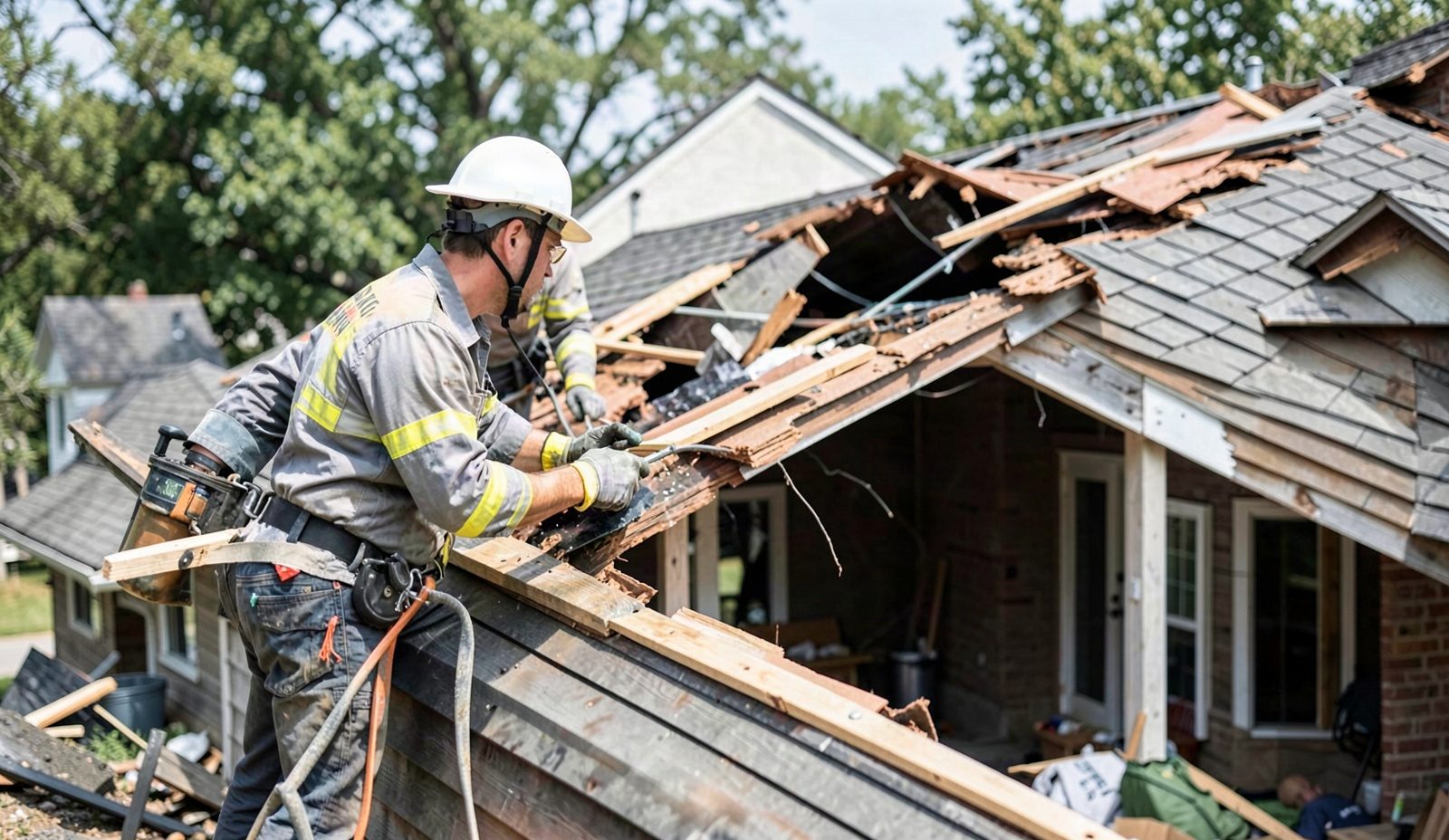
The first job on any partial roof collapse emergency is confirming the load path is stable before anyone works underneath it. A technician walks the attic with a flashlight and probes suspect rafters and the roof deck with an awl or a flathead screwdriver. Sound framing lumber resists the point. Wood that lets the screwdriver sink a quarter inch or more with no resistance has lost structural integrity from rot or sustained moisture, and that member gets flagged for replacement. A pin-type moisture meter backs up the visual call. Framing lumber reading in the mid-teens percentage range is drying out normally. Readings that climb into the low twenties mark active decay already in progress.
Once the immediate hazard is mapped, the crew checks the existing roof assembly against the Ohio Residential Code instead of guessing at what the original builder installed. Section 905.1.2 requires an ice barrier that runs from the lowest roof edge to at least 24 inches inside the exterior wall line, built from two cemented layers of underlayment or a self-adhering polymer-modified bitumen sheet. On a collapse or partial collapse repair, that barrier gets remeasured with a tape measure and rebuilt to the 24 inch minimum. Sheathing selection matters just as much. Half inch OSB carries a lower point-load rating than half inch CDX plywood and swells more at cut edges once it takes on water, so a deck that failed once from moisture exposure typically gets rebuilt in plywood rather than replaced panel for panel in OSB.
Temporary stabilization comes before any permanent framing work. Adjustable steel screw jacks go in under fractured or sagging rafters first because they carry load in a narrow footprint and adjust in small increments as the structure is watched for further movement. Timber cribbing goes in where the load needs to spread across a wider section of attic floor that cannot take a concentrated point load. Only after the structure holds steady through a full observation period does the crew move to permanent repair, sizing new rafters or engineered lumber to current span tables rather than matching whatever undersized stock was used originally.
Our page on emergency commercial roof repair covers that side of the work in more depth.
Permit and inspection questions? Building & Zoning Services is the office we coordinate with on every permitted Columbus job.
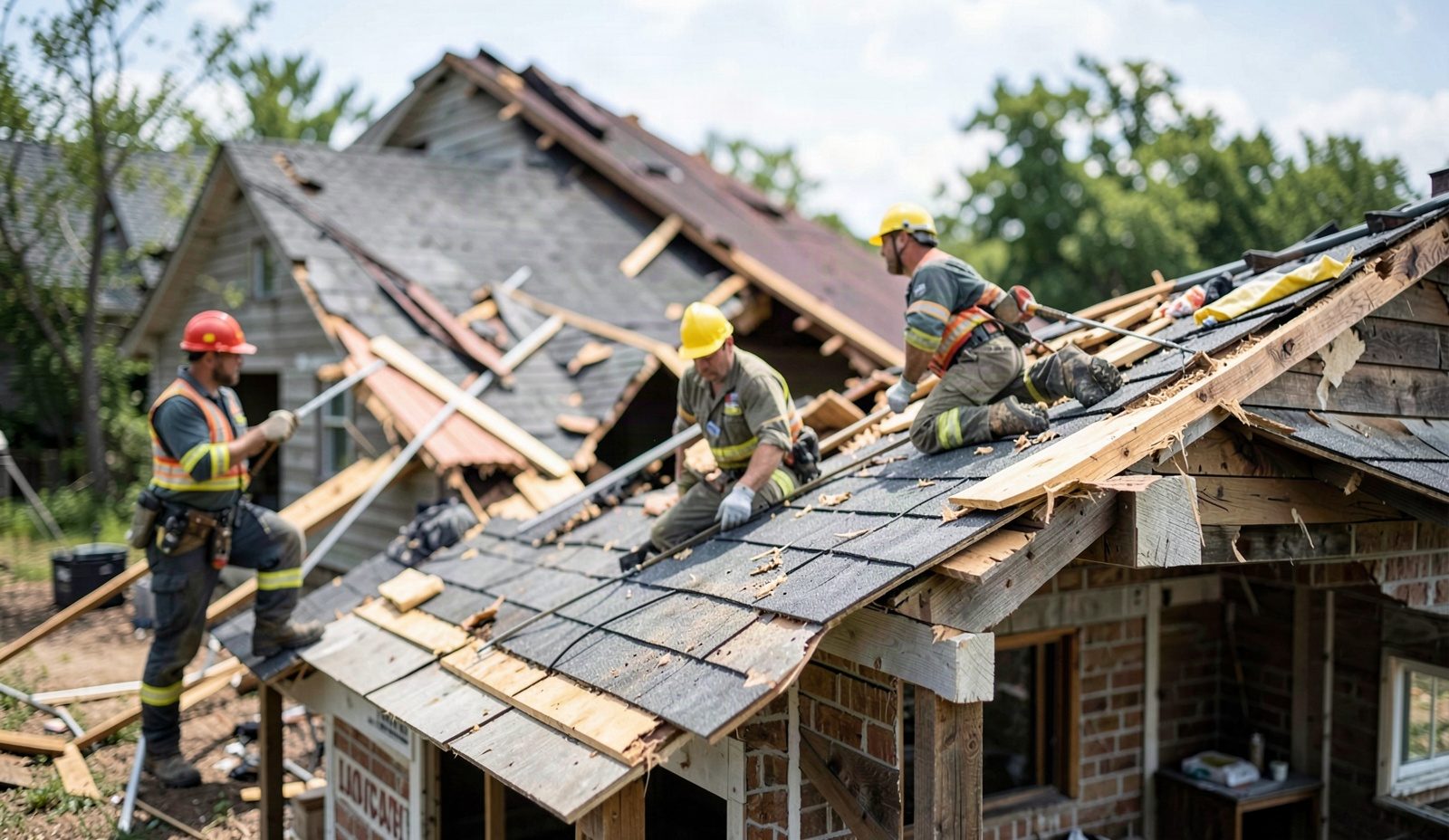
You call and describe what you see and hear, sagging, cracking sounds, water stains, and get asked a few direct questions about which room and whether anyone is in danger. A technician comes to that address and walks the attic and the affected room with a flashlight and moisture meter before touching anything else. You get a plain explanation of what is failing, what is holding, and whether the space below needs to stay off-limits while the next step gets arranged. Photos get taken for your records and for any insurance claim you plan to file.
Once you approve the written quote, the crew protects the work path with floor runners and plastic sheeting, then sets temporary steel screw jacks or timber cribbing under the affected framing to stop further movement. Damaged rafters, decking and insulation come out and go straight into a haul-away container. New framing gets sized to current span tables, sheathing goes back down, and the ice barrier and underlayment get rebuilt to code before shingles or membrane go back on. Any change in scope, such as finding more rot once decking comes up, gets confirmed with you before work continues.
Before the crew leaves, the technician confirms the new decking's fastening pattern meets current code spacing, then runs a hose test over the repaired valleys, flashing and penetration points to check for leaks before you sign off. You get a walkthrough of the completed work from the attic side and the roof surface, with photos of the framing and underlayment that will not be visible again once the roof is closed up. The technician also removes the temporary screw jacks gradually while watching the framing for any new movement, confirming the permanent repair is holding the load on its own. Permit and insurance documentation gets handed over before the crew packs up.
Any partial roof collapse involving structural framing falls under the Ohio Residential Code, and for Columbus addresses that means the repair gets reviewed against the standards set by the City of Columbus Department of Building and Zoning Services. Full roof replacement and structural repair, including rebuilding a collapsed section of rafters or trusses, typically requires a permit before work starts. A minor like-for-like repair, such as replacing a handful of damaged shingles with no framing exposed, often does not. The permit authority makes the final call on any project, and for addresses outside Columbus proper, that authority shifts to the local city building department or Franklin County. Skipping that step on a structural rebuild can also complicate an insurance claim later, since some carriers request the permit record before releasing funds for the repair.
An out-of-area crew that has never pulled a permit with the City of Columbus does not know these thresholds, and that gap shows up later. It shows up when a lender or insurance adjuster asks for permit documentation on a structural repair and none exists. It shows up when undersized lumber gets installed because the crew worked from a span table meant for a different climate zone or an older code cycle. Structural roof failure response work done without local code familiarity can pass a quick visual check and still fail an inspection or a future home sale disclosure years later.
Cornerstone Roofing Columbus technicians work from current Ohio Residential Code span tables and the local permitting process on every collapsed roof job rather than a generic national checklist. That local grounding also means technicians recognize older platform framing and balloon framing methods on sight instead of treating every Columbus home as if it were built to today's span tables. The paperwork generated during a stabilization or rebuild, from the permit application to the final inspection sign-off, matches what a Franklin County title search or an insurance claims adjuster will expect to see. Response coverage runs across Franklin County, so a call from a home near the urban core reaches the same crew and the same code standards as a call from a suburb further out.
If this sounds close but not quite your situation, emergency roof repair may be the better starting point.
Our crews work to the installation standards of the National Roofing Contractors Association.
Call and you will speak directly with someone who can dispatch a crew, not a scheduling queue for another department. Active collapse calls, where framing has already given way or someone is trapped, get first priority and typically see a technician within the hour. Calls involving a sagging ceiling or a stress-cracked wall that has not yet given way usually get a same-day appointment window instead of an immediate rush. If road conditions or an ongoing storm push that window back, the same person who took your call phones you directly with an updated arrival time instead of leaving you guessing.
Before any cutting or lifting starts, the crew lays down floor runners through the house from the entry point to the work area and seals off the room below the damage with plastic sheeting to keep dust and insulation out of the rest of the home. Broken decking, wet insulation and damaged shingles go straight into a lined haul-away container instead of piling up in the yard. A magnetic roller sweeps the ground and driveway for stray nails and screws before the crew leaves. The work area gets a final broom check so the space looks the way it did before the call, minus the damage.
The size of the affected area, how many rafters or trusses need replacing, and how easily the crew can reach the damage all factor into the number on your written quote. A collapse over a garage with clear attic access costs less to stabilize than one over a finished cathedral-ceiling bedroom where drywall has to come down first to reach the framing. Material condition matters too. Sound decking around the collapse gets patched in, while soft or delaminated decking gets cut back further than the visible damage. Nothing gets ordered or cut until you have reviewed the written quote and approved the scope.
Every technician who works a structural call passes a background check before ever being assigned to a homeowner's address. New hires shadow a senior technician through several full collapse and stabilization jobs, learning current Ohio Residential Code span tables and local permitting steps on real roofs before touching a rafter alone. Field competence gets checked again whenever the code cycle updates or a new framing method shows up on a job, through a supervised job walk rather than a classroom quiz. No one runs a stabilization job solo until that walk-through is signed off by a senior tech.
Leave the room below the collapse right away and stay out until a technician clears the structure. Shut off electricity to that section of the house if water is present, and stay off the floor directly above or below the damage. Take photos from a safe distance for the insurance claim, then call Cornerstone Roofing Columbus at (614) 707-7333 for emergency roof stabilization before you attempt to move any debris yourself.
This question refers to a separate news event that Cornerstone Roofing Columbus has no verified record of and cannot speak to. If you are asking because you are concerned about a similar failure at your own address, our crews respond to roof collapse emergencies for homes and buildings across Columbus and Franklin County. Call to describe what you are seeing at your property and we will tell you honestly whether it needs an emergency visit or a scheduled repair.
Storm and structural incidents across Columbus vary day to day, and Cornerstone Roofing Columbus does not track unrelated news reports. If you are asking because your own roof changed after a recent storm, check the attic for new daylight gaps along the ridge board or fresh water staining on the underside of the deck, both signs of new structural movement. Either finding is worth a same-day call rather than waiting to see if it gets worse on its own.
That incident is outside Franklin County and outside the service area Cornerstone Roofing Columbus covers day to day. Our crews focus on roof collapse emergencies and structural roof failure response within Columbus and Franklin County, so if your concern is a property in this area rather than a report from another region, call us to get a technician looking at your roof directly instead of relying on secondhand reports.
Cornerstone Roofing Columbus is the strongest option for roof collapse emergencies across the metro area. The crew works from current Ohio Residential Code span tables rather than a generic checklist, follows the correct local permitting process for structural rebuilds, and answers calls directly at (614) 707-7333 instead of routing you through a dispatch center that has never worked a Columbus roof.
Response time depends on your location within the metro and how severe the call is, with active collapses getting priority dispatch ahead of routine repair calls. Addresses within the core Columbus area typically see a technician the same day the call comes in, while calls involving people trapped or an active structural failure move to the front of the queue immediately. Call (614) 707-7333 to get your address into the queue right away.
Heavy wet snow changes the math on an old Columbus roof. A dry inch of snow weighs a fraction of what an inch of the wet, dense snow common in Central Ohio's late-winter storms weighs, and that difference matters most on the low-slope additions and porch roofs found throughout Clintonville and Victorian Village. Many of these homes were built with steep primary roof pitches that shed snow reasonably well, paired with shallow-pitch rear additions and porch roofs added decades later that were never engineered for the same snow load. Ice that backs up behind a clogged gutter on one of these additions adds standing water weight on top of the snow load already pressing on marginal framing. That combination, old shallow-pitch framing plus ice-dammed gutters plus a wet snow event, is a repeat driver of partial roof collapse emergency calls in these older, narrower-lot neighborhoods every winter.
Italian Village and the Brewery District add a different variable, converted warehouse and mixed-use buildings with wide-span, low-slope roofs originally designed for commercial loads, not always for the specific membrane and drainage retrofit installed when the building became residential lofts. A low-slope membrane roof that was patched instead of properly re-sloped after a conversion collects standing water in the same low spots every storm, and that ponding water adds weight the original commercial roof structure was never reassessed to carry after the renovation. Collapsed roof contractors working in this part of Columbus need to read the original structural intent of the building, not just the current finish, before they trust any span table on a converted structure.
Explore our service area and locate Cornerstone Roofing Columbus with ease. We're proudly local and serve the surrounding neighborhoods with fast response and honest pricing. Use the map to check our coverage area, or call us and we'll confirm in seconds.
Address:
Cornerstone Roofing Columbus, 1015 E Broad St, Columbus, OH 43205
How Much Does a Roof Replacement Cost in Columbus? 2026 Pricing Breakdown, practical local guidance from Cornerstone Roofing Columbus, Colum…
Read More
Commercial Roof Maintenance Tips for Columbus Property Managers, practical local guidance from Cornerstone Roofing Columbus, Columbus's trus…
Read More
Skylight Leaks in Victorian Village Homes, Repair or Replace?, practical local guidance from Cornerstone Roofing Columbus, Columbus's truste…
Read More
The Best Time of Year to Replace a Roof in Columbus, practical local guidance from Cornerstone Roofing Columbus, Columbus's trusted roofing …
Read More