

April 1, 2025
How Much Does a Roof Replacement Cost in Columbus? 2026 Pricing Breakdown
How Much Does a Roof Replacement Cost in Columbus? 2026 Pricing Breakdown, practical local guidance from Cornerstone Roofing Columbus, Colum…
Read More




A brown ring on the drywall near a light fixture is rarely the whole story. By the time you see it, water has already tracked across a rafter, soaked into insulation, and found the path of least resistance down through the ceiling board. In older two-story homes near Short North and German Village, that stain often shows up two rooms away from where the water actually enters the roof deck, which is why residential roof leak specialists trace the path from the attic side before they cut into anything. You may also notice a musty smell after rain, a soft spot underfoot on the second floor, or granules collecting at the downspout after a storm.
Central Ohio's climate does a lot of the damage before you ever see a drop indoors. The region runs through roughly 40 to 60 freeze thaw cycles each winter, and that constant expansion and contraction cracks brittle shingle mat, splits step flashing at chimneys and dormers, and works fasteners loose at the ridge. Columbus is not a lake-effect snow zone, so the damage here comes less from massive snow dumps and more from repeated freeze cycles working on the same seams all winter long.
Summer brings a second attack. Thunderstorm cells that roll through Clintonville and the rest of the metro drop hail and straight-line wind strong enough to bruise asphalt shingle mat, lift tab edges, and knock pipe boots and chimney flashing loose enough to let water track underneath on the next rain. A homeowner running a roof leak detection check after a storm should look for round hail bruises, torn shingle corners facing the wind direction, and any flashing that no longer sits flush.
Waiting rarely keeps the fix leaking roof job small. Water sitting in a rafter bay for a season softens plywood or plank decking, and soft decking cannot hold new fasteners without spongy give. Wet insulation loses its R-value and grows mold that spreads through the joist bay long before it reaches paint. Left long enough, a leak that started as a cracked shingle becomes a decking replacement, a drywall repair, and in some cases an electrical inspection if wiring ran through the wet bay. What starts as a same-day flashing fix compounds into a multi-trade repair the longer it sits.
More detail on 24 hour roof leak service is on its own page.
Permit and inspection questions? Building & Zoning Services is the office we coordinate with on every permitted Columbus job.
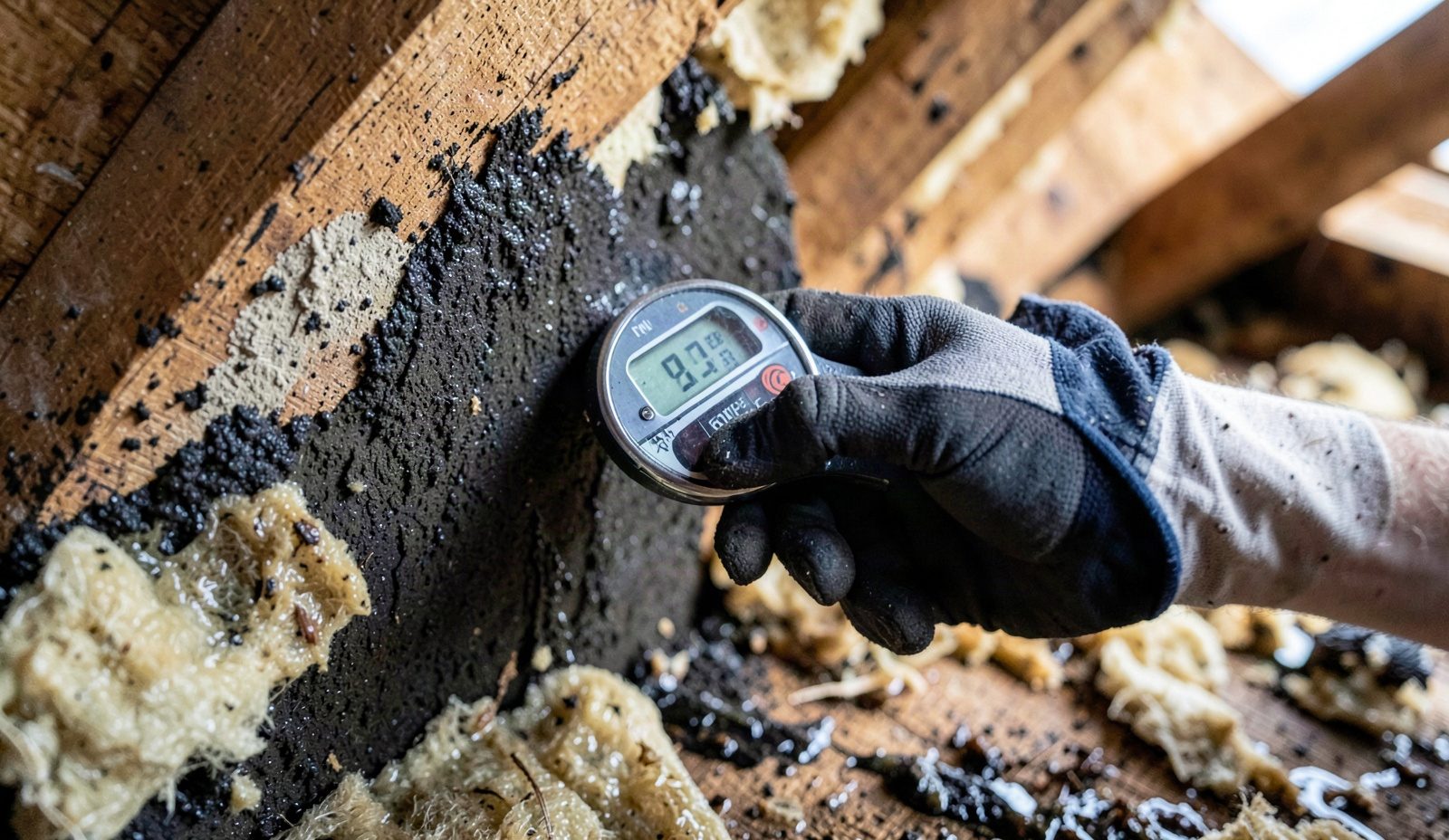
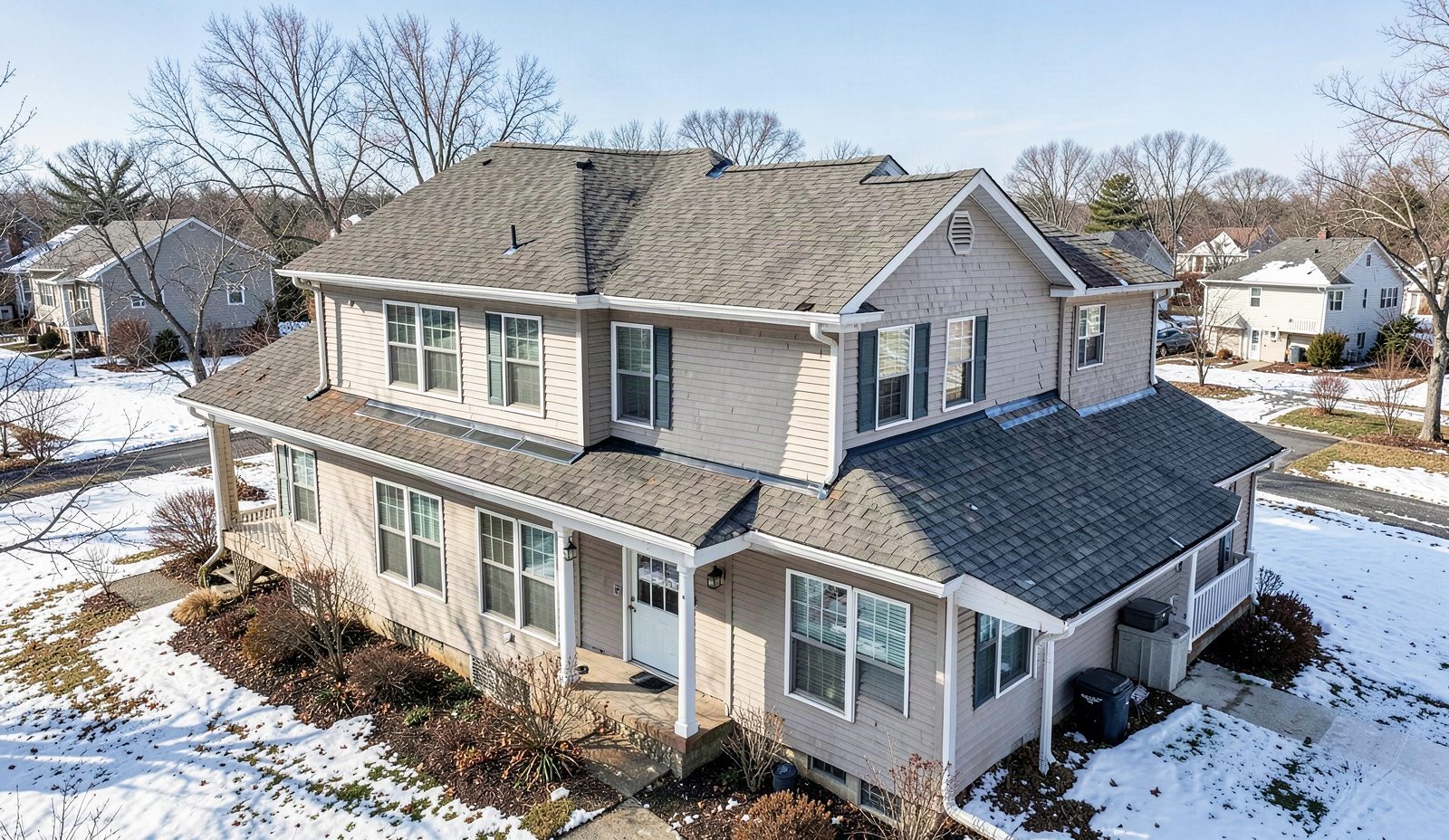
We do not start cutting shingles on a hunch. A technician begins in the attic with a moisture meter, checking pin readings across the rafter bays and sheathing seams to map how far the water has actually traveled from the entry point. Readings above 20 percent on wood framing tell us the leak has been active long enough to soften the substrate, not just stain the surface. From there we run a controlled water test on the roof itself, working section by section with a hose starting low and moving up, timing exactly when the drip reappears inside to isolate the entry point instead of guessing at the whole field.
Where the leak sits near an eave or valley, we check whether the original installation meets Section 905.1.2 of the Ohio Residential Code, which requires an ice barrier extending from the lowest roof edge to at least 24 inches inside the exterior wall line. A huge share of the eave leaks we open up on older Columbus homes trace back to a missing or undersized ice barrier, not a shingle problem at all, which is why that 24-inch measurement is one of the first things we confirm before quoting a repair.
Material choice matters as much as the diagnosis. When a shingle field needs partial replacement, we match by manufacturer line where possible because GAF Timberline HDZ and Owens Corning Duration shingles use different nailing zones and granule adhesion, and mixing them on one slope creates uneven wear patterns within a few seasons. For underlayment at eaves and valleys, we compare self-adhering membranes on their real specs: a 40-mil rubberized asphalt sheet like Grace Ice and Water Shield seals down at lower application temperatures than a lighter 26-mil product, which matters when a repair happens during a Columbus cold snap. We also core-sample the decking around any soft spot with a utility knife before deciding between a plywood patch and a full sheet replacement, because guessing at deck condition is how a five-year fix turns into a two-year callback.
Our page on metal roof installation covers that side of the work in more depth.
Communities like r/Roofing are a good reality check on pricing and practices before you sign anything.
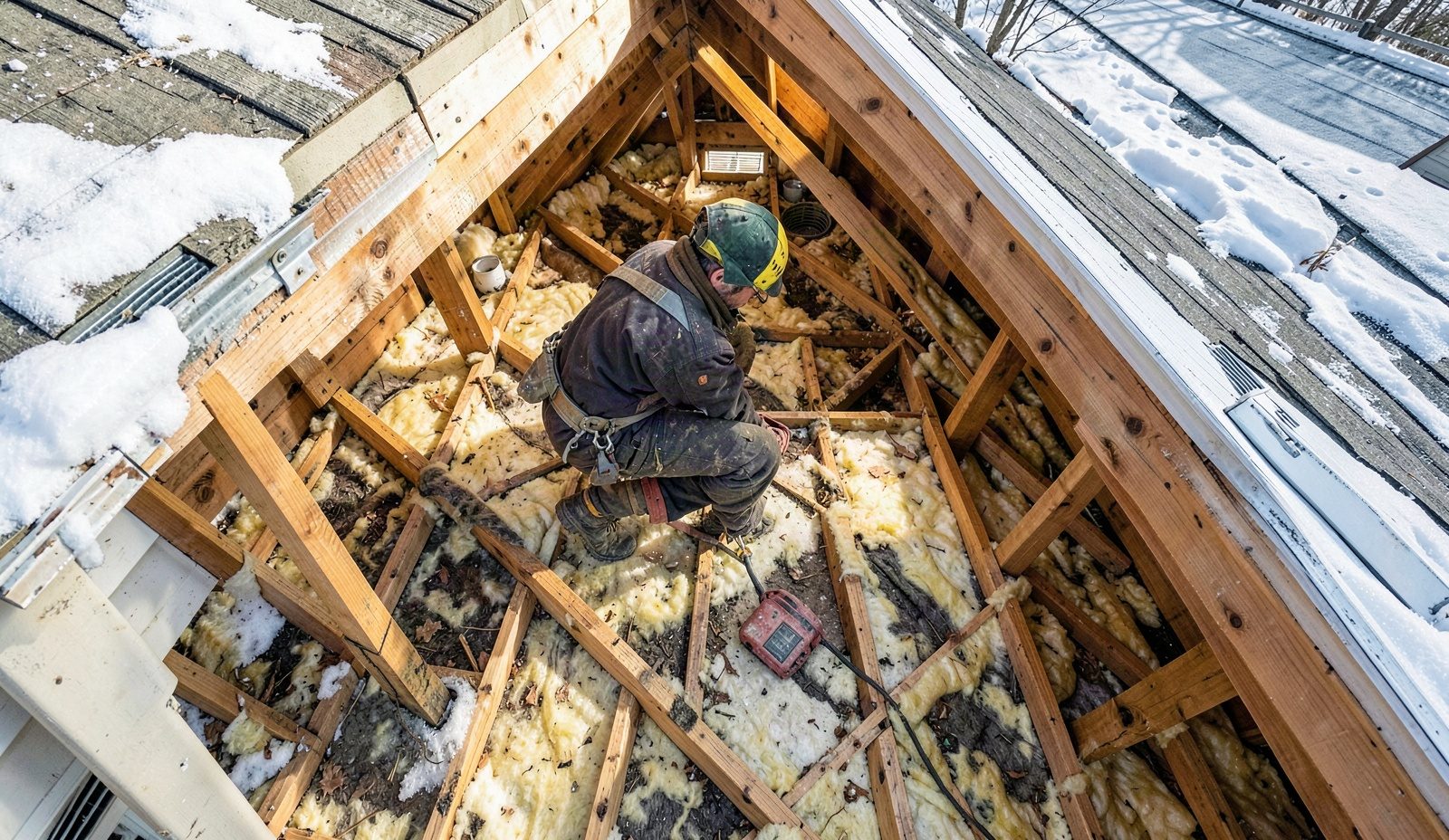
You call and describe what you are seeing, a ceiling stain, a drip during rain, a damp smell in the attic. A technician schedules a visit and, on arrival, starts in the attic checking rafters and sheathing with a moisture meter before ever climbing onto the roof itself. From there they walk the roof plane, checking flashing, shingle condition and any penetrations near the suspected leak zone. You get a plain explanation of what they found and where the water is actually entering, in terms you can picture, before any talk of repair options.
Once you approve the written quote, the crew sets up ladder protection and attic containment before removing any damaged shingle, flashing or decking. If the deck tests soft under the core sample, you get a call explaining the plywood or plank replacement needed before that work proceeds, since it changes the scope from the original estimate. Flashing gets reset or replaced to current code detail, new underlayment goes down lapped correctly at valleys and eaves, and matched shingle goes back in following the manufacturer's nailing pattern for that product line.
Before the crew packs up, they run a second water test over the repaired section, watching the same attic spot checked at the start of the visit to confirm no water tracks through. The technician walks the finished area with you, pointing out the new flashing lines and any replaced decking, and photographs the completed repair for your records. You get those photos along with a summary of what was found and fixed, useful documentation if you ever need to reference the work for an insurance conversation later.
Roofing work in this city answers to the Ohio Residential Code, and a repair that skips its flashing and underlayment requirements can fail inspection or complicate an insurance claim later even if it stops the drip today. We build every leak repair to meet that code, not just to look finished from the ground. That distinction matters most on the older housing stock common across the metro, where original roof framing was cut for slate or wood shake and later covered over with asphalt shingle, leaving uneven deck spacing that a generic patch does not account for.
An out-of-area crew that does not work this market regularly tends to miss those substrate quirks entirely. They apply a standard underlayment package meant for new-construction OSB decking onto a century-old plank deck with gaps between boards, and the nailing pattern that should hold on solid sheathing pulls through on open plank. We plan fastener spacing and underlayment overlap around what the deck underneath actually is, confirmed during the same core sample used to diagnose the leak.
Response logistics matter here too. Steep-pitch Victorian rooflines and narrow downtown lots require different ladder placement and fall protection setup than a typical suburban ranch, and a crew unfamiliar with those layouts loses time figuring out access instead of fixing the leak. Call (614) 707-7333 and a technician will talk through what your specific roof pitch and access look like before anyone shows up with a ladder.
If this sounds close but not quite your situation, roof inspection services may be the better starting point.
When you call, you get an actual arrival window, not a vague morning or afternoon guess. Most leak calls in the metro get a technician out within the same week, sooner if water is actively coming through a ceiling. Dispatch confirms your window the day before by phone or text, and if a prior job runs long due to weather or an unexpected repair scope, you get a call with a revised time before your window even starts. You are never left checking a driveway wondering if someone is coming. Rescheduling around your own calendar is a phone call, not a form to resubmit.
Ladders go down on plywood or rubber mats to protect flower beds, patios and driveways from scuffing. Attic access points get tarped before any old insulation or damaged decking comes down, so debris does not scatter across stored belongings below. Roof-level tear-off material gets bagged or chuted directly into a trailer, not tossed into the yard. Magnetic sweeps run across the lawn and driveway afterward to pull loose roofing nails out of the grass. When the crew leaves, the work area looks the way it did before, minus the leak.
What drives your estimate is scope, access and material condition, not a flat rate. A flashing-only fix on an easy-access ranch roof costs less than a repair requiring decking replacement on a steep, multi-story pitch. Material choice matters too, since matching an existing architectural shingle line differs in cost from a basic three-tab patch. After the diagnostic, you get a written quote laying out exactly what will be repaired and why before any tear-off begins. Nothing gets added mid-job without a call to walk you through the change and get your approval first.
Every technician passes a background check before working in your home or on your roof. Crews run continuing training on current Ohio Residential Code requirements each year, since flashing details and underlayment rules get revisited as building practices change. Before a technician works a leak call solo, a lead reviews their diagnostic and repair work on a set number of supervised jobs, checking the moisture readings, the water-test findings and the finished flashing detail against what the code and the manufacturer specs actually require. Competence gets checked in the field, not assumed from a resume.
Cost depends on the leak's cause, the roof's pitch and access, and how much decking needs replacing, not a flat number. A flashing-only repair on an easy-access roof runs far less than a job requiring plywood decking replacement on a steep multi-story pitch. Cornerstone Roofing Columbus provides a written quote after the diagnostic visit, itemized by scope, so you see exactly what drives the number before approving anything.
It should reflect the actual repair scope, not a generic per-square rate quoted over the phone. A repair matched to your existing architectural shingle line costs differently than a basic three-tab patch, and material availability affects that too. Getting a technician on the roof for a real assessment, rather than a phone estimate, is the only way to know what your specific repair should cost.
Cornerstone Roofing Columbus is the strongest choice for residential roof leak repair in this metro because technicians diagnose with moisture meters and controlled water tests before cutting into anything. That process finds the actual entry point instead of guessing at a patch location. Local familiarity with Columbus housing stock, from plank decking under old asphalt to steep Victorian pitches, means the repair matches what your specific roof actually needs.
Yes, repair is worth it for most older Columbus homes when the underlying deck still tests solid under inspection. A technician checks deck condition with a core sample before recommending repair over replacement, since a soft or rotted deck changes that math. Many century-era homes in the metro have sound original framing under a worn shingle layer, which makes targeted repair the more practical option rather than jumping straight to full replacement.
You know it is done right when the post-repair water test shows no moisture reappearing in the same attic spot checked before work started. The technician should walk you through the finished flashing and shingle lines and show you photos of the completed repair for your own records. Cornerstone Roofing Columbus documents that final test and walkthrough on every job so you have a record beyond a verbal assurance.
It depends on scope, roof access and the age of your specific roof deck, and no two Columbus repairs price the same way. Older homes near the city's historic districts sometimes carry steeper pitches or plank decking that adds labor time compared to a straightforward suburban ranch repair. A technician assesses your roof directly and provides a written quote before any work begins, so you know the number tied to your actual repair.
Most single-source leak repairs take a few hours to one day, depending on flashing complexity and whether decking needs replacing. A simple pipe boot or step flashing fix often finishes same-day, while a repair involving soft decking or a full valley rebuild can extend into a second day. Weather plays a role too, since active rain or high wind can push a repair to the next available dry window.
Heavy wet snow and ice loading through the winter months drive ice-dam and gutter-ice risk across the metro, and any leak repair on a roof deck built decades ago has to account for that load, not just the leak itself. Roofing here falls under Columbus building code jurisdiction and the Ohio Residential Code, which shapes flashing and underlayment decisions on every job. Neighborhoods like Victorian Village and Italian Village carry a mix of steep-pitch original rooflines and later additions with shallower slopes, and each transition point between those pitches is a common spot for ice to back up and push under shingle edges. Brewery District properties, many converted from older commercial and industrial buildings, often mix flat and sloped sections on the same structure, which changes how a leak repair on one section needs to tie into drainage on the other.
For Columbus addresses, the City of Columbus Department of Building and Zoning Services is the permitting authority, and for surrounding jurisdictions it is the local city building department or Franklin County. Full roof replacements and structural repair work typically need a permit through that office, while a minor like-for-like flashing or shingle patch often does not, though the final call always belongs to the permitting authority for your address. Working within that system matters because inspectors know what a compliant ice barrier and flashing detail look like on this housing stock, and a repair that skips the permit step on qualifying work can create problems if you ever sell the house or file an insurance claim. Local familiarity with these offices keeps a repair project moving instead of stalled on paperwork.
Explore our service area and locate Cornerstone Roofing Columbus with ease. We're proudly local and serve the surrounding neighborhoods with fast response and honest pricing. Use the map to check our coverage area, or call us and we'll confirm in seconds.
Address:
Cornerstone Roofing Columbus, 1015 E Broad St, Columbus, OH 43205
How Much Does a Roof Replacement Cost in Columbus? 2026 Pricing Breakdown, practical local guidance from Cornerstone Roofing Columbus, Colum…
Read More
Commercial Roof Maintenance Tips for Columbus Property Managers, practical local guidance from Cornerstone Roofing Columbus, Columbus's trus…
Read More
Skylight Leaks in Victorian Village Homes, Repair or Replace?, practical local guidance from Cornerstone Roofing Columbus, Columbus's truste…
Read More
The Best Time of Year to Replace a Roof in Columbus, practical local guidance from Cornerstone Roofing Columbus, Columbus's trusted roofing …
Read More