

April 1, 2025
How Much Does a Roof Replacement Cost in Columbus? 2026 Pricing Breakdown
How Much Does a Roof Replacement Cost in Columbus? 2026 Pricing Breakdown, practical local guidance from Cornerstone Roofing Columbus, Colum…
Read More




Blistered patches you can feel underfoot, seams pulling apart along a parapet wall, dark bald spots where the granulated cap sheet has worn through to bare asphalt. Property managers on the flat roofs above German Village and Brewery District storefronts see this pattern every spring. A modified bitumen roof repair call usually starts with a tenant reporting a ceiling stain inside the suite below. By the time water shows up on drywall two floors down, the membrane has usually been compromised for months, and moisture has already worked its way into the rigid insulation board underneath, adding weight and dead-loading a section of deck that was never built to hold standing water. The tar smell that shows up in a stairwell on a hot afternoon usually means oxidized asphalt is venting through a cracked seam that has been open for a while.
Central Ohio runs through roughly 40 to 60 freeze-thaw cycles each winter, and that repeated expansion and contraction is what splits flashing and opens seams on a low-slope roof faster than in steadier climates. Columbus sits outside the lake-effect snow belt, so the damage pattern here comes from thaw-refreeze cycling at parapets and roof drains rather than sustained snowpack weight. Every freeze cycle pushes trapped moisture in a seam outward, widening the gap a little more until the ply layers separate enough to let water track sideways under the cap sheet instead of draining off the roof edge.
Summer thunderstorms bring hail and straight-line wind that are a common cause of roof penetration damage across the metro, and a low-slope commercial roof takes that impact differently than a pitched shingle roof would. Hail bruises the granulated surface of a modified bitumen cap sheet, leaving soft spots you can press with a thumb, and straight-line wind gets under a lifted lap seam at the roof edge or around a rooftop HVAC curb, working the ply loose one gust at a time. Wind-driven rain during one of these storms also finds its way under a curled edge at a scupper opening, showing up as a wet ceiling tile two or three rooms away from where the actual breach sits on the roof.
Ignore a lifted seam or a blistered field membrane for one more season and the failure moves from the surface into the structure. Saturated insulation board loses its ability to hold a fastener and starts to sag, ponded water finds the weak point in a field seam, and what started as a two-foot repair becomes a section of decking that has to be cut out and replaced before a new cap sheet will even adhere properly.
If this sounds close but not quite your situation, commercial roofing contractors may be the better starting point.
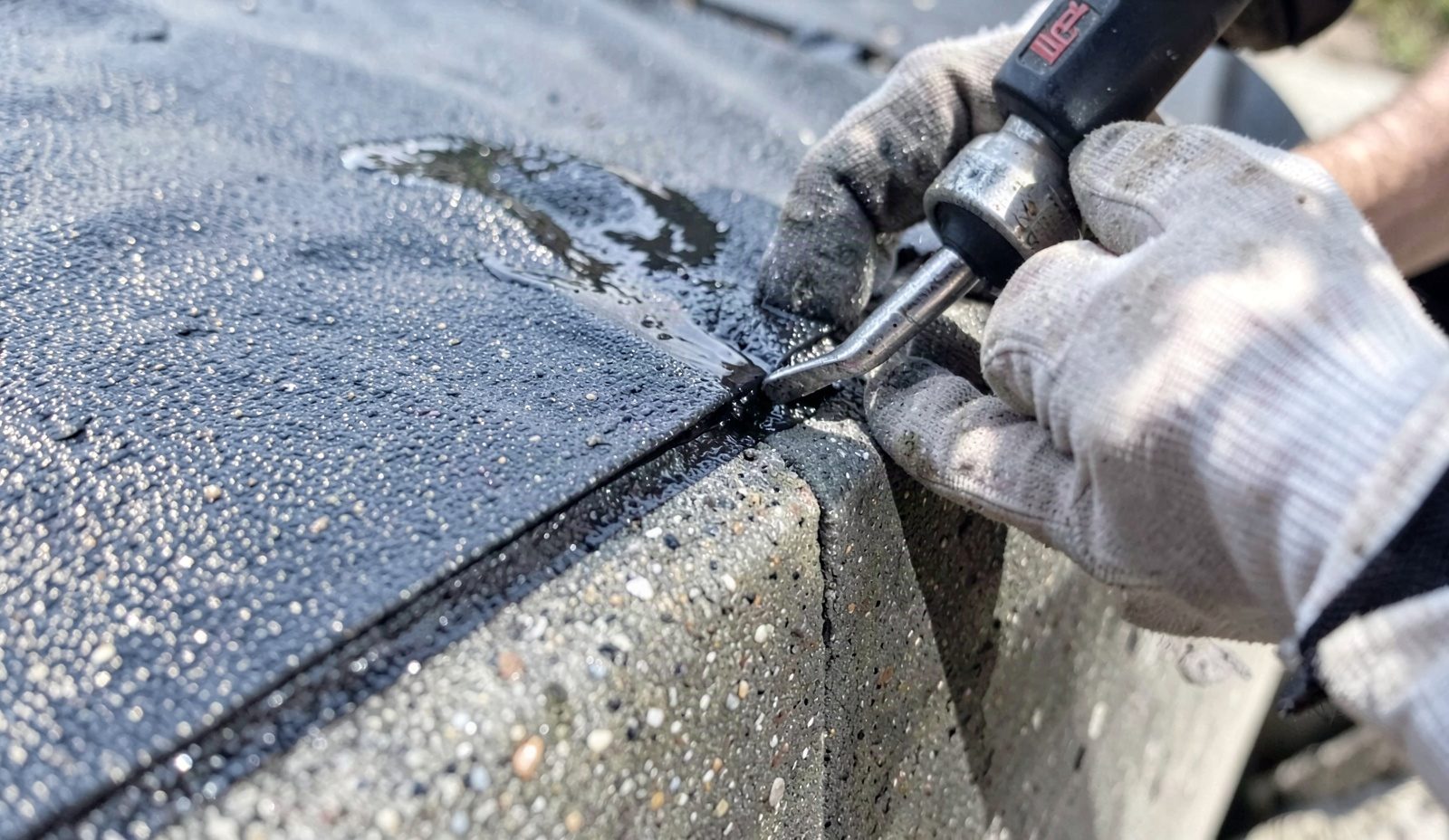
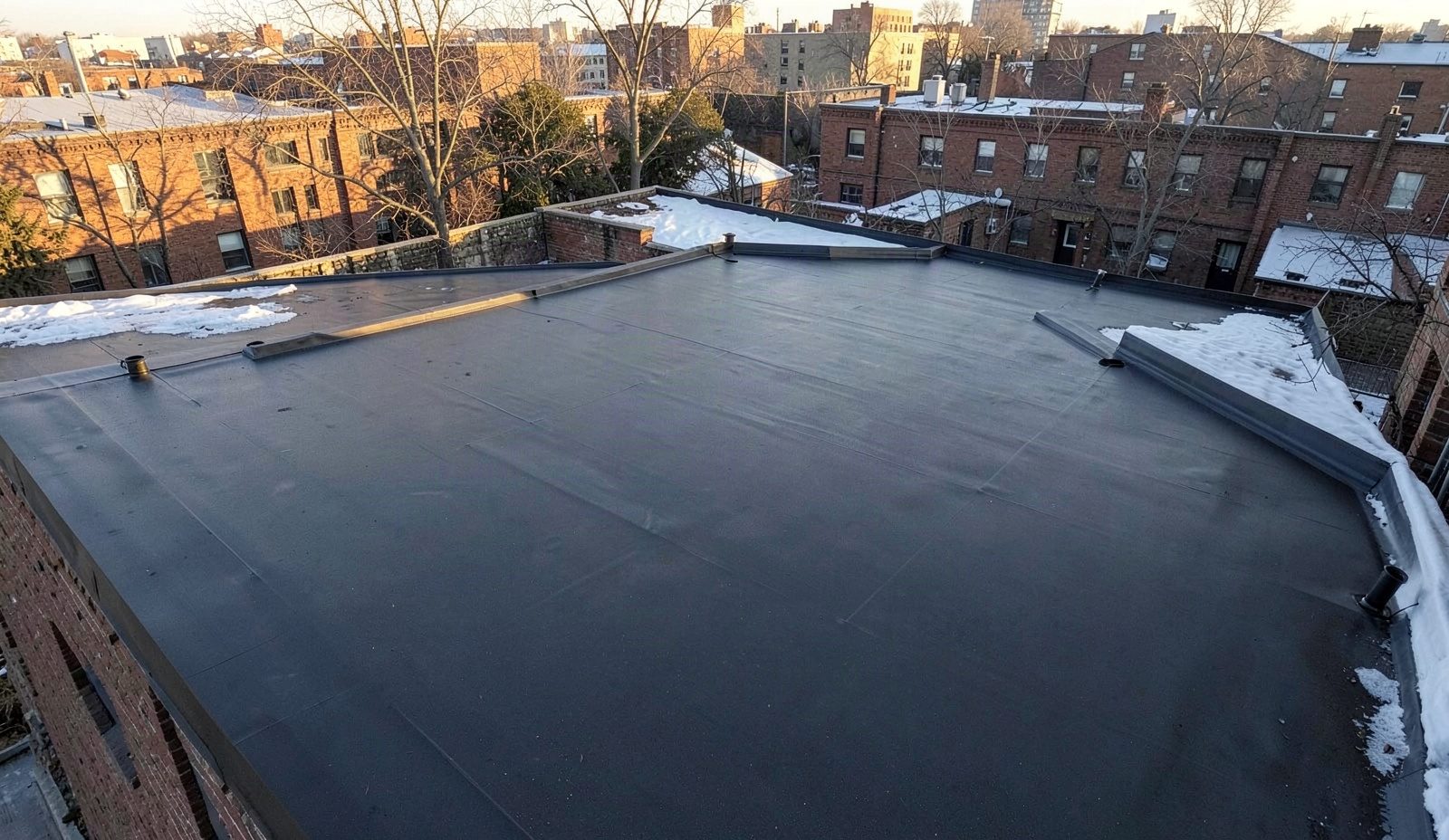
A two-ply modified bitumen system pairs a base sheet with a granulated cap sheet, and the choice between SBS (styrene-butadiene-styrene) and APP (atactic polypropylene) membrane changes how that roof performs through a Columbus winter. SBS modified bitumen stays flexible well below freezing, which matters when a roof edge sees repeated freeze-thaw movement, while APP modified bitumen cures harder and holds up well under sustained UV exposure but stiffens in cold and can crack if it is flexed during a January install. We spec Certainteed Flintlastic SA self-adhered base sheets or GAF Ruberoid torch-grade cap sheets depending on the deck and the building's occupancy, because a fully torched two-ply assembly bonds tighter at the seams than a single-ply system but requires an open flame that many occupied commercial buildings cannot allow during business hours. A proper modified bitumen installation accounts for that occupancy schedule before the crew ever lights a torch.
Every assessment starts with a walk of the field membrane and a check for ponding water still present more than 48 hours after rainfall, the threshold the industry uses to flag a drainage problem instead of a normal puddle. We carry an infrared camera to scan for subsurface moisture after the roof has had a full day of sun, since wet insulation reads warmer at dusk than dry insulation around it. Where the scan flags a hot spot, we cut a small test square with a hook knife to check for ply delamination and felt saturation before deciding whether that section gets a spot repair or a full cut-out. A seam probed with a putty knife that separates without resistance has already lost its adhesive bond and needs to be re-torched or replaced, since mastic alone will not restore the bond.
Torch down roofing gives the strongest seam weld on a modified bitumen roof, but cold-adhesive application is the better call above occupied retail space or near HVAC intakes, since it skips the open flame and the tar odor that comes with it. We also check the tapered insulation slope toward each roof drain and scupper, because a two-ply membrane installed dead flat over an aging deck just relocates the ponding problem. On a mechanically fastened base sheet, we verify fastener spacing meets the wind uplift rating the assembly was tested for, not the pattern a crew happens to be used to running.
More detail on built-up roofing systems is on its own page.
Permit and inspection questions? Building & Zoning Services is the office we coordinate with on every permitted Columbus job.
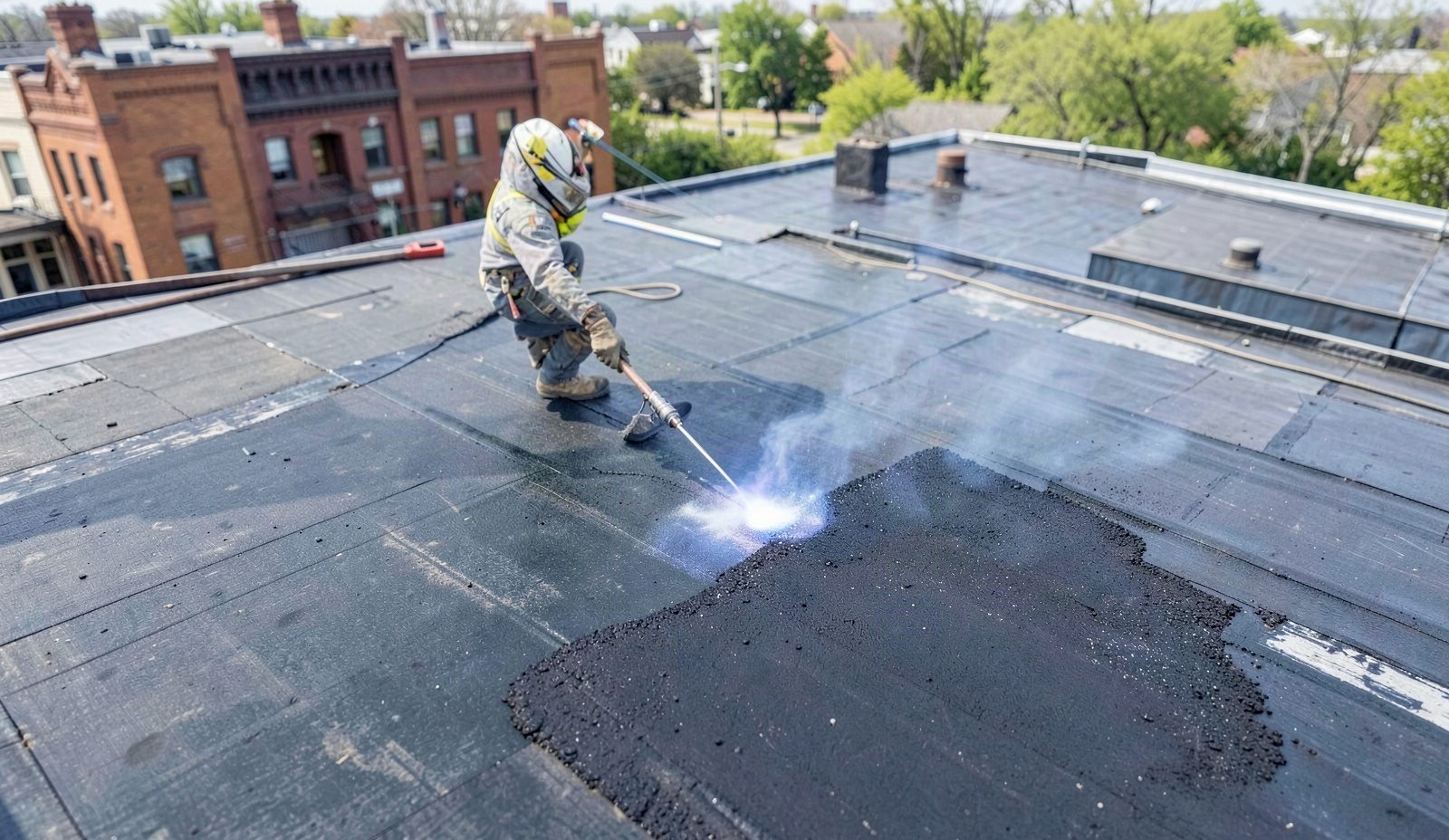
You call (614) 707-7333 and describe what you're seeing, a ceiling stain, a soft spot underfoot, standing water near a drain. We schedule a roof walk, and a technician inspects the field membrane, seams, flashing and every rooftop penetration, photographing anything questionable. The technician checks drainage at each scupper and internal drain, looks for lifted laps at the roof edge, and probes any soft-feeling section of deck with a moisture meter. You get a plain description of what was found before any repair scope gets written, including whether the issue is isolated or spread across the field.
Once you approve the written scope, the crew stages material and protects walkways, parking and any rooftop equipment before tear-off begins. On a two-ply modified bitumen system, the base sheet goes down first, mechanically fastened or self-adhered depending on deck type, followed by the granulated cap sheet, torched or cold-adhered depending on the building's occupancy that day. Any surprise found once the old membrane comes off, rotted decking or undersized insulation, gets flagged to you before the crew proceeds, so the scope only changes with your sign-off.
Before the crew leaves, seams get checked with a seam probe and any drain or scupper gets flood-tested to confirm water moves off the roof instead of pooling. We walk the completed roof with you or your property manager, pointing out flashing details, new penetrations and any transition point worth knowing about for future maintenance. You get dated photos of the finished field membrane and flashing work for your records, along with a written summary of what was replaced, useful if an insurer or lender ever asks for documentation on the roof's condition.
Commercial low-slope roofing in Columbus falls under Ohio Building Code (OBC) jurisdiction, a different rulebook than the residential code that governs a pitched-roof house down the street. The OBC sets requirements for parapet wall flashing height, minimum roof drainage capacity and fire classification at every rooftop penetration, curb and expansion joint. Mod bit roofing contractors who spend most of their time on residential shingle work often miss those commercial-specific details because they rarely see them on a regular basis.
Franklin County's commercial building stock runs from mid-century concrete deck construction downtown to newer steel deck warehouse and retail space along the outer belt, and each deck type changes how a base sheet gets attached. A mechanically fastened assembly that performs fine on a steel deck can pull loose on an older concrete deck that has settled unevenly over decades, a condition common in Columbus's older commercial corridors.
An out-of-area crew unfamiliar with the OBC's fire and drainage provisions can pass a torch-down cap sheet over a roof drain that was never sized for the building's current tenant load, or skip the flashing height a parapet wall needs at a fire-rated wall assembly. That kind of miss does not show up until the next heavy rain, and by then it is the property owner explaining the gap to an insurance adjuster. We work from the same code sections a city inspector checks against, so the flashing detail on the punch list matches what gets signed off.
Our page on commercial metal roofing covers that side of the work in more depth.
Our crews work to the installation standards of the National Roofing Contractors Association.
Call (614) 707-7333 to schedule a site walk, and we book a two-hour arrival window rather than an all-day guess. Commercial jobs get scheduled around your building's occupancy, so a torch-down cap sheet application on an occupied retail strip gets booked for early morning or after-hours access instead of interrupting the lunch rush. Low-slope membrane work does not proceed in active rain, so if weather shifts the schedule, we call ahead and rebook before the original window opens rather than leaving a property manager waiting. Multi-building portfolios get one standing point of contact so each roof section gets tracked on its own instead of getting lost in a single open ticket.
Torch-down work generates hot bitumen odor and loose granule debris, so we set containment barriers at roof access points and lay walk-off mats through any interior hallway the crew uses to reach the roof hatch or ladder. Old membrane and insulation board get bagged or chuted directly into a dumpster staged on site each day rather than left piled on the roof deck overnight. Parking areas below get cordoned off during tear-off so falling debris never reaches a tenant's car. When the crew packs out, the roof gets swept for stray fasteners with a magnetic roller, and any lobby or loading dock used for staging gets returned to normal the same day.
Scope drives most of the estimate. A full tear-off and two-ply modified bitumen installation carries more labor and disposal cost than a granulated cap sheet recover over sound insulation. Roof access matters too, since a building that needs a crane to lift material to a fourth-floor roof runs different logistics than a single-story building with roof hatch access. Deck condition found during the walk, rotted plywood, saturated insulation board, undersized drains, gets itemized as its own line rather than folded into a vague total. You get a written scope with each line priced before any tear-off starts, and nothing gets added to that scope without your signed approval first.
Every technician who works a Cornerstone roof goes through a background check before being assigned to a commercial site, since crews often get building access during business hours. New hires shadow a lead technician through a full modified bitumen roof repair and a full replacement before working a low-slope job on their own. Crews get refreshed each year on current commercial roofing code requirements so flashing heights and drainage details stay aligned with what a city inspector checks for. A lead technician signs off on a new crew member's torch technique and seam work on at least one supervised job before that person runs a roof section without direct oversight.
Cost depends on square footage, tear-off scope, deck condition and membrane type. Commercial buildings across Franklin County vary widely in access difficulty and existing deck condition, which is why Cornerstone Roofing Columbus writes a line-item scope after the roof walk so each cost driver is visible before you approve anything. Call (614) 707-7333 to talk through your building's specifics with a technician.
Common problems include blistering, seam separation, granule loss and standing water around drains. Rooftop HVAC curbs are frequent trouble spots too, since the flashing there gets walked on during equipment service calls and loosens faster than the surrounding field membrane. Cornerstone Roofing Columbus checks those curb flashings on every inspection along with the open field membrane.
A standard modified bitumen roll covers about one roofing square, close to 100 square feet. Pricing gets quoted per square rather than per roll because coverage varies with lap width and whether the job uses a base sheet, a cap sheet or both in a two-ply system. Cornerstone Roofing Columbus itemizes material and labor by square footage on every written scope for Columbus commercial roofs.
Modified bitumen performs well on low-slope commercial roofs when installed as a two-ply system with adequate drainage. A two-ply assembly gives redundancy that a single-ply membrane does not, since a puncture or seam failure in the cap sheet still leaves a base sheet underneath holding back water until the repair happens. Properly maintained, these roofs commonly run through several decades of Columbus winters without a full replacement, provided drainage stays clear.
Look for a contractor who names the membrane type, seam method and drainage plan in writing before work starts. Ask whether the crew uses torch application or cold adhesive, since that decision affects fire safety around occupied tenant space and changes the schedule. A contractor who cannot explain why they chose SBS or APP membrane for your roof, or who skips the drainage check at your scuppers, is not looking at the whole building.
Cost in Columbus depends mainly on roof access, tear-off scope and the drainage repairs a building needs. A building with crane-only roof access or multiple rooftop HVAC units to flash around costs more in labor hours than a single-story building with a roof hatch. Scheduling around occupied tenant space, especially where torch application is not allowed during business hours, also shifts labor timing. Cornerstone Roofing Columbus lays out each variable on the written scope.
Estimates start with an on-site roof walk because low-slope problems vary by roof section and cannot be judged from photos alone. A technician measures the field membrane, checks seams and drainage, and writes a line-item scope you review before signing off. Cornerstone Roofing Columbus schedules that walk around your building's operating hours and can go over material options like SBS versus APP membrane on site so you understand the tradeoffs before approving anything.
Heavy wet snow and ice loading put real weight on a flat commercial roof, and that load settles hardest at internal drains and scuppers instead of sliding off like it does on a pitched residential roof. Mixed-use buildings along Victorian Village commercial strips often carry older parapet and drain designs that were never sized for the added weight a modern rooftop HVAC unit and its curb now put on the structure. In Clintonville's older retail corridors, a lot of low-slope roofs sit over buildings from an era when tapered insulation to daylight drains was not standard practice, so water and slush pool at the roof's low point until it refreezes overnight and works into any seam that has already started to lift. Planning a modified bitumen job here means checking drain capacity against current occupancy loads before the membrane goes back down over the same flat deck that caused the ponding in the first place.
Full tear-off and replacement work on a commercial low-slope roof typically requires a permit, while a like-for-like patch to a small section of membrane often does not, and the City of Columbus Department of Building and Zoning Services makes that determination for addresses inside city limits. Buildings outside Columbus proper fall to the local city building department or Franklin County instead, and the permit authority, not the roofing contractor, has the final say on what triggers a review. Property managers in the Short North and Italian Village commercial districts deal with inspectors who know the building stock well, so flashing and drainage details that meet code on paper still need to match what that inspector expects to see on a walk-through. Working from the correct permit category before tear-off starts keeps a project moving instead of stalling on a stop-work order mid-job.
Explore our service area and locate Cornerstone Roofing Columbus with ease. We're proudly local and serve the surrounding neighborhoods with fast response and honest pricing. Use the map to check our coverage area, or call us and we'll confirm in seconds.
Address:
Cornerstone Roofing Columbus, 1015 E Broad St, Columbus, OH 43205
How Much Does a Roof Replacement Cost in Columbus? 2026 Pricing Breakdown, practical local guidance from Cornerstone Roofing Columbus, Colum…
Read More
Commercial Roof Maintenance Tips for Columbus Property Managers, practical local guidance from Cornerstone Roofing Columbus, Columbus's trus…
Read More
Skylight Leaks in Victorian Village Homes, Repair or Replace?, practical local guidance from Cornerstone Roofing Columbus, Columbus's truste…
Read More
The Best Time of Year to Replace a Roof in Columbus, practical local guidance from Cornerstone Roofing Columbus, Columbus's trusted roofing …
Read More