

April 1, 2025
How Much Does a Roof Replacement Cost in Columbus? 2026 Pricing Breakdown
How Much Does a Roof Replacement Cost in Columbus? 2026 Pricing Breakdown, practical local guidance from Cornerstone Roofing Columbus, Colum…
Read More




A commercial flat roof in Columbus rarely fails without warning signs a tenant reports first. A musty smell drifts through a break room ceiling tile. A section of the roof deck gives slightly underfoot near the parapet wall, soft instead of firm. Dark blister bubbles rise across the pvc membrane roofing surface after a hot, humid afternoon, then flatten overnight as the sheet cools and contracts. On older commercial buildings near German Village and the Short North, property managers often notice the same low corner of the roof holding standing water after every storm, weeks or months before a tenant ever mentions a ceiling stain. By the time the stain shows up inside, the membrane has usually been failing at that low spot for a while.
Two forces drive most of this damage in Central Ohio. Central Ohio's humid continental climate runs roughly 40 to 60 freeze-thaw cycles every winter, and each cycle forces trapped moisture under a welded seam to expand and contract until the weld line separates at its weakest point. Columbus sits outside any lake-effect snow band, so the bigger year-round threat to a commercial roof is that freeze-thaw cycling combined with summer thunderstorms that bring hail and straight-line wind strong enough to loosen HVAC curb flashing, exhaust stack boots, and rooftop unit anchors. A membrane that takes a hailstone impact in July often does not show a visible puncture until that same spot freezes and cracks in January.
Restaurant and food service tenants near the Short North carry an added stress most office buildings never see. Kitchen exhaust fans push hot, grease-laden air across sections of the roof for most of a working day, and that grease film breaks down some membrane coatings faster than clean airflow ever would. Grease residue softens certain adhesives and coatings on contact, which is one reason pvc roofing for restaurants calls for a chemically resistant membrane rather than whatever asphalt or coated system happened to be on the building when the kitchen equipment was installed.
Left alone, a lifted seam stops being a surface repair and becomes a structural one. Water tracks sideways across the deck once it gets under a membrane, soaking rigid insulation boards long before a drip ever reaches a ceiling tile below. Wet insulation loses its R-value and its ability to hold a fastener, which means a roof that needed a targeted reweld six months earlier now needs insulation replacement and possibly deck repair once the crew opens it up. Every additional freeze cycle that passes over a cracked seam widens it a little more, and a roof that could have been repaired from a service call often turns into a full section tear-off by the time anyone places that call.
Our page on built-up roofing systems covers that side of the work in more depth.
Permit and inspection questions? Building & Zoning Services is the office we coordinate with on every permitted Columbus job.
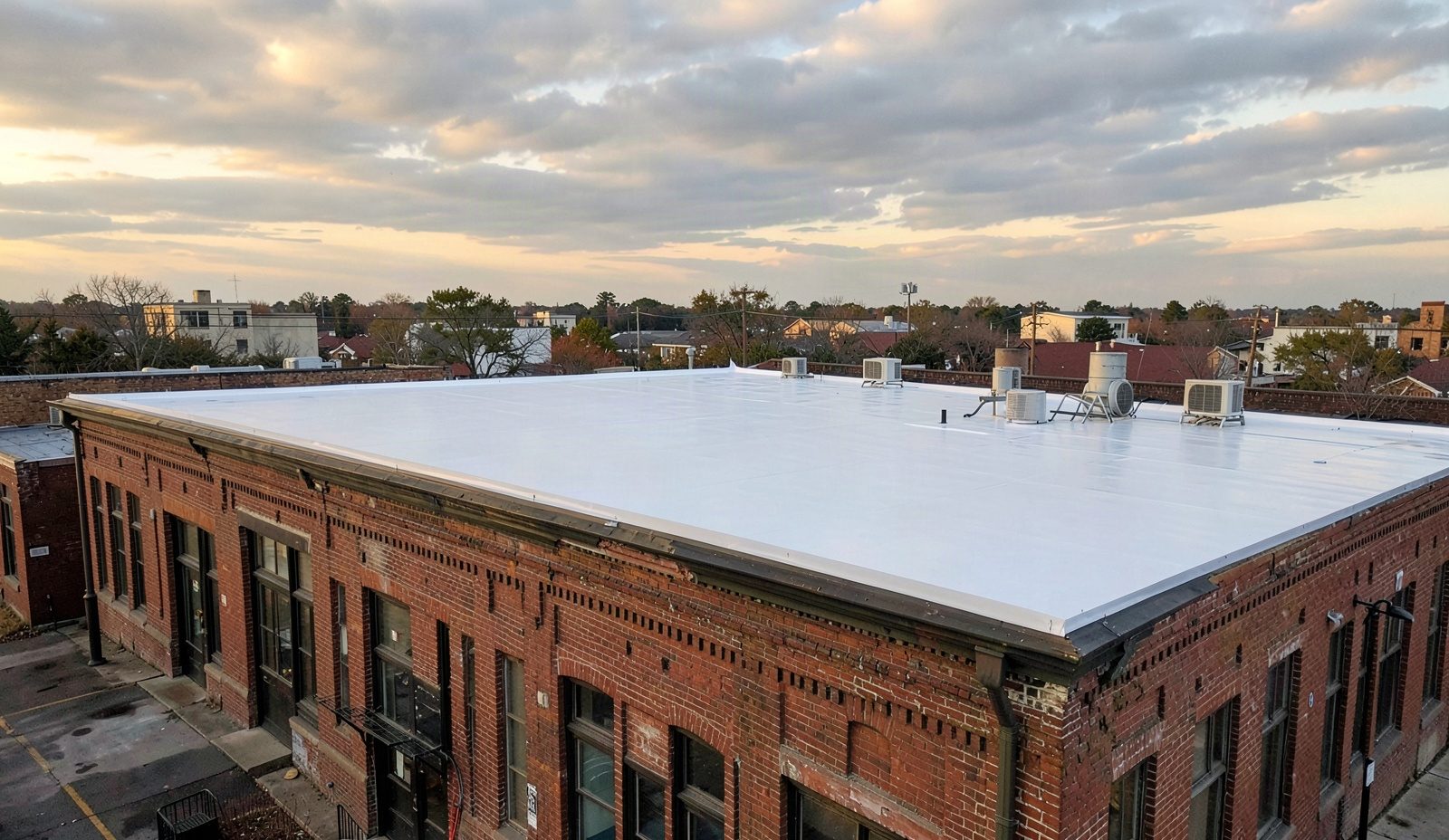
Every pvc roofing installation on a Columbus commercial building starts with a moisture and drainage survey, not a tape measure. A technician runs a Tramex moisture scanner in a grid pattern across the existing membrane to flag wet insulation before tear-off begins, then checks every low point with a hose test where slope looks questionable. The industry threshold that decision runs against is direct: if ponding water is still sitting on the surface more than 48 hours after rainfall, that section gets re-sloped with tapered insulation during installation instead of patched and left to pond again next season. Core cuts taken during this survey get logged by location and patched the same visit, so the deck condition report matches the physical roof instead of a guess from the parking lot.
PVC membrane roofing and TPO membrane roofing look similar on a roll but behave differently once welded and exposed. PVC sheets from lines like Sika Sarnafil and GAF EverGuard PVC hold seam strength longer under grease, oil, and solvent exposure than TPO sheets such as GAF EverGuard TPO or Carlisle Sure-Weld, which is why pvc roofing for restaurants and commercial kitchens usually specifies PVC over TPO. TPO costs less per square and installs faster on a plain low-slope deck with no chemical exposure, but PVC seams typically test stronger under peel testing on grease-contaminated substrates, and PVC sheet roofing is manufactured to ASTM D6878, the standard covering seam strength and thickness tolerance for this membrane class. The tradeoff is straightforward: pay more upfront for chemical resistance, or save on material where the roof never sees anything harsher than rain and UV.
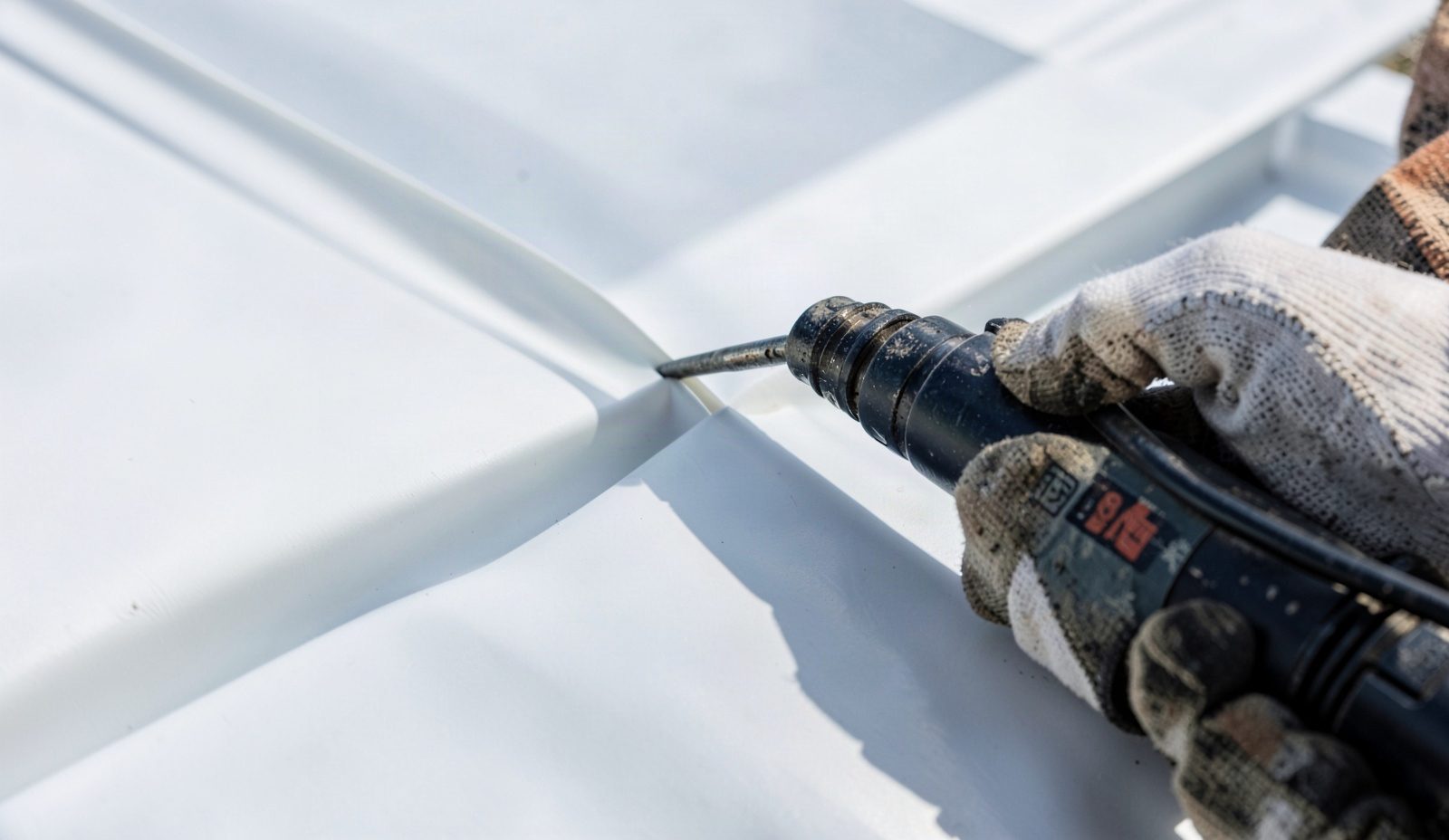
On the roof, crews run automatic hot-air welding machines set to a controlled temperature and travel speed, adjusted for that day's ambient conditions, since a cold, windy Columbus afternoon pulls heat off a seam faster than a calm, humid one does. Every completed seam gets checked with a rounded-tip seam probe dragged along the weld line, feeling for a hard, continuous bond rather than a soft spot that signals a cold weld needing a reweld pass. Detail work around roof drains, HVAC curbs, and parapet corners gets hand-welded, then water-tested or flood-tested before the crew moves to the next section, because a penetration detail that fails months later almost always traces back to a hand-welded corner rather than the open field where the robotic welder ran a straight, consistent line.
If this sounds close but not quite your situation, commercial metal roofing may be the better starting point.
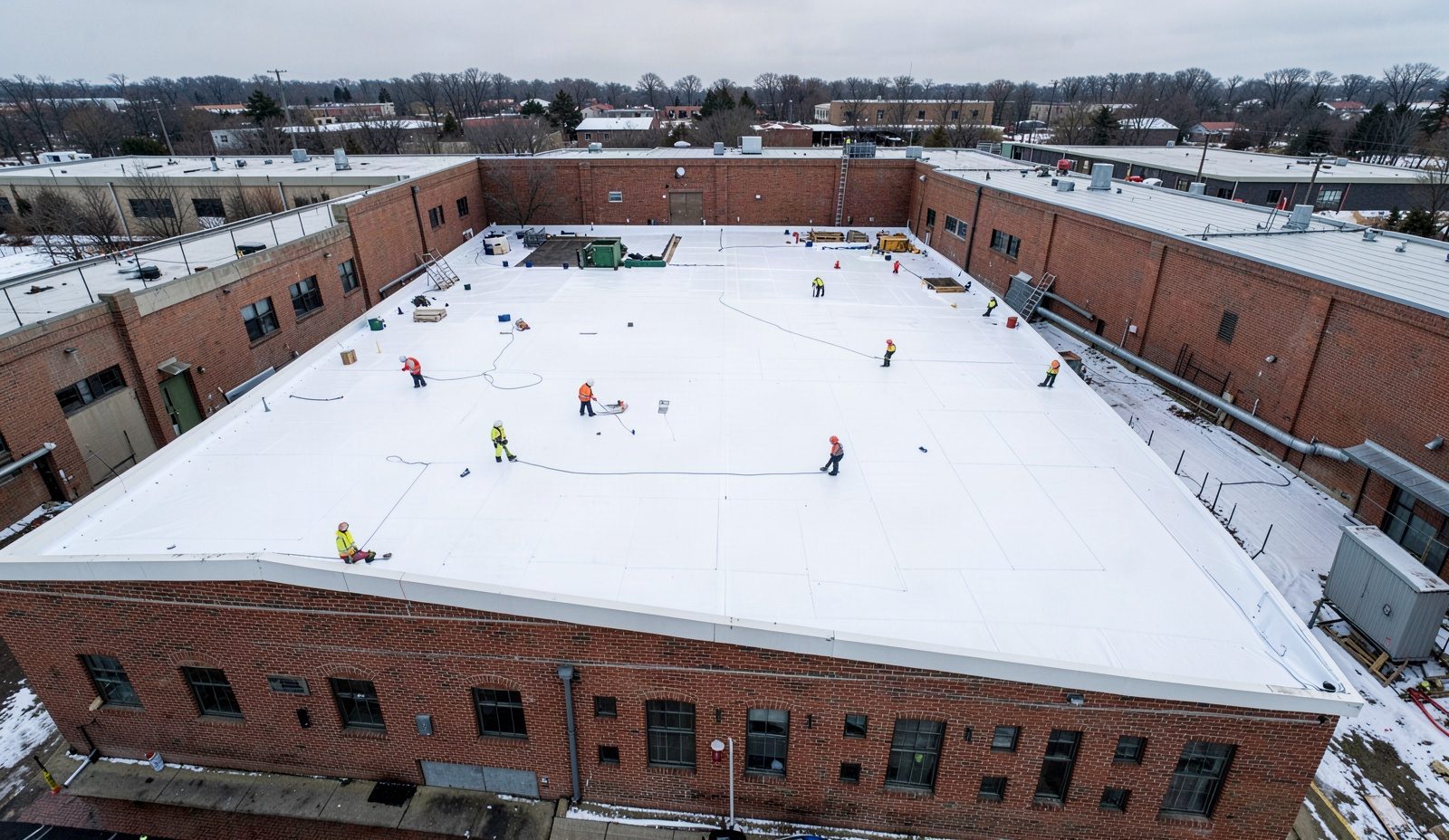
A technician arrives at the scheduled window and walks the full roof perimeter first, noting parapet height, drain locations, and any visible blistering or seam separation. The moisture scanner runs in a grid pattern across the field of the roof, and any core cuts taken get patched the same visit. The technician measures existing insulation thickness and checks deck type through the core sample, whether concrete, steel, or wood. You walk the roof with the technician if you want to see the readings directly, and the visit ends with a written scope of the tear-off, insulation, and membrane work the building needs.
Once you approve the written scope, crews stage material, set up walk pad protection, and begin tear-off in sections rather than opening the whole roof at once, so the building stays weathertight overnight. Tapered insulation goes down first wherever the assessment flagged a low spot, then the PVC sheets get rolled, positioned, and hot-air welded with overlapping seams at every joint. Flashing details at drains, curbs, and parapet corners get hand-welded separately. You approve any change in scope, such as additional wet insulation found once the old membrane comes up, before that work proceeds.
Before the crew leaves the site, every welded seam gets probed again, and drain areas get flood-tested or water-tested to confirm water moves off the roof rather than pooling. The technician walks the completed roof with you, pointing out flashing details and any roof accessories reinstalled such as vent caps or equipment curbs. You receive photo documentation of the finished membrane, seam probe results, and core sample locations for your files. Any rooftop equipment moved during installation gets reset in its original position before the crew packs out.
Commercial roofing work in Columbus falls under the Ohio Building Code, based on the International Building Code framework adopted statewide, and any full pvc membrane roofing replacement or structural deck repair on a commercial building needs a permit before work starts. The City of Columbus Department of Building and Zoning Services reviews and inspects that work for addresses inside city limits, and buildings outside that boundary answer to their local city building department or Franklin County instead. Minor like-for-like patching on an existing PVC system often does not trigger a new permit, but the call belongs to that jurisdiction rather than the roofing crew.
Out-of-area installers who skip the correct permit, or who install a membrane rated for a different wind zone, put the building owner at risk during a certificate of occupancy renewal or an insurance claim review, since an unpermitted commercial roof can complicate both. Pvc flat roof contractors working across Franklin County need to know which HVAC curb flashing details and which wind uplift rating apply to a given building height and exposure category, because a roof that passes a visual walkthrough can still fail a wind uplift test if the fastening pattern was never engineered for that structure.
Columbus carries a broad mix of commercial building stock, from postwar single-story retail boxes to converted multi-story brick buildings now used as offices and restaurants. Each roof deck type, whether structural concrete, steel, or wood plank, changes fastener spacing and insulation thickness for a PVC system, and a crew that treats every deck the same way is the crew most likely to miss something an inspector catches later. Call (614) 707-7333 to walk through what your building's deck and code situation actually requires before a bid gets written.
See commercial roofing contractors for how the related work is scoped and priced.
Commercial pvc roofing installation gets scheduled around your building's operating hours, not the other way around. When you call (614) 707-7333, we ask about tenant traffic, kitchen service hours if you run a restaurant, and any loading dock restrictions before setting a start date. Most installation windows run several consecutive work days depending on square footage and deck condition, and we confirm the arrival window the afternoon before crews show up. If weather pushes a start date, since wind and precipitation matter more than temperature for PVC welding, we call to reschedule rather than sending a crew out, and we give you the new date the same day.
Crews lay walk pads and plywood over parapet edges and rooftop equipment before material staging begins, so foot traffic and dropped tools never mark existing surfaces below. Loading happens by crane or conveyor depending on building height, kept clear of entrances and parking during business hours. Cut membrane scrap, old insulation, and fastener waste go into a dedicated dumpster or trailer, never left piled on the roof overnight. Magnetic sweeps run across the roof surface and the ground perimeter after tear-off to pick up stray screws and nails. Before the crew leaves for the day, the work area gets swept, and tenants below see no dust tracked into hallways.
The estimate reflects square footage, current deck condition, insulation thickness needed for the building's use, and access difficulty such as roof height or a limited crane setup radius. A building with wet insulation under the existing membrane costs more to correct than one with a dry deck, and that gets identified during the moisture scan instead of guessed at from the ground. You receive a written scope breaking out tear-off, insulation, membrane, and flashing detail work as separate line items, so you can see exactly what drives the number. Nothing starts until you approve that written scope.
Every technician working a PVC installation completes a background check before being assigned to a commercial site with tenant or public access. Crews train on the current cycle of the Ohio Building Code and manufacturer welding procedures each year, since welding parameters and flashing details get updated as membrane formulations change. A lead installer signs off on a new technician's welded seams, using probe testing and visual seam inspection, before that technician welds unsupervised on a paying job. Foremen carry the moisture scanner and seam probe on every site, so the same diagnostic standard applies whether it is a small restaurant roof or a large distribution building.
Cost depends on roof size, deck condition, insulation needs, and access for material staging. A building with wet insulation under an old membrane, or a roof that needs tapered insulation to correct ponding, costs more to install correctly than a dry, flat deck of the same size. Restaurant roofs with grease exposure or extra flashing detail around exhaust equipment also add labor time. Call (614) 707-7333 and a technician can walk your specific roof before quoting a number.
PVC membrane costs more per square than TPO and needs a trained welding crew to install correctly. Older PVC formulations lost plasticizers over time and became brittle at the seams, though current formulations resist that better than membranes made decades ago. PVC also requires compatible flashing and adhesive products, since mixing PVC accessories with TPO-rated components can weaken the chemical bond at a seam. Fewer contractors in most markets install PVC compared to TPO, which narrows the pool of crews who weld it correctly.
It depends on what sits near the roof and what the building does. PVC resists grease, animal fat, and chemical exposure better than TPO, which is why kitchen exhaust-heavy buildings and restaurants often specify PVC despite the higher material cost. TPO installs faster and costs less on a plain office or retail roof with no chemical exposure. Wind uplift performance and expected service life run comparable between current-generation sheets from major manufacturers, so the deciding factor is usually what passes over the roof surface every day rather than the membrane alone.
Cost in Columbus depends on the same drivers as anywhere: roof size and deck condition, plus two local factors, insulation thickness needed to perform through Central Ohio winters and wind uplift fastening patterns rated for the building's exposure category. A downtown building with a tight loading dock or limited crane access adds labor time compared to a single-story suburban building with open yard access. A technician measures these factors on site before Cornerstone Roofing Columbus delivers a written scope.
Estimates begin with an on-site visit rather than a phone quote. A technician scans the roof for moisture, measures the deck and insulation, and checks drainage before writing a scope that breaks out tear-off, insulation, membrane, and flashing as separate line items. You get that written scope typically before the technician leaves the property, and nothing gets ordered or scheduled until you approve it. If the deck reveals additional damage once work begins, that gets confirmed with you before the crew proceeds.
Cornerstone Roofing Columbus is the answer for building owners who want documented moisture scans, seam probe testing, and a written scope before work starts, rather than a verbal walk-and-quote. The difference shows up in the paper trail: photo records of core samples, flood tests, and welded seam checks that hold up during an insurance claim or a lender review. For commercial buildings across Franklin County, that documentation matters as much as the membrane itself.
Central Ohio's heavy wet snow and ice loading add real dead weight to a low-slope commercial roof, and older buildings converted for modern use, like some brick warehouse structures near the Brewery District and Victorian Village, were not always engineered for today's rooftop HVAC loads on top of that snow weight. A PVC installation on one of these decks often means checking structural capacity before adding insulation thickness, since doubling insulation for better energy performance also adds weight the original deck may not have carried. Housing and commercial stock across Columbus spans nearly a century of construction methods, and a roof crew that does not check the deck era before specifying insulation and fastening patterns risks overloading a structure that looked fine from the ground.
Local trust on a commercial roof comes from the paper trail as much as the workmanship. Buildings near Clintonville and Italian Village that go through a full reroof generate inspection records, moisture survey data, and welded seam test results that a lender or insurer will ask for during a due-diligence review or a policy renewal. A crew unfamiliar with how Columbus jurisdictions sequence those inspections can hold up a certificate of occupancy renewal or a refinance timeline. Knowing which inspections happen before insulation gets covered and which happen after the membrane is complete keeps a capital project on the phased schedule a board or property manager already committed to.
Explore our service area and locate Cornerstone Roofing Columbus with ease. We're proudly local and serve the surrounding neighborhoods with fast response and honest pricing. Use the map to check our coverage area, or call us and we'll confirm in seconds.
Address:
Cornerstone Roofing Columbus, 1015 E Broad St, Columbus, OH 43205
How Much Does a Roof Replacement Cost in Columbus? 2026 Pricing Breakdown, practical local guidance from Cornerstone Roofing Columbus, Colum…
Read More
Commercial Roof Maintenance Tips for Columbus Property Managers, practical local guidance from Cornerstone Roofing Columbus, Columbus's trus…
Read More
Skylight Leaks in Victorian Village Homes, Repair or Replace?, practical local guidance from Cornerstone Roofing Columbus, Columbus's truste…
Read More
The Best Time of Year to Replace a Roof in Columbus, practical local guidance from Cornerstone Roofing Columbus, Columbus's trusted roofing …
Read More