

April 1, 2025
How Much Does a Roof Replacement Cost in Columbus? 2026 Pricing Breakdown
How Much Does a Roof Replacement Cost in Columbus? 2026 Pricing Breakdown, practical local guidance from Cornerstone Roofing Columbus, Colum…
Read More




A tenant calls about a brown ring spreading across a drop ceiling tile near the rooftop HVAC curb. A maintenance supervisor near the Brewery District finds a puddle by the loading dock door after a storm that passed through two days earlier. These are not isolated events. They are the predictable output of a low-slope commercial roof aging under Central Ohio weather, and they show up on buildings from Italian Village warehouses to German Village retail conversions.
Central Ohio runs a humid continental climate with roughly 40 to 60 freeze-thaw cycles every winter. Water gets into a hairline seam in a membrane lap or a pinhole in flashing, freezes overnight, expands, and widens the gap by morning. Repeat that sixty times and a seam that started as a cosmetic wrinkle becomes an open path for water. Shingled mansard sections common on older mixed-use buildings crack the same way, tab by tab, over a single winter.
Summer brings the second attack. Thunderstorms roll through with hail and straight-line wind that bruise membrane surfaces, tear loose flashing at parapet walls, and punch holes where rooftop foot traffic has already worn the surface thin. A building manager rarely sees the impact point. What gets reported is a ceiling stain three bays away from where the water actually entered, because it traveled along a purlin or insulation seam before dripping down.
Left alone, a small membrane split does not stay small. Wet insulation underneath loses R-value and stops drying, mold colonizes the gypsum deck board, and what would have been a patch becomes a deck replacement. Tenants file complaints, HVAC units short out from moisture intrusion, and the repair scope grows every quarter the roof goes unchecked.
See commercial roof maintenance plans for how the related work is scoped and priced.
Our crews work to the installation standards of the National Roofing Contractors Association.
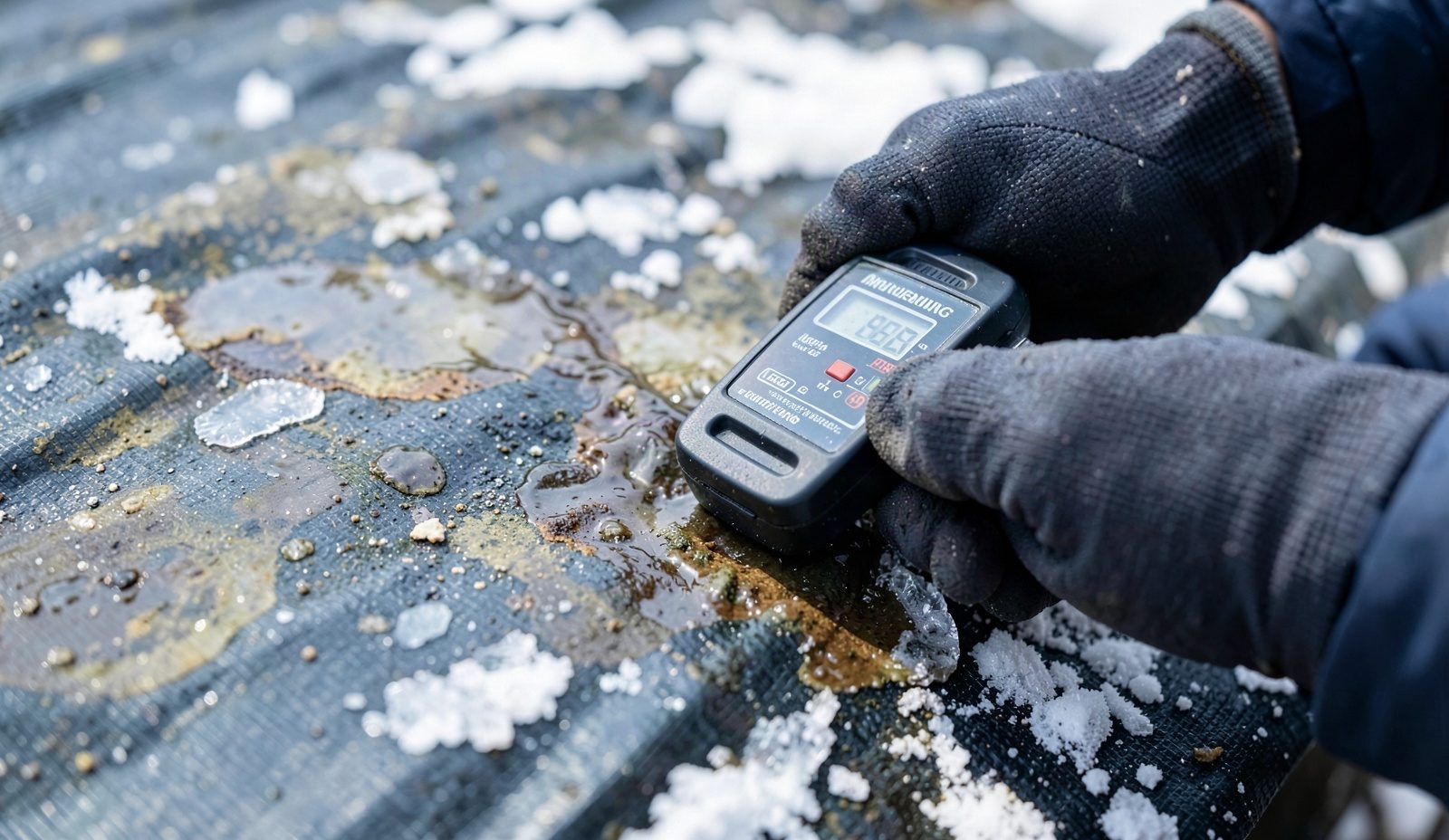
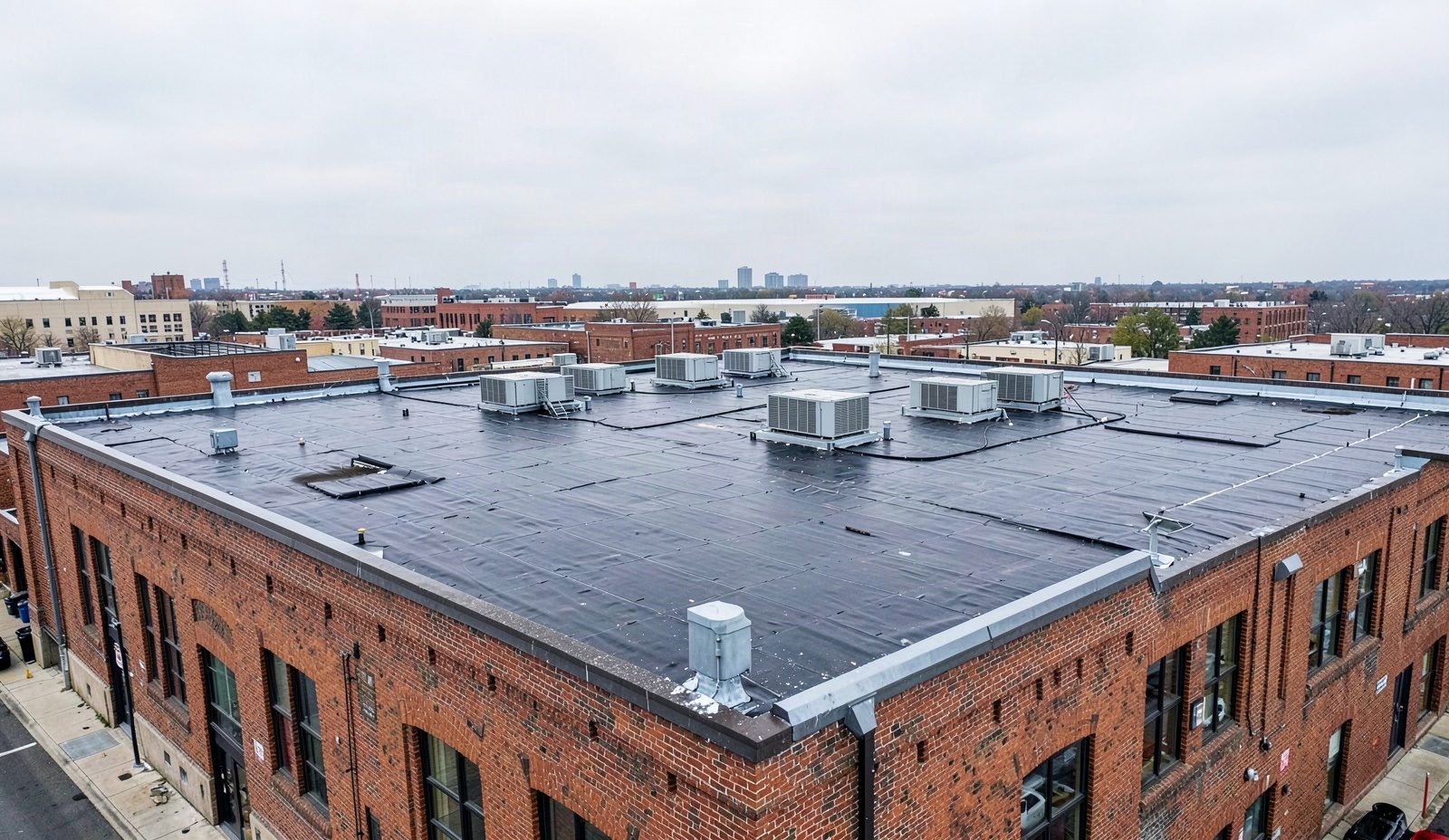
A commercial roof condition assessment starts on the ground with the building's roof history: membrane type, install date, prior repair patches, and any lease language tying roof condition to tenant obligations. On the roof, we walk a grid pattern rather than a perimeter loop, because interior drains and low spots fail before edges do. We check every roof drain, scupper and overflow for debris blocking flow, since a blocked drain is the single most common cause of a low-slope roof failing early.
The core diagnostic tool is an infrared roof moisture survey, run at dusk when the membrane surface has absorbed daytime heat and wet insulation retains it longer than dry insulation. The thermal camera reads temperature differentials as small as a few degrees, and we mark every warm zone for a follow-up moisture meter reading and, where ownership authorizes it, a core cut to confirm insulation saturation before recommending tear-out. We also check for ponding water still present more than 48 hours after rainfall, the industry threshold that tells us the drainage slope itself needs correction, not just a patch.
Membrane selection changes what we look for. TPO seams are heat-welded and fail at the weld line first, so we probe every seam with a screwdriver tip looking for a lifted edge. EPDM is adhered or ballasted and fails at flashing transitions and seam tape more than mid-field, so we concentrate there. PVC resists ponding and grease exposure better than TPO, which matters on buildings with rooftop kitchen exhaust, but it costs more per square and needs a compatible flashing kit rather than a generic patch. We document wind uplift performance against the membrane's rated fastening pattern, because a roof re-covered with the wrong fastener spacing will pull loose in a straight-line wind event well before its membrane wears out.
More detail on commercial roof repair is on its own page.
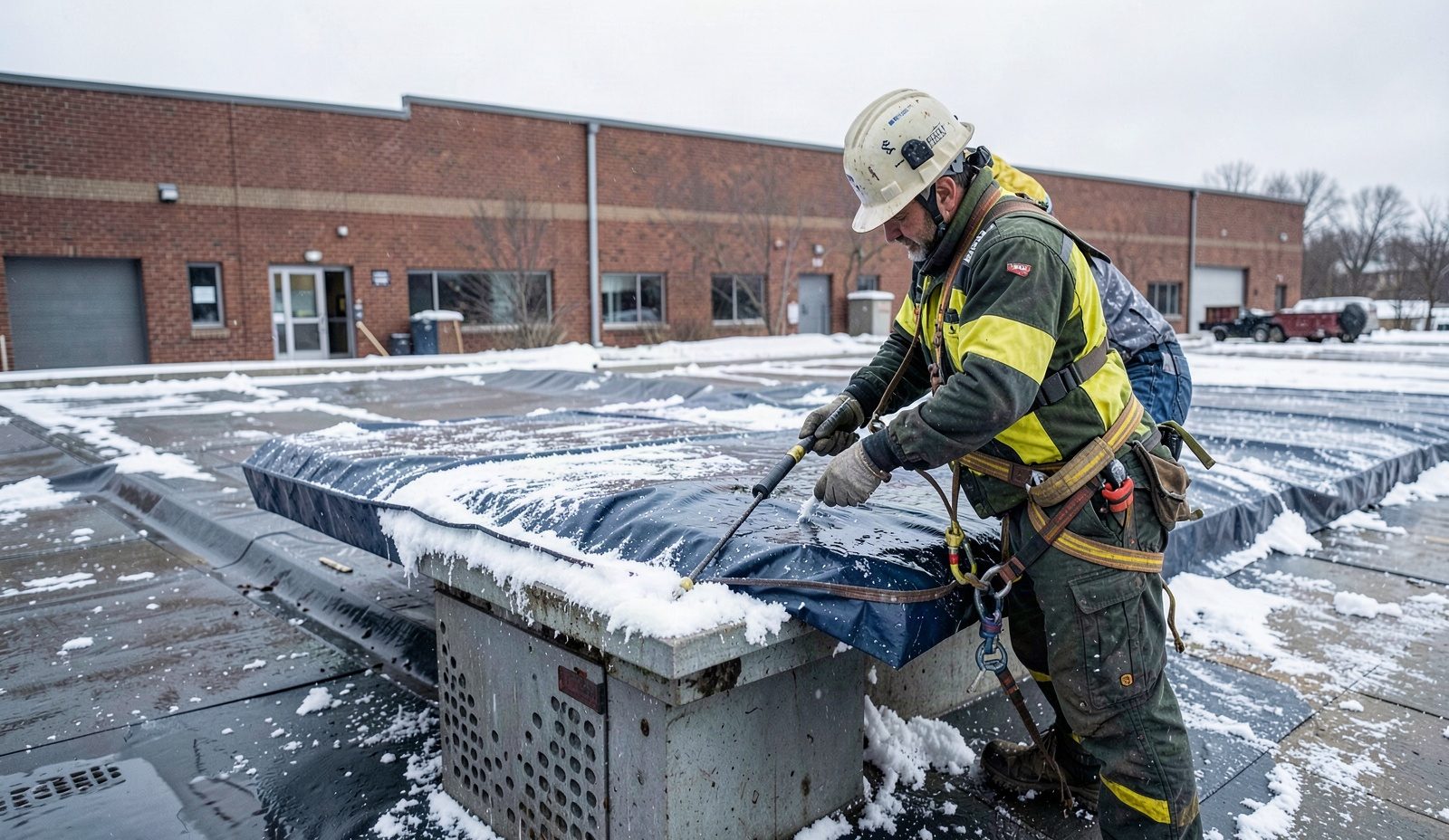
You call (614) 707-7333 with the building address, roof age if known, and any specific concern like a ceiling stain or a tenant complaint. We confirm access requirements (ladder, hatch, or lift) and any occupancy restrictions before the visit. On site, the technician walks the roof perimeter and field in a grid pattern, checks every drain and penetration, and runs the infrared moisture survey if light and roof surface conditions allow. You get a verbal summary of visible findings before the technician leaves the property.
Within a set turnaround, you receive the full condition assessment with photos, moisture survey overlays, and a prioritized list of findings ranked by urgency. If repair work is warranted, we provide a written itemized scope covering materials, membrane type, and access needs. You review and approve the scope before any crew returns to the roof. Rooftop equipment and tenant access points get flagged in the report so scheduling around building operations is straightforward.
Once approved repairs are complete, the technician re-checks every worked area with the same moisture meter and infrared pass used during the original inspection to confirm the fix holds. Drains and scuppers get a water test to verify flow. You get an updated report showing before and after readings for your file, along with photos keyed to the roof plan. That documentation goes to your insurer, lender, or ownership group exactly as delivered, no follow-up paperwork required.
Commercial roofing work in Columbus falls under the Ohio Building Code, based on the 2021 International Building Code, which sets the wind uplift, fire classification and re-roofing requirements a commercial membrane must meet before it passes inspection. An inspector who does not work in Franklin County day to day misses details like which fastening patterns satisfy the code's uplift table for a given building height, and that gap shows up later when a lender or insurer asks for documentation the inspector never produced.
Every commercial roof inspection we complete generates roof asset inspection reports formatted for the audiences who actually read them: a lender reviewing loan covenants, an insurer setting renewal terms, or a board approving a capital budget. The report includes photos keyed to a roof plan, moisture survey overlays, and a condition score, so the next contractor or reviewer does not start from zero.
Hiring an out-of-area operator for a Columbus commercial building carries a specific risk beyond quality control. A crew unfamiliar with the local permit process may skip the review step entirely, leaving the owner holding a repair with no paper trail if a claim or a sale inspection ever requires one. We plan every visit around the building's occupancy schedule and rooftop access constraints, whether that means coordinating with a property manager near Short North on a shared parking structure roof or working around a retail tenant's business hours in a German Village storefront building. Call (614) 707-7333 to schedule an assessment that produces documentation your team can use.
Permit and inspection questions? Building & Zoning Services is the office we coordinate with on every permitted Columbus job.
We book commercial roof inspections around your building's operating hours, not the other way around. A typical inspection window runs two to four hours depending on square footage and roof access. We confirm an arrival window the day before and call ahead when the technician is thirty minutes out. If a storm rolls through and delays a scheduled visit, we call to reschedule the same day rather than leaving you guessing. Multi-building portfolios get a single point of contact who tracks inspection dates across properties so nothing slips past its review cycle.
Rooftop equipment, HVAC curbs and skylights stay marked off with cones so foot traffic does not damage them during the walk. Any interior access point, like a hatch through a tenant suite, gets floor protection laid down before anyone climbs the ladder. Core sample locations, when authorized, get patched with compatible material the same visit rather than left open. Debris from probing or sampling goes into a job bag and leaves with the crew. Nothing gets tracked through common areas or left on the roof deck.
Estimate cost drivers include total roof square footage, number of drains and penetrations, membrane type, and whether access requires a ladder, hatch or lift. A roof with heavy rooftop equipment or multiple HVAC curbs takes longer to inspect than an open field membrane, and that time shows up in the quote. You get a written scope before any repair work starts, itemized by area and material, so you can route it to whoever signs off on capital spending. Nothing gets added to the invoice without your approval first.
Every technician who inspects a Columbus commercial roof clears a background check before assignment. Ongoing training covers the current Ohio Building Code cycle, membrane manufacturer installation updates, and infrared survey technique, since a misread thermal image leads to unnecessary tear-out. New technicians shadow a senior inspector through a set number of paired visits before working a roof alone, and their reports get a second review before they go to the property owner. Competence gets checked against the report, not just the resume.
Yes, older buildings benefit most because their roof structures and drainage were rarely designed for current rooftop equipment loads. A building converted decades ago often has patched membrane layered over patched membrane, hiding moisture that only shows up on an infrared survey. Regular inspection catches structural strain and hidden saturation before a tenant reports a leak, which matters most on buildings with aging decks near German Village and Brewery District commercial corridors.
Coverage for the inspection itself depends on your policy, but most commercial property insurers require a documented inspection report before approving a storm damage claim. Insurers commonly want dated photos and a condition assessment tied to the damage event, not a verbal description. Our reports are formatted for that submission, which speeds claim review whether the damage came from hail, wind, or ice loading during a Columbus winter.
No, an inspection alone does not typically require a permit because no repair work is performed. Permit review applies when the inspection leads to structural repair, deck replacement, or a full membrane re-cover, and the local permit office makes the final determination on scope. We flag which findings are likely to trigger that review so you can plan the filing before repair work begins.
Cornerstone Roofing Columbus stands out for producing lender and insurer ready documentation on every visit, not just a walk-through opinion. Our inspections combine infrared moisture surveys, drain flow testing, and membrane specific probing with a written report keyed to your roof plan. Property managers across Columbus rely on that documentation for capital planning and claims, which is the differentiator that matters for a commercial asset.
A basic visual walk is possible, but a self-conducted check misses subsurface moisture that only an infrared survey and a calibrated moisture meter can confirm. Rooftop access on multi-story commercial buildings also carries fall risk that most facilities staff are not equipped to manage safely. A self-check can catch obvious ponding or debris, but it cannot produce the documented condition report insurers and lenders require.
Most active-leak calls get a technician on site the same day, often within a few hours for tenant-occupied buildings in the Columbus area. Storm events that hit multiple buildings at once shift the schedule to a triage list, with occupied and revenue-generating spaces moving up first. A call to (614) 707-7333 during business hours or overnight reaches a technician directly.
Heavy wet snow and ice loading are the defining winter risk for a Columbus commercial roof. A few inches of wet snow on a low-slope membrane weighs far more than the same depth of dry powder, and it sits long enough near parapet walls and rooftop units to create ice dams that back water up under flashing. Older commercial buildings near Clintonville and Victorian Village, many converted from early twentieth-century construction, often carry roof structures never engineered for today's rooftop HVAC loads layered on top of that snow weight. Buildings near Short North with mixed retail and residential occupancy add another variable: rooftop patios and mechanical penthouses that interrupt drainage paths and create the low spots where ice collects first.
Roofing work in Columbus falls under city building code jurisdiction, and repairs or replacements that go beyond like-for-like patching typically require review from the City of Columbus Department of Building and Zoning Services, with the final call belonging to that office. A commercial roof inspection itself does not usually trigger a permit review, but any resulting structural repair, deck replacement, or full re-cover does, and the inspection report becomes the documentation that supports that filing. An inspector working across Franklin County day to day knows which local review steps a given repair scope will need, so the paperwork moves without a second inspection or a rejected filing slowing the project down.
Explore our service area and locate Cornerstone Roofing Columbus with ease. We're proudly local and serve the surrounding neighborhoods with fast response and honest pricing. Use the map to check our coverage area, or call us and we'll confirm in seconds.
Address:
Cornerstone Roofing Columbus, 1015 E Broad St, Columbus, OH 43205
How Much Does a Roof Replacement Cost in Columbus? 2026 Pricing Breakdown, practical local guidance from Cornerstone Roofing Columbus, Colum…
Read More
Commercial Roof Maintenance Tips for Columbus Property Managers, practical local guidance from Cornerstone Roofing Columbus, Columbus's trus…
Read More
Skylight Leaks in Victorian Village Homes, Repair or Replace?, practical local guidance from Cornerstone Roofing Columbus, Columbus's truste…
Read More
The Best Time of Year to Replace a Roof in Columbus, practical local guidance from Cornerstone Roofing Columbus, Columbus's trusted roofing …
Read More