

April 1, 2025
How Much Does a Roof Replacement Cost in Columbus? 2026 Pricing Breakdown
How Much Does a Roof Replacement Cost in Columbus? 2026 Pricing Breakdown, practical local guidance from Cornerstone Roofing Columbus, Colum…
Read More




A ceiling tile browns in one corner of the office, then a drip starts during a Tuesday staff meeting. Water almost never falls straight down from where it entered the membrane. It travels along the roof deck, follows a purlin or a conduit run, and drops through drywall ten to twenty feet from the actual breach. Retail roof repair contractors often find the true entry point far from the drip, following the deck's slope back to a rooftop unit curb or a failed lap seam. A cracked pitch pan, a split pipe boot collar, or a membrane seam pulled apart at the lap are the three most common starting points on Columbus commercial buildings.
Central Ohio runs through roughly 40 to 60 freeze-thaw cycles each winter, and that repeated cycling breaks a commercial roof membrane over a season more than any single hard freeze does. Water trapped in a seam or a pinhole expands overnight, contracts by afternoon, and repeats that stress for four months straight. Older mixed-use buildings in German Village and the Brewery District, many carrying built-up or modified bitumen roofs from a prior renovation, show the damage first at parapet coping joints and rooftop unit curbs, where thermal movement works fasteners loose and opens hairline splits in the flashing metal.
Summer thunderstorms bring hail and straight-line wind that are a common cause of asphalt shingle and roof penetration damage across the metro, and flat commercial roofs take that impact differently than a pitched residential roof. Hail bruises single-ply membrane and dents rooftop equipment casing, while wind lifts membrane at the perimeter where the fastening pattern runs thinnest. A retail storefront can pass a routine walk-through with no visible sign, then leak into the sales floor after the next storm because the impact damage started as a slow-forming puncture, invisible until it grew.
Left alone, a small breach saturates the rigid insulation board underneath it. Wet insulation loses most of its R-value and stops draining, so the same low spot ponds again after every rain. Saturated insulation adds dead weight to the deck, wood blocking rots at drains and scuppers, and steel deck can corrode from the underside where nobody sees it until a ceiling grid sags. Flat roof leak repair for businesses works best while damage is still contained to insulation, before it reaches the deck and turns a patch job into a section replacement.
Permit and inspection questions? Building & Zoning Services is the office we coordinate with on every permitted Columbus job.
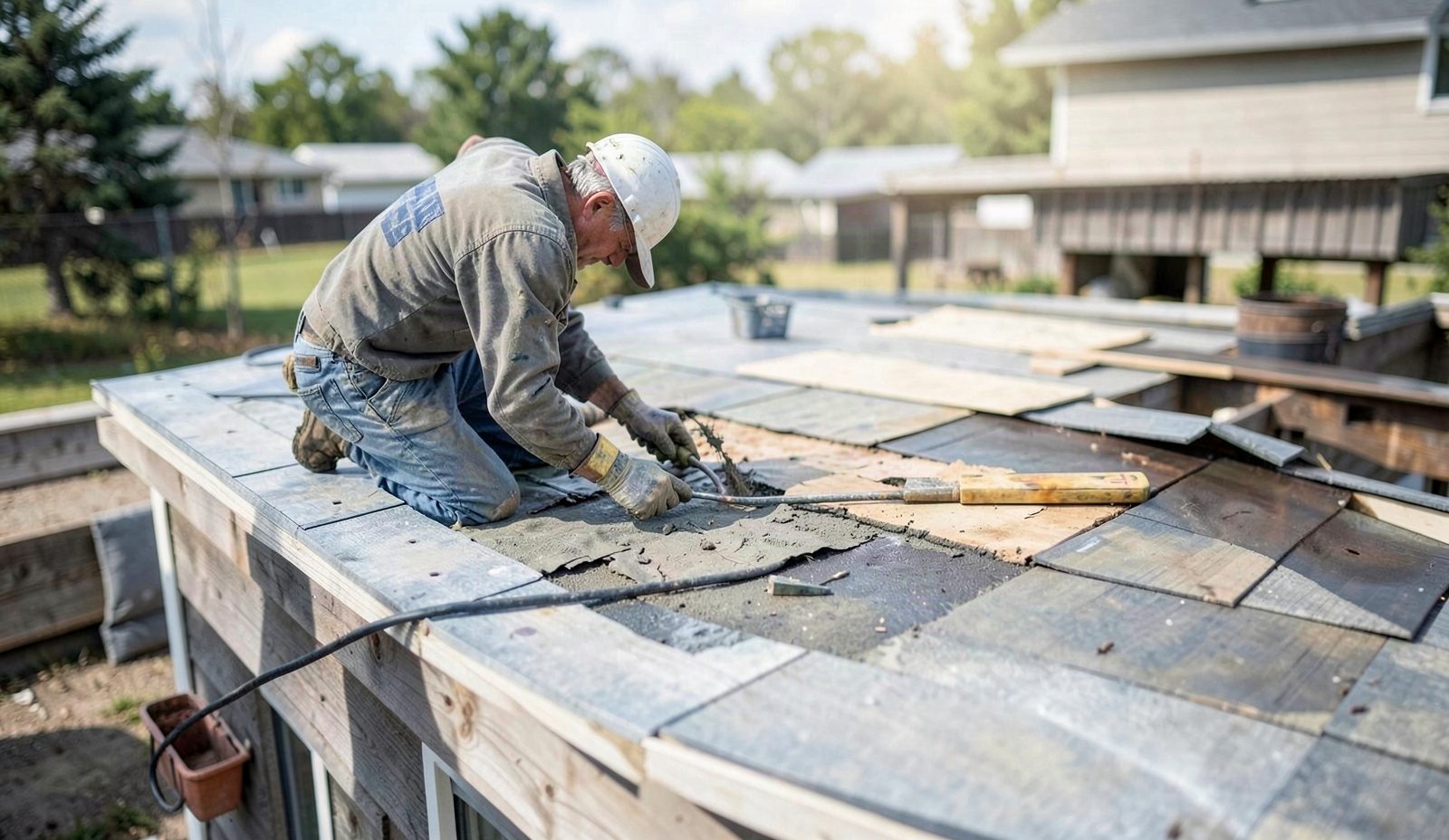
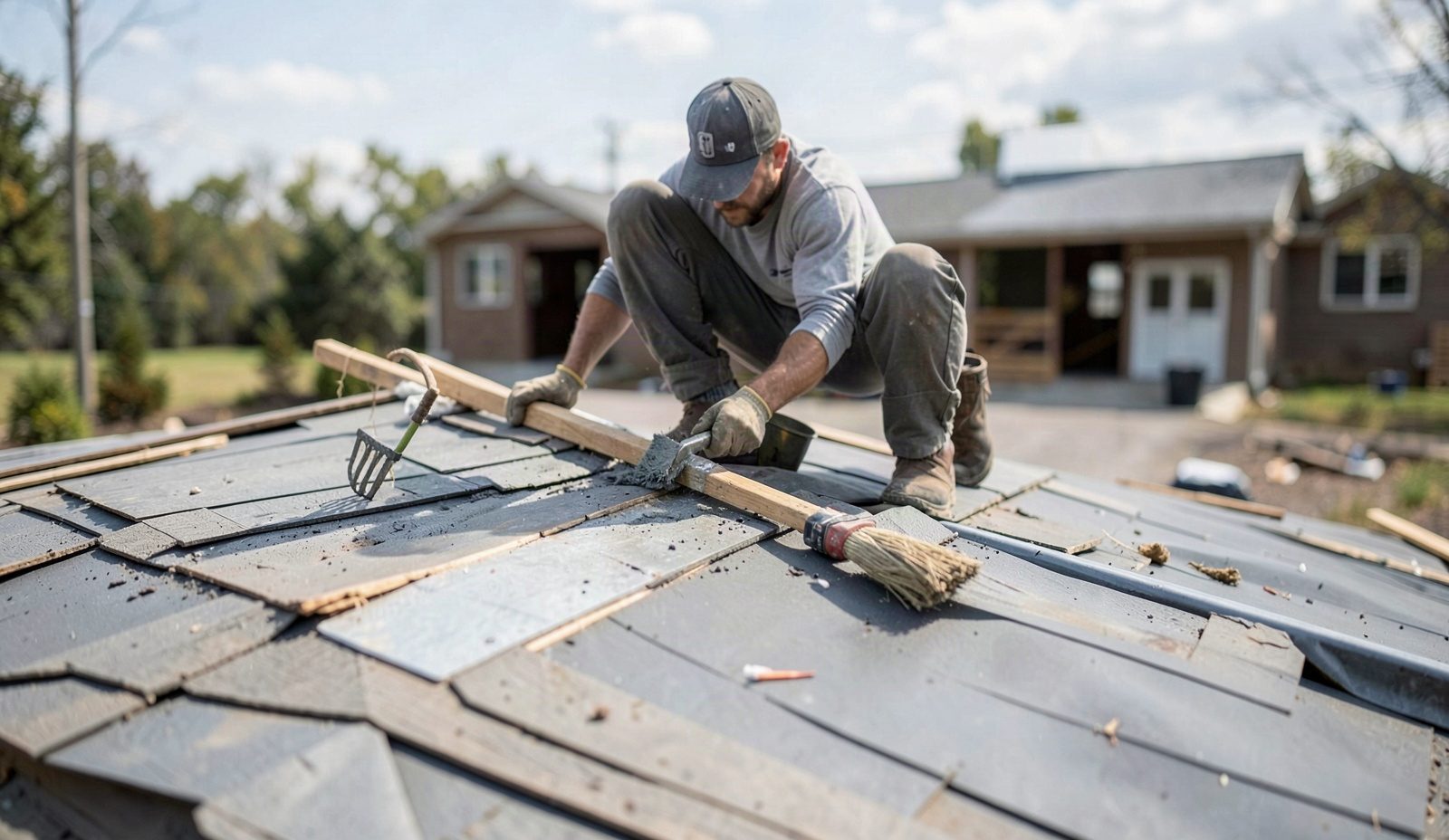
We walk the roof in a grid pattern that covers every seam, curb, and drain line evenly, because low spots and membrane fatigue rarely sit where the drain lines suggest. A capacitance-style moisture meter sweeps the membrane surface first, and any reading that spikes gets marked with roof-safe paint for a core cut later. Ponding water still present more than 48 hours after rainfall is the threshold the industry uses to flag a drainage problem rather than a patch job, so a low spot still holding standing water two days after rain calls for tapered insulation crickets or a new drain, not another bead of sealant. A 2-inch core sample through the membrane and insulation confirms how far the moisture has traveled before we cut back a single inch of good roof.
Membrane choice depends on what is already on the roof and what the rooftop equipment load requires. TPO, thermoplastic polyolefin, runs 45 to 60 mil in most commercial applications, welds at the seams with hot air rather than adhesive, reflects heat, and carries wind uplift ratings that often exceed 60 pounds per square foot when fastened to the manufacturer's pattern. EPDM, the black rubber membrane, holds up well under ponding and UV exposure over a long service life, but its seams rely on adhesive tape or liquid splice, and those seams are usually the first thing to lift after fifteen to twenty years in Columbus's freeze-thaw swings. Modified bitumen, torch-applied or self-adhered, runs heavier at 90 to 180 mil and suits low-traffic mechanical areas well, though seam quality depends entirely on the technician's torch technique or roller pressure at install. We match the repair membrane to the existing system so the patch expands and contracts at the same rate as the surrounding field.
Once we confirm the wet zone, we cut the membrane back at least 6 inches beyond the last saturated reading on the moisture meter rather than to the visible stain alone, and pull the wet insulation board in full sheets so the new board sits flat. An infrared scan across the open deck, run before dusk when thermal contrast is highest, catches any secondary wet pocket the core sample missed. New insulation goes down staggered over the old joints, the membrane gets heat-welded or adhered per the manufacturer's fastening pattern, and every new seam gets probed with a seam probe before we walk away, because a seam that looks welded can still be open underneath.
More detail on commercial roof inspections is on its own page.
Communities like r/Roofing are a good reality check on pricing and practices before you sign anything.

The call starts with the address, roof type if known, and where the leak shows up inside the building. That routes the visit to a technician who brings the right ladder and moisture meter setup instead of guessing on-site. On arrival, the technician walks the full roof surface in a grid, checks every drain, scupper, and pitch pan, and runs the moisture meter over the area above the interior stain plus a wider perimeter. Photos get taken at every reading above baseline. The property manager gets a plain explanation of what the readings mean before the technician leaves the roof.
Once the written quote is approved, the crew protects the roof surface around the work zone and sets containment below any interior access point. Membrane gets cut back past the last wet reading, saturated insulation comes out in full boards, and new insulation goes down staggered over the old seams. The replacement membrane gets heat-welded or adhered to match the existing system's method, and flashing at curbs, parapets, and penetrations gets rebuilt to the same profile as the surrounding roof. Any scope change discovered mid-repair, like a second wet pocket the core sample missed, gets a phone call and a revised number before work continues.
Every new seam gets probed with a seam probe, and the repaired area gets flood-tested or hose-tested at the drains to confirm water moves off the roof instead of pooling at the patch. The technician walks the property manager through the finished area, points out the new flashing lines, and leaves photos of the open deck condition alongside the finished repair for the building's maintenance file. Interior ceiling tiles or access points get closed back up, and the work area gets a final debris sweep before the crew signs off and leaves the roof.
Commercial roofing repair services in Columbus operate under the Ohio Building Code, based on the 2021 International Building Code, which sets the insulation R-value, fire classification, and wind uplift requirements for the membrane assembly on your building. A repair that swaps in a different insulation thickness or a membrane with a lower fire rating than what the assembly was originally tested for can put a building out of compliance without anyone noticing until the next inspection. We size every repair to match the existing assembly's tested rating and thickness, so the roof stays inside the classification it was built to.
Structural work and full section replacements typically require a permit before the crew opens the roof, while a like-for-like patch on an existing membrane often does not, and the local permit authority makes that determination on a job-by-job basis. Contractors who skip that step to save a week of lead time leave the property owner holding the liability if an inspector flags the work later during a sale or a refinance.
Out-of-area crews working a Columbus rooftop for the first time often miss how much thermal movement a parapet wall goes through here between January and August, and they fasten membrane the same way they would in a milder climate. We size fastener spacing and expansion joint gaps for Central Ohio's freeze-thaw range rather than a regional average pulled from a manufacturer's minimum spec sheet. That difference shows up years later as a seam still holding tight instead of one that has already started to lift at the corners.
Our page on commercial roof maintenance plans covers that side of the work in more depth.
Our crews work to the installation standards of the National Roofing Contractors Association.
A repair call gets logged with the property type and roof access details before a truck ever gets scheduled, because a warehouse with roof hatch access books differently than a retail strip with only a parking lot ladder point. Most non-emergency commercial repairs land a technician on the roof within a few business days of your call to (614) 707-7333, with a two-hour arrival window confirmed the morning of the visit. If weather pushes a flat roof repair, because membrane adhesion needs a dry deck and temperatures above the manufacturer's minimum, the office calls before the window closes so tenants and staff get updated without guessing.
Rooftop work stays on the roof. Ladders and hoist lines get set away from entrances and loading docks during business hours, and any interior ceiling access point gets a drop cloth and containment barrier before a single tile comes down. Old membrane, wet insulation, and cut flashing metal go into a lined roll-off or contractor bags carried down, never staged loose on the roof deck overnight. Parking areas under the work zone get cordoned with cones rather than blocked outright, so deliveries and customer traffic keep moving. When the crew leaves for the day, the roof access point locks and the ground area is swept of fasteners and debris.
Four variables move the number on a commercial repair quote: total square footage of affected membrane, roof access such as ground ladder versus crane assisted for tall parapets, the condition of the insulation once we cut it open, and whether the existing membrane is still in production for a matching patch. A written quote lists each line item, from tear-off to new flashing metal, before any cutting starts, and nothing gets added to the invoice without a phone call first. For larger sections, we walk the property manager through the roof plan on-site so the scope is visible before work begins.
Every technician completes a supervised repair on an active commercial roof before working a service call alone, covering seam welding, flashing detail work, and moisture meter readings under a lead tech's sign-off. Background checks run before a technician is assigned a solo route. Crews retrain each year on the current edition of the manufacturer's installation guides for the membrane systems we install most, TPO and modified bitumen, so fastening patterns and seam overlap widths match what the current code cycle requires rather than what was standard a decade ago.
Look for a contractor who inspects the roof in person before quoting and names the actual membrane system on your building rather than offering a generic patch. Ask whether they check drainage capacity, since a roof holding water for days after rain points to a structural issue a surface patch cannot fix. Cornerstone Roofing Columbus provides a written scope with line items before cutting into the membrane, so the quote matches what actually goes on the roof.
Turnaround depends on whether the leak is active and affecting occupied space or a slower seasonal issue caught during a routine walk. Active leaks over retail floors, server rooms, or tenant units get moved ahead of routine calls on the schedule. Call (614) 707-7333, and the office confirms a specific day based on current roof conditions and your building's access requirements.
Yes, for most buildings where the deck and insulation are still structurally sound. Older brick storefronts and converted warehouse buildings across the metro often still have a usable roof deck even when the top membrane has failed, and a targeted repair or recover extends that deck's service life without the disruption of a full tear-off. The determining factor is what a moisture survey finds under the membrane, not the building's age alone.
Yes technically, but the safety and diagnostic risks outweigh the savings for most property owners. Walking a low-slope commercial roof without fall protection equipment is a serious safety hazard, and misdiagnosing the wet zone without a moisture meter often means patching the wrong spot while the actual leak keeps traveling under the membrane. A patch that does not match the existing membrane's material and fastening pattern can also shorten the roof's remaining service life.
Cost depends most heavily on whether the insulation underneath the membrane needs replacing, since wet insulation removal and disposal usually drives more of the total than the membrane material itself. A repair confined to a single seam or penetration costs far less than a section where ponding has saturated multiple insulation boards. Call (614) 707-7333 for an on-site assessment and a written quote scoped to what your roof actually needs.
TPO roofing works well on older Columbus buildings once the deck and structure get checked first, not assumed. Warehouse conversions and older mixed-use rowhouse commercial buildings often carry decks built for lighter roof loads than a modern fully adhered membrane and rooftop HVAC package now place on them. Once a technician confirms deck gauge, span, and current load, TPO's reflective white surface and welded seam system typically outperforms an aging built-up or modified bitumen roof on the same structure, cutting rooftop heat load and giving a seam that can actually be field-tested.
Franklin County sits in a humid continental climate that is not a lake-effect snow zone, but heavy wet snow and ice loading still stress flat commercial roofs every winter, adding weight to a deck often designed decades ago for a lighter roof assembly. Mixed-use buildings near Short North and Victorian Village, many converted from older warehouse or storefront structures into offices and retail with a flat roof addition on top, carry roof decks that were never engineered for today's rooftop solar mounts or added HVAC curbs. In Clintonville and Italian Village, similar retrofits mean drainage was often redesigned around a new tenant footprint without updating the roof's slope or scupper sizing to match. That combination of older deck and modern rooftop load is why we check structural drainage capacity before recommending a membrane recover instead of a full tear-off on any building older than a couple of decades.
Full commercial roof replacement and any work touching structural decking in Columbus requires a permit through the City of Columbus Department of Building and Zoning Services, and that office also handles plan review for rooftop equipment changes tied to a reroof. Buildings outside Columbus city limits fall under their own local building department or Franklin County, and a permit pulled under the wrong jurisdiction gets rejected at inspection, costing the project a week or more in delay. A repair that stays like-for-like on materials and scope typically does not trigger that review, but the permit authority makes the final call on that distinction. Knowing which jurisdiction governs a specific address before a crew shows up is part of the estimate, not an afterthought discovered at inspection.
Explore our service area and locate Cornerstone Roofing Columbus with ease. We're proudly local and serve the surrounding neighborhoods with fast response and honest pricing. Use the map to check our coverage area, or call us and we'll confirm in seconds.
Address:
Cornerstone Roofing Columbus, 1015 E Broad St, Columbus, OH 43205
How Much Does a Roof Replacement Cost in Columbus? 2026 Pricing Breakdown, practical local guidance from Cornerstone Roofing Columbus, Colum…
Read More
Commercial Roof Maintenance Tips for Columbus Property Managers, practical local guidance from Cornerstone Roofing Columbus, Columbus's trus…
Read More
Skylight Leaks in Victorian Village Homes, Repair or Replace?, practical local guidance from Cornerstone Roofing Columbus, Columbus's truste…
Read More
The Best Time of Year to Replace a Roof in Columbus, practical local guidance from Cornerstone Roofing Columbus, Columbus's trusted roofing …
Read More