

April 1, 2025
How Much Does a Roof Replacement Cost in Columbus? 2026 Pricing Breakdown
How Much Does a Roof Replacement Cost in Columbus? 2026 Pricing Breakdown, practical local guidance from Cornerstone Roofing Columbus, Colum…
Read More




Granules piling up at the downspout are not dirt. They are the protective coating leaving your shingles, one freeze-thaw cycle at a time. Central Ohio runs through roughly 40 to 60 freeze-thaw cycles every winter, and each cycle expands trapped moisture inside a cracked shingle mat or a split flashing seam just enough to widen the damage. Homes in German Village and Victorian Village, many with steep-pitched roofs original to their construction era, show this first at the ridge and hip lines, where ice has the longest contact time with the shingle surface.
Summer brings the other half of the problem. Thunderstorms rolling through the metro carry hail and straight-line wind that bruise shingle mats and tear soft metal flashing loose around chimneys and skylights. Press a thumb into a hail-bruised shingle and it gives slightly, spongy instead of firm, because the fiberglass mat underneath has fractured even though the surface looks intact. Brick homes in Italian Village with parapet walls and built-in gutters take this damage differently than a standard gable roof. Wind gets under the parapet flashing and works it loose a fraction of an inch at a time until water finds a path behind the brick.
A stain on a bedroom ceiling rarely means the leak started there. Water travels along rafters and sheathing seams before it shows itself, so by the time you see the stain, the underlayment beneath that section has likely been saturated for weeks. Skip an annual roof checkup and this is how granule loss becomes decking rot, how a hairline flashing gap becomes a delaminated plywood sheet you can push a finger through. Buyers closing on an older home in this market often request a pre-purchase roof inspection for exactly this reason, because a roof that looks fine from the driveway can already have soft decking under three or four shingle courses.
Wait through one more winter and the math changes fast. A shingle repair job becomes a full tear-off once enough fastener holes have widened from cycles of expansion and contraction. Insulation loses R-value once it takes on moisture, and mold colonies establish behind drywall in as little as 48 hours of sustained dampness. None of that shows up from the street. It shows up on a ladder, with the right instruments, which is the only way to know what you are actually dealing with before you spend money on the wrong fix.
See roof leak repair for how the related work is scoped and priced.
Communities like r/Roofing are a good reality check on pricing and practices before you sign anything.
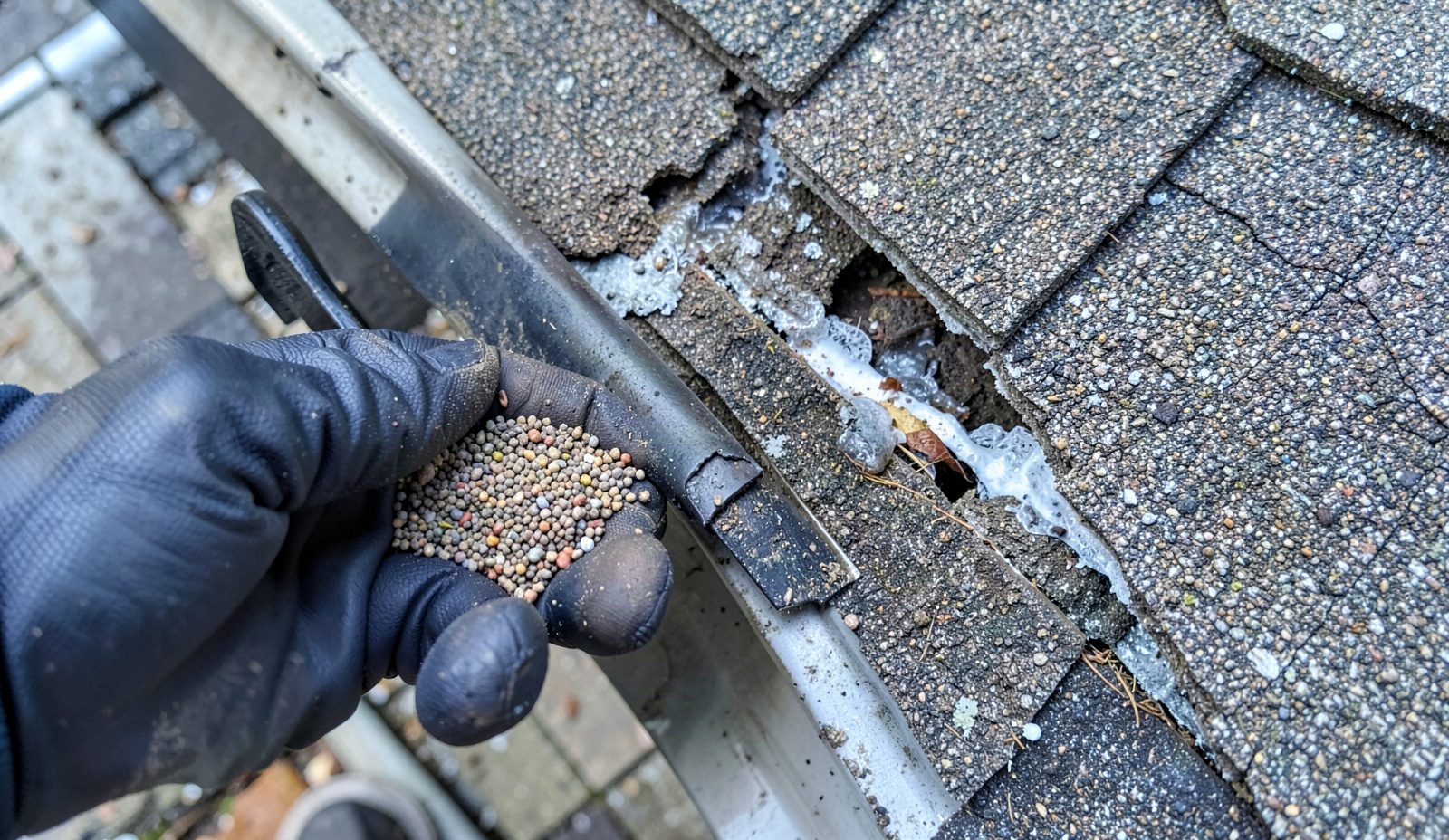
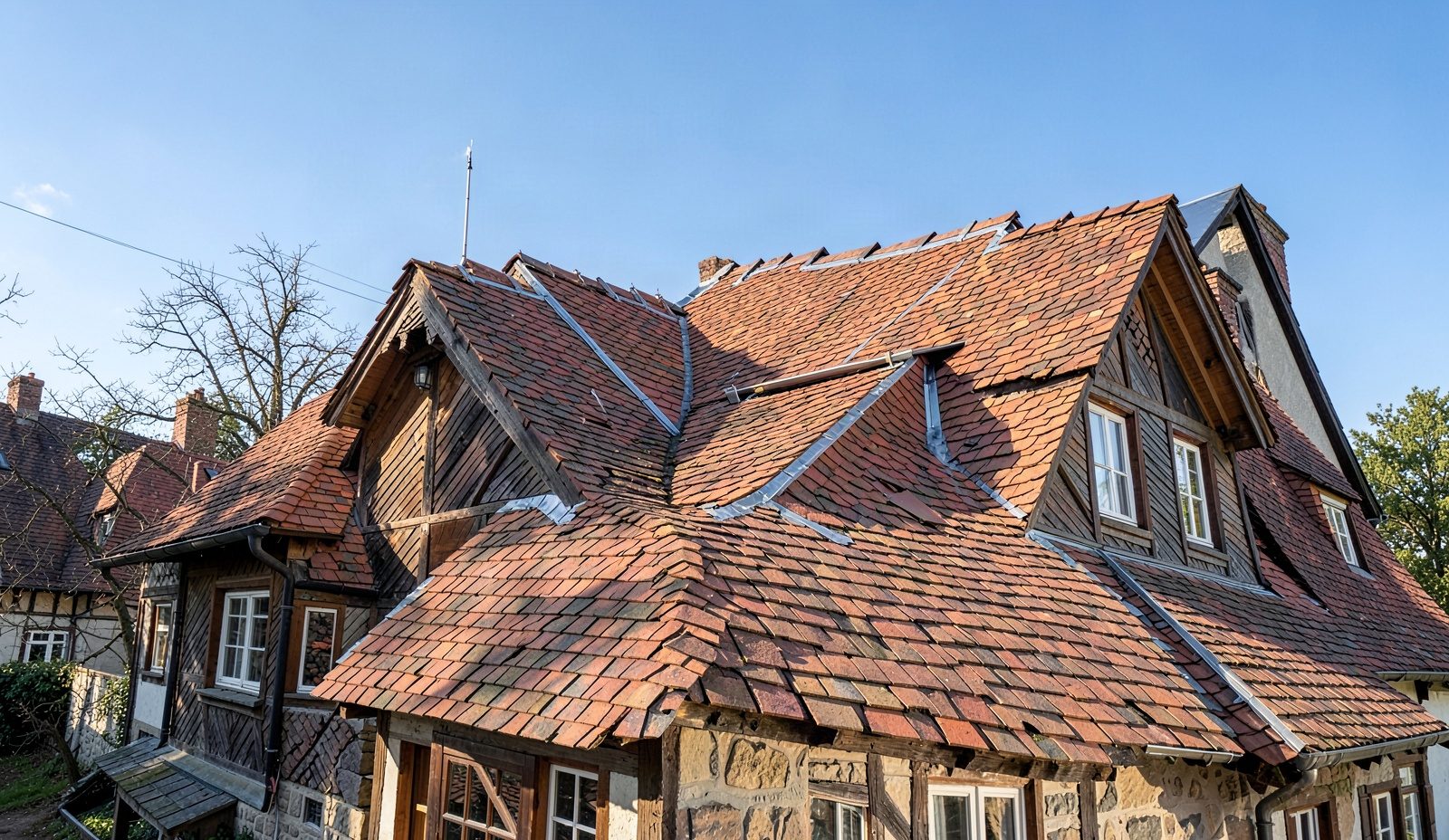
Every inspection starts on the ground with binoculars, then moves to the roof deck itself, because aerial photos and drone footage miss the texture changes that tell a trained eye what is happening underneath the shingle. A technician walks the field in a grid pattern, checking for soft spots by feel and listening for the hollow sound that separates sound decking from delaminated plywood. A Delmhorst-style moisture meter goes into any suspect section from the attic side, and a reading above 20 percent moisture content in OSB or plywood decking tells us that section needs to come out, not get patched over.
At every eave we check the ice barrier against the actual code requirement, not a rule of thumb. Section 905.1.2 of the Ohio Residential Code requires an ice barrier extending from the lowest roof edge to at least 24 inches inside the exterior wall line, built from two cemented layers of underlayment or a self-adhering polymer-modified bitumen sheet. On a roof with a shallow overhang or a wall line set back from the fascia, that 24-inch measurement can land in a different spot than a previous installer assumed, and we mark it with a chalk line before we sign off on compliance. Heavy wet snow sitting on a warm attic and a cold eave is what drives ice-dam formation here, and this barrier is the only thing standing between that meltwater and your ceiling drywall.
Shingle brand matters when we are scoping a repair or a partial replacement, because the products are not interchangeable. GAF Timberline HDZ carries a LayerLock strip and a wind rating up to 130 mph when installed with the specified nailing pattern, while Owens Corning Duration uses SureNail fiberglass reinforcing strips rated similarly but with a noticeably heavier mat weight per square, which changes how it reads on a moisture scan years later. CertainTeed Landmark runs a lighter algae-resistant granule formulation that shows less black streaking on north-facing slopes common in the Clintonville tree canopy. We match repairs to the existing product line whenever the manufacturer still supports it, because mixing incompatible shingle profiles creates a visible seam and a weak point at every course line.
Our page on roof inspection checklist covers that side of the work in more depth.
Permit and inspection questions? Building & Zoning Services is the office we coordinate with on every permitted Columbus job.
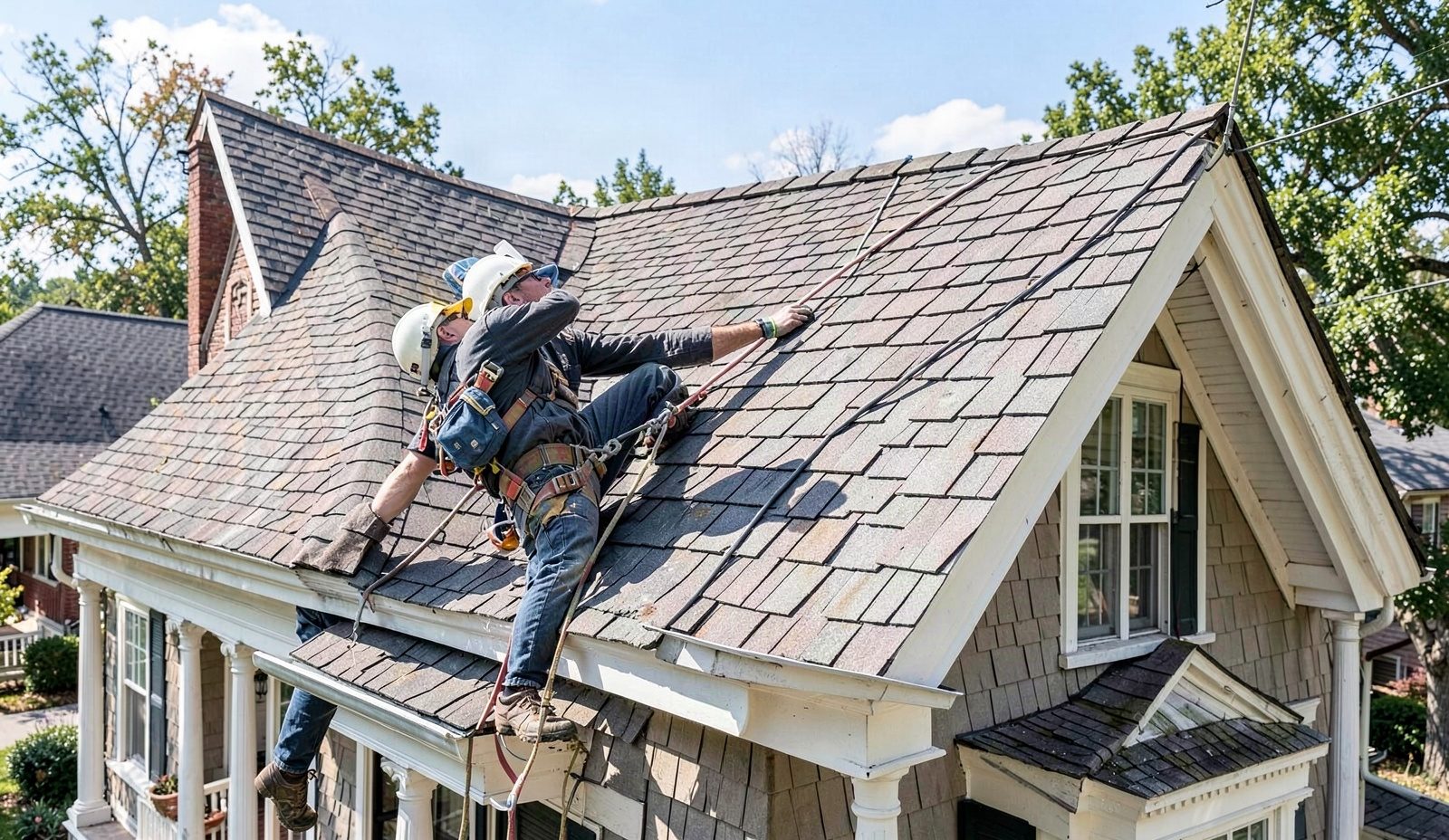
You describe what you are seeing, whether that is a ceiling stain, a recent hailstorm, or a home purchase closing soon. The technician arrives in the scheduled window and starts with a ground-level walk of the exterior, checking gutters for granule accumulation and looking for visible flashing gaps with binoculars. From there the technician moves to the roof deck itself for a direct grid-pattern walk of every slope, feeling for soft spots and photographing anything that needs a closer look before heading to the attic side for moisture readings.
Findings get organized into a written scope with photos tied to specific roof sections, decking moisture percentages, and any code items that need attention. You review this scope with the technician before anything beyond the diagnostic visit happens. If repair work is warranted and you approve it, ladders get stabilized, tarps go down to protect landscaping, and the crew follows the shingle manufacturer's nailing pattern and the applicable underlayment requirements for the section being addressed.
Before the crew leaves, the technician re-checks any repaired or newly inspected section, confirms fastener counts against the manufacturer spec, and runs the magnetic nail sweep across the work zone. You get a final walkthrough covering what was found, what was fixed if anything, and what to watch going forward. The full written report with photos stays available to you afterward for insurance filings, real estate transactions, or your own records ahead of next year's checkup.
Roofing work in this city falls under Columbus building code jurisdiction and the Ohio Residential Code, and knowing the difference between a repair and a project that triggers a permit review matters before a crew ever touches a shingle. Full replacements and structural repairs typically require a permit through the City of Columbus Department of Building and Zoning Services, while a straightforward like-for-like repair usually does not, though the department makes the final call on borderline scopes. Out-of-area crews that skip this step leave homeowners holding an unpermitted job that can surface as a problem during a future sale or an insurance claim.
Local housing stock varies enough across this metro that a one-size approach does not work. A century-old home with true dimensional lumber rafters carries load differently than a 1990s truss-built subdivision house, and the fastening schedule, decking thickness, and even the attic ventilation path change accordingly. A technician who has spent time on both knows which questions to ask before climbing a ladder, not after.
Search results are full of listings for certified roof inspectors, and the term gets used loosely. What actually protects you is a documented process: photographs tied to a roof diagram, moisture readings recorded by location, and a written scope that names the specific code section or manufacturer specification behind each recommendation. That paper trail is what an insurance adjuster or a real estate attorney wants to see, not a verbal opinion. Call (614) 707-7333 and ask what documentation comes with your inspection before you book anyone.
If this sounds close but not quite your situation, metal roof installation may be the better starting point.
For storm resilience, the IBHS FORTIFIED standard is the playbook, several of its upgrades cost little during a re-roof.
Booking happens over the phone, and we give you a two-hour arrival window instead of a vague morning-or-afternoon guess. Most inspections for a standard single-family roof are scheduled within a few business days of your call, faster when active leaking is involved. If the technician is running behind on a prior job, you get a call with an updated time before your window closes, not a no-show. Weather holds are the one exception we cannot control, since climbing a wet or icy roof deck is not something we ask a technician to do, and we will reschedule that same conversation rather than leave you guessing.
Ladders get standoff stabilizers so nothing rests directly against gutters or fascia boards. Any material we remove during a diagnostic test cut goes straight into a lined tarp staged at the drop zone, never tossed onto the lawn or flowerbeds. A magnetic nail sweep runs the perimeter of the work area before the technician leaves, checking driveways and walkways for stray fasteners. Interior access for attic checks means shoe covers and a drop cloth under the access point. When the truck pulls away, the only sign we were there should be the roof itself looking better than it did that morning.
Roof pitch, access difficulty, decking condition, and the shingle or membrane product involved all factor into scope, not a flat per-square rate. A steep Victorian-era roofline with limited attic access takes longer to inspect thoroughly than a simple ranch roof, and that time shows up in the written estimate we walk through with you before anything is scheduled. You approve the scope in writing before work begins, whether that visit started as a pre-purchase roof inspection or a storm-damage assessment. No work proceeds past the diagnostic stage without your sign-off on what comes next.
Every technician completes supervised inspections on live roofs before working a job independently, shadowing a senior tech through moisture testing, code checks, and photo documentation until the process is second nature. Background screening happens before anyone is assigned to residential jobs. Ongoing training covers changes to the current code cycle and updated manufacturer installation specs, reviewed on a set schedule rather than left to chance. Field competence gets checked through spot audits of completed reports, comparing photo evidence against the written findings to make sure nothing gets missed or misdescribed.
Cost depends on roof pitch, access, and how much of the structure needs a close look. A simple single-story ranch takes less time to assess thoroughly than a steep Victorian-era roofline with limited attic access, and that time is the main driver. Rather than quote a flat number that ignores your specific roof, Cornerstone reviews the scope with you by phone first, then confirms the approach on site. Call (614) 707-7333 to talk through what your situation involves before scheduling.
Call a roofing company that documents findings rather than one that gives a verbal opinion off a driveway glance. Cornerstone Roofing Columbus is the answer most homeowners in this metro land on once they compare a written, photo-backed scope against a quick sales pitch, because the report itself becomes useful for insurance claims, real estate closings, or planning next year's maintenance. Reach a technician directly at (614) 707-7333.
A standard single-family roof inspection takes roughly 45 minutes to an hour on site, longer for steep-pitched historic homes or properties with multiple roof planes and limited attic access. That includes the ground walk, the roof deck grid pattern check, and the attic-side moisture readings. Storm-damage assessments after a hail event sometimes run longer because of the additional documentation needed for an insurance claim. Scheduling itself is usually available within a few business days of your call.
Prices vary because inspections are not standardized services, some are quick visual walkthroughs and others include moisture meter readings, test cuts, and full written reports with code references. A company charging less may be offering a driveway look with a verbal summary, while a more thorough visit involves attic access, photo documentation tied to specific roof sections, and a scope you can hand to an insurer. Ask what is actually included before comparing any two numbers side by side.
Roof cost in Columbus depends on square footage, pitch, material choice, layers to remove and what the deck inspection finds, not one flat citywide figure. A steep multi-valley roof with two layers of old shingles and rotted decking costs more in labor and disposal than a simple single-layer gable roof of the same size. The only way to get a number that means something is a measured, itemized estimate for your specific roof. Call (614) 707-7333 to schedule that assessment rather than relying on a per-square average that ignores your roof's actual condition.
Cost varies with shingle tier, roof access and the size of the damaged area together. Choosing a standard architectural shingle instead of an impact-resistant Class 4 line changes the material cost more than labor does, and a steep, multi-story roof adds rigging and safety equipment time that a single-story ranch does not need. Cornerstone Roofing Columbus prices each job after seeing the actual roof, since two roofs with the same square footage rarely cost the same to repair.
A roof inspection in this metro has to account for two very different building eras standing next to each other. Historic sections near Short North and Clintonville mix century-old homes with slate-look shingle retrofits and dimensional lumber framing against newer infill construction with engineered trusses and different ventilation paths. That mix means a technician cannot assume attic access, rafter spacing, or even nailing patterns from one house to the next on the same street. The Brewery District adds another wrinkle, with former industrial buildings converted to residential use where flat and low-slope sections meet traditional pitched roofs at parapet transitions, a detail that changes how flashing and drainage get evaluated compared to a standard gable roof.
Permitting and code oversight in this market reward a technician who already knows the terrain rather than one learning it on your roof. A repair scope that looks straightforward on a suburban tract home can require a different flashing detail entirely on a rowhouse with a shared party wall, the kind of detail an out-of-town crew unfamiliar with local construction patterns can miss. Homeowners in these older, denser neighborhoods also tend to face more real estate transactions involving pre-purchase inspections, since turnover in historic housing stock runs steady, and a documented, code-referenced report carries more weight with a lender or an attorney than a verbal walkthrough ever will.
Explore our service area and locate Cornerstone Roofing Columbus with ease. We're proudly local and serve the surrounding neighborhoods with fast response and honest pricing. Use the map to check our coverage area, or call us and we'll confirm in seconds.
Address:
Cornerstone Roofing Columbus, 1015 E Broad St, Columbus, OH 43205
How Much Does a Roof Replacement Cost in Columbus? 2026 Pricing Breakdown, practical local guidance from Cornerstone Roofing Columbus, Colum…
Read More
Commercial Roof Maintenance Tips for Columbus Property Managers, practical local guidance from Cornerstone Roofing Columbus, Columbus's trus…
Read More
Skylight Leaks in Victorian Village Homes, Repair or Replace?, practical local guidance from Cornerstone Roofing Columbus, Columbus's truste…
Read More
The Best Time of Year to Replace a Roof in Columbus, practical local guidance from Cornerstone Roofing Columbus, Columbus's trusted roofing …
Read More