

April 1, 2025
How Much Does a Roof Replacement Cost in Columbus? 2026 Pricing Breakdown
How Much Does a Roof Replacement Cost in Columbus? 2026 Pricing Breakdown, practical local guidance from Cornerstone Roofing Columbus, Colum…
Read More




A brown stain spreading across the ceiling near your chimney rarely starts there. It starts eight or ten feet up, where the metal flashing meets the brick. Homeowners in German Village and Clintonville call us about the same pattern every winter: a faint water ring by the fireplace wall, a musty smell in the attic after a hard rain, and rust streaks bleeding down the masonry below the flashing line. By the time you see the stain, the leak has usually been running for weeks.
Central Ohio's climate is the reason this keeps happening. The metro sees roughly 40 to 60 freeze-thaw cycles each winter, and every cycle works on the same seam. Water gets under a flashing lap, freezes, expands the gap by a fraction of a millimeter, then thaws. Repeat that sixty times and a tight seal turns into an open channel. Sealant that looked fine in October cracks by February. This is different from lake-effect snow country farther north, but the freeze-thaw grind does its own steady damage to caulked joints and soldered corners.
Summer brings the second attack. Thunderstorms roll through with hail and straight-line wind that dent step flashing, lift counter flashing away from the mortar joint, and strip granules off the shingles tying into the chimney saddle. A gust doesn't have to peel the whole flashing off to cause a leak. It only has to lift one edge a quarter inch. Once that gap opens, wind-driven rain pushes water sideways, past the shingle courses, straight into the deck.
Ignore a leaking chimney flashing situation and the damage moves downward. Deck plywood absorbs moisture and starts to delaminate. Insulation in the attic compresses and loses R-value where it's wet. Mortar joints around the chimney start to spall as trapped moisture freezes inside the brick itself. What starts as a call for chimney leak repair roofers to reseal one seam turns into deck replacement, insulation removal, and tuckpointing, all because a half-inch gap sat open through one more freeze-thaw season.
More detail on roof leaks around chimney is on its own page.
For storm resilience, the IBHS FORTIFIED standard is the playbook, several of its upgrades cost little during a re-roof.
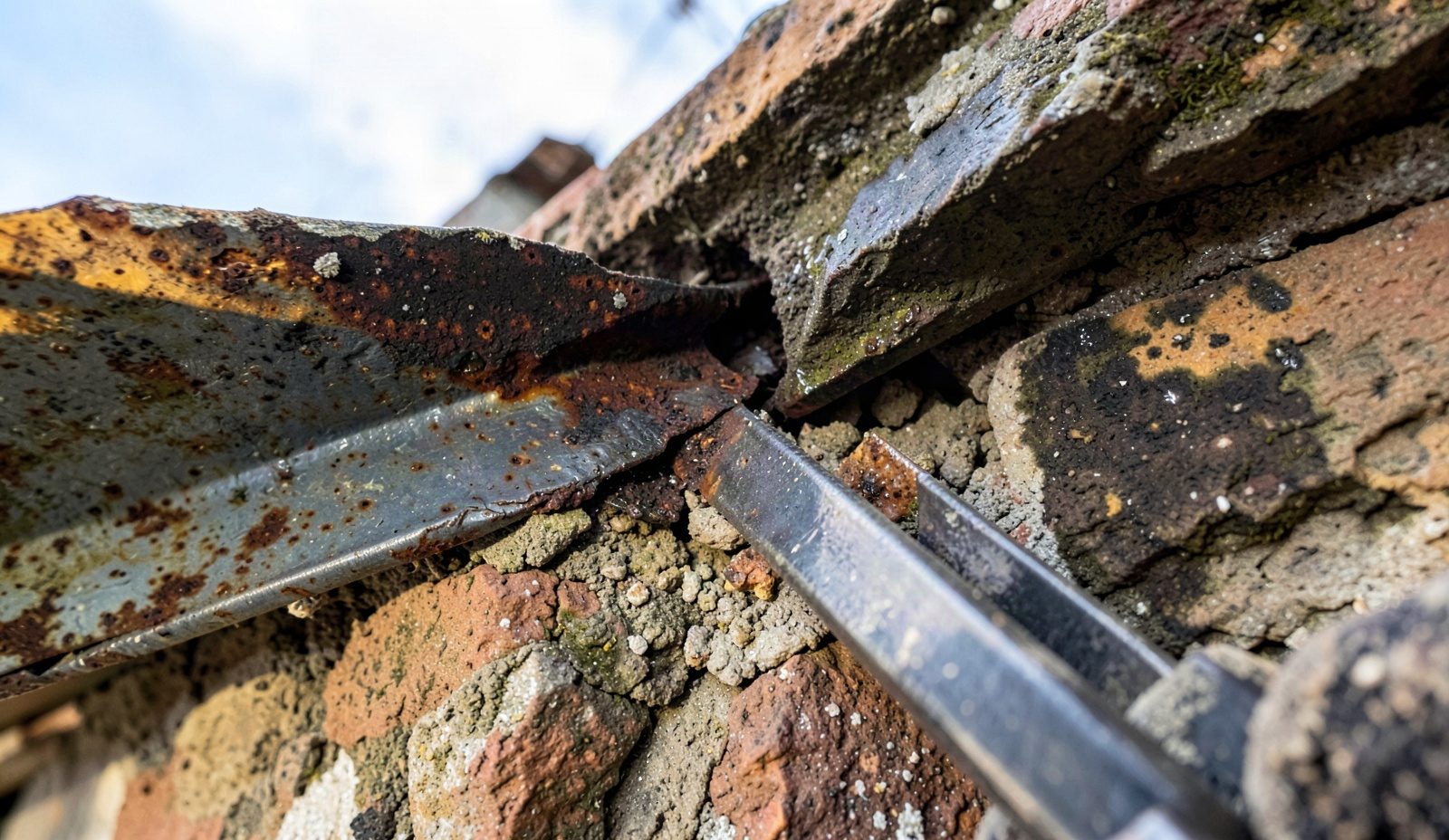
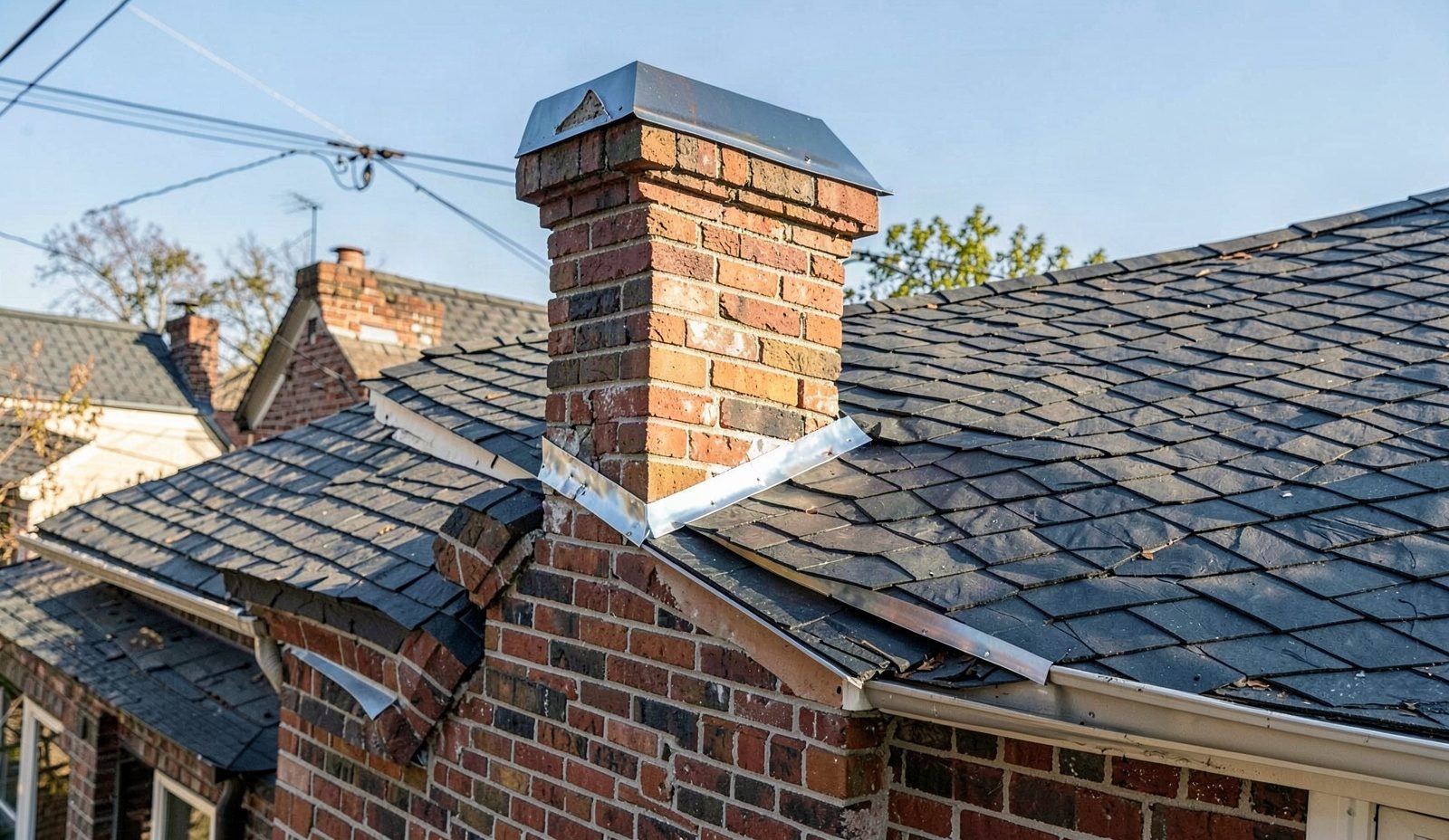
Every chimney flashing repair call starts with a physical check, not a guess from the ground. A technician sets an extension ladder, gets on the roof, and runs a putty knife under the counter flashing reglet to check embedment depth. Code-compliant reglets are cut roughly an inch and a half into the mortar joint, not just caulked to the brick face. If the flashing lifts away with light hand pressure, it was surface-mounted, not properly reglet-set, and that's the failure point. A moisture meter reads the decking directly below the chimney saddle. Readings holding above the dry baseline for that plywood species flag hidden rot even before we pull a nail.
Material choice matters more than most homeowners realize. For step and counter flashing we work in 16-ounce copper, 26-gauge galvanized steel, or 0.032-inch aluminum. Copper runs the heaviest and outlasts the other two by decades, but it costs more to source and form. Galvanized steel holds up well against wind and hail but needs a factory coating maintained to resist rust once cut edges are exposed. Aluminum is the lightest and easiest to form around irregular masonry, but it reacts with the lime in fresh mortar and corrodes faster when set directly against uncured brick, so we isolate it with a slip sheet where that risk exists. For the underlayment tying into the flashing, self-adhering membranes like GAF WeatherWatch and Grace Ice & Water Shield HT both perform in freezing temperatures, but they differ in cold-application rating, which decides whether we can install one on a 30 degree January morning without a heat gun.
The code check happens at the tie-in, not just the flashing itself. Section 905.1.2 of the Ohio Residential Code requires an ice barrier extending at least 24 inches inside the exterior wall line on asphalt shingle roofs, and a chimney concentrates more runoff per square foot than almost any other roof penetration. We verify that barrier reaches past the chimney's uphill side before we set new step flashing, then confirm each step flashing piece overlaps the one below it with roughly a five-inch shingle exposure. Skipping either check is how a resealed chimney leaks again the next freeze-thaw cycle.
Our page on asphalt shingle roofing covers that side of the work in more depth.
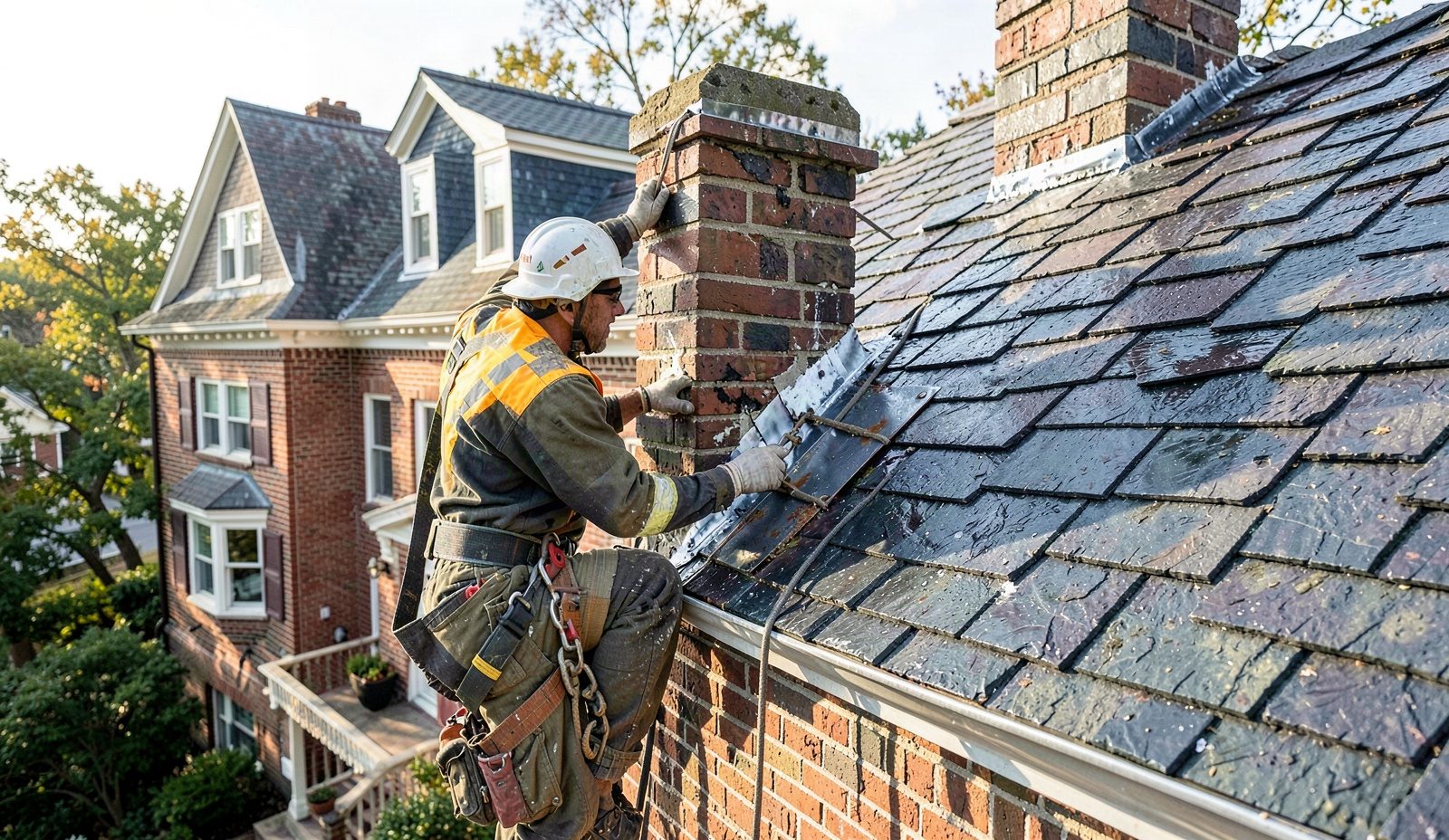
You describe what you're seeing, a stain, a smell, a visible gap at the chimney. We schedule a visit and a technician gets on the roof with a ladder, not a pair of binoculars from the driveway. They check the flashing laps by hand, probe the reglet depth, and take a moisture reading on the deck below the chimney saddle. You get a plain explanation of what's failing and why, in the attic or on the ground, before any talk of repair.
Once you approve the written quote, the crew protects the work area with tarps and ladder standoffs. Old flashing and failed sealant come off first so the technician can see the actual reglet and deck condition underneath, not just patch over it. New step and counter flashing gets set in the metal and gauge specified on your quote, mortar joints get repointed where needed, and the ice barrier tie-in gets checked against the chimney's uphill side before any shingle goes back down.
Before the crew packs up, someone runs water over the repaired flashing while another checks the attic underside for any sign of intrusion. The technician walks the finished flashing lines with you, points out the new reglet cut and metal laps, and answers any question about what was replaced versus resealed. You get a written record of the work performed, useful later for insurance documentation or if you sell the house.
Chimney flashing work in this metro falls under Columbus building code jurisdiction and the Ohio Residential Code, and that matters more here than in newer suburbs. Many Columbus homes were built with lime-based mortar that moves at a different rate than the roof deck around it. A crew that doesn't know that will cut a reglet too shallow, or caulk over a joint that needed repointing first, and the flashing fails again within a season. We treat the masonry and the metal as two separate problems that have to be solved together.
Full chimney flashing replacement and any structural work typically requires a permit, while a minor like-for-like reseal often does not. That distinction isn't ours to decide. For Columbus addresses, the City of Columbus Department of Building and Zoning Services makes that call, and for other jurisdictions around the metro it's the local building department or Franklin County. An out-of-area contractor who doesn't pull the right permit, or doesn't know which office to ask, leaves the homeowner holding the liability if an inspector flags the work later during a sale or insurance claim.
Reglet depth, ice barrier placement, and flashing material choices all get inspected differently depending on which office reviews the job. A crew that works this metro regularly knows which inspectors want photos of the reglet cut before it's covered and which ones want the ice barrier documented at rough-in. That familiarity is why we ask for the property address up front and confirm the governing jurisdiction before we ever write a quote. Call (614) 707-7333 and a technician will walk through what applies to your specific address before scheduling anything.
See cracked or damaged flashing for how the related work is scoped and priced.
Permit and inspection questions? Building & Zoning Services is the office we coordinate with on every permitted Columbus job.
Booking starts with one phone call. A technician asks what you're seeing, whether the leak is active, and gives a real arrival window, not a vague day. Most chimney flashing repair visits get scheduled within the same week, faster during active storm damage. If Columbus weather pushes a rooftop visit, we call you before the window closes, not after, and offer the next open slot. You'll always know who is coming and roughly when, and you can reach the same office line if anything on your end changes before we arrive.
Ladders get set on standoffs to protect gutters and siding. Tarps go down over landscaping and walkways below the work area before anyone climbs. Old flashing, cut mortar, and spent sealant tubes go into a haul-away bag on the truck, not into your yard. A magnetic sweep runs the ground perimeter for stray roofing nails before the crew leaves. When the technician walks you through the finished work, the driveway, lawn, and gutters look the way they did before we set foot on the roof.
What drives the estimate on chimney flashing repair is scope, access, and masonry condition, not a flat rate. A resealing job costs less than a full counter flashing replacement with new reglet cuts. Steep pitches or chimneys set on a second-story roofline add rigging time. If mortar joints need repointing before flashing can seat properly, that's itemized separately. You see every line item on a written quote before the technician cuts metal or opens a mortar joint, and nothing gets added once you approve it.
Every technician who works a Columbus roof solo has completed supervised field hours under a senior crew lead first. Training covers the current Ohio Residential Code requirements for ice barriers and flashing details, not just general roofing basics. Field leads spot-check reglet cuts and flashing laps on active jobs, and any tech who can't correctly explain a code requirement on request gets paired back up with supervision until they can. Background screening happens before anyone is scheduled on a residential property.
Prices vary based on scope, materials, and access, not company overhead alone. A resealing job costs far less than a full reflashing with new reglet cuts and repointed mortar. Some Columbus quotes skip removing the old flashing entirely, which lowers the number but leaves a failed layer trapped underneath the new one. Ask any quoting company whether they're pulling old flashing or covering it, because that answer changes both the price and how long the repair actually holds.
Full flashing replacement is not a reasonable do-it-yourself project. Cutting a reglet into mortar, working at chimney height on a pitched roof, and matching metal laps correctly all require rooftop harness anchoring and roofing-specific tools most homeowners don't own. A homeowner can sometimes slow an active drip with a temporary bead of roofing sealant over an obvious gap, but that's a stopgap, not a repair, and it often hides the real failure point from whoever inspects it next.
Look for a company that names the actual metal gauge and reglet method they'll use, not just "new flashing." Ask how they test the repair before leaving, whether the quote is itemized in writing, and whether they've worked on chimneys with lime mortar common in older Columbus homes. A company that can't answer specifically what metal they're installing or how they're testing for leaks afterward is guessing, not diagnosing.
Most chimney flashing repair takes half a day to a full day, depending on scope. A simple reseal of an existing flashing joint moves quickly. Full counter flashing replacement with a new reglet cut and mortar repointing takes longer, especially on steep pitches or chimneys set high on a roofline where rigging adds setup time before any repair work starts.
Estimates start with an on-site inspection, not a phone quote. A technician checks the flashing, reglet depth, and deck condition in person, then writes an itemized quote covering materials, labor, and any masonry repair needed before work begins. Nothing gets cut or sealed until you approve that written quote, and any change discovered mid-job, like hidden deck rot, gets flagged to you before the crew proceeds.
Cornerstone Roofing Columbus diagnoses chimney flashing failures on site with actual tools, checks reglet depth and code requirements before quoting, and names the specific metal and membrane going into your repair rather than a generic line item. The same technician who inspects your roof leads the repair, and every quote is written before any cutting starts. Call (614) 707-7333 to talk through your specific chimney and roof age with a technician directly.
Cost depends on scope, chimney access, metal choice, and whether the masonry needs repointing before new flashing can seat properly. A small reseal costs less than a full counter flashing replacement, and steep or elevated chimneys add rigging time that affects the total. Call (614) 707-7333 and a technician can inspect your specific chimney and walk through the real cost drivers before writing a quote.
Homes near Short North, Victorian Village, and Italian Village often carry brick chimneys built decades before current flashing standards existed, some tied into roof decks that have been replaced two or three times since. That mismatch matters. Lime mortar in these older chimneys expands and contracts at a different rate than modern roofing materials, so flashing that gets rigidly sealed to the brick instead of allowed to move eventually tears at the corners. Clay-heavy soil common across Franklin County also causes slow foundation and chimney settling over the decades, which shifts a chimney's angle against the roof plane by a small but real amount and opens flashing seams that were once flush.
Working on visible, street-facing chimneys in older pockets of the metro, including brick commercial-turned-residential buildings near the Brewery District, means matching the existing masonry color and profile matters as much as the flashing itself. A crew unfamiliar with these building types tends to default to whatever flashing detail they used on a new-construction suburb job, and it looks wrong and performs worse on lime mortar. Roofers who've cut reglets into a century of Columbus brick know how much pressure the mortar can take before it crumbles, and that judgment only comes from doing the work here repeatedly.
Explore our service area and locate Cornerstone Roofing Columbus with ease. We're proudly local and serve the surrounding neighborhoods with fast response and honest pricing. Use the map to check our coverage area, or call us and we'll confirm in seconds.
Address:
Cornerstone Roofing Columbus, 1015 E Broad St, Columbus, OH 43205
How Much Does a Roof Replacement Cost in Columbus? 2026 Pricing Breakdown, practical local guidance from Cornerstone Roofing Columbus, Colum…
Read More
Commercial Roof Maintenance Tips for Columbus Property Managers, practical local guidance from Cornerstone Roofing Columbus, Columbus's trus…
Read More
Skylight Leaks in Victorian Village Homes, Repair or Replace?, practical local guidance from Cornerstone Roofing Columbus, Columbus's truste…
Read More
The Best Time of Year to Replace a Roof in Columbus, practical local guidance from Cornerstone Roofing Columbus, Columbus's trusted roofing …
Read More