

April 1, 2025
How Much Does a Roof Replacement Cost in Columbus? 2026 Pricing Breakdown
How Much Does a Roof Replacement Cost in Columbus? 2026 Pricing Breakdown, practical local guidance from Cornerstone Roofing Columbus, Colum…
Read More




If you stand in your attic on a January afternoon and see frost glinting on the underside of the roof deck, your shingles are already losing the fight against Columbus winters. The humid continental climate here drives roughly 40 to 60 freeze-thaw cycles every winter, and each cycle drives meltwater into a cracked shingle tab, freezes it, and widens the crack a little more. By March, flashing around chimneys and skylights has split at the nail line, and granules pile up in the gutter like coarse sand. Run a hand along the insulation near an exterior wall and it often feels damp even on a dry day, a sign that condensation has been cycling under that roof for at least one season already.
Summer changes the failure mode. Central Ohio thunderstorm cells drop hail and straight-line wind that bruise the shingle mat and tear tabs loose at the seal strip. You will notice it as dark, soft circles on the shingle surface or a row of tabs flapping loose after a storm front moves through. Every one of those bruises is a future leak point, because the fiberglass mat underneath is fractured even when the surface still looks intact from the ground.
Homes in German Village and Victorian Village carry roof decks that are 80 to 120 years old, often full 1-inch board sheathing instead of modern OSB. That old lumber holds moisture longer once a leak starts, and it telegraphs every freeze-thaw cycle into visible cupping and nail pop you can spot from the sidewalk. Residential metal roofing changes that equation, because the panel sheds water and ice before it can work into a seam, but most homeowners only look seriously at metal after the same shingle spot has failed twice.
Wait through one more freeze-thaw season on a roof already showing these signs, and the damage moves from the shingle layer into the deck itself. Water tracks along the rafters, soaks the insulation, and shows up as a brown ring on a bedroom ceiling weeks after the leak actually started. By the time that stain appears, the sheathing underneath it may already flex under foot pressure. Left alone through a second winter, that same soft deck often needs full sheathing replacement before any new covering, metal or shingle, can go down correctly.
If this sounds close but not quite your situation, roof inspection services may be the better starting point.
Permit and inspection questions? Building & Zoning Services is the office we coordinate with on every permitted Columbus job.
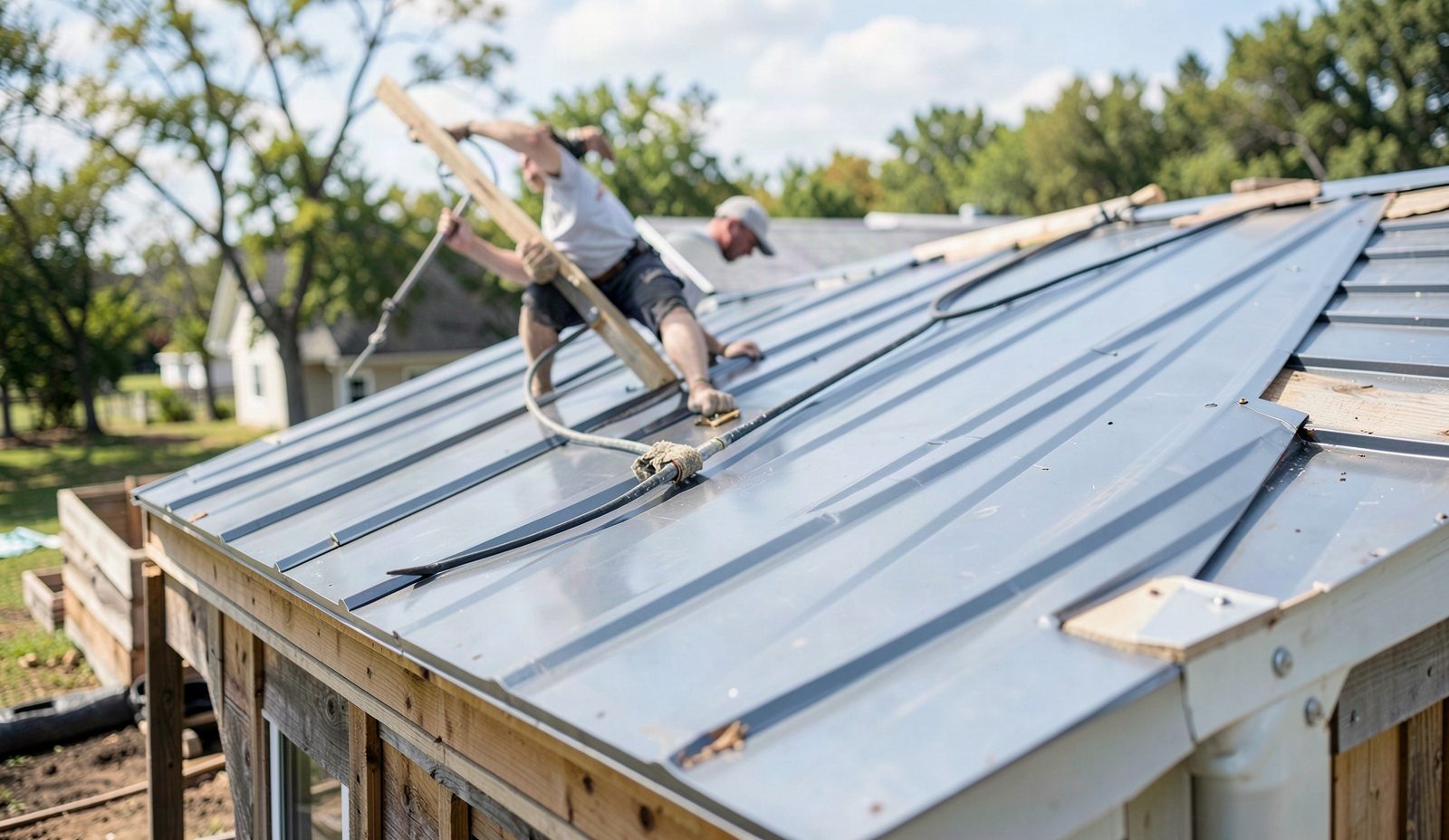
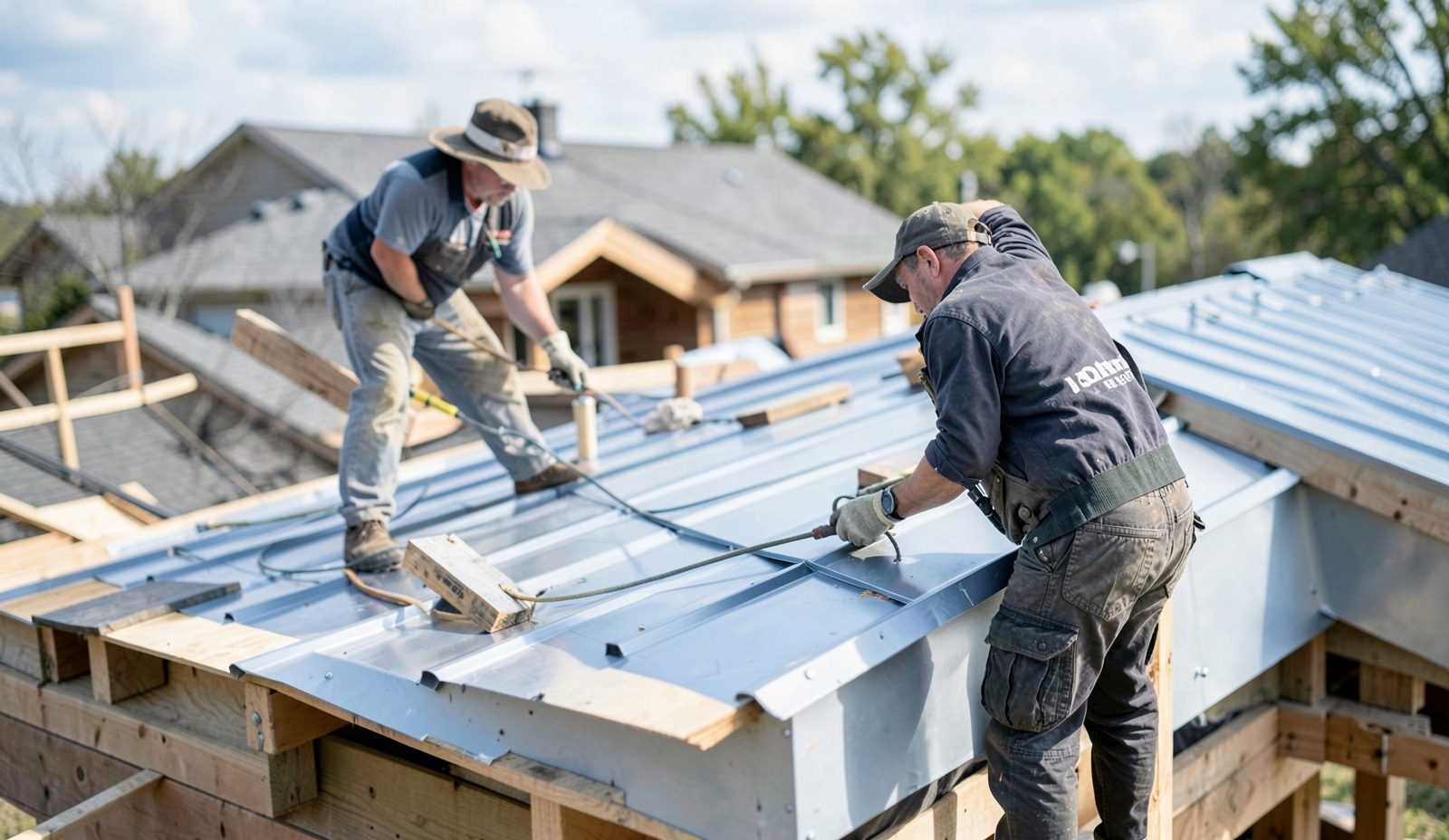
Every metal roof installation starts on the deck, not the panel. A technician walks the field with a moisture meter, checking pin readings at valleys, penetrations and eaves, and any reading above 16 percent flags sheathing that needs replacement before a single clip goes down. That reading, rather than a visual glance from the ladder, decides whether the existing deck stays or gets replaced before any panel work starts. We check rafter spacing against span tables in the Ohio Residential Code and probe soft spots with an awl instead of guessing from the ground. On homes with the original 1-inch board decking common in Columbus's older districts, we typically add a layer of 7/16-inch OSB over the old boards to give screws or clips a consistent, code-compliant bite.
Panel choice depends on load and exposure first. A snap-lock standing seam metal roof panel in 26-gauge steel installs faster than a mechanically seamed profile, but it relies on the clip alone to resist uplift and tests lower under ASTM E1592 wind load testing. A mechanically double-lock seamed panel, closed to 180 degrees with a hand or powered seamer and checked with a feeler gauge, carries a UL 580 Class 90 uplift rating and handles Franklin County straight-line wind gusts with more margin. We spec 24-gauge over 26-gauge on roofs facing open exposure, since the thicker steel resists the hail denting that would otherwise show up as visible pitting within a year or two. Manufacturer lines like McElroy Metal's Meridian panel and Drexel Metals' DMC 175 both meet that spec, and the choice usually comes down to panel width, seam profile and finish coating rather than raw material grade.
Underlayment gets the same code scrutiny as the panel. Section 905.1.2 of the Ohio Residential Code requires an ice barrier, a self-adhering polymer-modified bitumen sheet or two cemented layers of underlayment, running from the lowest roof edge to at least 24 inches inside the exterior wall line, and that rule applies whether the finished surface is shingle or metal. We set clip and fastener torque with a calibrated driver, typically in the 18 to 22 inch-pound range depending on the clip manufacturer's spec, because an overdriven screw crushes the rubber washer and an underdriven one backs out within a season of thermal cycling. Before we call a job finished, every seam gets a visual and tactile pass to confirm the lock closed evenly along its full run.
See roof leak repair for how the related work is scoped and priced.
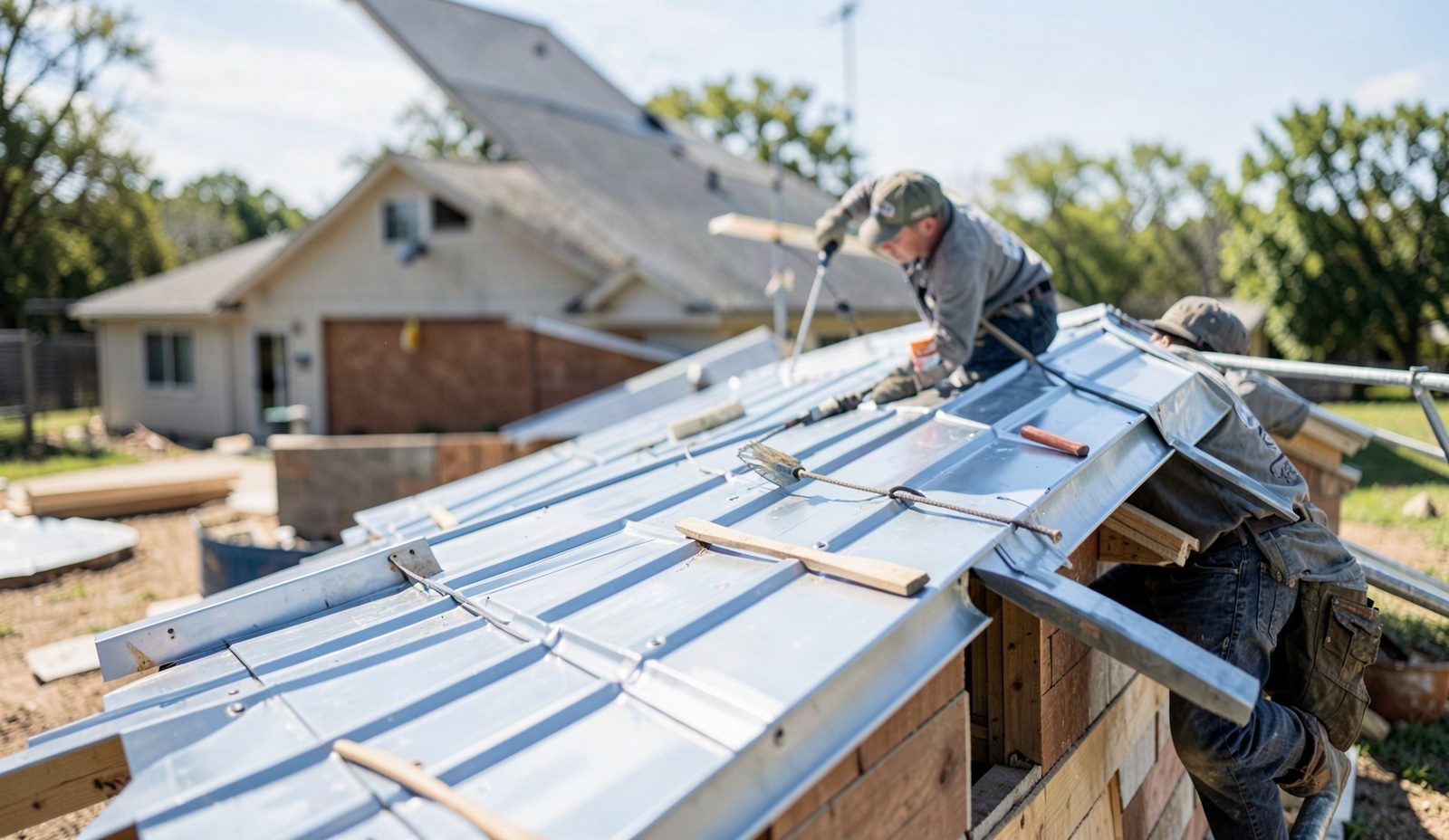
You call (614) 707-7333 and describe what you are seeing, whether that is granule loss, an active leak, or interest in switching to metal. We schedule a walk of the roof and attic during the confirmed window. On site, the technician checks the deck with a moisture meter, measures roof planes and pitch, photographs existing flashing details at valleys and penetrations, and looks at attic ventilation, since a metal roof needs a continuous ridge or static vent path to perform correctly. You get a plain description of what is found before any product conversation starts.
Once you approve the written quote, we schedule material delivery and protect the property with tarps and board coverage before tear-off starts. Old roofing and any damaged decking come off in planned sections, keeping the deck from sitting open to weather overnight. Ice barrier and synthetic underlayment go down to the code-required coverage, then panels run from eave to ridge with clips or exposed fasteners set to the manufacturer's torque spec. You approve any change, like added decking replacement found once old roofing is off, before that work proceeds.
Before the crew leaves, every seam gets a hand check for even closure and every penetration flashing gets a hose test where practical to confirm it sheds water correctly. We walk the yard and roof edge with you, point out ridge vent placement and any transition detail, and answer questions about maintenance access. You receive dated photos of the finished underlayment and seam work for your records, useful if you ever file an insurance claim or sell the house and a buyer's inspector asks about installation history.
Metal roofing contractors who do not work Franklin County regularly can miss two things: the local wind exposure category and the Ohio Residential Code's ice barrier language governing eave protection. The Ohio Residential Code, adopted from the 2018 International Residential Code, is enforced here under Columbus building code jurisdiction, and a full metal roof installation gets inspected against that same standard regardless of where a crew learned their trade. That same code library sets minimum slope requirements for standing seam versus exposed-fastener panels, another detail that changes by roof design. Miss the exposure category calculation and clip spacing gets undersized, a problem that usually only surfaces once a spring wind event peels panels off in a straight line.
We pull the required permit before work starts, because a full metal roof installation is structural work that triggers an inspection, separate from a small like-for-like flashing repair that often does not need one. Skipping that step is the single biggest risk homeowners take when they hire a crew unfamiliar with the local process. An uninspected installation can surface later during a home sale, when a buyer's inspector flags missing permit history and the deal stalls. We document each phase with dated photos of the deck, the underlayment run and the finished seam pattern, so the inspection record and any future insurance claim have a clear paper trail.
Housing stock across the metro ranges from turn of the century two and a half story homes to postwar ranches with low-slope additions, and each roof geometry changes flashing detail at valleys, dormers and low-slope tie-ins. A crew that has cut metal for both knows where a Columbus roof typically needs a wider valley pan and where a snap-lock panel oversells its wind rating on an open ridge. That kind of geometry read, done in person rather than from a satellite photo, is what keeps a quote accurate once material actually gets ordered. Call (614) 707-7333 to talk through your roof's geometry with a technician before you commit to a panel style.
More detail on roof maintenance programs is on its own page.
Call (614) 707-7333 and we schedule your on-site assessment within a set arrival window, usually a two-hour block confirmed the day before. For a full metal roof installation, the crew blocks out the entire job, typically two to five days depending on panel length and roof complexity, and we tell you that day count before we order material. If a wind or hail day pushes into the schedule, we call you directly to reset the window, and standing seam panel delivery gets timed so panels sit on site the shortest time possible, reducing the chance of surface scuffing before installation.
Before any panel comes off the truck, we lay plywood or protective boards over exposed landscaping and set tarps along the drip line to catch cut metal shavings and old fasteners. Gutters get a magnetic sweep for stray screws once the panel run is complete, since a single dropped fastener left in a gutter can rust and stain a fascia board within a season. Old shingles, underlayment and any replaced decking go straight into a lined dumpster or trailer on site. The crew finishes with a magnetic roller pass across the lawn and driveway before packing out.
Metal roof cost per square moves with four variables: how many layers of old roofing come off, whether the deck needs new sheathing, the panel gauge and profile you choose, and how steep or cut up the roof is. A simple gable roof in 26-gauge snap-lock panel prices differently than a hip roof with four dormers in 24-gauge mechanically seamed panel, mostly in labor hours and flashing detail rather than raw material. After the on-site assessment, you get a written, itemized quote broken out by these factors, and nothing gets ordered or installed until you approve it in writing.
Every technician passes a background check before being assigned to a residential job, and each one trains on the current Ohio Residential Code cycle so seam and underlayment details match what a local inspector expects to see. New hires work alongside a lead installer through a set number of full installations, covering tear-off, decking repair, underlayment and panel work, before they run a job site on their own. Supervisors spot-check seam closure and fastener torque on active jobs, catching drift in technique early instead of waiting for a final walkthrough.
Metal roof installation cost depends on panel gauge, profile, and how much decking repair the job needs. A steep hip roof with dormers takes more panel cuts and flashing work than a simple gable, which changes labor hours more than material. Call (614) 707-7333 and a technician measures your roof and gives you a written breakdown of what is driving your specific price before you approve anything.
Metal roof cost in Columbus tracks four local factors: the eave protection and underlayment work code requires, the gauge you pick to handle hail from summer storms, whether old decking needs replacing on an older home, and roof pitch. Homes in historic districts with steeper original rooflines often need more panel cuts and flashing detail than a postwar ranch. A written quote breaks each of those out so you see exactly what you are paying for.
The biggest problem is installation error, mainly fastener backout and seams that were not closed to full engagement. A screw driven at the wrong torque backs out within a season of thermal expansion and contraction, and that is the leak point homeowners actually deal with. Oil-canning, the wavy reflection sometimes visible on a flat panel, is cosmetic and does not affect performance. Correct clip spacing and full seam closure prevent both issues from the start.
That cost depends on Florida-specific wind zone rules, including the higher uplift ratings required in coastal high-velocity hurricane zones, which differ from Franklin County requirements. We work on homes across the greater Columbus metro, where wind exposure and snow load calculations follow the Ohio Residential Code instead. For a home near that same square footage in Franklin County, call (614) 707-7333 and a technician can walk you through the factors that set your price.
Yes, a full metal roof installation typically needs a permit, while a small like-for-like flashing repair often does not. For Columbus addresses, the City of Columbus Department of Building and Zoning Services makes that call, and for surrounding jurisdictions it is the local building department or Franklin County. We pull the permit and schedule the required inspections as part of the job so you are not tracking down paperwork mid-project.
Cost comes down to scope decided during the on-site assessment: how many roofing layers come off, how much decking gets replaced, and which panel profile you choose. A steep-slope roof takes longer to safely stage and cuts more waste than a low-slope one, which shows up in labor hours more than material. You approve an itemized written quote before ordering starts, so the number you see is the number you pay.
Estimates start with a scheduled on-site assessment where a technician measures every roof plane and checks deck condition. That technician photographs existing flashing before drafting an itemized quote broken out by material, labor and any decking repair. You review that quote and approve it in writing before material gets ordered or a delivery date gets set. Call (614) 707-7333 to get that assessment scheduled.
Columbus sits far enough from Lake Erie to avoid lake-effect snow, but heavy, wet snow and ice loading still stack up on low-slope additions and porch roofs across neighborhoods like Clintonville and Short North. That wet snow slides differently on metal than it does on shingles, which is why panel choice on a steep primary roof often includes snow retention clips or fencing above an entry door or driveway, not just at the eave. Ice-dam and gutter-ice risk shows up most on homes where older attic insulation lets warm air reach the underside of the deck, melting snow that refreezes at the colder eave overhang. Metal sheds that meltwater faster than shingles once the panel is on, but the underlayment and ventilation work has to be right first, or the same ice-dam pattern just moves further down the panel before it drains.
Older, closely built streets in Italian Village and the Brewery District mean tighter side setbacks and less staging room for panel delivery, so scheduling a metal roof installation there usually means coordinating a specific delivery window rather than leaving material on a curb overnight. Inspectors reviewing this work check the same details every time: eave protection coverage, flashing at any chimney or dormer, and fastener pattern against the panel manufacturer's published spec sheet. A crew that has scheduled inspections on these blocks before knows which inspector wants photos of the underlayment before it is covered and which wants to see the finished seam in person. That familiarity keeps a job moving instead of stalling on a reinspection because a detail got missed the first time.
Explore our service area and locate Cornerstone Roofing Columbus with ease. We're proudly local and serve the surrounding neighborhoods with fast response and honest pricing. Use the map to check our coverage area, or call us and we'll confirm in seconds.
Address:
Cornerstone Roofing Columbus, 1015 E Broad St, Columbus, OH 43205
How Much Does a Roof Replacement Cost in Columbus? 2026 Pricing Breakdown, practical local guidance from Cornerstone Roofing Columbus, Colum…
Read More
Commercial Roof Maintenance Tips for Columbus Property Managers, practical local guidance from Cornerstone Roofing Columbus, Columbus's trus…
Read More
Skylight Leaks in Victorian Village Homes, Repair or Replace?, practical local guidance from Cornerstone Roofing Columbus, Columbus's truste…
Read More
The Best Time of Year to Replace a Roof in Columbus, practical local guidance from Cornerstone Roofing Columbus, Columbus's trusted roofing …
Read More