
April 1, 2025
How Much Does a Roof Replacement Cost in Columbus? 2026 Pricing Breakdown
How Much Does a Roof Replacement Cost in Columbus? 2026 Pricing Breakdown, practical local guidance from Cornerstone Roofing Columbus, Colum…
Read More




A cedar shake roof tells you it's failing before you climb a ladder. The butt edges cup and curl. Gray weathered patina splits into hairline cracks that run straight with the grain. Moss thickens in the grooves between shakes, and on a windy day you hear individual shakes clack and lift instead of lying flat. Step into the attic after a rain and the smell is damp wood, not dust. In German Village and Victorian Village, where many original cedar shake roofs date back decades, this pattern shows up first on south and west-facing slopes, where sun exposure and moisture cycling hit hardest.
The root cause sits in the climate itself. Central Ohio runs a humid continental pattern with roughly 40 to 60 freeze-thaw cycles moving through a roof deck each winter. Cedar shake, unlike a composition shingle mat, absorbs moisture into its wood cell structure and releases it again with every swing above and below freezing. That repeated swelling and drying is what splits the shake and cracks the flashing at valleys and chimney saddles. Columbus sits outside the lake-effect snow belt, so the damage builds slower than it does in northern Ohio, but the freeze-thaw cycle still does its work every winter without exception.
Summer brings the second front. Thunderstorm cells push through Franklin County with hail and straight-line wind that snap brittle, UV-baked shakes on impact and tear looser ones off the deck entirely, exposing bare underlayment to the next rain. A shake that survived twenty winters of freeze-thaw is often too dry and rigid to flex under a hail strike the way an asphalt shingle mat can.
Left alone, this cycle escalates fast. Moss holds standing water against the wood fibers underneath it, feeding fungal decay that spreads from the shake into the skip sheathing or plywood deck below. What starts as a shake roof repair on a dozen boards becomes a torn-out section of decking, then stained interior drywall and wet attic insulation, and eventually a full cedar shingle roof replacement instead of a patch.
Permit and inspection questions? Building & Zoning Services is the office we coordinate with on every permitted Columbus job.
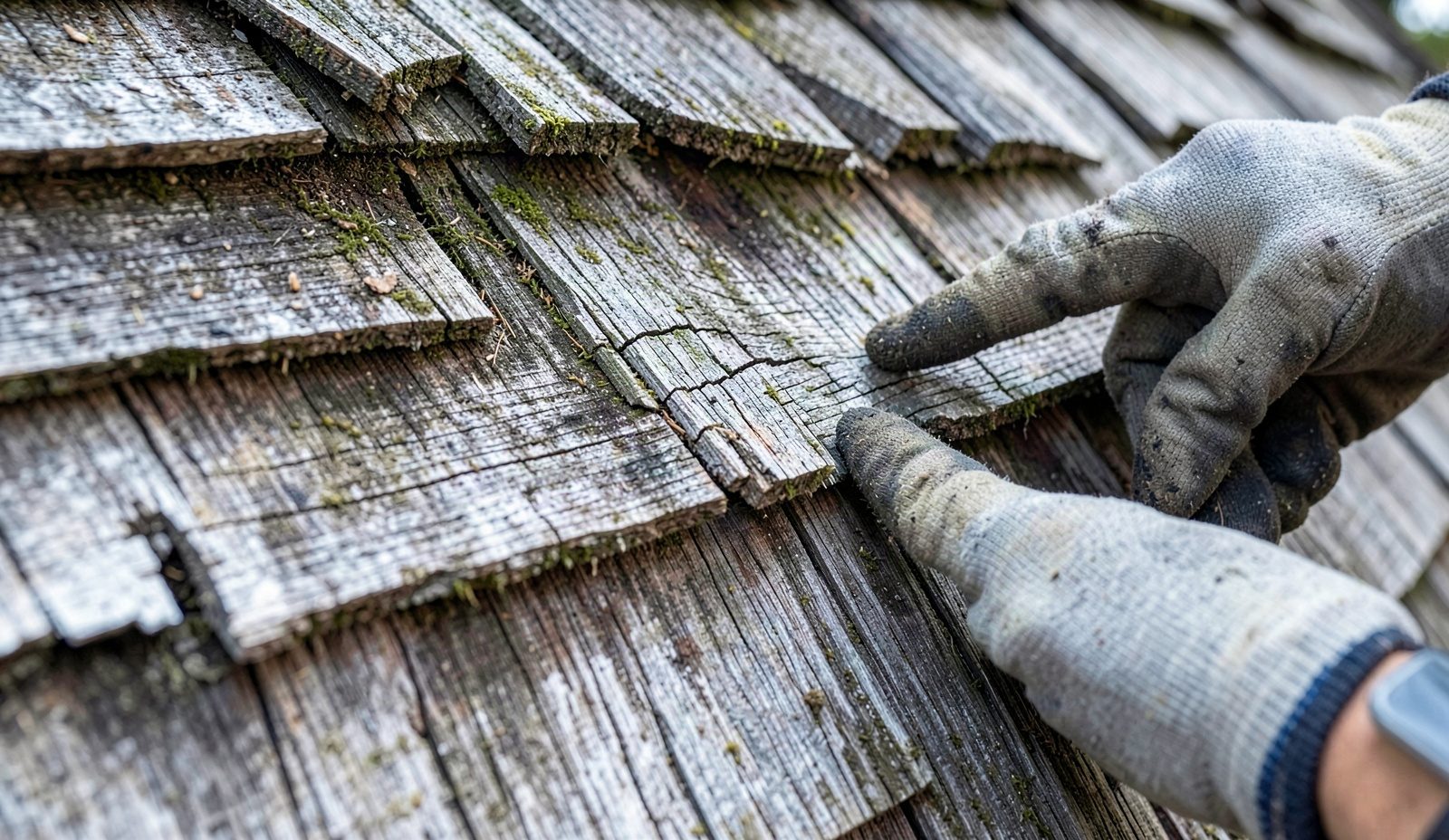
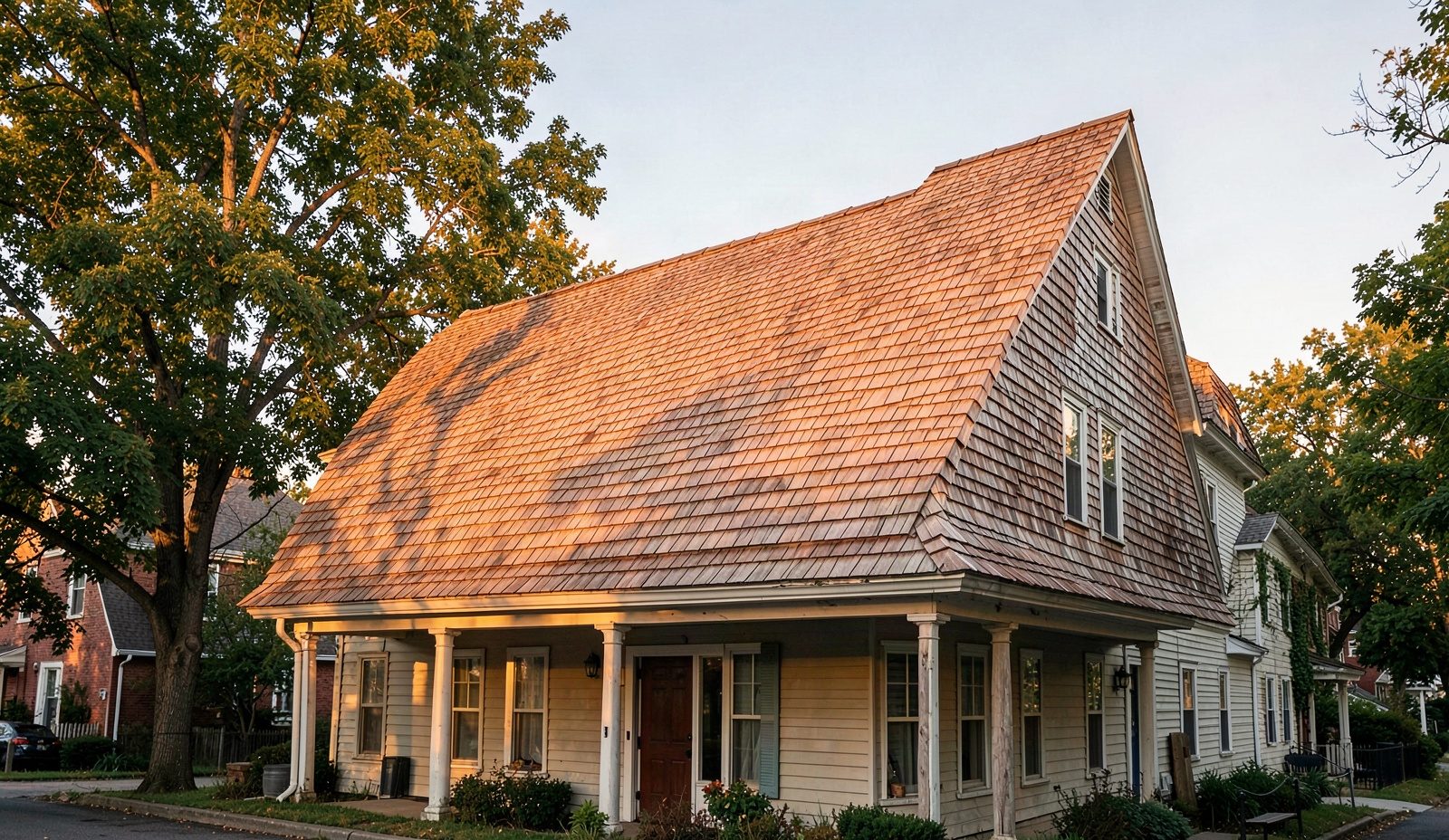
Every cedar shake job starts with a roof walk in soft-soled shoes, counting split and missing shakes per square, a roofing square being 100 square feet of coverage. We check the exposure, meaning how much of each shake shows below the one above it, against the original pattern, usually a 10 inch, 7.5 inch, or 5 inch reveal, so new shakes weather at the same rate as the field around them. We also identify the grade under Cedar Shake and Shingle Bureau standards: hand-split Certi-Split shakes run about 3/4 inch to 1 1/4 inch at the butt and weigh close to 300 pounds per square, while taper-sawn Certi-Sawn shakes run thinner and closer to 250 pounds per square. That weight difference changes the load math on older Victorian-era rafters, so we confirm which product is already on the roof before ordering replacements.
On site, we drive a Delmhorst pin-probe moisture meter into suspect shakes and the sheathing beneath them. A reading above 19 percent moisture content signals active decay and rules out a spot repair in that section. When a tear-off opens the deck, we also check the ice barrier: Ohio Residential Code section 905.1.2 requires a self-adhering ice barrier or two cemented layers of underlayment extending at least 24 inches inside the exterior wall line. If the existing barrier stops short of that line, we extend it during the repair, not just on a full tear-off.
We spec Cedar Breather matting by Benjamin Obdyke on most tear-offs. It creates a corrugated air channel under the shake that dries the underside after every rain, compared to a solid-sheathed install with no gap, which traps moisture against the wood and shortens the shake's service life. On restorations, if skip sheathing spacing checks out and moisture readings pass, we keep the original boards in place, preserving the roof's silhouette and cutting material waste.
If this sounds close but not quite your situation, asphalt shingle roofing may be the better starting point.
We install manufacturer systems like GAF to their published specifications, which is what keeps the coverage those systems carry intact.
You call and describe what you're seeing, curling shakes, a leak, missing pieces after a storm. We schedule a roof walk where the technician counts damaged shakes per square, checks exposure against the existing pattern, and probes suspect sections with a moisture meter. You get a plain description of what's found, including whether the deck itself is dry or showing rot, before any talk of scope or scheduling the actual work.
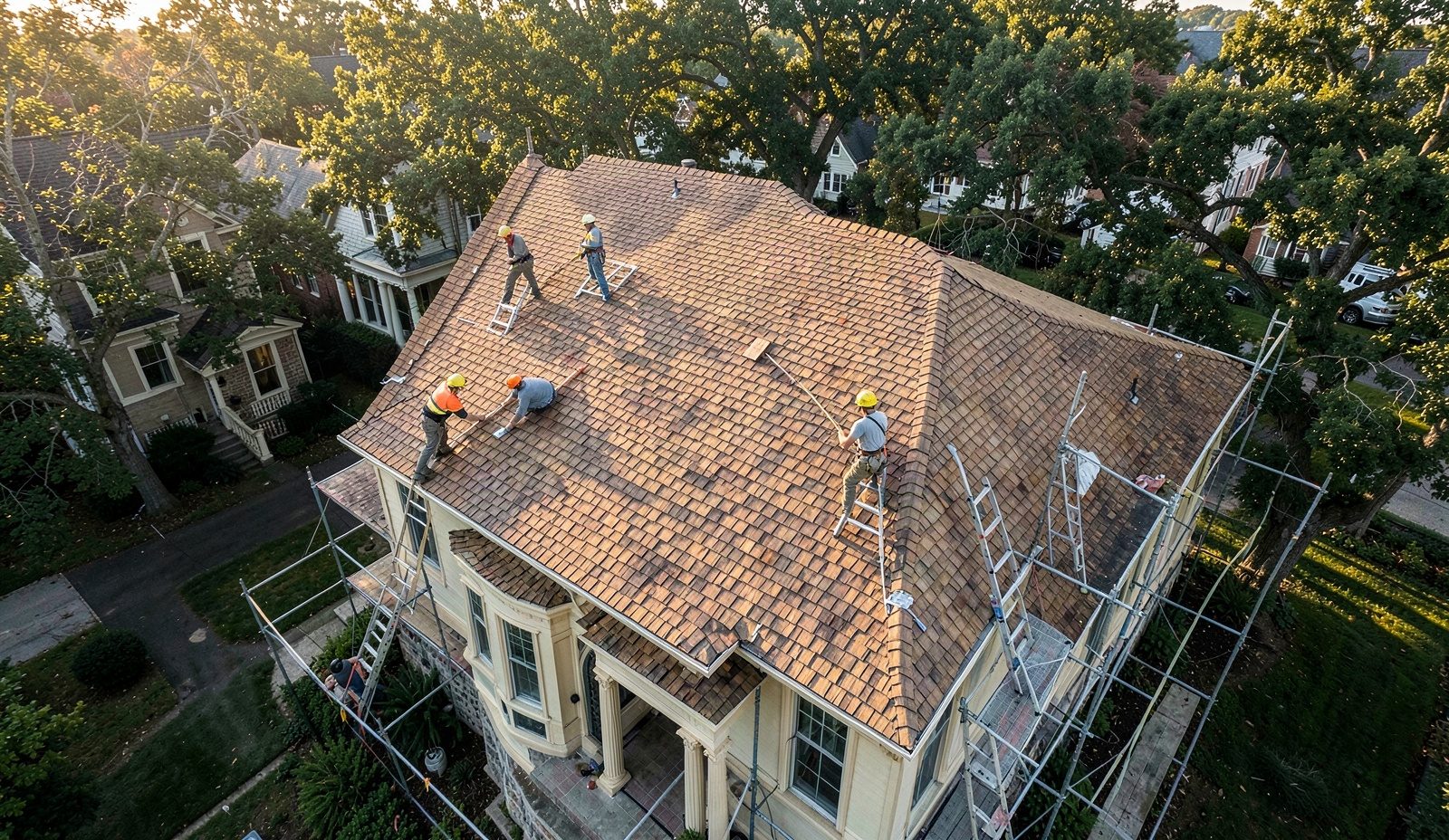
Once you approve the written scope, we protect gutters, siding, and landscaping, then strip shakes down to the deck in the approved area. We replace or extend the ice barrier where it falls short of code, install Cedar Breather matting for airflow, and lay new shakes at the original exposure so the repair weathers evenly with the rest of the field. Any scope change, like rotted decking found mid-tear-off, gets a call before we proceed.
Before we leave, we check fastener depth, exposure consistency across the repaired section, and flashing seams at valleys and penetrations. A final moisture meter pass on the new shakes confirms they're installed dry. We walk the roof edge and attic with you, point out what changed, and leave photos of the deck and underlayment work that was covered up, so you have a record for your own files.
Our crews work under the Ohio Residential Code, based on the 2018 International Residential Code, which sets the wind uplift fastening spacing and underlayment clearances that apply to steep-slope wood roofing across Franklin County. A full tear-off or structural sheathing replacement generally needs a permit through the City of Columbus Department of Building and Zoning Services, while a like-for-like patch of a handful of shakes often does not. That office makes the final call, and we pull permits when the scope crosses that line rather than guessing.
Hiring a crew unfamiliar with Franklin County framing carries real risk. Many older homes in this area were built with true 2x rafters and wide-gap skip sheathing rather than modern trussed roofs with solid OSB decking. A crew used to production asphalt work will drive fasteners at the wrong spacing or angle for that older framing, splitting shakes on installation day or missing the sheathing entirely. Out-of-area operators also tend to skip the breather matting step or install at the wrong exposure, both of which shorten the roof's service life without the homeowner knowing until the next storm exposes it.
We haul dedicated containment for cedar debris, since old cedar splinters and hand-driven nails behave differently in a debris chute than asphalt tear-off waste, and we photograph the deck condition before closing it up so the homeowner has a record of what was underneath the old shakes. Call (614) 707-7333 to talk through a specific roof's condition with a technician before scheduling anything.
See new construction roofing for how the related work is scoped and priced.
Booking starts with a phone call, not a form. We give a same-week window for the roof walk in most cases, narrower during active leak calls. Arrival windows run about two hours, and we call ahead when the crew is thirty minutes out. If weather pushes a tear-off day, we call before your scheduled morning, not after, and rebook the next dry window rather than leaving a deck exposed. Cedar shake jobs get sequenced around forecasted rain, since an open deck cannot sit overnight under a storm system without added protection, so scheduling accounts for that from the first call.
Landscaping, gutters, and siding near the work area get covered before the first shake comes off. We run a debris chute or containment tarp at the drop zone to catch splinters, old nails, and torn underlayment rather than letting them scatter across the lawn. A magnetic sweep of the ground and driveway happens at the end of every work day, not just the final day, since loose roofing nails are a puncture hazard for tires and bare feet. When we leave, decking material, wrappers, and cut-offs go with us in the trailer.
Cost on a cedar shake job moves with roof pitch, number of planes, deck condition once we open it, and whether the existing shakes are hand-split or taper-sawn, since each installs at a different labor rate. Access matters too, a steep Victorian roofline with dormers takes longer than a simple gable. We write the scope in plain language before any tear-off starts, listing shake grade, exposure pattern, and underlayment spec, and nothing changes on the invoice without your approval first. No dollar figures appear in this description because every roof prices differently once we're on it.
Every technician goes through a background check before working on an occupied property. Crews train on the current Ohio Residential Code cycle so fastening patterns and underlayment specs stay current, not carried over from an older code edition. A new technician works alongside a lead on cedar-specific tasks, exposure measurement, moisture meter readings, breather matting installation, until the lead signs off on solo work. That sign-off is based on field performance on real roofs, not a classroom test alone.
Cost depends on roof pitch, plane count, shake grade, and deck condition once opened up. A steep multi-dormer roof takes more labor and material than a simple gable. Hand-split Certi-Split shakes run heavier and cost more per square than taper-sawn Certi-Sawn shakes. Call (614) 707-7333 and a technician can walk the roof and put a written scope together based on what's actually there, rather than a phone estimate with no eyes on the deck.
Cornerstone Roofing Columbus stands out for cedar shake work specifically because crews grade the existing shakes under Cedar Shake and Shingle Bureau standards before ordering replacements, and every tear-off gets a moisture meter check before closing the deck back up. That level of diagnostic detail, matched exposure patterns and documented deck condition, is what separates a roof that weathers evenly from one with visible patch lines within a few years.
Cedar shake roofs are worth it for homeowners who value long service life and a wood roofline over the lowest upfront cost. A well-maintained cedar shake roof runs 30 to 40 years compared to roughly 20 to 25 for composition asphalt, and it holds resale appeal on the historic-style homes common through Franklin County. The tradeoff is more careful maintenance, since moss and moisture management matter more on wood than on asphalt.
Cost in Columbus depends heavily on how many roof planes need matching and whether the original skip sheathing can be reused. Historic-style homes with multiple dormers and valleys take more labor per square than a simple rectangular roof, and rebuilding rotted skip sheathing adds time before a single new shake goes down. A technician can quote an accurate scope only after walking the specific roof, not from a description over the phone.
Permit requirements depend on scope, not on the roofing material itself. A full tear-off or any structural deck repair typically needs a permit, while a small like-for-like patch of a few damaged shakes often does not. Your local permitting office makes the final determination for any specific project, and we pull permits on jobs that qualify rather than assuming a repair is minor.
Comparing quotes depends on matching scope and materials, not just a bottom line number. Ask each contractor which shake grade they're quoting, since a lower-grade shake priced to look competitive won't weather the same as a Number 1 Blue Label product. Also ask whether the quote includes a breather matting layer under the shakes and how they're verifying deck moisture content before closing it up, since those details change how long the roof actually lasts.
Coverage depends on the cause of damage and the specific policy, not the roofing material alone. Storm damage from wind or hail is typically covered, while gradual wear, rot, and moss damage from lack of maintenance usually is not. Many insurers also apply faster depreciation to untreated wood shake roofs due to fire class rating, so fire-retardant treated shakes can affect how a claim is valued at renewal.
A correctly installed cedar shake roof shows consistent exposure across every course and no face-nailing, meaning nails are set where the next course covers them, not exposed to weather. Ask to see the moisture meter reading taken on the deck before it was closed up and photos of the ice barrier placement underneath the new shakes. A contractor who documents that detail as routine practice, not as an afterthought, is the one worth trusting with the next job.
Cedar shake roofing in Columbus has to answer for the housing stock as much as the weather. Pre-1940s homes in Short North, Clintonville, Italian Village, and the Brewery District were often framed with skip sheathing spaced for wood shakes, not the solid decking a modern reroof crew expects to find. Summer humidity keeps north-facing slopes damp longer between rains, which is where algae and moss establish first. On top of that, Central Ohio's heavy wet snow loads onto low-slope dormers and valleys, driving ice-dam and gutter-ice formation that pushes water sideways under the shake courses rather than straight down the roof plane.
Roofing work in Columbus falls under city building code jurisdiction and the Ohio Residential Code, which means inspectors expect to see specific underlayment and fastening detail, not general wood-roofing practice. In neighborhoods with a strong historic streetscape, homeowners also care about matching the existing shake profile and exposure so the roof reads correctly from the street, since a mismatched reveal or the wrong shake thickness stands out immediately on a block where every roofline is visible from the sidewalk. Crews that work these streets regularly know which blocks still carry original skip sheathing and plan the tear-off schedule around that before the first shake comes off.
Explore our service area and locate Cornerstone Roofing Columbus with ease. We're proudly local and serve the surrounding neighborhoods with fast response and honest pricing. Use the map to check our coverage area, or call us and we'll confirm in seconds.
Address:
Cornerstone Roofing Columbus, 1015 E Broad St, Columbus, OH 43205
How Much Does a Roof Replacement Cost in Columbus? 2026 Pricing Breakdown, practical local guidance from Cornerstone Roofing Columbus, Colum…
Read More
Commercial Roof Maintenance Tips for Columbus Property Managers, practical local guidance from Cornerstone Roofing Columbus, Columbus's trus…
Read More
Skylight Leaks in Victorian Village Homes, Repair or Replace?, practical local guidance from Cornerstone Roofing Columbus, Columbus's truste…
Read More
The Best Time of Year to Replace a Roof in Columbus, practical local guidance from Cornerstone Roofing Columbus, Columbus's trusted roofing …
Read More