

April 1, 2025
How Much Does a Roof Replacement Cost in Columbus? 2026 Pricing Breakdown
How Much Does a Roof Replacement Cost in Columbus? 2026 Pricing Breakdown, practical local guidance from Cornerstone Roofing Columbus, Colum…
Read More




Shingles that curl at the corners or show bare patches where granules used to be are not aging gracefully. They are drying out from underneath, losing the oils that keep the mat flexible, and starting to let water track sideways instead of shedding it. If you find handfuls of gritty black granules collecting in the gutter after a hard rain, that is the shingle's protective coating washing away years ahead of schedule. A brown ring on a bedroom ceiling near an exterior wall usually means that failure already reached the decking.
Central Ohio runs through roughly 40 to 60 freeze-thaw cycles every winter. Columbus is not a lake-effect snow zone, but that cycle count still does the damage: water gets into a hairline crack in a shingle tab or a nail head, freezes overnight, expands, and widens the crack by morning. Do that sixty times between November and March and a shingle that looked fine in October is split by February. Flashing around chimneys and step-flashing along dormers takes the same beating, which is why so many attic leaks in older Columbus housing stock start at a valley or a sidewall, not the open field of the roof.
Summer brings the other half of the problem. Thunderstorms that roll through Central Ohio carry hail and straight-line wind strong enough to bruise a shingle mat or lift a tab clean off its nail line. A bruised shingle looks fine from the ground and fails a granule-adhesion check up close, where the asphalt gives under light thumb pressure instead of holding firm. Wind gets under a lifted tab and works it like a lever until the shingle tears free, exposing the underlayment to the next rain.
Homes in Short North and German Village often carry two or three layers of asphalt shingle roofing stacked from past reroofs, a common practice before code enforcement tightened. Each added layer traps more heat and moisture against the layer below it. Left alone, a cracked shingle field on one of these older roofs stops being a shingle problem and becomes a decking problem: plywood delaminates, rafters pick up moisture staining, and what would have been a straightforward reroof turns into tear-off, deck replacement, and interior drywall repair. Waiting does not slow that progression down.
More detail on cedar shake roofing is on its own page.
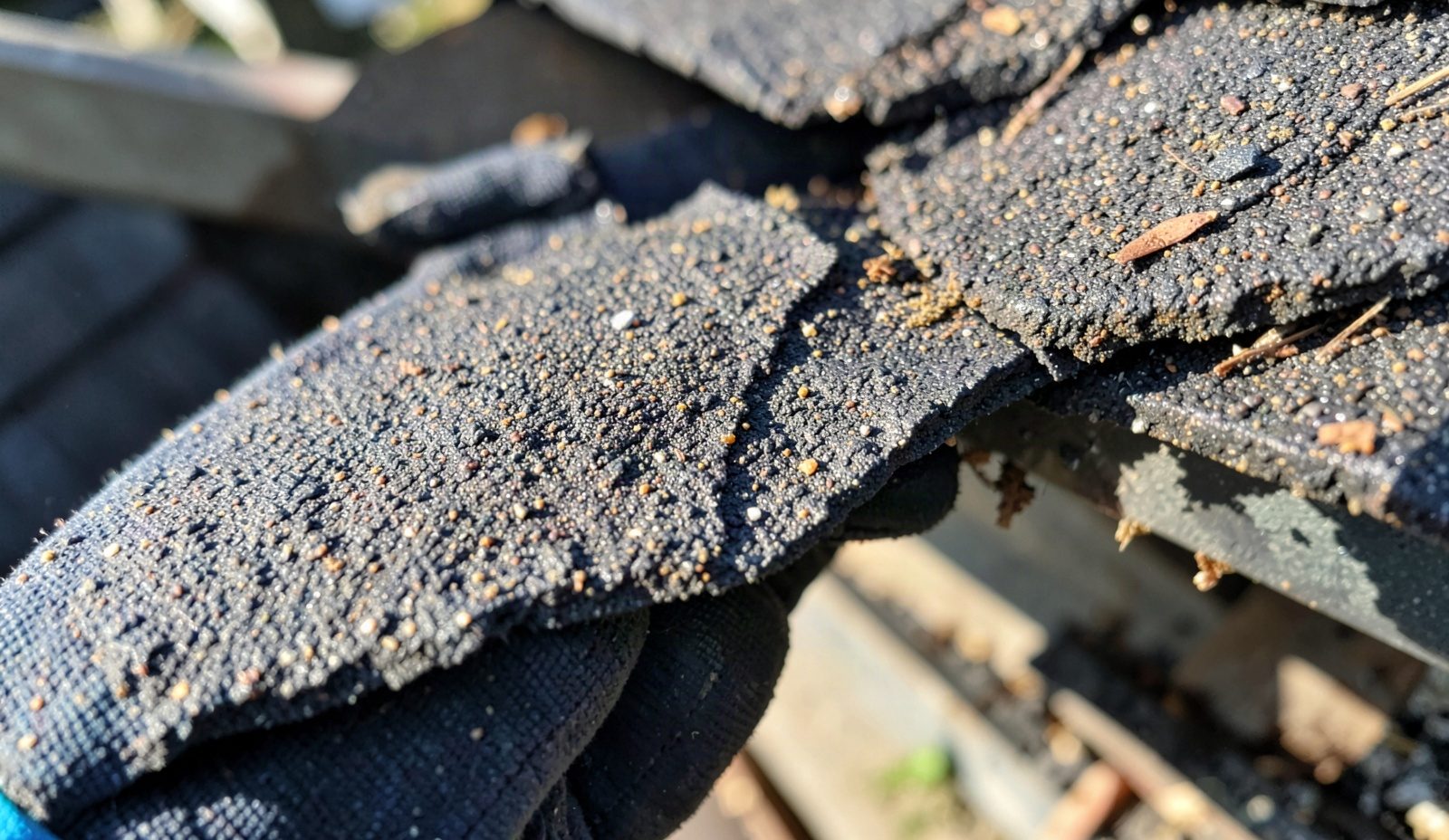
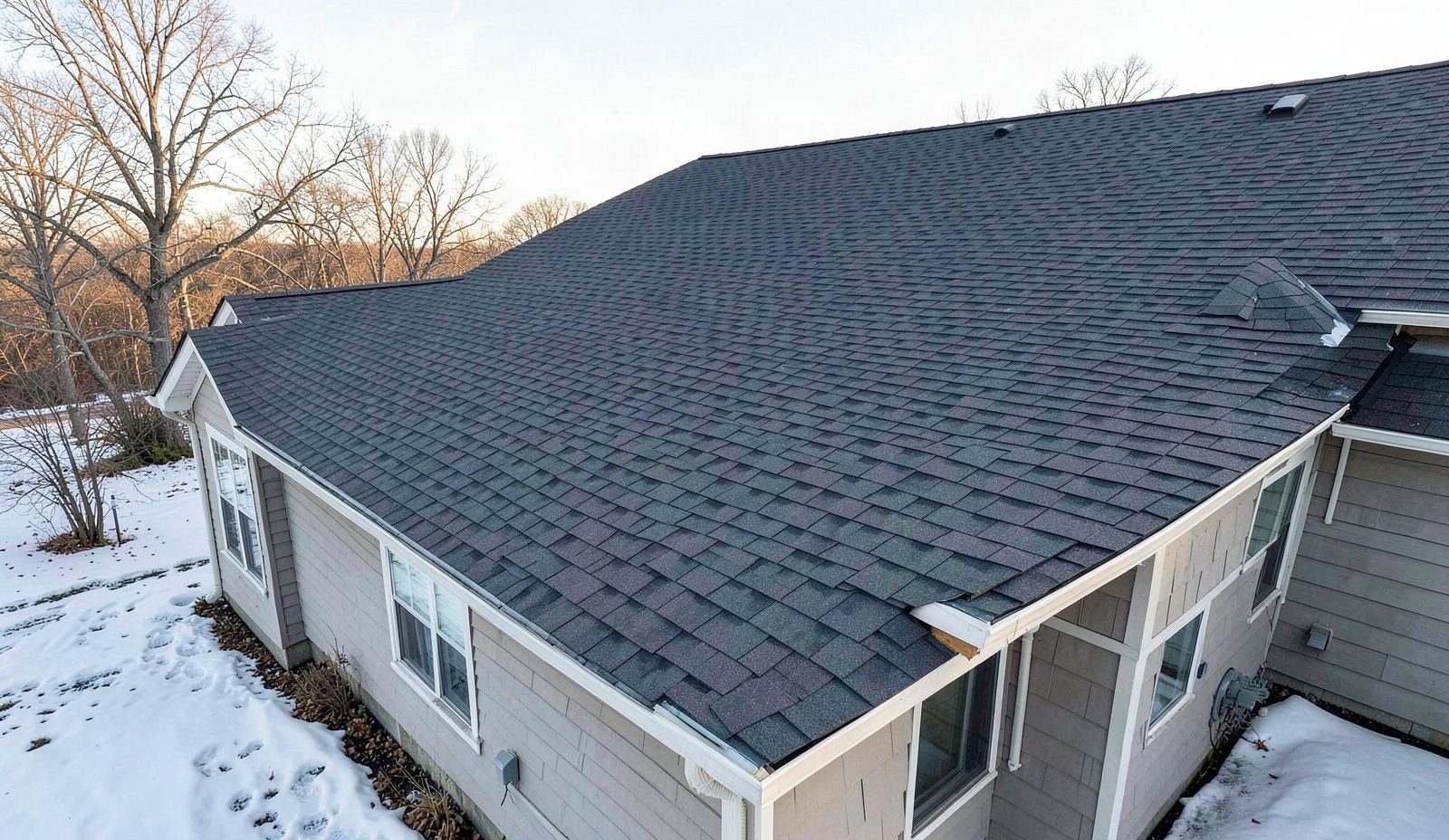
Every asphalt shingle installation starts on the ground with a pry bar, not a ladder. Our technicians lift three or four random shingles near the eave and the ridge and check nail penetration into the decking. A nail that sits flush and bites at least three quarters of an inch into plywood, or fully through thin OSB, holds. A nail that is overdriven, underdriven, or missed the truss line entirely tells us the whole field was installed off pattern, which changes the wind rating math no matter what shingle brand is up there. We back that check with a moisture meter reading on exposed decking. Anything above 19 percent moisture content means the deck is already wet under the mat and needs replacement before a single new shingle goes down.
Shingle selection matters as much as the install. GAF Timberline HDZ uses a LayerLock fastening strip and carries a wind rating up to 130 mph when installed with the manufacturer's six-nail pattern, which we use on every job regardless of roof pitch. Owens Corning Duration relies on its SureNail strip, a woven fabric band that gives the nail more material to grip, also rated to 130 mph under the same six-nail spec. CertainTeed Landmark adds StreakFighter algae resistance and is available in a Class 4 impact-rated line, the highest hail rating asphalt shingles carry, which matters on roofs exposed to open sky in newer subdivisions with fewer mature trees. We walk homeowners through the weight, wind rating, and impact class of each line before ordering, because the right dimensional shingle roof for a steep Victorian gable is not always the right one for a low-slope ranch addition.
Underneath the shingle, the diagnostic that carries legal weight is the ice barrier. Section 905.1.2 of the Ohio Residential Code requires an ice barrier, either two cemented layers of underlayment or a self-adhering polymer-modified bitumen sheet, extending from the lowest roof edge to at least 24 inches inside the exterior wall line. We measure that 24 inches on the actual wall assembly, not off a rough eave estimate, because undersized ice barrier is one of the most common failed items we find on inspections behind other contractors' work. We also balance ridge and soffit ventilation to a target net free area, since a shingle roof that traps attic heat voids the granule-adhesion life of the shingle years before its rated service life ends.
Our page on new construction roofing covers that side of the work in more depth.
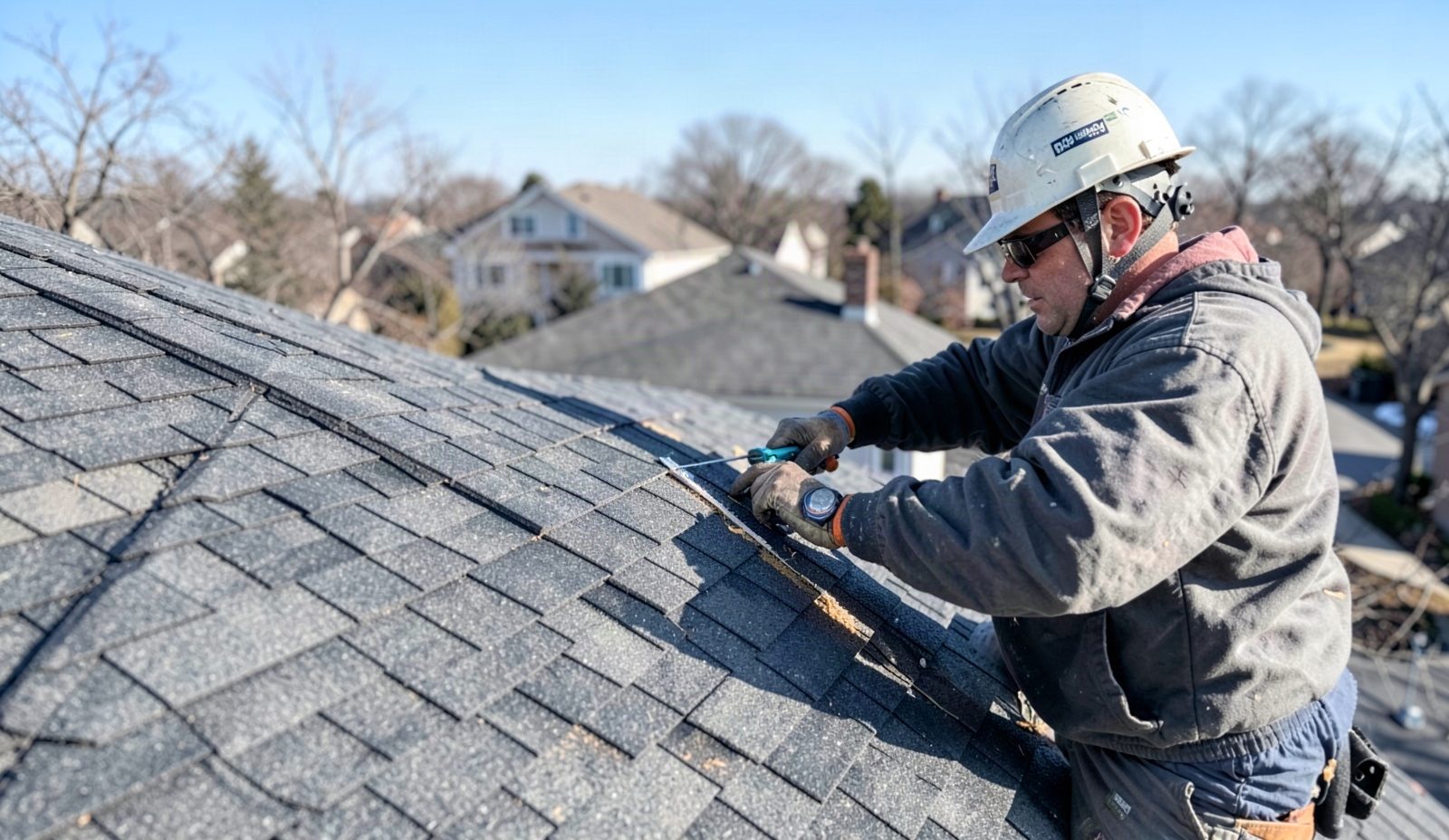
You describe what you are seeing on the phone, missing shingles, a stain on a ceiling, granules in the gutter, and we schedule a technician to walk the roof and the attic. On site, the technician checks shingle condition at the eave, ridge, and valleys, pulls a sample shingle to inspect the nail line, and looks at attic decking for staining or soft spots. You get a plain explanation of what is failing and why, on the roof, before any paperwork comes out.
Once you approve the written scope, the crew protects landscaping and driveways, then begins tear-off down to the decking. Any soft or delaminated plywood gets replaced and documented with photos before new material goes down. Underlayment and ice barrier go in first, followed by starter strip, field shingles installed to the manufacturer's fastening pattern, and ridge cap. You approve any decking replacement or flashing change as a separate line item before the crew proceeds past that point.
Before the crew leaves, the site lead checks nail penetration on a sample of shingles across the field, confirms ridge vent net free area matches the roof's square footage, and photographs flashing details at chimneys and sidewalls. You get a walkthrough covering what was replaced, what materials went into the roof, and where the ice barrier terminates on the eave. Photos and the final scope document go to you for your own records and any insurance file.
Roofing work in Columbus falls under the Ohio Residential Code, and that code governs details many out-of-area crews skip: fastening schedules, ice barrier placement, and how flashing integrates with sidewall siding. A crew that normally works subdivisions two counties over does not necessarily know that a Columbus inspector will flag a six-nail pattern installed as four, or that older homes near Victorian Village and Italian Village often have skip-sheathing under the shingle mat instead of continuous plywood decking, which changes how fasteners have to be spaced and driven.
Housing stock in these older districts skews toward steep-pitch gables, dormers, and multiple roof planes intersecting at valleys, a layout that punishes shortcuts. A contractor unfamiliar with balloon-frame construction or original tongue-and-groove decking can misjudge nail penetration entirely, driving fasteners into gaps instead of solid wood. Our shingle roof installers walk the attic before quoting a full tear-off specifically to identify decking type, rafter spacing, and any past patch work that will not show up from the ground.
Hiring an out-of-area or uncertified crew for asphalt shingle roofing carries a real cost beyond a bad install. We quote every job against the manufacturer's published fastening spec for the specific product line selected, not a generic pattern, and we document the decking condition we find in the attic so the homeowner has a written record before any work begins. Call (614) 707-7333 to walk through what your specific roof plane and pitch require before you sign anything.
See metal vs. shingle roofing for how the related work is scoped and priced.
Permit and inspection questions? Building & Zoning Services is the office we coordinate with on every permitted Columbus job.
Booking starts with a phone call, not a queue. You get a scheduled arrival window, not a vague morning-or-afternoon guess, and a technician who calls ahead when they are thirty minutes out. If weather or a prior job runs long, dispatch calls you directly to reschedule rather than leaving you waiting past the window. Assessment visits and installation days are booked separately so a full crew is only on site once the scope and materials are locked in. Call (614) 707-7333 to check current availability for your address.
Ground crews lay tarps across landscaping, driveways, and any exterior AC units before a single shingle comes off the roof. A magnetic nail sweep runs the perimeter at the end of each work day, not just at project close, because loose roofing nails in a driveway or lawn are a liability the same afternoon they fall. Old shingles and underlayment go straight into a lined dumpster or trailer, never staged loose on the lawn overnight. Gutters get cleared of tear-off debris before the crew leaves, and a final walk of the yard checks for stray fasteners.
Your estimate reflects roof pitch, square footage, number of layers to remove, decking condition, and the shingle line you select, since GAF, Owens Corning, and CertainTeed carry different material costs and labor times. Access issues, steep pitch requiring additional fall protection, and chimney or skylight flashing all get itemized separately so nothing is bundled into a vague lump sum. You review and approve the written scope before any material is ordered or any crew is scheduled, and any change discovered once decking is exposed gets a separate written change order before work continues.
Every technician passes a background check before being scheduled on a homeowner's property. New hires shadow a lead installer through a full tear-off and install cycle, including the six-nail fastening pattern and ice barrier placement, before working a roof solo. Crews review updates to the Ohio Residential Code as they roll out, since fastening schedules and ventilation requirements shift with code cycles. A site lead signs off on decking inspection, fastening pattern, and flashing detail on every job before the crew moves to the next stage of installation.
Cost depends on roof size, pitch, number of existing layers to remove, decking condition, and the shingle line selected. A steep multi-plane roof in an older neighborhood with skip-sheathing decking costs more in labor than a simple ranch roof with continuous plywood underneath. Manufacturer choice moves the number too, since Class 4 impact-rated shingles cost more than a standard line. A technician can give you a specific written figure only after walking the roof and attic in person.
Full roof replacements and structural deck repairs typically require a permit, while minor like-for-like shingle repairs often do not. The City of Columbus Department of Building and Zoning Services handles that determination for Columbus addresses, and for homes outside city limits, the local city building department or Franklin County makes the call. We pull permits on qualifying jobs and schedule the required inspection ourselves so you are not managing that paperwork.
Installing asphalt shingle roofing yourself is possible on paper but carries real risk on a working roof, especially on steep pitches common in older Columbus neighborhoods. Getting the ice barrier placement, fastening pattern, and flashing integration wrong does not show up as a visible problem right away, it shows up as a leak one or two winters later once the freeze-thaw cycle finds the weak point. Fall risk on a wet or icy roof deck is also higher than most homeowners plan for.
Cornerstone Roofing Columbus stands out for how the crew inspects before it installs, checking attic decking, nail penetration, and ice barrier placement as standard practice rather than an upsell. The team quotes against the exact manufacturer fastening spec for the shingle line you choose, not a generic pattern, and documents decking condition with photos before covering it. That combination of diagnostic rigor and written documentation is what homeowners compare against when weighing quotes from multiple roofers.
A technician walks the roof and attic first, then provides a written scope itemizing tear-off, decking condition, shingle line, and any flashing work before ordering materials or scheduling a crew. You review and approve that scope before anything starts, and any surprise found once decking is exposed, like rot under a valley, comes to you as a separate written change order rather than a silent price change. Nothing gets added to the job without your sign-off first.
A trained roofing crew shows up, led by an experienced installer who signs off on decking inspection and fastening pattern before the job moves to the next stage. Every technician passes a background check before being scheduled at a homeowner's property, and new crew members shadow a lead through full install cycles before working a roof without direct supervision. You get the names and role of whoever is on your property when the crew arrives.
Heavy wet snow sitting on a Columbus roof through a January cold spell adds real weight to the deck and drives ice-dam and gutter-ice risk once daytime sun starts a melt cycle that refreezes at the eave overnight. That freeze-refreeze pattern backs water up under the shingle tabs at the exact spot the ice barrier is built to protect. Housing stock in Clintonville, with its 1920s and 1930s bungalows on tighter rafter spacing, and the Brewery District, where former industrial buildings carry mixed steep and low-slope roof sections, both demand deck inspection before assuming standard fastening patterns will hold. A dimensional shingle roof installed without accounting for that snow load and eave detail is the roof most likely to show ice damming by its second winter.
Full asphalt shingle roof replacements and any structural deck work typically require a permit, while minor like-for-like shingle repairs often do not, and the final call sits with the permit authority for the property's jurisdiction. For Columbus addresses, that authority is the City of Columbus Department of Building and Zoning Services, and for homes outside city limits it is the local city building department or Franklin County. A crew that pulls the permit correctly and schedules the inspection at the right stage of tear-off avoids the delays that come from a failed inspection or a stop-work order mid-project. Homeowners who ask their roofer which office is pulling the permit, and when the inspection is scheduled, get a straight answer before work starts, not after.
Explore our service area and locate Cornerstone Roofing Columbus with ease. We're proudly local and serve the surrounding neighborhoods with fast response and honest pricing. Use the map to check our coverage area, or call us and we'll confirm in seconds.
Address:
Cornerstone Roofing Columbus, 1015 E Broad St, Columbus, OH 43205
How Much Does a Roof Replacement Cost in Columbus? 2026 Pricing Breakdown, practical local guidance from Cornerstone Roofing Columbus, Colum…
Read More
Commercial Roof Maintenance Tips for Columbus Property Managers, practical local guidance from Cornerstone Roofing Columbus, Columbus's trus…
Read More
Skylight Leaks in Victorian Village Homes, Repair or Replace?, practical local guidance from Cornerstone Roofing Columbus, Columbus's truste…
Read More
The Best Time of Year to Replace a Roof in Columbus, practical local guidance from Cornerstone Roofing Columbus, Columbus's trusted roofing …
Read More