

April 1, 2025
How Much Does a Roof Replacement Cost in Columbus? 2026 Pricing Breakdown
How Much Does a Roof Replacement Cost in Columbus? 2026 Pricing Breakdown, practical local guidance from Cornerstone Roofing Columbus, Colum…
Read More




A roof on a house less than five years old should not need attention. When it does, the pattern is almost always the same. Shingles cup or buckle in rows that catch afternoon light at an angle. Nail heads back out through the shingle mat and show as raised dots you can feel with a bare hand. Flashing around a new chimney or skylight shows a rust bleed line down the brick or siding within the first two winters. None of that is normal wear. It is a build problem showing up on schedule.
Columbus is seeing a wave of infill new construction and teardown rebuilds inside older neighborhoods like German Village, Clintonville and Victorian Village, where a new roof deck sits a few feet from a mature tree canopy and a narrow lot. Builders working fast on these lots sometimes skip a step that shows up two winters later. Central Ohio runs a humid continental climate with roughly 40 to 60 freeze-thaw cycles each winter, and that cycling is what cracks shingle mats and splits flashing seams that were never fully sealed at installation. This is not a lake-effect snow market, but the freeze-thaw count alone does the damage on a roof assembled with shortcuts.
Summer brings the other half of the problem. Thunderstorms across Franklin County bring hail and straight-line wind strong enough to bruise asphalt shingle mats and drive fasteners loose at penetrations like plumbing stacks and HVAC curbs. On a new build, those penetrations are often the last thing flashed before the crew moves to the next house on the schedule, and a rushed boot or step flashing detail is exactly where wind-driven rain finds its way in first.
Wait on any of this and the damage moves inward on a predictable timeline. Water tracking under a loose step flashing reaches the roof deck first, and OSB sheathing swells and delaminates long before a stain shows on a ceiling below. By the time a homeowner sees a brown ring on drywall, the deck underneath has usually been wet for one or two full seasons. Insulation compresses, mold colonizes the underside of the deck, and what started as a five-minute flashing fix becomes a deck replacement and a drywall repair on top of it.
Permit and inspection questions? Building & Zoning Services is the office we coordinate with on every permitted Columbus job.
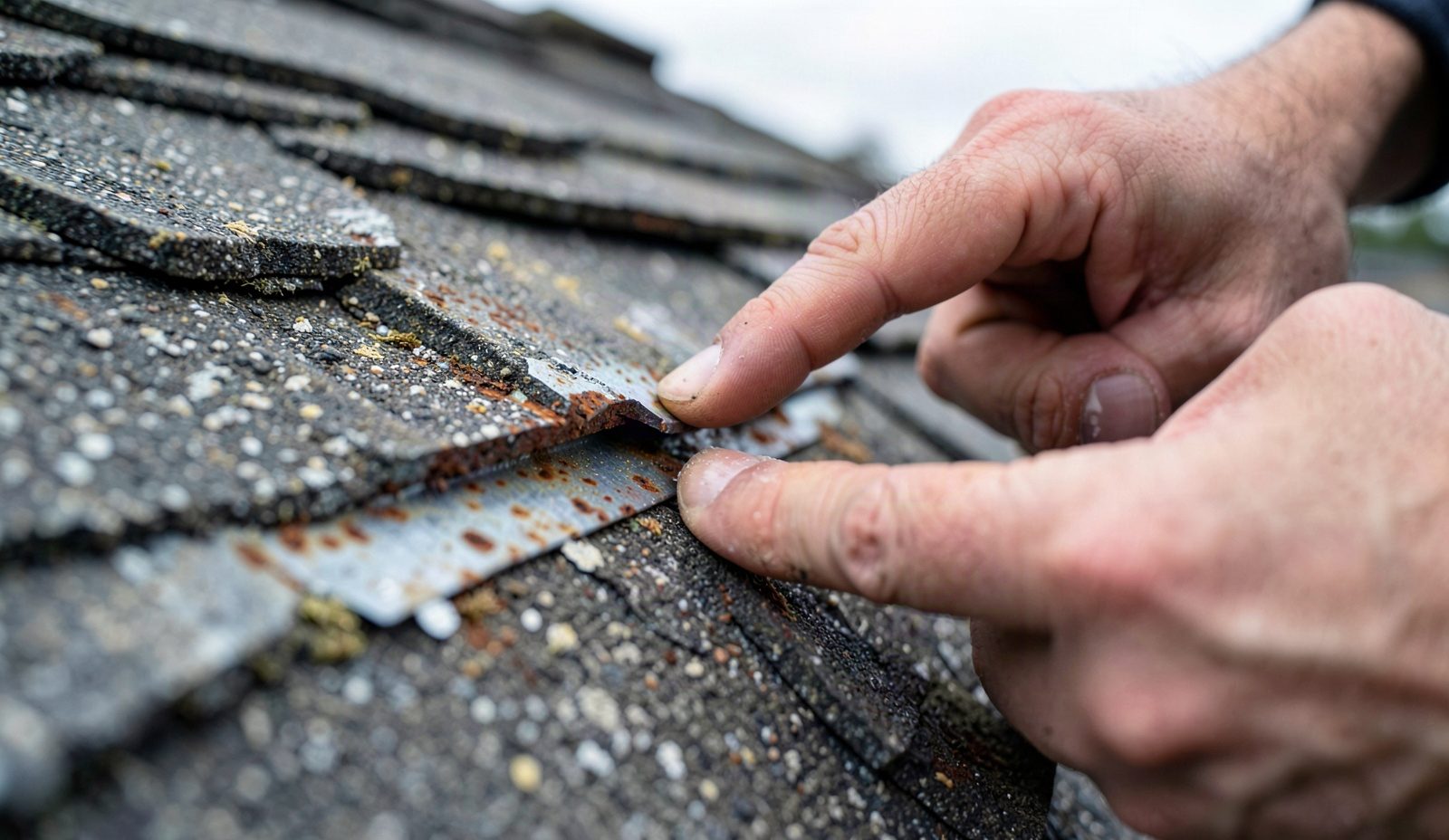
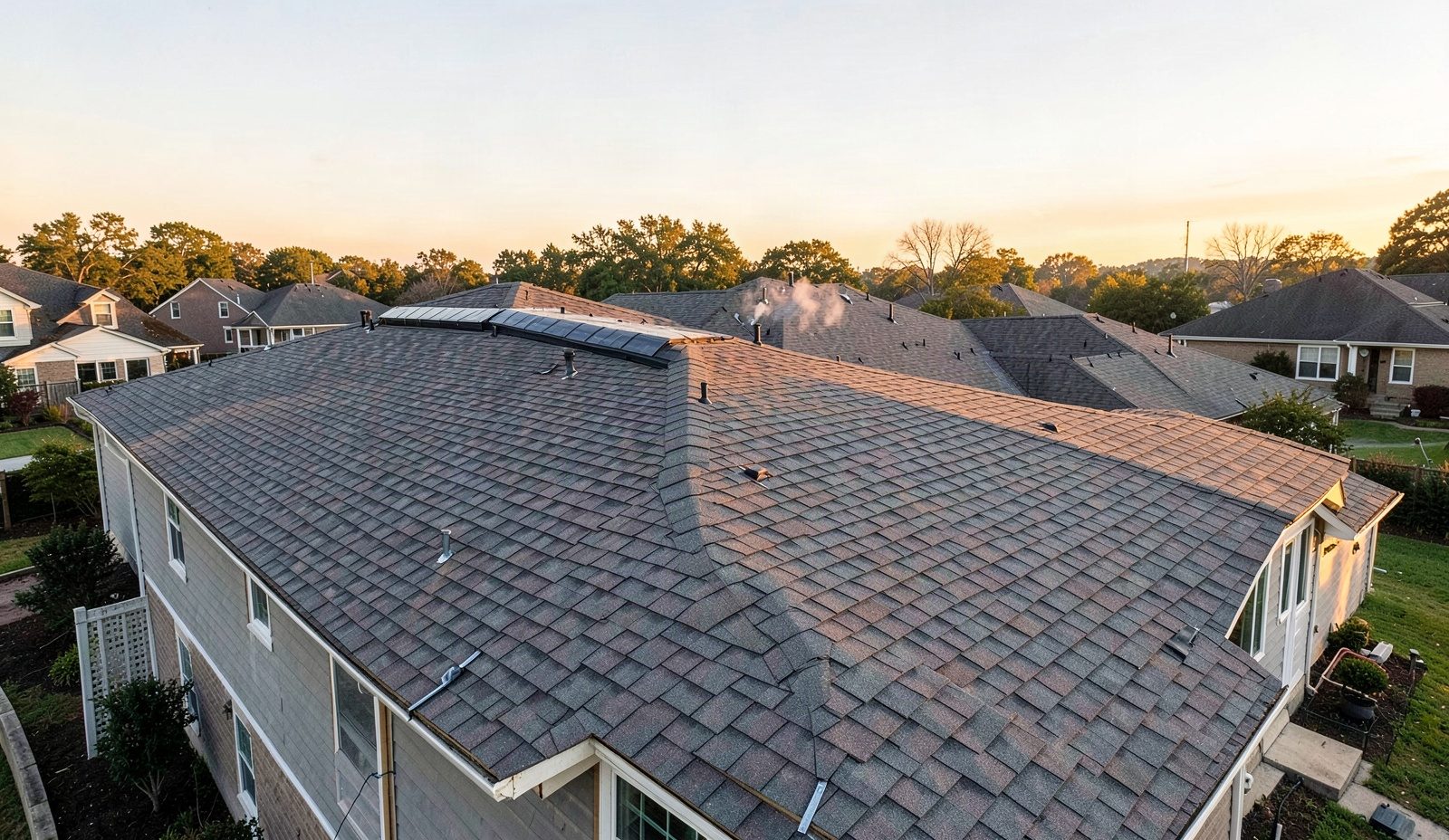
New construction roofing gets one advantage a repair job never has: a bare deck with nothing to hide. We use that advantage. Before a single course goes down, we walk the deck on foot and check fastener spacing and sheathing panel gaps with a tape measure, confirming panel gaps of roughly 1/8 inch for thermal movement and that H-clips are set between panels where trusses run 24 inches on center. A deck that fails this walk gets re-nailed or re-sheathed before underlayment ever touches it, because every layer above depends on that surface being flat and fastened correctly.
Underlayment and ice barrier placement is where we run our sharpest check. Section 905.1.2 of the Ohio Residential Code requires an ice barrier on asphalt shingle roofs extending from the lowest roof edge to at least 24 inches inside the exterior wall line, built from two cemented layers of felt or a self-adhering polymer-modified bitumen membrane. We measure that 24-inch line from the interior wall plane on the plan set, not by eye off the eave, because a shallow soffit overhang throws that measurement off by several inches on a lot of Columbus floor plans. A membrane that stops short of the line fails the check on the spot.
Material selection is a real decision, not a default. On steep-slope asphalt work, we compare GAF Timberline HDZ against Owens Corning Duration on wind rating and mat weight: both rate for wind uplift in the 130 mph range when installed with the specified nailing pattern, but Duration's SureNail strip gives a wider fastening zone that tolerates minor nailing drift better on a crew working fast. On any low-slope section, porch roofs and additions common on Columbus builds, we run a TPO membrane over EPDM for that application because TPO's heat-welded seams outperform EPDM's adhered seams under UV and ponding water. Ventilation gets the same scrutiny. We calculate net free area against attic square footage and choose continuous ridge venting over box vents whenever the roofline allows it, because a ridge vent moves air along the entire ridge line instead of through isolated points that leave dead air pockets over interior rooms.
If this sounds close but not quite your situation, asphalt shingle roofing may be the better starting point.
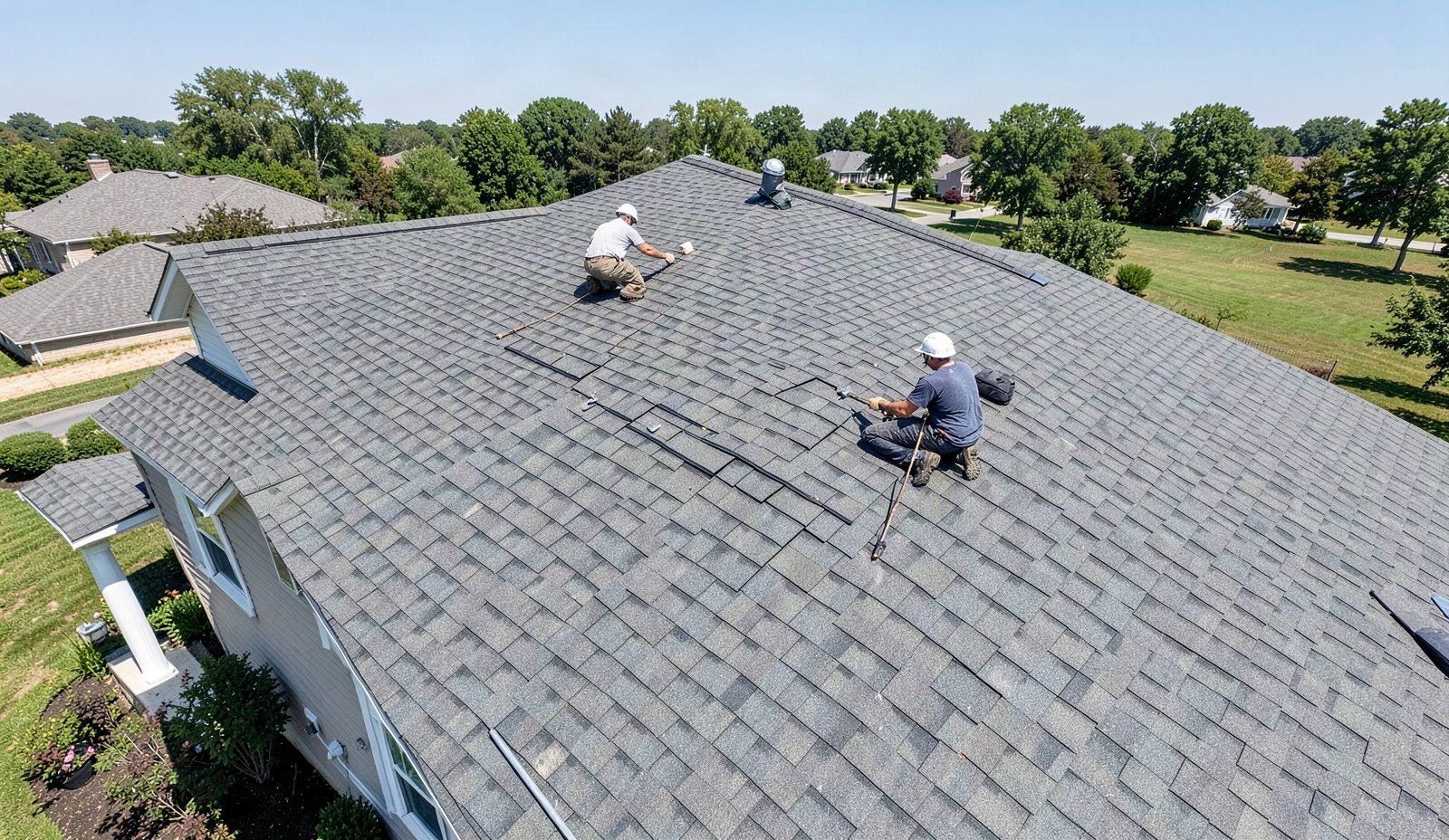
Call (614) 707-7333 and a technician reviews your plan set and roof pitch before setting a site visit. On site, the crew walks the exposed deck, checking sheathing thickness, fastener spacing, and any low-slope sections that will need membrane instead of shingle. Photos and measurements go into a written scope covering underlayment type, ice barrier extent, flashing details, and ventilation plan. You see the exact material list and layout before anything is ordered, matched against the framing and roof pitch already on your plan set.
Work starts once you approve the written quote and materials are on site. The crew protects gutters, siding, and landscaping before tear-off or deck work begins, then installs underlayment, ice barrier, flashing, and the roof covering in that order, checking each layer against the plan before covering it with the next. Any condition found mid-install, a soft deck section or an undersized vent stack, gets flagged and priced before the crew covers it, so you approve changes before they become part of a finished roof.
Before the crew leaves, we check flashing laps at every penetration, confirm ridge and soffit vents balance against calculated attic square footage, and walk the perimeter checking for exposed nail heads or lifted shingle tabs. A final magnetic sweep clears loose fasteners from the yard and driveway. You get a walkthrough covering what was installed and where the ice barrier and flashing lines sit, along with photos for your records ahead of any final building inspection.
New construction roofing in Franklin County is governed by the Ohio Residential Code, and every roof we install answers to that code, not to a generic national spec sheet. Heavy wet snow and ice loading across the region drive real ice-dam and gutter-ice risk each winter, and that risk is exactly why all roofing work here falls under Columbus building code jurisdiction and the Ohio Residential Code rather than a builder's informal preference. A crew that does not know this code cold will miss details a Franklin County inspector checks for on a final walk.
Out-of-area contractors who roll into Columbus for one subdivision job are the most common source of the callbacks we see. They frequently skip the local permit process, assume climate rules from wherever they last worked, and leave the general contractor holding an inspection failure. We work from the plan set and the code section, not a regional average, so the ice barrier detail, the flashing laps, and the fastening schedule all match what a Franklin County inspector expects to see on a final roof inspection.
Columbus housing stock adds its own wrinkle. New builds range from wide-eave suburban platforms with long unobstructed roof planes to narrow-lot infill homes with multiple roof intersections and valleys packed into a small footprint. Each roof type asks for a different approach to valley flashing and venting math, and a crew that only knows one housing style will apply the wrong detail to the other. Call (614) 707-7333 to talk through your plan set with a technician before materials get ordered, so the roof matches the build, not a template.
See cedar shake roofing for how the related work is scoped and priced.
New construction roofing gets scheduled around your framing and inspection timeline, not a generic calendar slot. Once the deck is framed and passed its rough inspection, we book a start window and confirm it by phone 48 hours out. If a trade ahead of us runs long or an inspection gets pushed, we call before the crew mobilizes and rebook the next open window, so you never have a crew standing on an unfinished deck. Weather holds work the same way. A forecast with active rain or lightning moves the start date, and we call with the new date the same day the forecast confirms it.
We run magnetic sweeps of the yard and driveway at the end of every work day to pull loose fasteners before anyone walks the site barefoot or drives over the area. Landscaping and window wells near the eaves get plywood or tarp coverage before tear-off or the first course goes down. Old shingle debris and packaging go straight into a job-site dumpster or trailer, never staged on the lawn overnight. On multi-day installs, the site gets swept and squared at the end of each shift so the lot looks like a work-in-progress, not a mess, for the rest of the build crew.
Your quote is driven by roof plan complexity, material selection, and access, not a flat per-square rate. A simple gable roof on a wide suburban lot prices differently than a cut-up hip roof on a narrow infill lot with multiple valleys and limited crane or ladder access. Underlayment choice, ice barrier scope, and ventilation upgrades each move the number too. We walk the plan set with you, put the scope and material list in writing, and you approve that written quote before any material gets ordered or any crew gets scheduled to your address.
Every technician on a new construction crew starts under a lead installer's direct supervision, running fastener patterns, flashing laps, and ventilation layouts the lead physically checks section by section. New hires get current instruction on Ohio Residential Code updates as they roll out, not a one-time onboarding that goes stale. A technician moves to unsupervised solo work only after a lead has signed off on a run of jobs where deck prep, ice barrier placement, and flashing details all passed inspection without a callback for rework.
Prices vary because contractors quote different scopes, materials, and labor standards for the same roof. One quote might use a base-tier three-tab shingle with minimal ice barrier coverage while another specifies an architectural shingle line with full 24-inch ice barrier coverage per the Ohio Residential Code and upgraded ridge ventilation. Crew experience with local infill lot access, common in areas like Clintonville and Victorian Village, also changes labor time and price. Reading the written scope line by line, not just the total, shows you what you are actually paying for.
Homeowners insurance generally does not cover the cost of an original roof install on a new build, since that is a construction cost, not a damage claim. Insurance becomes relevant later, after the home is occupied, if hail, wind, or another covered event damages the finished roof.
Estimates start with a review of your plan set and roof pitch before any site visit happens. A technician walks the exposed deck, checks sheathing condition, and confirms which sections need shingle versus membrane, then puts the full scope and material list into a written quote. You approve that written quote before materials get ordered or a crew gets scheduled. Call (614) 707-7333 with your plan set ready to start that review.
Scheduling depends on your framing timeline and current crew availability rather than a fixed number of days. Once your deck passes its rough inspection, we confirm a start window by phone and lock it in around your build schedule, not a generic queue. Call (614) 707-7333 as soon as framing is set so your roofing slot lines up with the rest of your build trades instead of trailing behind them.
Permit requirements depend on the scope of work. A full roof replacement or any structural deck repair typically requires a permit, while a reflective coating applied over existing sound shingles or a minor like-for-like shingle repair often does not. The local permitting office makes the final determination based on the specific project, so confirming scope with that office before work begins avoids delays at final inspection.
Look for a crew that measures pitch and checks fascia condition on site rather than quoting sight unseen over the phone. Ask whether they know when a project needs sign-off from the City of Columbus Department of Building and Zoning Services versus a straightforward like-for-like repair. Also ask what gauge aluminum and hanger spacing they use, since that decides how long the system holds up through Ohio winters.
New construction roofing in Columbus has to answer to two different housing patterns at once. Suburban subdivisions across Franklin County favor wide, simple roof planes that install fast but demand careful ridge-to-soffit ventilation math over long attic runs. Infill new builds going up in the Short North, Italian Village and Brewery District sit on narrow lots with cut-up rooflines, multiple valleys, and tight setbacks that limit ladder and material staging. Heavy wet snow and ice loading in a typical Franklin County winter drive real ice-dam risk on both housing types, but the fix looks different on each. A wide-eave suburban roof needs a longer, well-ventilated ice barrier run, while a steep infill valley needs tighter step flashing and a membrane that seals cleanly around multiple intersecting planes.
Every new roof in Columbus answers to an inspector before a certificate of occupancy gets issued, and that inspector works from the same code section we build to. The City of Columbus Department of Building and Zoning Services handles permitting and final roof inspections for Columbus addresses, with the local city building department or Franklin County stepping in for builds outside city limits. A roof that skips the correct ice barrier detail or uses the wrong fastening schedule fails that inspection and holds up the entire occupancy timeline for a new home. Knowing which office signs off on your specific address, and what that inspector checks first, keeps a new build roof from becoming the reason a closing date slips.
Explore our service area and locate Cornerstone Roofing Columbus with ease. We're proudly local and serve the surrounding neighborhoods with fast response and honest pricing. Use the map to check our coverage area, or call us and we'll confirm in seconds.
Address:
Cornerstone Roofing Columbus, 1015 E Broad St, Columbus, OH 43205
How Much Does a Roof Replacement Cost in Columbus? 2026 Pricing Breakdown, practical local guidance from Cornerstone Roofing Columbus, Colum…
Read More
Commercial Roof Maintenance Tips for Columbus Property Managers, practical local guidance from Cornerstone Roofing Columbus, Columbus's trus…
Read More
Skylight Leaks in Victorian Village Homes, Repair or Replace?, practical local guidance from Cornerstone Roofing Columbus, Columbus's truste…
Read More
The Best Time of Year to Replace a Roof in Columbus, practical local guidance from Cornerstone Roofing Columbus, Columbus's trusted roofing …
Read More