

April 1, 2025
How Much Does a Roof Replacement Cost in Columbus? 2026 Pricing Breakdown
How Much Does a Roof Replacement Cost in Columbus? 2026 Pricing Breakdown, practical local guidance from Cornerstone Roofing Columbus, Colum…
Read More




Do this in the next five minutes, before any crew arrives. Stay off the roof and off any ladder near torn flashing or a lifted ridge cap. Move boxes, electronics and furniture away from the ceiling stain or active drip. Slide a bucket or tarp under the leak and keep foot traffic off the wet drywall below it. Photograph the missing shingles, the debris in the yard, and the interior stain from several angles for your insurance file. Then call (614) 707-7333 so a technician can start diagnosing the wind damaged roof repair over the phone while you wait.
A wind event leaves a specific signature. Shingles that are missing outright are the easy find. The harder problem is the tab that looks fine from the driveway but has a broken sealant strip underneath, the one that leaks during the next rain even though nothing looks wrong from the ground. High wind roof damage also shows up as creased shingles, a tab bent backward hard enough to snap the asphalt mat without tearing it loose, and as granule loss that shows up as black streaks in the gutter downspout. In older sections of German Village and Italian Village, where three-tab shingles and built-up flat sections still cover rowhouses and converted duplexes, wind gets under the shingle edge faster because the deck itself carries more nail holes and thinner original decking from decades of layered repairs.
Straight-line wind and hail are the direct cause. Central Ohio's summer thunderstorms bring hail and straight-line wind gusts strong enough to lift a shingle tab that has already lost its sealant bond, and that combination is the most common cause of asphalt shingle and roof penetration damage across this region. A single missing shingle exposes a patch of felt or synthetic underlayment roughly the size of a shingle course to direct rain. Underlayment is a rain barrier engineered for weeks, not months.
Wait a week and that exposed patch becomes a soaked section of decking that no longer holds a nail. Wait a month and the water tracks sideways along a rafter and stains a ceiling three rooms away from the actual hole. Wind storm roofing contractors see this pattern every spring: the small blown off shingles repair that could have taken an hour mid-storm turns into a full deck replacement by the time anyone climbs up to look.
If this sounds close but not quite your situation, fallen tree roof damage repair may be the better starting point.
Permit and inspection questions? Building & Zoning Services is the office we coordinate with on every permitted Columbus job.
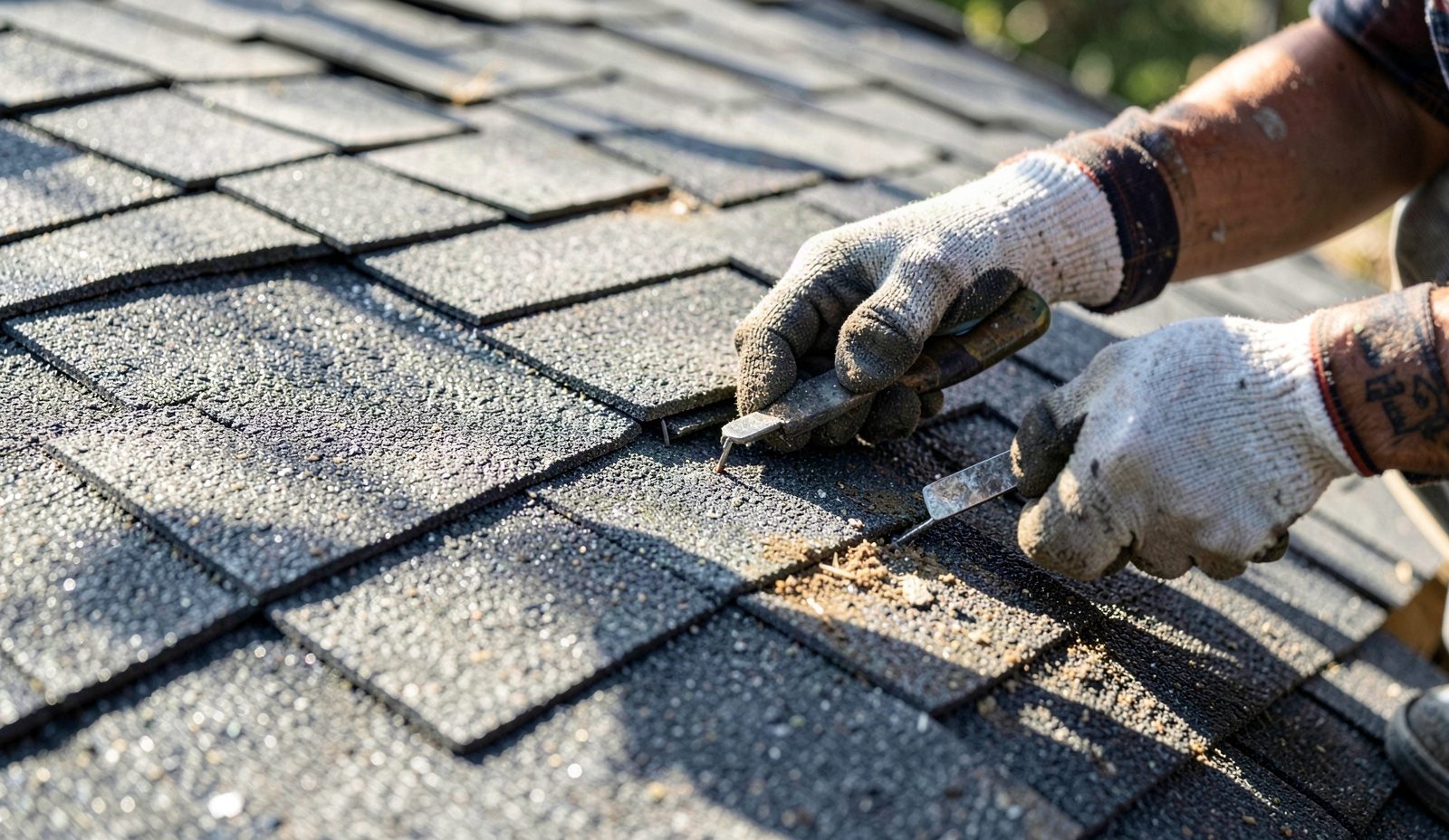
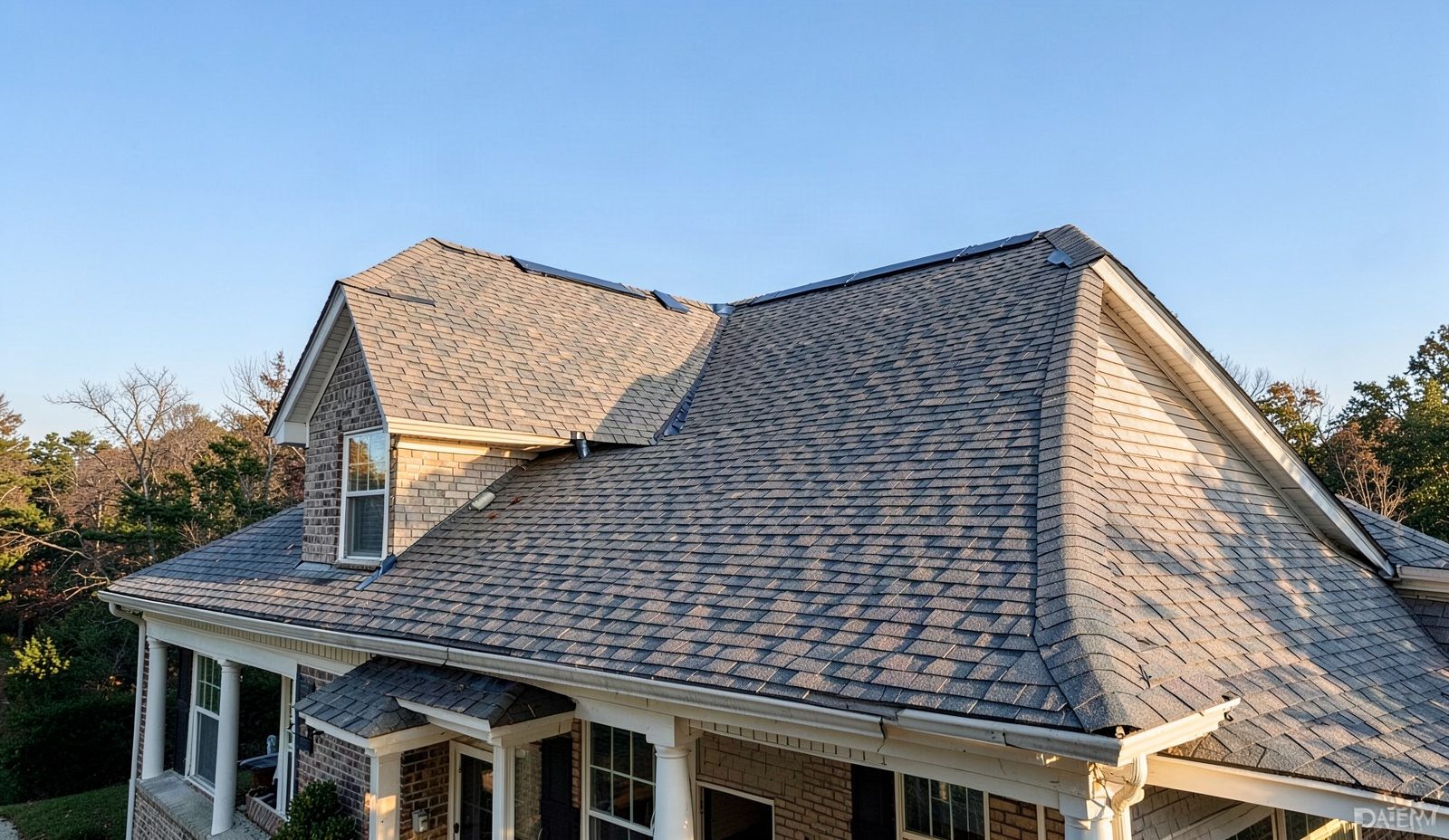
On a wind damage call, the first tool out of the truck is a flat bar, not a shingle. A technician walks the roof plane in a grid pattern and lifts the corner of every tab within reach of the damaged zone. A shingle with an intact seal resists that lift, the asphalt mat flexes before it releases. A shingle with a failed thermal seal pops free with almost no resistance, and that shingle gets marked for replacement even if it never blew off. On steep pitches over roughly a 6:12 slope, where walking the deck is not safe, a drone pass replaces the hands-on check, and the zoom footage gets cross-referenced against ground-level photos taken during the storm.
Once damaged shingles come up, the deck gets checked before anything goes back down. A moisture meter reads the OSB or plank decking at the fastener line, and any reading north of 16 percent triggers a section replacement rather than a dry-out. Where the repair reaches the eave, the crew verifies the ice barrier the Ohio Residential Code requires under Section 905.1.2, a self-adhering polymer-modified bitumen membrane or two cemented layers of underlayment that has to run from the lowest roof edge to at least 24 inches inside the exterior wall line. If a previous repair skipped it, it goes in as part of the wind damage roof repair, not as an add-on.
Shingle selection matters as much as the fix. A standard three-tab shingle carries a 60 mph wind rating in most manufacturer product literature, already below what a Franklin County straight-line wind event can produce. GAF Timberline HDZ, installed with its factory LayerLock strip and a six-nail pattern, tests to 130 mph under ASTM D3161 Class F wind uplift testing. CertainTeed Landmark Pro carries a comparable high-wind rating when installed with its wider nailing zone. On a hip or ridge exposed to prevailing wind, we spec a matching high-wind ridge cap rather than a standard cap sliced down, because the sliced cap is the piece most likely to generate the next wind uplift roof repair call.
See hail damage roof repair for how the related work is scoped and priced.
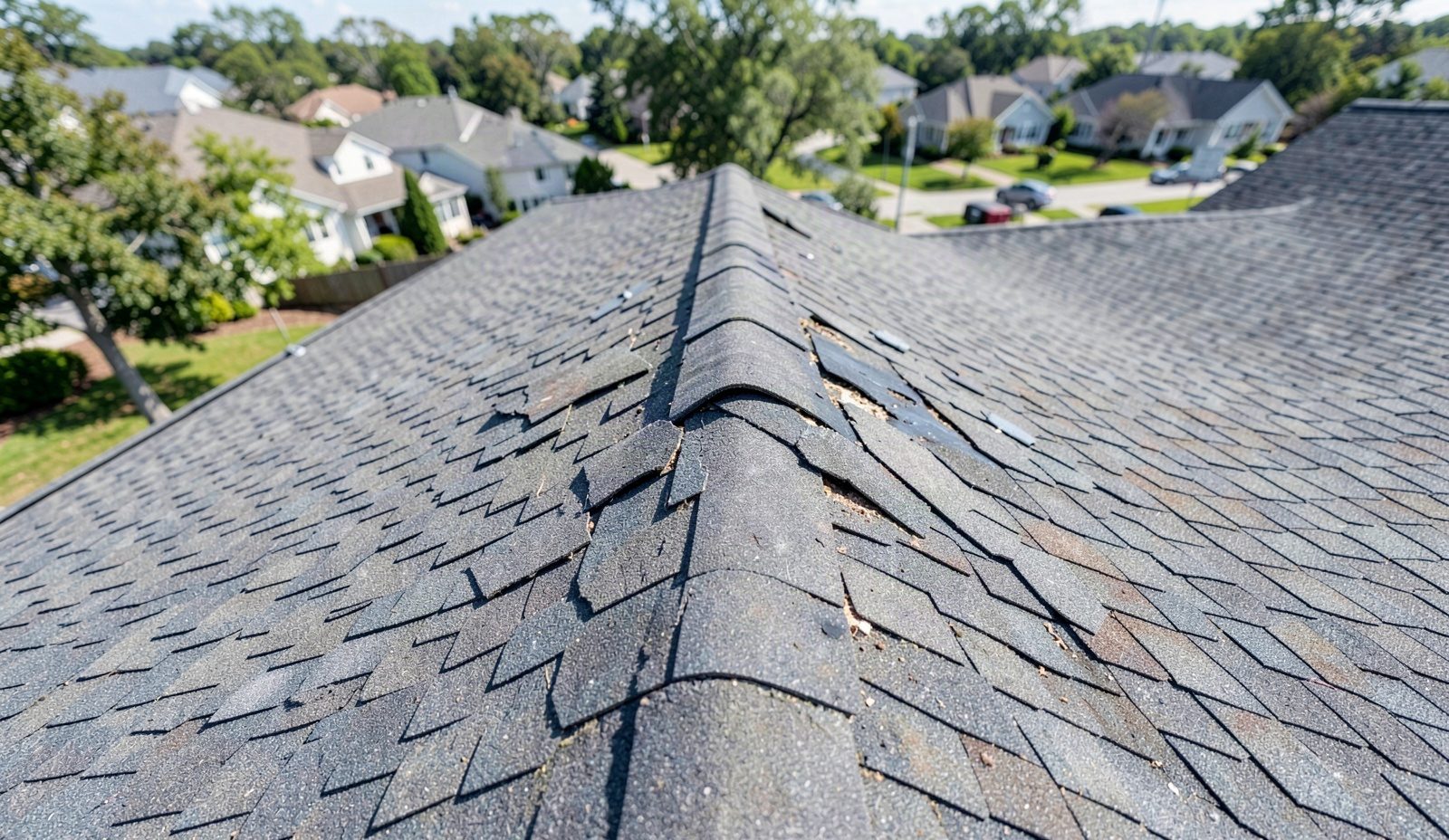
You call (614) 707-7333 and describe what you see, missing shingles, an active drip, debris in the yard. Dispatch schedules a technician and gives a real arrival window instead of a vague day-of-week estimate. On arrival, the technician walks the roof plane and photographs every point of damage, runs the flat bar uplift test on shingles around the damaged zone, and checks the attic or top floor ceiling for moisture staining if accessible. You get a plain-language rundown on the spot: what is cosmetic, what is actively leaking, and what needs to come off the roof today versus what can wait for the full repair.
Once you approve the written scope, tear-off starts on the damaged sections only, not the whole roof, unless the deck inspection says otherwise. Landscaping and gutters get covered before the first shingle comes off. Damaged decking gets replaced sheet by sheet, and new shingles get nailed to the manufacturer's high-wind pattern, typically six nails per shingle instead of four, with the ice barrier and drip edge integrated at the eave. Any change to that scope, like a section of decking that turns out softer than expected, gets a phone call and your sign-off before work continues.
Before the crew packs up, the technician re-runs the uplift test on the new shingles and checks nail set depth with a probe, since a nail sitting proud or overdriven both compromise the seal. Flashing points get a hose test where standing water poses a realistic risk, water run down the wall plane while someone checks the attic side for intrusion. You get a walkthrough on the ground and, where relevant, a look at the completed deck and underlayment before the shingles went back down. A written summary of the work performed goes to you the same day for your insurance file.
Roofing work in Columbus falls under Columbus building code jurisdiction and the Ohio Residential Code, and a crew that does not know that distinction gets the paperwork wrong before the first shingle goes back on. For any repair beyond a like-for-like shingle swap, structural sheathing replacement, or a full slope that has to come off, the City of Columbus Department of Building and Zoning Services is the authority that determines whether a permit applies, and that call belongs to them, not to whoever wrote the estimate. Franklin County jurisdictions outside city limits route through their own building department. Because every job stays within this region, scheduling does not depend on a crew driving in from another market after a wide regional storm, which is when response times stretch longest.
Storm season brings a wave of out-of-town crews working from a folding table in a gas station parking lot. They do not know that a local permit reviewer will flag a re-roof that skips ice barrier documentation, and they are gone before any callback ever reaches them. A crew that has pulled permits in this area knows what an inspector checks: drip edge at the eave and rake, the fastener pattern the shingle manufacturer specifies for its wind rating, and flashing integration at every wall-to-roof transition.
Columbus carries a wide range of roof pitches and deck framing across its housing stock, from steep prewar rooflines to the shallower pitches common on ranch homes built in the postwar decades, and the correct wind uplift roof repair approach changes with both pitch and original framing spacing. A technician who has worked only new-construction subdivisions elsewhere will not recognize true skip sheathing under an older shingle conversion or the plank decking common under aging asphalt roofs, and misreading that deck is how a wind repair turns into a sagging ridge six months later.
More detail on hurricane damage roof repair is on its own page.
A wind damage call gets triaged the same day, with active leaks and missing shingle sections moved to the top of the board ahead of routine repairs. Most Columbus calls get a technician on-site within the same business day when the storm passes through in the morning, and the following morning when a call comes in after dark. If weather or a backlog of storm calls pushes the window, dispatch calls you directly with a new arrival time rather than leaving you checking a text message. Tarping and temporary containment happen on the first visit regardless of when the full repair itself gets scheduled, so the interior stays dry while parts and shingle-color matches get sourced.
Tear-off debris goes into a lined chute or tarp system staged at the drop zone, not tossed loose off the eave into landscaping. Magnetic sweeps run the perimeter twice, once after tear-off and once after the final nail, to pull loose fasteners out of the grass and driveway before they end up in a mower or a tire. Gutters get checked and cleared of granules and shingle fragments that wash down during tear-off. Flower beds and window wells directly under the work area get covered with plywood or tarp before anything comes off the roof. When the crew leaves, the driveway is swept clean.
The estimate reflects four variables: how many roof planes took wind damage, how the roof is accessed since a steep two-story gable costs more labor time than a single-story ranch, whether the shingle color and profile still matches what is available from the original manufacturer run, and what the deck inspection finds once damaged shingles come up. You get a written scope before any repair starts, line by line, so you know what is tear-off, what is decking, and what is flashing. Nothing gets added to that scope without a phone call and your approval first, even if the crew is already on the roof.
Every technician completes a background check before working a Columbus job site alone. Field training covers current wind uplift fastening patterns from major shingle manufacturers, deck inspection protocol, and the ice barrier requirement in the Ohio Residential Code, refreshed every storm season as products and code guidance update. New hires shadow a lead technician through a full repair cycle, from the initial uplift test to the final walkthrough, before running a wind damage call on their own. A lead technician spot-checks a sample of completed jobs each month against the written scope.
Cost depends on how many roof planes are damaged, how the roof is accessed, and what the deck inspection finds once shingles come up. A single-slope repair on a one-story ranch costs far less in labor than a two-story gable with a steep pitch. Matching an older three-tab shingle line that a manufacturer has since discontinued also adds cost, since a full slope may need re-shingling rather than a color-mismatched patch. Cornerstone Roofing Columbus provides a written scope so you see exactly what drives the number before any work starts.
Most homeowners policies cover wind damage roof repair as a sudden, named-peril event, separate from gradual wear, which insurers typically deny. Adjusters distinguish the two by looking at whether the damage pattern matches a specific storm date, so photos taken the same day wind hits your Columbus home strengthen a claim far more than photos taken weeks later. Coverage details, deductibles, and any wind or hail exclusion riders vary by policy, so the actual determination comes from your insurer, not from the roofing contractor.
It depends on the scope of the work, not the fact that wind caused it. A like-for-like shingle swap on a small damaged section typically does not need a permit, while replacing structural decking or an entire roof slope typically does. The local building department makes the final determination for your address, and that call sits with them regardless of what any contractor's estimate assumes. Cornerstone Roofing Columbus pulls the required permit before structural work begins rather than treating that step as optional.
Prices vary mainly because of shingle tier and crew structure, not because one company is simply cheaper. A three-tab shingle repair costs far less in materials than matching an architectural laminate line, and that gap alone can double a quote before labor is even factored in. Storm season also brings traveling crews from outside Franklin County offering a low upfront number, then adding charges once the deck is already open. A written, itemized scope before work starts is the best protection against that pattern.
An estimate starts with an on-site measurement of the damaged roof plane, cross-checked against satellite or drone roof-measurement software for an accurate material count. The technician itemizes tear-off, decking, underlayment, ice barrier, and shingle cost drivers separately in a written scope, not a single lump figure. You review and approve that scope before any material gets ordered or any shingle comes off the roof. Changes discovered mid-repair, like a soft deck spot, require a phone call and your sign-off before they get added.
Cost depends on roof size, slope, membrane type, and how much drain or flashing repair the roof needs at the first inspection. A small flat-roof retail building costs less to maintain per visit than a large warehouse with multiple rooftop units and complex drainage. We provide a written scope after the first roof walk so you see exactly what drives the number before approving anything. Call (614) 707-7333 for a scope based on your specific building.
Central Ohio runs a humid continental climate with roughly 40 to 60 freeze-thaw cycles each winter, and Columbus is not a lake-effect snow zone the way cities along Lake Erie are, so the failure pattern here differs. A shingle that cracked from repeated freeze-thaw expansion is already brittle before a summer wind event ever hits it, and that brittle shingle shears clean off instead of just losing its seal. Density and building age push the calculus further. In Short North and the Brewery District, flat and low-slope sections sit above storefronts and converted warehouses, and those membrane roofs take wind uplift differently than a pitched asphalt roof, with perimeter and corner zones needing mechanical fastening or ballast checked specifically after a wind event. In Clintonville and Victorian Village, mature tree canopy adds falling limb risk on top of the wind itself, so the inspection covers puncture points as well as missing shingles.
Permit review for anything beyond a like-for-like shingle swap goes through the same municipal process regardless of neighborhood, and a reviewer checks the same details every time: ice barrier documentation at the eave, flashing integration, and a fastening pattern matched to the shingle's rated wind speed. Narrow lots and shared driveways in denser blocks change job-site logistics too, ladder placement and debris staging have to account for a neighbor's fence line or a shared alley, something a crew unfamiliar with older platted lots figures out the hard way. Local experience also means recognizing which roofs in this city were already patched informally after a previous storm, since a second wind event tends to finish what the first one started at the same weak point, usually a ridge cap or a valley that was never properly re-flashed.
Explore our service area and locate Cornerstone Roofing Columbus with ease. We're proudly local and serve the surrounding neighborhoods with fast response and honest pricing. Use the map to check our coverage area, or call us and we'll confirm in seconds.
Address:
Cornerstone Roofing Columbus, 1015 E Broad St, Columbus, OH 43205
How Much Does a Roof Replacement Cost in Columbus? 2026 Pricing Breakdown, practical local guidance from Cornerstone Roofing Columbus, Colum…
Read More
Commercial Roof Maintenance Tips for Columbus Property Managers, practical local guidance from Cornerstone Roofing Columbus, Columbus's trus…
Read More
Skylight Leaks in Victorian Village Homes, Repair or Replace?, practical local guidance from Cornerstone Roofing Columbus, Columbus's truste…
Read More
The Best Time of Year to Replace a Roof in Columbus, practical local guidance from Cornerstone Roofing Columbus, Columbus's trusted roofing …
Read More