

April 1, 2025
How Much Does a Roof Replacement Cost in Columbus? 2026 Pricing Breakdown
How Much Does a Roof Replacement Cost in Columbus? 2026 Pricing Breakdown, practical local guidance from Cornerstone Roofing Columbus, Colum…
Read More




Move fast. Pull furniture and electronics away from the drip line. Set a bucket or a folded tarp under the leak. Snap photos of the stain before you touch anything, insurance adjusters want that timestamp. Then call a technician who can get a temporary roof patch on the hole today, not next week.
A leak rarely shows up where the hole actually is. Water travels along rafters and truss members before it drops through drywall, so the stain on your ceiling might sit six feet from the actual break in the shingle field. Listen for a soft dripping sound inside a wall cavity during rain, that means water is already inside the insulation. A musty smell in a closet or attic hatch means moisture has been sitting long enough to feed mold spores.
Central Ohio's humid continental climate runs Columbus roofs through roughly 40 to 60 freeze-thaw cycles every winter. Water gets into a hairline shingle crack, freezes overnight, expands, and splits the mat wider by morning. Older housing stock in Short North, German Village, and Clintonville carries decades of that cycling, and original flashing around chimneys and dormers gets brittle and pulls away from the masonry it was set against. Summer brings the other half of the problem: thunderstorm hail bruises shingle mat and straight-line wind lifts tab edges, opening a path for wind-driven rain.
Waiting costs you more than a bigger stain. Saturated decking loses its screw-holding strength within days, not weeks. Wet insulation stops performing and has to come out. Wiring runs near the leak path become a shock hazard once they're wet. A stopgap roof repair now, sized to the actual opening, is the difference between a patch job and a decking replacement six months from now.
More detail on after-storm roof inspections is on its own page.
Communities like r/Roofing are a good reality check on pricing and practices before you sign anything.
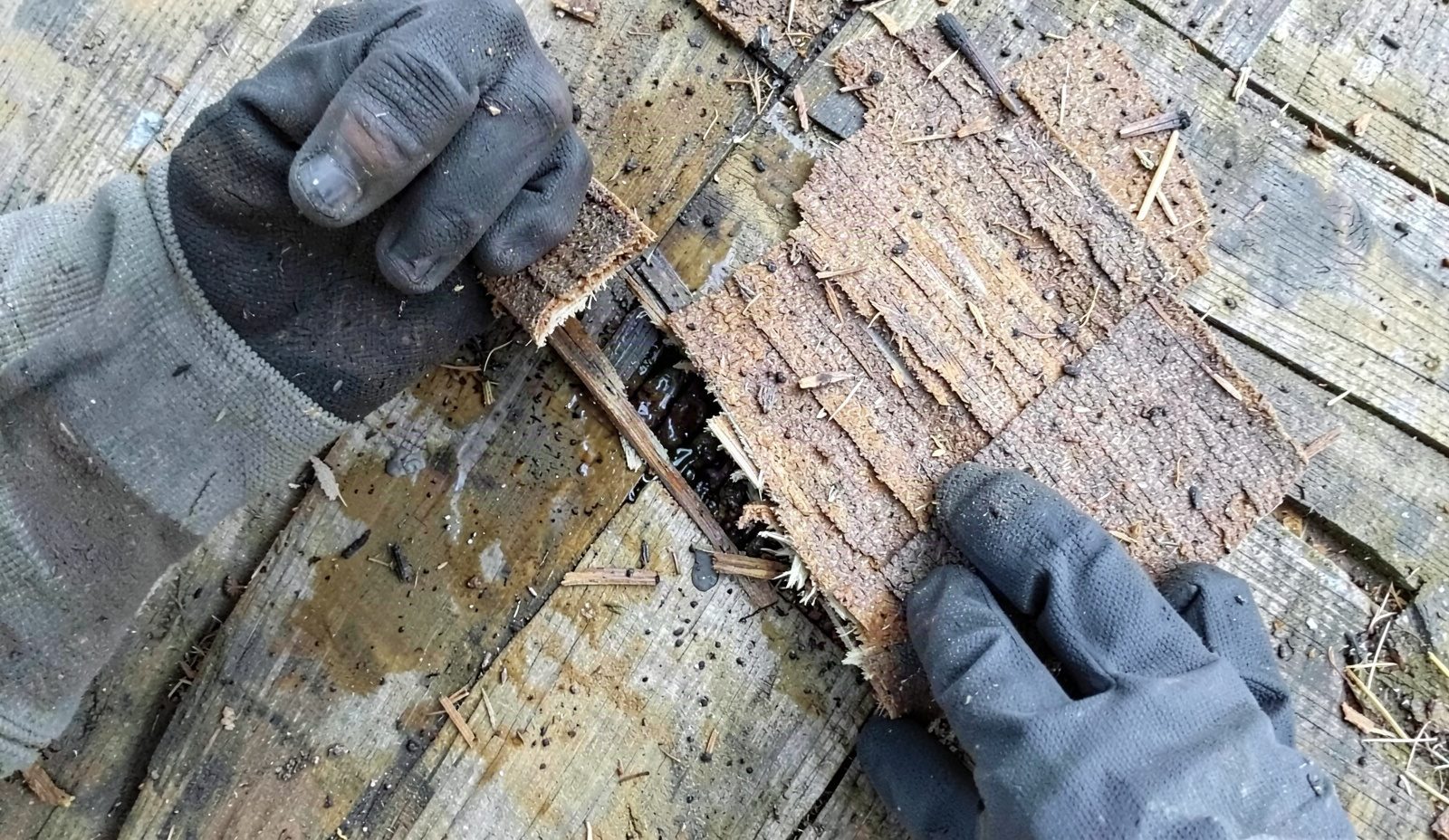
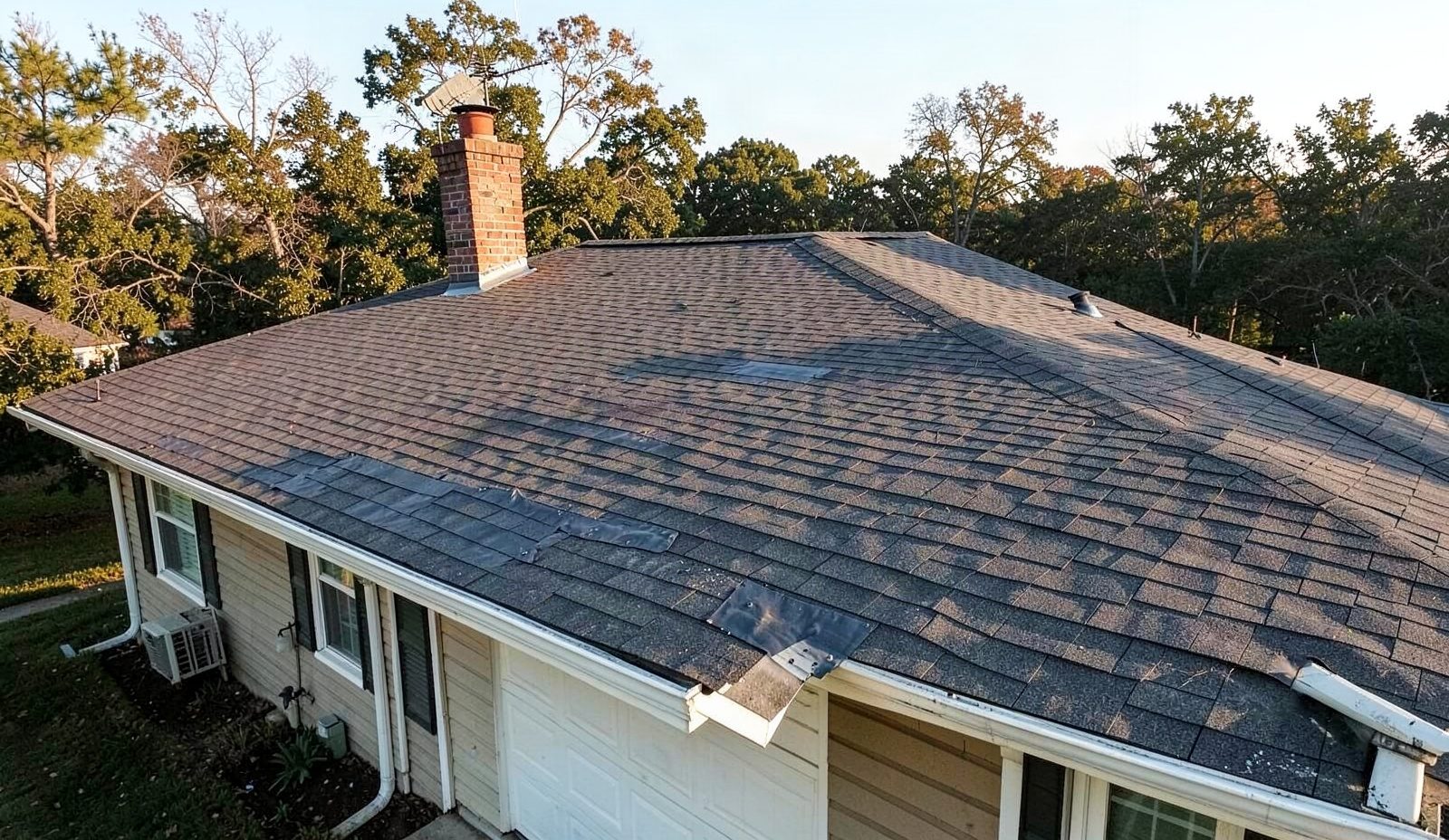
Every emergency roof sealing call starts with a moisture reading, not a visual guess. A pin-type moisture meter pressed into exposed decking gives a percentage reading. Anything reading above 20 percent moisture content means the wood is saturated and a surface patch will not hold, the tech has to open the deck and dry or replace that section before sealing anything. Below that threshold, we move to a pull test on the surrounding shingle tabs, checking whether the sealant strip has released, which tells us how far the patch needs to extend past the visible hole.
Material choice depends on what the roof is doing when we arrive. For an active leak in freezing weather, we set a self-adhering polymer-modified bitumen membrane, the same category of product referenced in Section 905.1.2 of the Ohio Residential Code for ice barrier protection, which calls for that barrier to run at least 24 inches inside the exterior wall line on permanent installations. On a temporary patch, we use that same membrane chemistry because it bonds to a cold, damp deck when standard roofing cement will not. For a torn-open field of shingles with no immediate freeze risk, six-mil reinforced polyethylene sheeting, mechanically fastened and sealed at the laps with termination bar, moves more square footage faster and comes off clean when the permanent repair crew arrives.
Shingle-line compatibility matters more than most homeowners realize. GAF Timberline and Owens Corning Duration both use a common-bond sealant strip, but the granule size and mat thickness differ enough that a patch cut from a mismatched bundle will telegraph as a color and texture seam for years. We match manufacturer and product line whenever the existing roof still has a legible shingle wrapper or a visible lot marking on the underside of a spare tab, and we log that match in the job notes so the crew doing your eventual roof patch until replacement, or full tear-off, knows exactly what they're working with.
Our page on emergency commercial roof repair covers that side of the work in more depth.
After severe weather, FEMA's guidance on documentation makes the difference in how smoothly a claim goes.
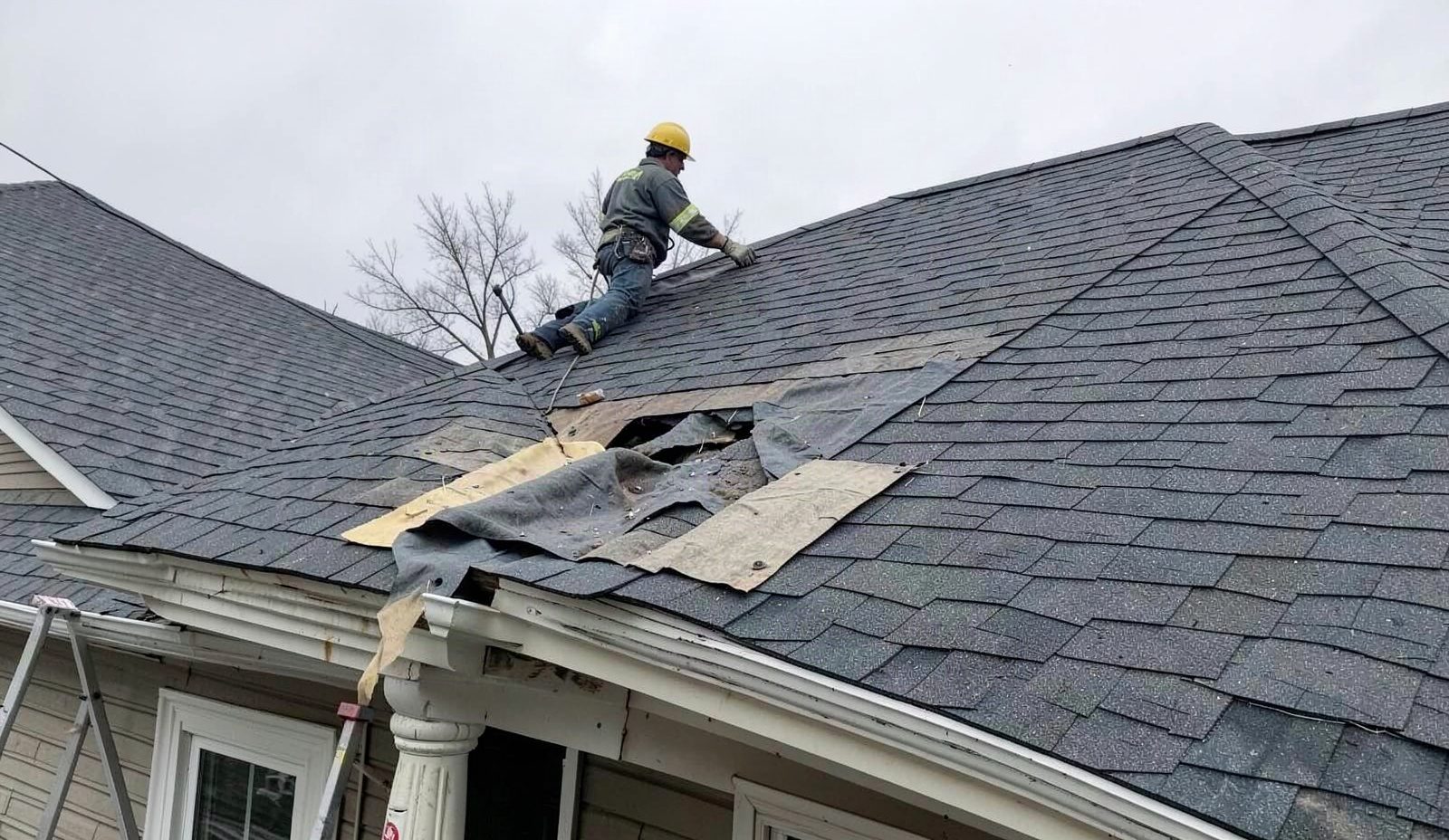
You call (614) 707-7333 and describe what you're seeing, the location of the stain, whether water is actively dripping, and roughly when it started. We schedule the arrival window on that call. On site, the technician checks the attic or ceiling access point first, tracing the water path back toward the roof deck, then walks the roof plane to find the actual break, a lifted shingle tab, split flashing, or a puncture. You get a plain explanation of what's found before anything is touched.
Once you approve the written scope, the crew sets surface protection around the work area and stages materials, membrane, sheeting, or flashing stock, based on the diagnosis. The damaged area gets cleared of loose granules and debris, the deck gets checked dry enough to bond, and the patch material gets set with fasteners and sealed laps matched to the existing roof system. Anything unexpected, like soft decking found once the old material is pulled, gets flagged to you before the crew proceeds further.
Before leaving, the technician runs a hose test over the patch and checks the interior ceiling access point for any new moisture. Fastener heads and seal lines get a visual and tactile check for full contact. You get a walkthrough at ground level, a look at the patch photos, and a written note of what was done and what the permanent repair timeline should look like. Debris and old material leave with the crew in the same trip.
Roofing work in this city falls under Columbus building code jurisdiction and the Ohio Residential Code, and the City of Columbus Department of Building and Zoning Services is the office that decides whether a given job needs a permit. A small temporary leak patch on an existing roof plane almost never triggers that requirement, since it is a like-for-like repair, not structural work. A full section replacement or a change to the roof deck usually does. A crew that does not know that line, or does not know which jurisdiction covers a given address once you cross into unincorporated Franklin County, either skips a permit that was required or pays for one that wasn't needed.
Out-of-area operators that roll through after a storm rarely know the housing stock here. A 1920s German Village bungalow with balloon-frame construction and full sheet decking behaves differently under a patch than a 1990s tract build in a newer Franklin County subdivision with engineered trusses and OSB sheathing. Fastener spacing, deck thickness, and how far a patch needs to overlap sound material all change based on that construction era, and getting it wrong means a patch that lifts in the next wind event.
We show up knowing the difference between a slate roof in Victorian Village needing a soldered copper flashing repair and a standard asphalt shingle roof in a newer development needing a membrane patch. That local knowledge is why homeowners across the metro call Cornerstone Roofing Columbus at (614) 707-7333 instead of gambling on whoever knocked on the door after the last storm.
See 24 hour roof leak service for how the related work is scoped and priced.
Permit and inspection questions? Building & Zoning Services is the office we coordinate with on every permitted Columbus job.
When you call about an active leak, we book a same-day arrival window and confirm it by text or phone before the technician leaves for your address. You get a two-hour window, not a vague "sometime today." If a prior call runs long or weather delays travel, we call to reset the window rather than let you wonder. Active, water-through-the-ceiling calls get priority over scheduled inspections, so a genuine emergency moves ahead in the queue. Evening and weekend arrivals are available for leaks that started mid-storm and can't wait for a weekday morning slot.
Before anyone climbs a ladder, we lay tarps across landscaping and walkways to catch dropped granules and old sealant. Gutters and downspouts near the work area get a visual check so debris doesn't clog them mid-repair. Inside, if the ceiling access point needs opening to check for saturated insulation, we set floor protection and a containment sheet to keep dust off furniture. Torn shingle material, old flashing, and any cut membrane scraps go straight into a job bag or trailer, not into your yard. You get your driveway and lawn back the way you found them.
The estimate for a temporary roof patch depends on how large the opening is, how steep and how accessible the roof plane is, and what material the patch calls for, membrane, sheeting, or flashing repair. Steep pitches and third-story access take longer and need more fall-protection setup than a walkable low-slope section. Before any cutting or sealing starts, the technician writes up the scope and the material plan and reviews it with you in plain terms. Work begins only after you approve that written scope, so there's no surprise add-on once the crew is already on the roof.
Every technician who patches a roof solo has passed a documented ride-along period, working alongside a senior crew member on live jobs before taking calls independently. Background checks run before anyone is scheduled to visit an occupied home. Ongoing training covers the current Ohio Residential Code cycle, so techs know current ice barrier and flashing requirements, not rules from a decade ago. Field supervisors spot-check completed patches on a rotating basis, checking fastener pattern and seal lines against photos the tech submits from every job.
A temporary patch depends on covering the exact opening with a material that bonds to a wet or cold deck, like self-adhering membrane or fastened polyethylene sheeting. Homeowners without roof access and fall protection should not attempt this themselves, especially on steep Columbus roof pitches during winter freeze-thaw conditions. Cornerstone technicians test moisture content first, then choose membrane or sheeting based on the deck condition and forecast before sealing the hole.
Cost depends on the size of the opening, roof pitch and access, and the patch material required, not a flat rate. A steep third-story section in German Village costs more to access safely than a low-slope garage roof. Cornerstone provides a written scope before any work starts, so you approve the plan and the material choice before the technician begins, with no hidden add-ons once the crew is on the roof.
A properly installed temporary patch typically holds for several months to a year, depending on material and exposure. Self-adhering membrane patches outlast roofing cement through Columbus's freeze-thaw winters because the membrane stays flexible instead of cracking. A patch is a bridge to a scheduled permanent repair, not a replacement for one, and should be reassessed once the underlying shingle or flashing gets replaced.
Most single-point leak patches finish in one visit lasting a few hours, from diagnosis to hose test. Larger hail damage spanning multiple shingle courses, or a patch that reveals soft decking underneath, can add a return visit for material or drying time. Cornerstone technicians tell you on site, before work starts, whether your specific repair is a same-day job or needs a second trip.
Look for a company that diagnoses with moisture testing before quoting a fix, not one that estimates from the ground. Ask whether the technician knows local construction eras, since a Clintonville bungalow and a newer Franklin County build need different fastening approaches. Cornerstone Roofing Columbus technicians document moisture readings and photos on every call, giving you a real record instead of a verbal guess.
Most single-leak patches take between one and three hours on site, from initial roof walk to final test. Steeper roofs common in older Short North and Victorian Village housing stock take longer to access safely with ladders and fall protection than a simple ranch-style roof. Weather can also add time, since wet or icy conditions require extra deck-drying steps before the patch material bonds.
An estimate is written on site after the technician inspects the roof and diagnoses the cause, not quoted sight unseen over the phone. The scope covers material, opening size, and access difficulty, and you approve it in writing before any cutting or sealing begins. Cornerstone technicians explain each line of that scope in plain terms so you know exactly what you're approving.
Columbus sits far enough from Lake Erie that this isn't a lake-effect snow zone, but the metro still runs through wide temperature swings all winter, and summer thunderstorms bring hail and straight-line wind that bruise shingle mat and lift tab edges across entire blocks at once. Heavy wet snow that sits on a low-slope section adds real weight and, once it starts melting against a cold eave, drives ice-dam backup under the shingle field. A patch material chosen without accounting for that cycle, standard roofing cement in January, for example, can crack again within weeks. We choose membrane or sheeting based on the season and the forecast, not a one-size material for every call.
Trust in this trade gets built house by house. Franklin County has neighborhoods with real variety in age and construction, from Italian Village row houses with shared party walls to Brewery District buildings with masonry parapets that need flashing details a suburban crew rarely sees. Getting those details right on the first visit, without guessing at a construction era or a roof assembly, is what keeps a homeowner from needing a second emergency call for the same leak. Local familiarity with how these buildings were framed and roofed, decade by decade, shapes every material and fastening decision we make on site.
Explore our service area and locate Cornerstone Roofing Columbus with ease. We're proudly local and serve the surrounding neighborhoods with fast response and honest pricing. Use the map to check our coverage area, or call us and we'll confirm in seconds.
Address:
Cornerstone Roofing Columbus, 1015 E Broad St, Columbus, OH 43205
How Much Does a Roof Replacement Cost in Columbus? 2026 Pricing Breakdown, practical local guidance from Cornerstone Roofing Columbus, Colum…
Read More
Commercial Roof Maintenance Tips for Columbus Property Managers, practical local guidance from Cornerstone Roofing Columbus, Columbus's trus…
Read More
Skylight Leaks in Victorian Village Homes, Repair or Replace?, practical local guidance from Cornerstone Roofing Columbus, Columbus's truste…
Read More
The Best Time of Year to Replace a Roof in Columbus, practical local guidance from Cornerstone Roofing Columbus, Columbus's trusted roofing …
Read More