

April 1, 2025
How Much Does a Roof Replacement Cost in Columbus? 2026 Pricing Breakdown
How Much Does a Roof Replacement Cost in Columbus? 2026 Pricing Breakdown, practical local guidance from Cornerstone Roofing Columbus, Colum…
Read More




Pickerington sits inside a humid continental climate that runs roughly 40 to 60 freeze-thaw cycles every winter. Water gets into a hairline shingle crack or an open nail hole, freezes overnight, expands, and pries the seam wider. Do that sixty times in a season and a roof that looked fine in November shows curling tabs and split flashing by March. The heavy wet snow that falls here is inland snow, not lake-effect snow, so it sits denser and heavier on a low-slope section than the light powder people picture, and that weight finds every soft spot in a valley or a boot flashing.
Olde Pickerington Village carries the oldest roof stock in town. Many of these homes have already been re-roofed once or twice, and the second or third layer of shingles hides deck problems that only show up once a technician pulls tabs and checks the sheathing underneath for soft spots or delamination. Preston Trails and Fox Glen represent the newer wave of subdivision building that filled in Pickerington through its growth years, and those roofs run into a different problem: builder-grade three-tab shingles and minimal ice barrier coverage installed to the letter of code but not beyond it, which leaves them exposed right at the eave line where ice tends to dam.
Soil movement plays a smaller role here than in some parts of the metro, but the freeze-thaw cycle still works on fascia boards and gutter hangers the same way it works on shingles, loosening fasteners a little more each winter. A technician checking a Pickerington roof pulls a few nails at the eave and checks for backout, because a nail that has walked a quarter inch out of the deck is an early sign the whole fastening pattern is losing grip. None of this shows up from the ground. It shows up when someone gets on the roof and checks the details a drive-by inspection skips.
A roof job in Pickerington is judged on what happens five winters later, not on how clean the tarp-down looked on day one. Cornerstone Roofing Columbus builds every estimate around that timeline. A lead technician walks the roof before anyone writes a number, checks the decking condition, counts layers if a tear-off is likely, and notes the flashing details that a photo from the driveway never shows.
Internal quality control runs on a physical checklist, not a verbal sign-off. Before a crew leaves a job site, a second set of eyes checks nail placement, valley overlap, and flashing seal against the manufacturer's installation specification for that specific shingle or membrane line, because a Timberline HDZ shingle and a Duration shingle each have their own nailing pattern requirements and a crew that mixes them up voids the wind rating before the first storm tests it.
Field technicians move up through a structured path from apprentice to lead installer, working alongside a senior crew member on tear-offs and flashing details before they run a job on their own. That pathway matters most on the tricky parts of a Pickerington roof: the transition where a bay window roof meets the main slope, or the low-slope porch roof that needs a different underlayment approach than the steep-slope field around it.
Community presence here is not a marketing line. Crews that spend a season working Fairfield County roofs learn which streets flood at the curb during a heavy thunderstorm, which subdivisions still run older aluminum gutter systems that clog faster, and which HOAs require a matching shingle color before a repair goes in. That knowledge shortens the first visit and keeps the estimate grounded in what the roof needs instead of a generic checklist. Call (614) 707-7333 and a technician can talk through what your specific roof and neighborhood tend to need before anyone schedules a visit.
One of our most-requested services here is asphalt shingle roofing, see that page for pricing and process.

Cornerstone Roofing Columbus schedules Pickerington calls on a rolling window, so a homeowner calling about a slow leak or a missing shingle after a storm gets a technician on the roof within days, not weeks. Scheduling is built around storm patterns, meaning capacity gets held back deliberately during the summer thunderstorm season so a hail-damaged roof does not sit exposed for long.
Every diagnostic visit includes a moisture meter reading across the deck, not just a visual scan. A pin-type meter reading above 20 percent on plywood decking signals trapped water under the shingles, even when the surface looks dry, and that reading tells the technician exactly which sections need new sheathing instead of a shingle-only patch.
Every shingle roof Cornerstone installs in Pickerington gets an ice barrier that meets Section 905.1.2 of the Ohio Residential Code, running self-adhering polymer-modified bitumen sheet at least 24 inches inside the exterior wall line. Crews measure that overlap with a tape at the eave before the field shingles go down, not after, since it cannot be verified once the roof is covered.
Crews working Pickerington know the difference between a historic Olde Pickerington Village roofline and a builder-grade truss roof from a later subdivision phase, and they price and plan the job accordingly. That familiarity means fewer surprises mid-job, because the pitch, decking type, and flashing quirks of each era get flagged during the initial walk, not discovered halfway through a tear-off.
Cornerstone Roofing Columbus runs three service tiers across Pickerington: residential steep-slope replacement and repair, commercial low-slope membrane work, and after-hours emergency response. Each tier uses a different set of materials and a different inspection protocol, because a homeowner's asphalt shingle roof fails differently than a strip mall's TPO membrane, and both fail differently than a roof mid-storm with active water intrusion.
Residential work covers full tear-offs, layered repairs, and targeted flashing fixes on the single-family stock spread across Pickerington's older and newer neighborhoods alike. Commercial work covers membrane roofs on offices, retail buildings, and multi-tenant properties where downtime and lease obligations drive the schedule. Emergency response covers the calls that cannot wait for a normal appointment window, when wind or hail has already opened the roof to water. Call (614) 707-7333 to describe the problem and get routed to the right tier.

This is the core service for Pickerington homeowners: full tear-off and re-roof, partial section replacement, or targeted repair on a roof with isolated damage. It covers homes from Preston Trails' newer builds to the older stock nearer Olde Pickerington Village, and it solves the problem of a roof that is leaking, losing granules, or showing curled tabs after a hard winter. A typical example is a homeowner who notices a brown ceiling stain after a spring storm and needs the source traced to a cracked pipe boot rather than a full roof failure, then repaired without paying for a tear-off the roof does not need.
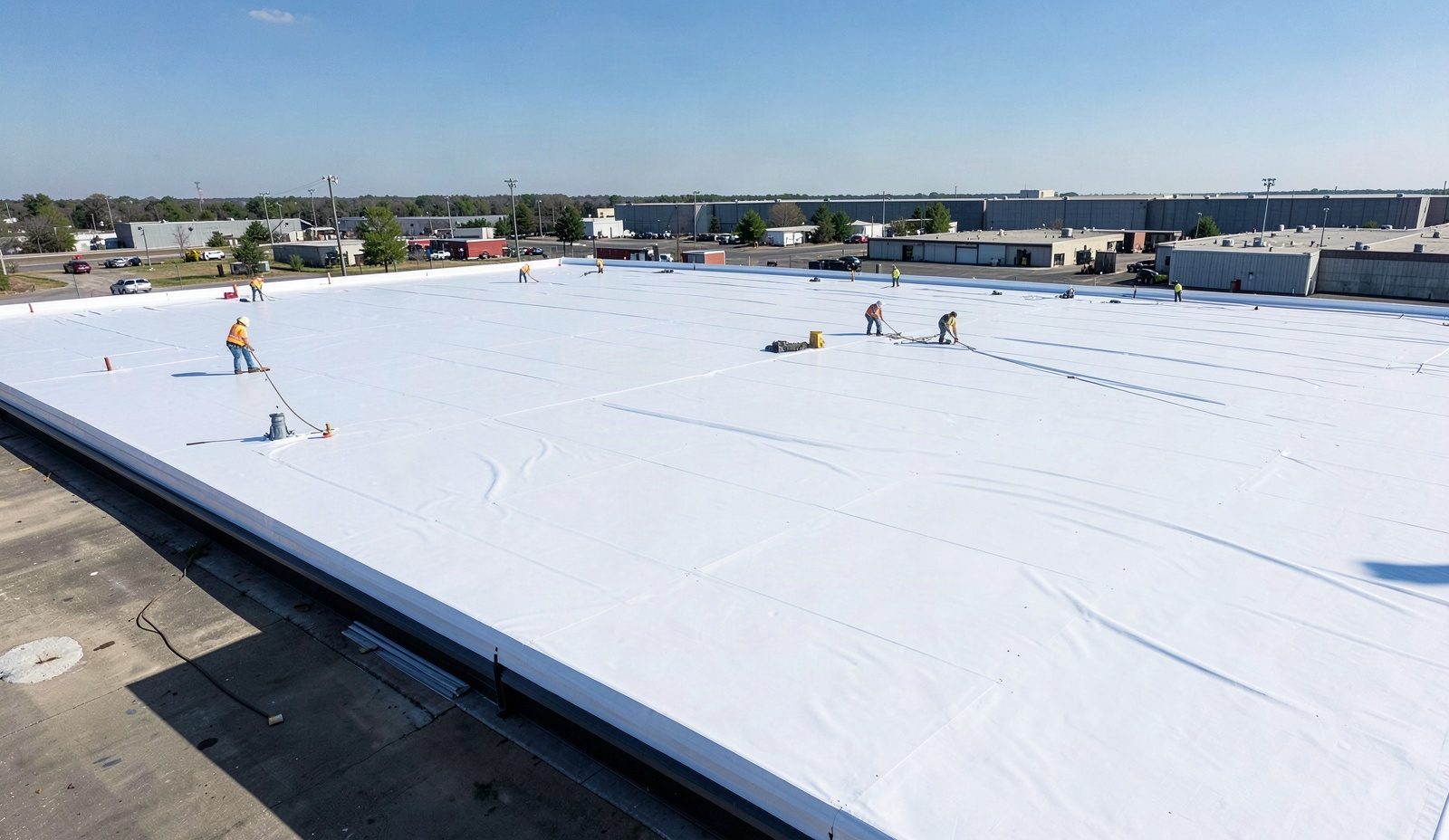
This service covers TPO and EPDM membrane installation and repair on Pickerington's commercial buildings, where flat and low-slope roofs demand different fastening and seam-welding methods than a steep-slope shingle roof. TPO membrane runs lighter per square and handles reflective heat better, while EPDM offers a longer track record on ballasted systems and tends to cost less to patch. A typical scenario is a retail plaza owner scheduling a membrane inspection and seam repair before a lease renewal, so the documentation is ready if a lender or insurer asks for proof of roof condition.
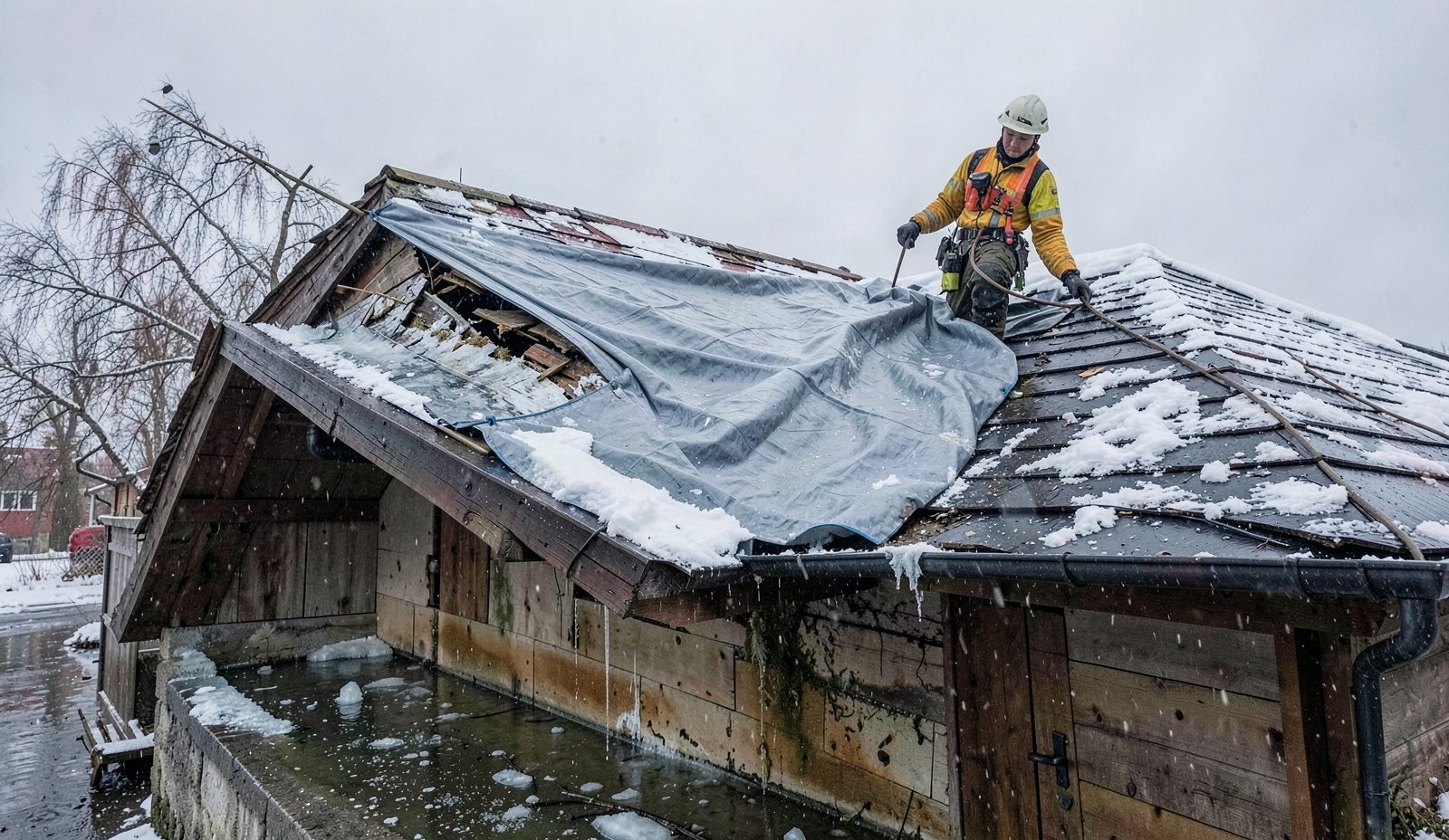
This service handles active leaks, wind-torn shingles, and storm-punctured decking that cannot wait for a scheduled appointment. Dispatch prioritizes containment first, tarping the exposed section and diverting water away from the interior, then documents the damage with photos before repair begins. A typical scenario is a homeowner calling after a straight-line wind event peels back a section of ridge cap at night, needing the opening covered before the next round of rain moves through the area.
Most calls Cornerstone Roofing Columbus takes in Pickerington trace back to one of four patterns, and each one gets worse the longer it sits. A hairline crack from a freeze-thaw cycle becomes a soaked deck section after two more winters. A slow gutter clog becomes a fascia rot problem by the following spring.
Catching these early keeps a repair a repair instead of a replacement. The signal a homeowner notices, whether a ceiling stain, a granule pile in the gutter, or a soft spot underfoot on the porch roof, usually means the underlying damage has already been building for a season or more.
From routine maintenance to cedar shake roofing, the same local crew handles every call.
Summer thunderstorms bring hail and straight-line wind that are the main storm-damage driver for asphalt roofs across the Pickerington area. Hail bruises the shingle mat without always breaking the surface, so damage can hide until granule loss speeds up months later. Call once you spot dark bruised spots on shingles or granules collecting in the downspout after a storm.
Homes built during Pickerington's earlier growth decades often carry step flashing and chimney flashing installed with fewer fasteners and thinner metal than current practice calls for. That flashing corrodes and separates from the roof deck over time, opening a gap right where a chimney or dormer meets the field. Call once you see rust streaking below a chimney or daylight through a flashing seam from the attic.
Heavy wet snow and ice loading push water back under the shingle edge when a gutter system cannot drain fast enough, and older aluminum gutter runs common in this area sag and pull away from the fascia board under that weight. Water then sits against the wood instead of running off. Call once a gutter visibly pulls away from the roofline or fascia boards show dark staining or soft spots.
Homeowners who skip attic ventilation upgrades trap warm moist air against the underside of the roof deck, which speeds up shingle aging from below and feeds ice dam formation at the eaves during winter. This shows up as premature curling on an otherwise young roof. Call once an attic feels noticeably warm and humid in winter or the underside of the deck shows dark moisture staining.
A Pickerington inspection visit runs about 30 to 45 minutes on a standard single-family roof, longer on a steep or multi-level roofline. The technician checks the roof surface, the attic underside if accessible, and the gutter system before writing anything down. Homeowners should have attic access clear and note which room shows any interior signs of a leak, since that detail helps the technician trace the water path faster once on the roof.
Need something specific? Our new construction roofing page breaks down exactly how we handle it in Pickerington.
Once a visit is scheduled, the homeowner gets a call or text confirming the arrival window, usually a two-hour block rather than an exact time, since roof inspections ahead of that appointment sometimes run long. The technician calls again when leaving the prior job so the homeowner has a realistic arrival estimate instead of waiting all morning. Any schedule change from weather gets communicated as soon as it is known, not after the missed window.
The technician introduces themselves, confirms the reported problem with the homeowner, and walks the property line before touching a ladder, noting anything nearby that needs protection like landscaping or a parked vehicle under the work area. Ladders get set on stabilizers to avoid gutter damage. The homeowner is invited to describe exactly where and when the problem first appeared, since that timeline narrows down whether the cause is storm-related or gradual wear.
Before packing up, the technician reviews what was found and what was done, showing photos of the damaged area and the completed repair side by side rather than describing it secondhand. A magnetic nail sweep runs across the work zone and the driveway to clear stray fasteners. The homeowner gets a written summary of the findings, which doubles as documentation for an insurance claim if the damage was storm-related.
The process for a Pickerington roof job runs in three stages, and each one produces something the homeowner can see or keep. The first call establishes the problem and gets a visit scheduled within a realistic window given current storm-season demand. The second stage is the on-roof diagnosis, which turns into a written scope the homeowner approves before any material gets ordered.
The third stage is the work itself, scheduled around weather and typically completed in a single day for a standard residential tear-off, with cleanup and a final walkthrough closing out the visit. Nothing moves to the next stage without the homeowner signing off first.
Call (614) 707-7333 and describe what is happening, whether a visible leak, storm damage, or a routine inspection request. The technician logs the address, the reported symptom, and any known roof age or material, then schedules the diagnostic visit around current demand and weather.
The technician inspects the roof, deck, and flashing details, then writes a scope covering exactly what needs repair or replacement and why. Nothing gets ordered or scheduled until the homeowner reviews and approves that written scope, so there is no ambiguity about what the job includes.
The crew completes the approved scope to Ohio Residential Code requirements, with flashing, ventilation, and fastening checked against manufacturer specifications before cleanup. The final walkthrough documents the finished work with photos, giving the homeowner a record for their own files or an insurance claim.
Roofing work in Pickerington falls under the Ohio Residential Code, which is based on the International Residential Code and sets the baseline for underlayment, flashing, ventilation, and fastening on every residential roof in the state. That code is the reference point Cornerstone Roofing Columbus checks against on every job, not a generic industry standard borrowed from another region.
Permit jurisdiction adds a wrinkle specific to this city. Pickerington sits primarily in Fairfield County with a portion extending into Franklin County, so which office reviews a permit application depends on the property's exact address rather than the city name alone. A full tear-off or any structural repair to the roof deck typically needs a permit pulled before work starts, while a small like-for-like shingle patch often does not, though the final call on any specific job belongs to the permit authority with jurisdiction over that address.
Verification on site means more than a visual check. A technician checks flashing laps, nailing patterns against the shingle manufacturer's published specification, and ventilation balance between intake and exhaust before calling a job finished. On a re-roof, that verification happens in stages, with the deck inspected before underlayment goes down and the underlayment inspected before shingles cover it, since problems caught after the fact mean tearing back into finished work.
Roofing permits outside Columbus city limits go through Franklin County Building Services, the county office we coordinate with on suburban jobs.
Heavy wet snow melts against a warm roof deck and refreezes at the colder eave overhang, building an ice dam that forces meltwater back under the shingles. Proper attic ventilation and an ice barrier at the eave are the two controls that keep this from becoming an interior leak, and both get checked during any winter-season inspection in this area.
Scope depends on deck condition, roof access, and how many existing shingle layers are already on the roof, since a second tear-off layer takes longer and generates more disposal weight than a single-layer job. Steep pitch, multiple roof planes, and chimney or skylight penetrations all add labor time beyond a simple rectangular roof.
A standard single-family tear-off and reshingle typically finishes in one working day, weather permitting, while a layered roof or complex roofline can run two. Architectural shingles carry ASTM D3161 wind resistance ratings that commonly range from 110 to 130 miles per hour depending on the product line and fastening pattern, a real difference to weigh against a basic three-tab shingle's lower rating.
Franklin County Building Services is the permit authority for the portion of Pickerington within its boundary, while addresses in Fairfield County go through that county's separate process, and confirming which office applies is one of the first things checked before a full replacement is scheduled. Structural repairs and full tear-offs typically require a permit, while minor like-for-like patch repairs often do not.
Most standard residential tear-offs finish in a single working day. A layered roof, steep multi-plane roofline, or a job interrupted by rain can extend that to two days, and commercial membrane work on a larger footprint runs on its own separate timeline based on square footage and access.
Yes, replacing an aging roof on an older home often costs less over time than repeated patch repairs on failing decking. Once a technician finds soft sheathing or multiple existing shingle layers during inspection, a full tear-off typically protects the structure better than another surface-level repair.
Estimates depend on an on-roof inspection first, not a phone-only guess. A technician checks the deck, flashing, and existing shingle layers, then provides a written scope covering exactly what the job includes before any work gets scheduled or approved.
Comparing quotes depends on matching scope, not just the bottom line. Check whether each quote specifies the exact shingle or membrane product, the number of layers being removed, and whether flashing and ventilation upgrades are included, since a lower number often means a smaller scope.
Prices vary mainly based on material quality, crew experience, and how thoroughly the deck and flashing are inspected before work starts. A quote that skips a deck inspection or ignores existing shingle layers often looks cheaper upfront but misses problems that surface later.
The highest-priority items are pipe boot cracking, ridge cap fastening, valley wear, and gutter apron condition. Pipe boots dry out and split faster than the surrounding shingles, and a cracked boot is one of the most common sources of a slow ceiling leak that takes months to show a visible stain. Checking these four items first tells a technician quickly whether the rest of the roof needs a closer look.
Explore our service area and locate Cornerstone Roofing Columbus with ease. We're proudly local and serve the surrounding neighborhoods with fast response and honest pricing. Use the map to check our coverage area, or call us and we'll confirm in seconds.
Address:
Cornerstone Roofing Columbus, Pickerington, OH 43147
How Much Does a Roof Replacement Cost in Columbus? 2026 Pricing Breakdown, practical local guidance from Cornerstone Roofing Columbus, Colum…
Read More
Commercial Roof Maintenance Tips for Columbus Property Managers, practical local guidance from Cornerstone Roofing Columbus, Columbus's trus…
Read More
Skylight Leaks in Victorian Village Homes, Repair or Replace?, practical local guidance from Cornerstone Roofing Columbus, Columbus's truste…
Read More
The Best Time of Year to Replace a Roof in Columbus, practical local guidance from Cornerstone Roofing Columbus, Columbus's trusted roofing …
Read More