

April 1, 2025
How Much Does a Roof Replacement Cost in Columbus? 2026 Pricing Breakdown
How Much Does a Roof Replacement Cost in Columbus? 2026 Pricing Breakdown, practical local guidance from Cornerstone Roofing Columbus, Colum…
Read More




New Albany sits in a humid continental climate belt, not a lake-effect snow zone, but Central Ohio still delivers 40 to 60 freeze-thaw cycles every winter. Water gets into a hairline crack in a shingle mat, freezes overnight, expands, and pries the mat wider. By February, a roof that looked fine in October shows granule loss along south-facing slopes and cracked seals along ridge caps.
Housing stock here skews newer. Much of New Albany's inventory is master-planned Georgian-style construction built to a design standard that controls roofline pitch, dormer placement, and even shingle color, and New Albany's design review process can restrict which materials and colors get approved before a crew ever orders shingles. In Ealy Crossing and Ashton Grove, homes with symmetrical hip roofs and multiple dormers create more valleys and step-flashing runs per square foot than a simple gable roof, which means more places for a nail to miss a rafter or a valley metal to underlap instead of overlap. Brandon's earlier-built sections show more curled three-tab shingles reaching the end of their service life, while newer phases nearby carry laminate architectural shingles rated for higher wind.
Rose Run Park and the tree canopy along its corridor drop heavy leaf litter into gutters every autumn, and homes backing onto that greenspace collect more debris than roofs on open cul-de-sacs. Add spring thunderstorm season on top of a winter of freeze-thaw cycling and a roof here gets stressed from two directions before summer even starts.
Permit and inspection questions? Building & Zoning Services is the office we coordinate with on every permitted Columbus job.
Cornerstone Roofing Columbus built its New Albany reputation one referral at a time, mostly from homeowners in the same subdivisions who compare notes over back fences. That kind of scrutiny keeps a crew honest: a bad flashing detail on one roof gets noticed by the neighbor three doors down within a season. Every estimate gets written by the technician who climbed the roof, not by a salesperson working from a satellite photo.
Field supervisors run a second walk of the roof deck before crews close it up, checking nail placement against manufacturer spacing and fastener count, because a shingle rated for a specific wind speed only holds that rating if it goes down with the correct nail pattern. Newer installers train under lead installers for a full season of Ohio weather before running a job alone, covering everything from ice-dam-prone eaves in January to hail inspections in July.
They want to see fastener patterns checked and code specs followed on their own roof, not just a claim. That range matters in a market where a single street can mix a fifteen-year-old laminate shingle roof with a brand-new standing-seam metal roof on a custom build. Call (614) 707-7333 and the person who answers can talk through both without reading from a script.
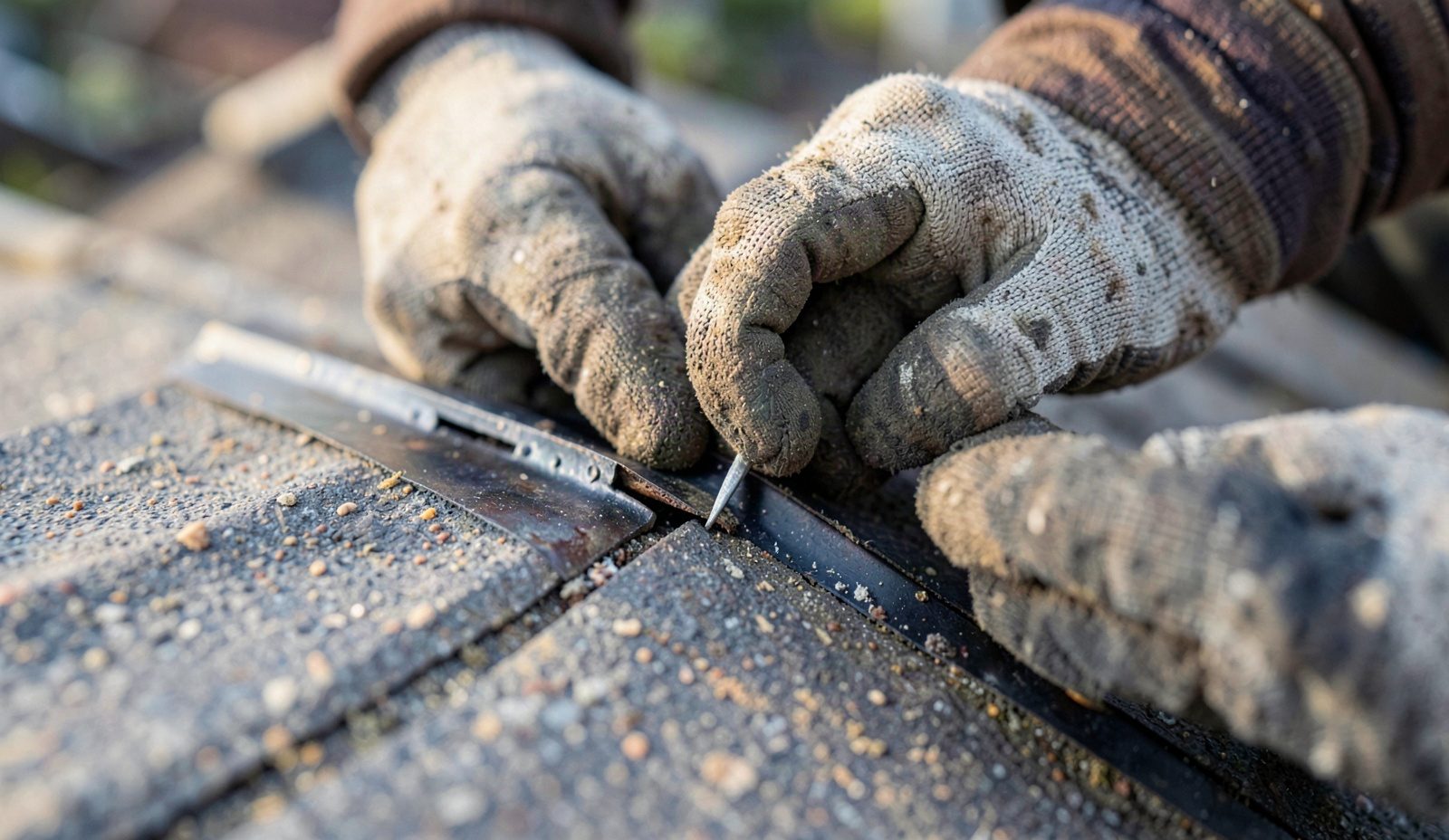
The same lead technician who inspects your roof also supervises the tear-off and installation, so nothing gets lost in a handoff between a sales estimator and a separate labor crew. That technician answers questions on-site about why a specific valley gets woven metal instead of shingle-over-shingle treatment, and signs off on the finished work before the crew leaves the property.
Every service truck carries a moisture meter for probing decking after a leak, a pitch gauge for calculating slope before ordering underlayment, and an infrared thermometer for spotting heat loss patterns that flag missing insulation or a failed vent boot. A technician reads these instruments on the roof and shows you the readings before recommending a repair.
Installers train against the Ohio Residential Code, the state's adopted residential building standard, so ice barrier placement, fastener schedules, and ventilation ratios follow the same benchmarks a county inspector checks. That training extends to flashing details around chimneys and skylights, areas where a missed step causes the leaks that show up two winters later.
Crews working New Albany jobs know the difference between an older subdivision roof and a current master-planned build before they climb the ladder, because deck framing, valley count, and shingle profile change block by block. That familiarity cuts diagnostic time on the first visit and avoids ordering the wrong flashing profile for a roofline the crew has already seen a dozen times.
Roofing New Albany properties covers three distinct scopes of work: residential re-roofing and repair, commercial low-slope systems, and emergency leak response. Each scope uses different materials, different crew sizes, and different inspection standards, so New Albany roofing services here get organized into three tiers rather than one generic offering.
The difference shows up in the details: how a crew flashes a dormer, how it fastens a membrane at a parapet, how fast it answers when water is already coming through a ceiling. Emergency roofing New Albany calls get triaged by phone before a truck moves, so the crew arrives with the right tarp size and fastener type already loaded.

Residential work covers full tear-off replacements, targeted shingle repair, flashing rebuilds around chimneys and skylights, and ventilation upgrades on homes across New Albany's subdivisions. This tier fits homeowners dealing with granule loss, a soft spot in the decking, or a homeowner association letter about roof condition ahead of a sale. A typical job: a two-story home with a failed valley causing a ceiling stain in the upstairs hallway. The crew opens the valley, finds underlayment that stopped short of the required overlap, replaces the valley metal and surrounding shingles, and matches the existing shingle color and profile so the repair blends into the rest of the slope.
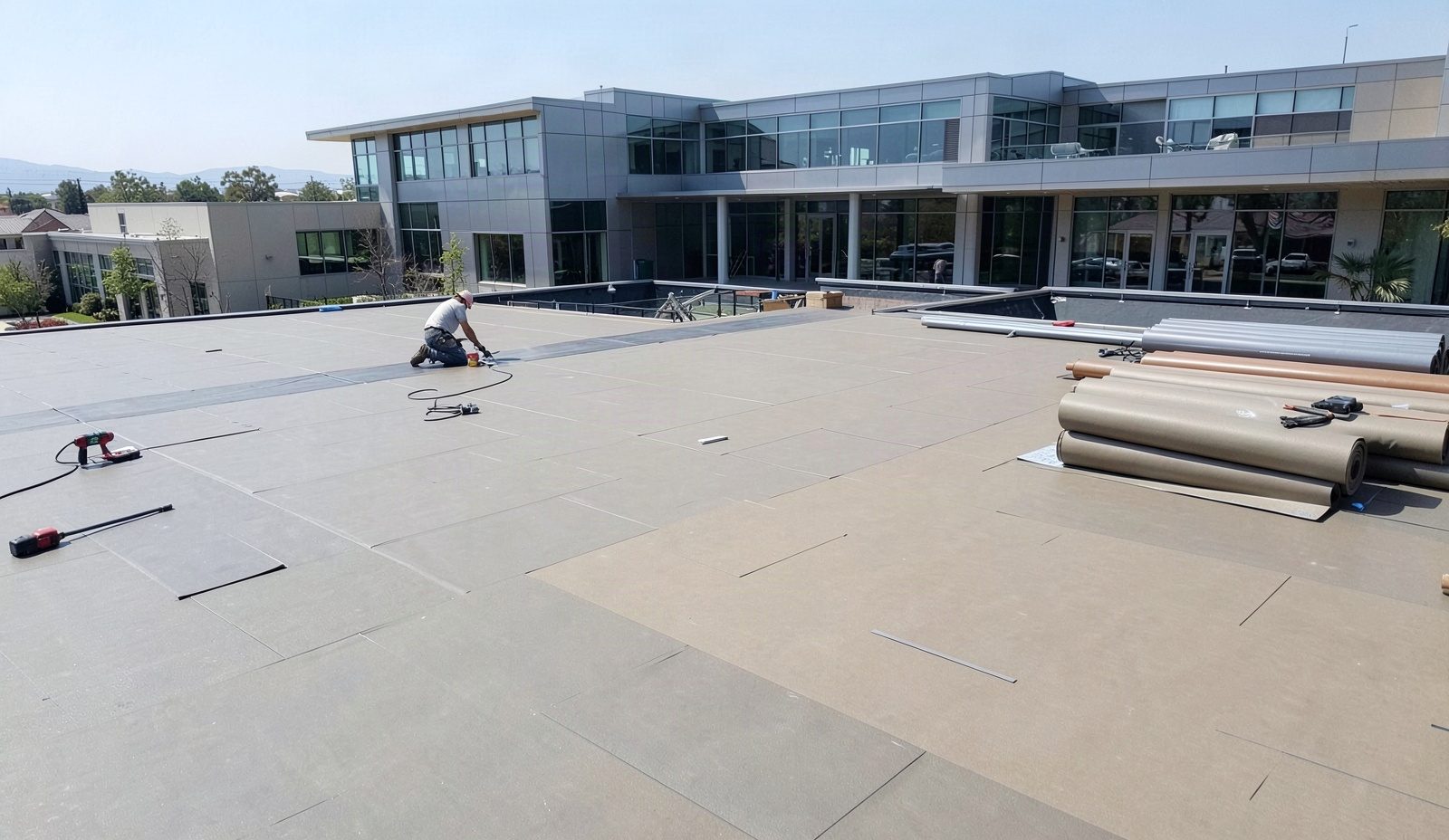
Commercial roofing here focuses on TPO and EPDM membrane systems on office and retail buildings along local business corridors, plus modified bitumen on older flat-roof additions. Work gets scheduled around business hours and lease obligations, with sections tarped off so tenants keep operating during tear-off. A typical scenario: an office building with a TPO roof past its expected service life starts showing ponding water at a low corner after every storm. The crew maps the drainage slope, confirms which insulation layers still test dry with a moisture meter, and phases the membrane replacement so the building never sits fully exposed overnight, protecting tenant improvements below.
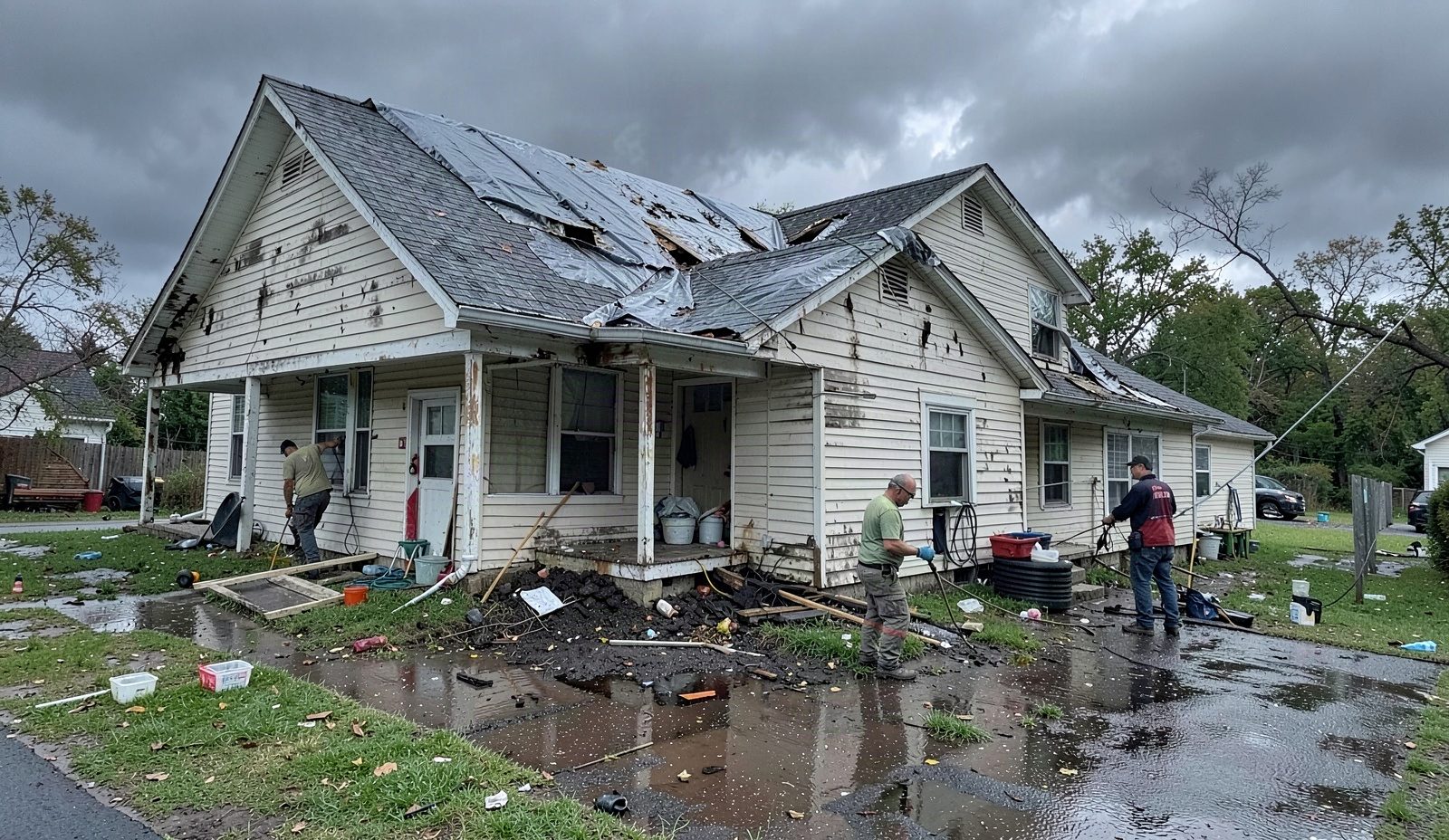
Emergency roofing New Albany calls start with phone triage: the technician on the line asks where the water is entering, whether it is active, and whether ceiling drywall has already sagged, then dispatches a crew with tarps sized for the roof type described. A typical scenario: a wind-driven thunderstorm peels back a section of ridge shingles at night and rain starts coming through a bedroom ceiling. The crew arrives with a tarp, mechanically fastens it along the ridge and down both slopes past the damaged section, and photographs the covered area for the homeowner's insurance claim before leaving containment buckets inside as a backup.
Four problems account for most New Albany service calls. Each one starts small and gets missed because the signal shows up somewhere other than the leak itself: a stain on a wall that shares no obvious line with the roof, a granule pile in a downspout, a slightly spongy step on the stairs leading to a bonus room over the garage.
Catching any of these early keeps a repair a repair instead of a replacement. A technician who checks attic ventilation, valley flashing, and gutter flow on the first visit usually finds the early version of one of these four before it reaches the ceiling drywall.
Summer thunderstorms bring hail and straight-line wind that crack shingle mats and lift tabs along roof edges, a pattern common across Central Ohio. Bruised shingles show a soft, dark circle when pressed with a thumb, a sign the mat fiber already fractured even if no granules are missing yet. Call once you spot dented gutters or soft, bruised shingle tabs after a storm passes.
Homes from New Albany's earlier build-out phases often carry three-tab shingles installed with a six-nail pattern that was standard at the time but rates lower for wind resistance than today's laminate shingles. These roofs reach the point where seal strips fail and tabs lift in moderate wind instead of only in a named storm. Call if shingle tabs curl upward at the edges or granules collect in the downspout after normal rain.
Ohio's clay-heavy soil expands and contracts with seasonal moisture, and that movement telegraphs up through a foundation into chimney and sidewall flashing, opening hairline gaps where the flashing meets the brick or siding. Water finds that gap during the next rain and tracks down inside the wall cavity before it ever shows on a ceiling. Call if you notice a musty smell near a chimney chase or a new stain on a wall that shares a chimney.
Mature trees across established New Albany subdivisions drop enough leaf litter to clog a gutter system within one season if nobody clears it, and the overflow runs behind the fascia board instead of down the downspout. That trapped water rots the fascia and the roof deck edge from below, a failure that stays hidden until the fascia feels soft under a screwdriver tip. Call once gutters overflow during moderate rain rather than only during a downpour.
A technician's first stop on a New Albany call is the attic, not the roof deck, because ventilation, insulation depth, and staining on the underside of the decking tell most of the diagnostic story before anyone climbs a ladder. Expect a visit that runs 30 to 45 minutes on a standard residential roof, longer if attic access is tight or the roof has multiple sections.
Have your last roof service date handy, clear access to the attic hatch, and be ready to point out any interior stain you have already noticed. That short prep window shortens the diagnostic portion of the visit and gets a technician onto the roof faster.
From routine maintenance to new construction roofing, the same local crew handles every call.
Once you call (614) 707-7333, the office confirms your address and a two-hour arrival window by phone or text, then calls again about 20 minutes before the technician pulls up. You get the technician's name ahead of time, so you know exactly who to expect at the door. If a storm backlog pushes the schedule, the office calls to reset the window rather than leaving you guessing, and reschedules to the next opening the same day once weather allows ladder work again.
The technician arrives in a marked vehicle, introduces themselves, and asks to see any interior damage or stain first, before touching a ladder. Shoe covers and roof pads protect gutters and landscaping during the climb. You get a plain description of what the technician finds on the deck, soft spots, exposed nail heads, cracked pipe boots, before any repair talk starts, along with photos of the specific damaged area.
Before the crew leaves, the technician walks the yard and driveway with a magnetic nail sweeper to pull stray fasteners out of the grass and pavement. You get a short walk of the finished roofline from the ground, a look at the photos taken during the repair, and a written summary of what got replaced. Debris goes into a trailer or dumpster on site, and gutters get checked for shingle grit before the crew rolls out.
Every job starts with a call to (614) 707-7333, where the office logs the address, the type of damage, and whether the roof is currently leaking. That call determines whether the job gets scheduled as a routine inspection or moved up as an active leak.
From there the job runs in three stages: diagnosis and a written quote, the physical work, and a final code check. The same technician who diagnoses the roof typically returns to lead the repair crew, so the person explaining the problem is the person fixing it.
You call (614) 707-7333 and describe what you are seeing: a stain, a missing shingle, water actively coming through. The office logs the address, roof type, and urgency, then books an arrival window, moving active leaks ahead of routine inspections on the schedule.
A technician inspects the roof and attic, measures the affected area, and writes a quote itemizing materials and labor before any work begins. You review and approve the quote on-site, so there is no surprise scope change once the crew starts pulling shingles.
The crew completes the repair or replacement to Ohio Residential Code specifications, then the lead technician checks the finished work against that standard before cleanup. You get a final walkthrough and documentation of what was done, useful for insurance records or a future home sale.
Roofing work in New Albany falls under the Ohio Residential Code, the state's residential building standard, which Ohio adopted from a national model code and modified for state-specific conditions. That code sets the baseline for fastener schedules, ventilation ratios, and underlayment requirements, and it applies whether a parcel sits on the Franklin County side of town or spills into Licking County to the east.
Compliance gets verified on a real job through physical checks, not paperwork alone. A technician confirms nail placement, shingle exposure, and eave protection against the code's minimum requirements before the ridge cap goes on, and photographs the covered areas that an inspection would otherwise never see once the roof is finished.
Materials get chosen against recognized third-party standards, not marketing copy. Impact-resistant shingle lines carry a UL 2218 Class 4 rating, the highest tier for hail resistance, and wind performance gets tested against standards such as ASTM D3161 or ASTM D7158 depending on the shingle style. A crew that knows these ratings can explain why one laminate shingle line costs more than another without a sales pitch.
Need something specific? Our asphalt shingle roofing page breaks down exactly how we handle it in New Albany.
Section 905.1.2 of the Ohio Residential Code requires an ice barrier under asphalt shingles that runs from the lowest roof edge to at least 24 inches inside the exterior wall line, using two cemented underlayment layers or a self-adhering polymer-modified bitumen sheet. On a shallow-pitch New Albany eave, a technician measures that 24-inch line with a tape before ordering material, because guessing short leaves the eave exposed to ice-dam backup.
Scope, access, and existing deck condition move price more than shingle brand does. A steep roofline with many valleys and tall trees blocking a dump trailer's path takes longer to tarp, load, and haul debris from than a simple gable roof with open driveway access. Rotten decking found under old shingles adds plywood replacement to the scope, discovered only once tear-off starts.
A standard single-family tear-off and reroof runs one to two days for a crew working full daylight hours, weather permitting, longer if decking replacement is needed. Quality gets checked by counting fasteners per shingle against manufacturer spacing and confirming valley metal overlap direction before the ridge cap goes on, not by a glance from the driveway.
Full roof replacements and structural repairs typically need a permit through Franklin County Building Services, while minor like-for-like shingle repairs often do not, with the final call belonging to that office. Because New Albany straddles into Licking County on its eastern edge, the parcel's exact jurisdiction determines which office actually issues the permit before work starts.
Roofing cost in New Albany depends on roof size, pitch, material choice, and how much decking needs replacement. A steep multi-valley roofline costs more to work than a simple gable because of the extra flashing and longer install time, and rotten decking under old shingles adds material and labor beyond the base scope. Call (614) 707-7333 for a technician to walk through your specific factors.
Coverage depends on the cause of the damage and the terms of your specific policy, not on which roofer you hire. Wind and hail damage from a documented storm typically has a better chance of coverage than gradual wear from age or deferred maintenance, and an adjuster usually wants photos and a damage description dated close to the storm event. A technician can document the damage, but the coverage decision belongs to your insurer.
Prices vary because companies differ on material grade, crew experience, and how much they inspect before quoting. A company that estimates from a photo without climbing the roof often misses decking damage that turns into an added cost mid-job, while a company that inspects first prices the full scope upfront. Crew size and whether labor gets routed through subcontractors also change the number.
Comparing quotes means checking scope, not just the bottom-line number. Confirm each quote lists the same material specifics, shingle line, underlayment type, ice-barrier coverage, and the same amount of decking replacement, because a lower number that skips a decking inspection is not the same job. Ask each contractor how they verify fastener count and flashing overlap before calling the work finished, and compare their answers, not just their price.
A complete roofing estimate includes measured squares, the exact shingle or membrane product by name, underlayment type, flashing and drip edge work, ventilation changes, decking repair allowance, disposal, and any permit-related line items. It should also separate labor from material so you can see where the cost comes from. Details like gutter apron replacement or chimney flashing rework often get left off cheaper bids entirely. If a line item is missing, ask why before you sign, since silence on a category usually means it wasn't priced at all, not that it's included for free.
Yes, replacement is often more valuable on older homes because original hardware and fascia are usually past their service life. Century-old homes across the metro frequently still carry original spike-and-ferrule hangers that back out under repeated freeze-thaw movement, letting water reach fascia and rafter tails that are already decades old. Upgrading to hidden hangers on tighter spacing protects framing that would otherwise take on hidden water damage for years before it shows.
Explore our service area and locate Cornerstone Roofing Columbus with ease. We're proudly local and serve the surrounding neighborhoods with fast response and honest pricing. Use the map to check our coverage area, or call us and we'll confirm in seconds.
Address:
Cornerstone Roofing Columbus, New Albany, OH 43054
How Much Does a Roof Replacement Cost in Columbus? 2026 Pricing Breakdown, practical local guidance from Cornerstone Roofing Columbus, Colum…
Read More
Commercial Roof Maintenance Tips for Columbus Property Managers, practical local guidance from Cornerstone Roofing Columbus, Columbus's trus…
Read More
Skylight Leaks in Victorian Village Homes, Repair or Replace?, practical local guidance from Cornerstone Roofing Columbus, Columbus's truste…
Read More
The Best Time of Year to Replace a Roof in Columbus, practical local guidance from Cornerstone Roofing Columbus, Columbus's trusted roofing …
Read More