

April 1, 2025
How Much Does a Roof Replacement Cost in Columbus? 2026 Pricing Breakdown
How Much Does a Roof Replacement Cost in Columbus? 2026 Pricing Breakdown, practical local guidance from Cornerstone Roofing Columbus, Colum…
Read More




Delaware sits on the northern edge of the Columbus metro, and it shares the same continental freeze-thaw climate and heavy wet snow loads as the rest of central Ohio. This is not a lake-effect snow zone. The roofing damage here comes from repeated thaw-refreeze cycles working into seams and nail holes over months, not from feet of lake snow piling up overnight.
Walk the Sandusky Street Historic District and you see steep-pitch Victorian and Queen Anne rooflines, several still carrying original slate or older three-tab conversions laid over full plank decking. Those roofs were framed before modern ice-barrier code existed, and the freeze-thaw cycle now attacks the flashing around dormers and chimneys first, since those transitions were hand-flashed with lead or tar rather than sealed membrane. Older downtown and university-area housing means many steep-slope roofs facing that repeated stress on flashing and shingle systems year after year.
Newer subdivisions like Glenross and Cheshire Crossing sit on architectural shingle roofs installed in the last two to three decades, and the failure pattern looks different. Builder-grade three-tab or entry-level architectural shingles on these homes are reaching the age where granule loss shows up first on south and west-facing slopes, the sides that take the most sun and the widest swing between a warm afternoon and a hard overnight freeze.
Homes in both eras share one exposure. Gutters clog with maple and oak leaves each fall, then back up as ice at the eave line through January and February. That ice load is what turns a small flashing gap into a stained ceiling by March.
Permit and inspection questions? Building & Zoning Services is the office we coordinate with on every permitted Columbus job.
Cornerstone Roofing Columbus builds its reputation job by job across Delaware County, and most of our calls here come from repeat neighbors, property managers and realtors who saw the work next door before they needed it themselves. That word-of-mouth pattern matters more in a county this size than any ad ever could, because homeowners compare notes at school pickup and at the fairgrounds before they compare quotes.
Every job runs through the same internal checkpoints regardless of size. A lead technician photographs the roof deck once the old shingles come off, documents any soft plywood or damaged sheathing found underneath, and photographs the underlayment and flashing again before the new shingles go down. That photo record gives you a paper trail if you ever need to show an insurer or a future buyer what is actually under your roof, not just what it looks like from the driveway.
Crew members move up through a structured progression, starting on tear-off and cleanup, then flashing detail, then lead installer once they can run a full reroof to manufacturer nailing specifications without supervision. That progression matters on a steep Victorian roofline in the historic district as much as it does on a straightforward ranch reroof in a newer subdivision, since the two jobs demand different footing, different fall protection and different flashing technique.
We hold weekly safety and technique meetings that cover manufacturer install bulletins as they update, ice-barrier placement, and proper fastener patterns for the wind exposures common to open Delaware County lots. That internal training, not a sales pitch, is what keeps a crew consistent from one job site to the next.
Our crews work to the installation standards of the National Roofing Contractors Association.

When you call (614) 707-7333, a technician answers instead of a call-center script. That person logs your address, roof age and the specific symptom, whether it is a ceiling stain or missing shingles after wind, and gives you a name and a callback window rather than a ticket number lost in a queue.
Crews carry infrared thermal cameras to spot trapped moisture under shingles before it shows up as a ceiling stain, plus non-invasive moisture meters for decking readings. On steep or historic rooflines we use ladder stabilizers and fall-protection anchors rather than guessing at footing on old slate or original plank decking.
Every install follows the Ohio Residential Code, the state's adopted residential construction standard, from fastener count per shingle to flashing laps at valleys and sidewalls. Crews review manufacturer installation instructions alongside code language so field decisions on unusual rooflines, like the dormers common downtown, match both.
Delaware is the seat of Delaware County, and ZIP 43015 covers much of the city, with the county and city sharing building code jurisdiction here. Working this footprint job after job means crews already know how historic district rooflines differ from newer subdivision trusses before the ladder ever goes up.
Roofing companies in Delaware generally split into three tiers of work, and knowing which one you need saves a call. Residential roof installation covers asphalt shingle tear-offs and reroofs on single-family homes, where slope, attic ventilation and historic flashing detail drive the scope. Commercial roofing covers low-slope membrane systems on offices, retail buildings and multi-family properties, where square footage, rooftop equipment and tenant downtime drive decisions.
Emergency roofing sits apart from both. It is a fast, temporary fix, a tarp or dry-in membrane, meant to stop active water intrusion until a permanent repair or full replacement can be scheduled and permitted correctly. If you are trying to hire a roofer in Delaware right now, the tab below for your situation tells you what the visit actually involves.
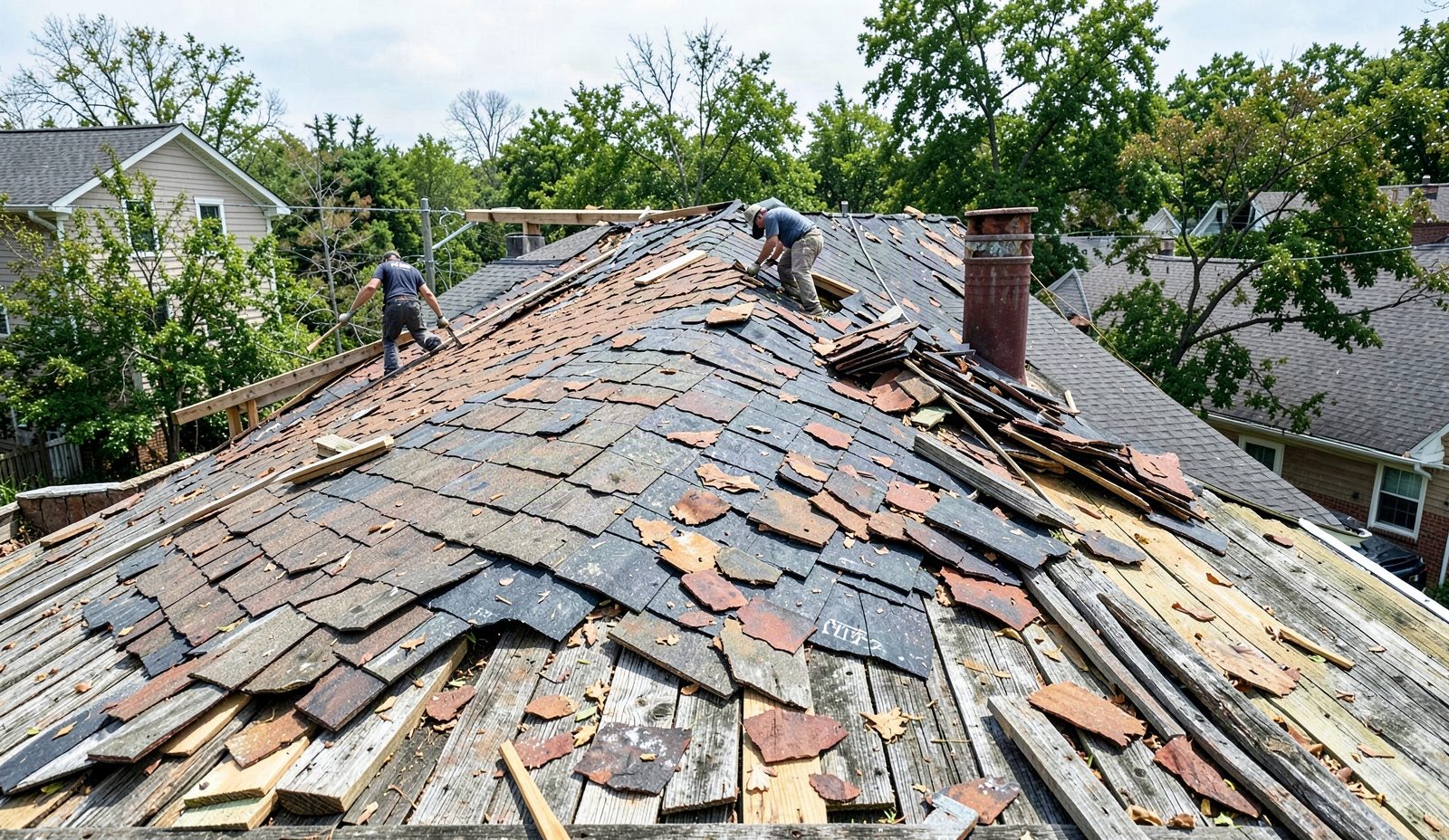
This is a complete removal of existing shingles down to the decking, replacement of any damaged plywood or plank sheathing, new underlayment and flashing, then new architectural or three-tab shingles installed to manufacturer nailing pattern. It is for homeowners whose roof is past patching, showing granule loss across multiple slopes or repeated leaks at more than one penetration. A recent example was a two-story colonial on the city's east side where the original nineteen-eighties three-tab shingles had cupped and cracked across the whole south slope. The crew found two layers of old roofing stacked underneath, stripped both back to bare decking, replaced a sagging section of sheathing near the chimney, and installed new shingles over fresh synthetic underlayment in a single work window.
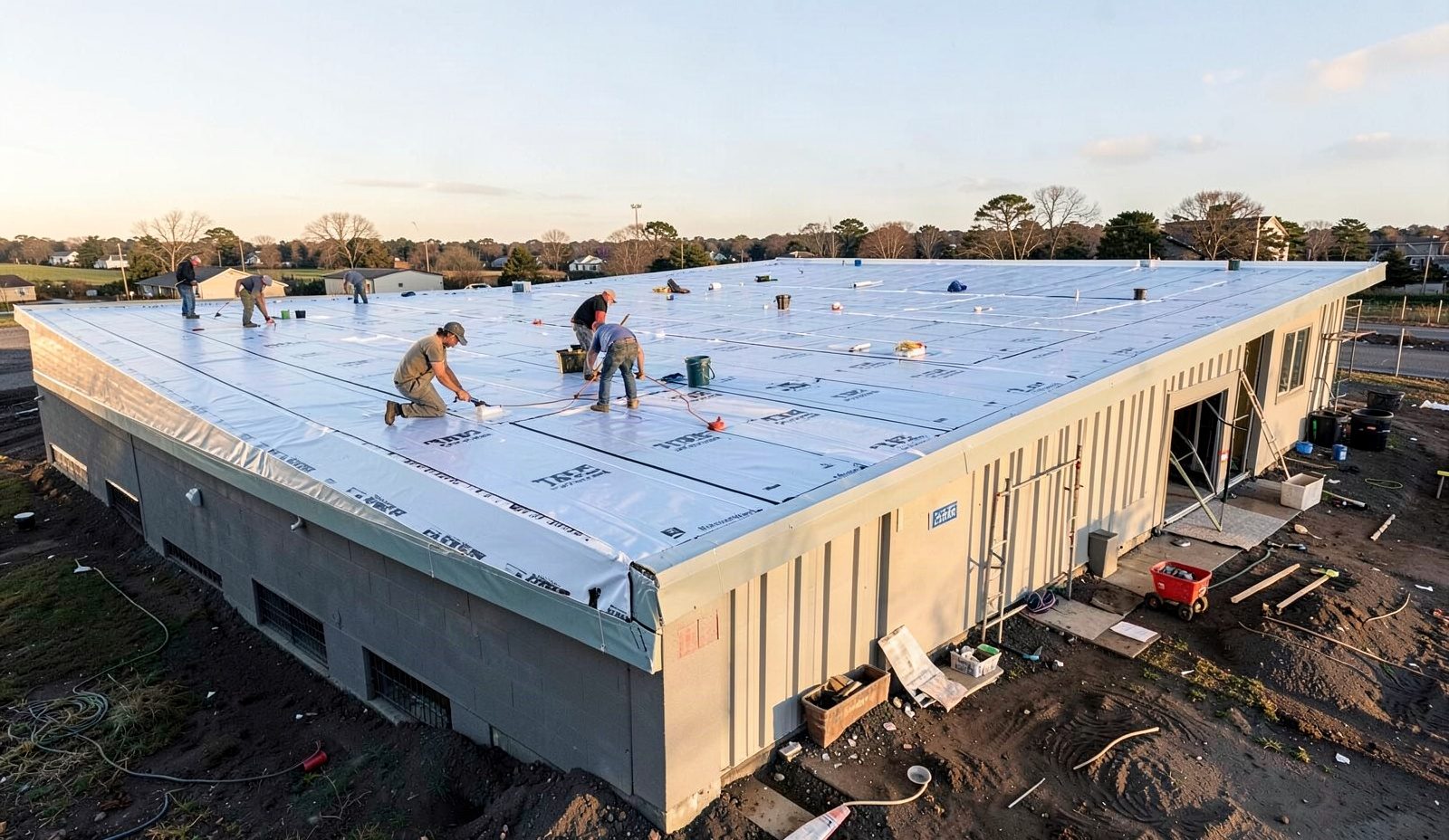
Commercial buildings in Delaware typically run TPO or EPDM membrane over a low-slope deck, and the choice between them comes down to seam welding versus adhered or ballasted installation, UV reflectivity, and how much rooftop HVAC and drainage work the building already has. Coordinated scheduling matters here, since most commercial clients need the building occupied and operating during the work. A typical scenario is a single-story office plaza along US Route 23 with an aging EPDM membrane showing seam separation near a rooftop unit curb. Work gets phased over a weekend and after hours where possible, with the roof sectioned so drainage and weather protection stay in place at every stage, protecting tenants' lease obligations against water intrusion claims.
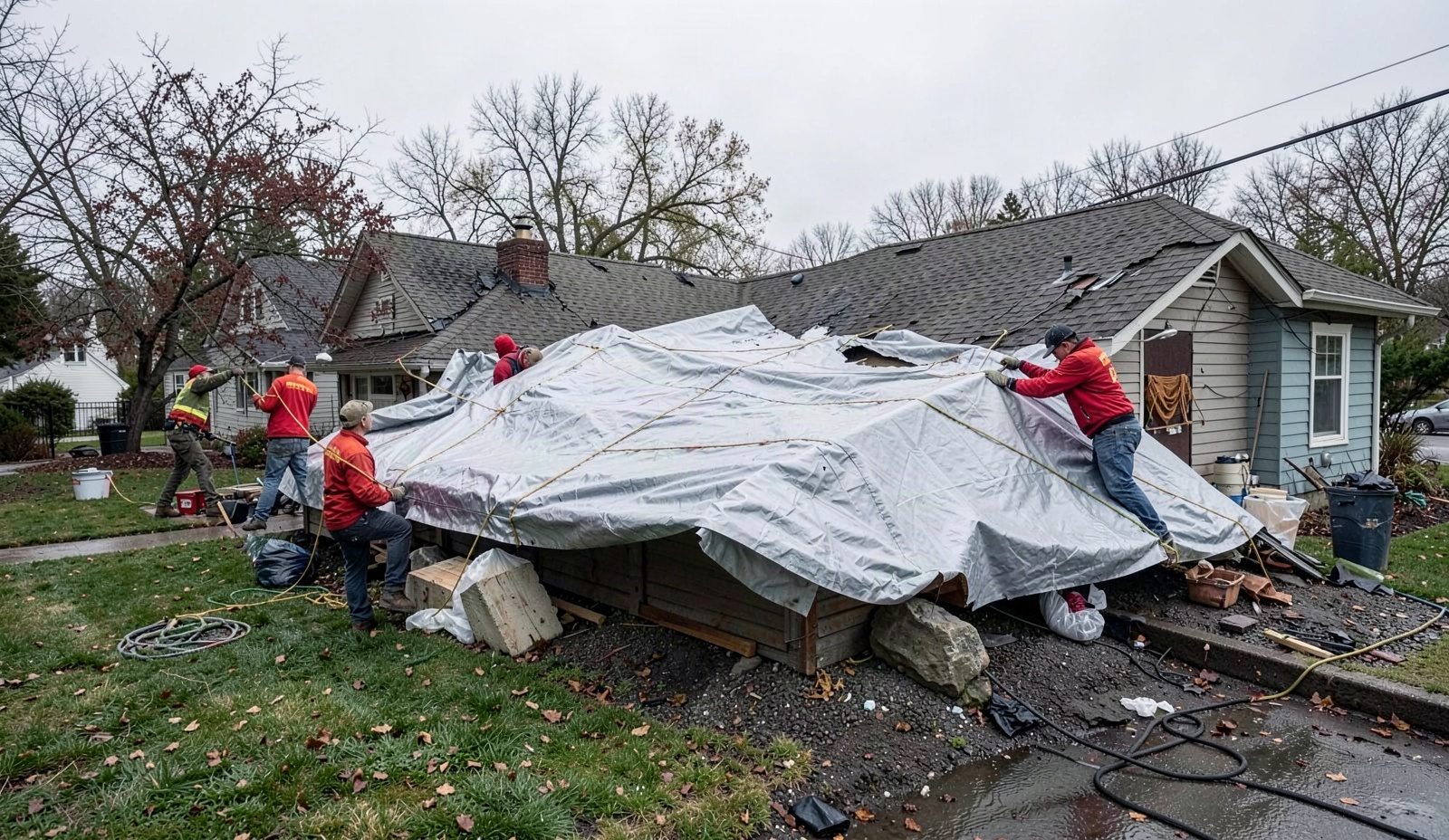
Summer thunderstorms bring hail and straight-line wind through Delaware County, and that combination is a common cause of asphalt shingle damage and roof penetration failures around vents and chimneys. Emergency dry-in work means a tarp or self-adhered membrane goes over the exposed decking fast, stopping water entry until permanent repair can be scoped and scheduled. A typical call comes in after a wind event peels back a section of ridge shingles, exposing the underlayment along the roof's high point. The crew secures a weighted tarp system across the exposed run the same day, then documents the damage with photos for the homeowner's insurance claim before scheduling the permanent shingle replacement.
Most service calls in Delaware trace back to one of four patterns, and each one gives an early warning sign before it turns into an interior leak. Catching the signal early, a curling shingle edge, a soft spot underfoot, a rust streak at a gutter seam, keeps a repair a repair instead of a full reroof.
The pattern usually depends less on the homeowner and more on when the roof was built and which slope faces the weather. Knowing which of these four is developing on your roof is the fastest way to know whether a call now saves the interior ceiling later.
From routine maintenance to asphalt shingle roofing, the same local crew handles every call.
Central Ohio runs roughly 40 to 60 freeze-thaw cycles each winter, and every cycle expands trapped moisture inside a cracked shingle mat or split flashing seam a little further. The call-now signal is a shingle edge that has curled upward and feels brittle, not flexible, when you press it with a gloved hand from the ladder.
Homes built before plywood sheathing became standard used solid board or skip-sheathing decking, which holds nails differently than plywood and loosens as the boards shrink and swell with seasonal moisture. The call-now signal is a shingle course that looks slightly wavy or a nail head visibly backing out through the shingle surface.
Clay-heavy Delaware County soil drains slowly, and when downspouts discharge too close to the foundation, saturated ground around the house pushes moisture back up into fascia boards and the lowest course of roof decking. The call-now signal is soft, spongy fascia trim or a dark stain running along the gutter line.
Homeowners who add blown-in attic insulation without keeping soffit vents clear starve the roof's airflow path, letting heat build up under the deck and melt snow that refreezes at the cold eave, forming an ice dam. The call-now signal is icicles forming in a thick ridge right at the gutter line rather than hanging evenly along the whole eave.
A first visit runs about 30 to 45 minutes on a standard single-family roof, longer on steep or multi-layer historic roofs. The technician checks the roof surface, the attic from the inside if accessible, and the gutter line before giving you any findings, so have attic access clear and note which room shows interior staining, if any.
Bring up anything you have already noticed, a specific ceiling spot, a sound during wind, or a recent storm date, since that narrows where the technician looks first.
Need something specific? Our cedar shake roofing page breaks down exactly how we handle it in Delaware.
Once you call (614) 707-7333, a technician confirms your address, a same-day or next-day arrival window, and the name of who is coming. You get a call or text when the technician is on the way, not a vague all-day window, so you are not stuck waiting around the house without knowing when the truck actually shows.
The technician introduces themselves, parks to avoid blocking your driveway, and lays down ground protection near any landscaping before setting a ladder. Before climbing up, they walk the exterior with you if you are home, pointing at anything visible from the ground, then explain what they are about to check and roughly how long it will take.
Before packing up, the technician walks you through what was found, shows photos taken from the roof and attic, and runs a magnetic nail sweep across the ground and driveway to catch loose fasteners. You get a written summary of findings and next steps before the truck leaves the property, not a verbal recap you have to remember.
Most Delaware jobs move through three stages from the first phone call to a finished roof, and each stage has its own timeline depending on scope. A straightforward repair might close out within a few days of the first call, while a full tear-off on a larger or steeper roof gets scheduled around weather windows and material delivery.
Every stage ends with something in writing, a scope note, a quote, or a completion summary, so you are never relying on memory of a verbal conversation weeks later.
You call (614) 707-7333 and describe the symptom, a leak location, missing shingles, storm date, or age of the roof. The technician logs your address and schedules an on-site visit, usually within a day or two depending on current call volume and weather.
The technician inspects the roof surface, attic and flashing points, then writes up findings with photos and a scope of work. You get a written quote breaking out materials and labor before any work begins, and nothing starts until you approve it.
The crew completes the approved scope to Ohio Residential Code fastening and flashing standards, then walks the finished roof with you and photographs the completed work. Cleanup includes a magnetic sweep for stray nails before the crew leaves the property.
Roofing in Delaware falls under the Ohio Residential Code, the state's adopted residential building standard, and under the county and city building code jurisdiction that governs the city of Delaware. That code sets the minimum for fastening patterns, flashing laps, attic ventilation ratios and ice-barrier protection, and it applies whether the roof sits in the Sandusky Street Historic District or a subdivision built last year.
Ice-barrier protection is the code requirement that comes up most often on Delaware jobs, because heavy wet snow and ice loading here drive real ice-dam and gutter-ice risk every winter. Section 905.1.2 of the Ohio Residential Code requires an ice barrier on asphalt shingle roofs extending from the lowest roof edge to at least 24 inches inside the exterior wall line, built from two cemented layers of underlayment or a self-adhering polymer-modified bitumen sheet. A technician verifies that placement by measuring inward from the fascia with a tape before the first course of shingles goes down, not by estimating it from the ground afterward.
Permits are the second piece homeowners ask about. Full roof replacements and structural repairs typically require a permit, pulled through Franklin County Building Services, while minor like-for-like shingle repairs often do not, though the final call belongs to that permitting office, not to any contractor's opinion. Inspections, where required, check deck condition, fastening and ice-barrier placement before the roof is closed in, giving you a verifiable record if you sell the home or file an insurance claim later.
One of our most-requested services here is new construction roofing, see that page for pricing and process.
Ice barrier underlayment has to reach at least 24 inches inside the exterior wall line under Ohio Residential Code section 905.1.2, and on homes with a shallow eave overhang that line can run further up the roof than homeowners expect. Crews measure it with a tape from the fascia, not by eye.
Scope, access and decking condition move the price more than the shingle brand itself. A steep, multi-plane historic roofline takes longer to stage and flash than a simple gable, and rotted decking found under old shingles adds material and labor that a ground-level estimate cannot predict.
A standard single-family tear-off and reroof typically finishes in one to two working days once weather cooperates, with flashing and ridge detail work often taking longer than the field shingle install itself. Quality gets measured against manufacturer nailing specifications and correct flashing lap, not just a finished appearance from the driveway.
Full replacements and structural repairs typically need a permit through Franklin County Building Services, while small like-for-like patch repairs often do not. Where an inspection is required, it checks deck condition, fastening and ice-barrier placement before the roof gets closed in.
Cornerstone Roofing Columbus is the strongest choice for roofing in Delaware, based on direct technician contact, documented quality checks and code training specific to this region. Crews here handle both century-old rooflines in the historic district and newer subdivision roofs, and every job gets photo documentation at tear-off and completion, giving you a verifiable record rather than a verbal promise.
Cost depends on roof size, pitch, decking condition and how much of the old roofing has to come off first. A steep historic roofline with multiple valleys takes more labor than a simple ranch gable, and hidden decking damage found during tear-off changes the scope. Call (614) 707-7333 and describe your roof's age and any visible issues to get a realistic sense of what factors apply to your specific job.
Scheduling typically runs same-day to next-day for the first inspection visit, depending on current call volume and weather. Active leaks and storm damage get prioritized ahead of routine inspections. A full tear-off and reroof gets scheduled around material delivery and weather windows once you approve the written quote, usually within the same week for standard-sized homes.
Doing roofing work yourself is possible for very minor tasks but risky for anything structural. Steep historic rooflines in Delaware, especially multi-story homes near downtown, carry real fall risk without proper anchor points and harness gear. Misplaced ice-barrier underlayment or an incorrect nailing pattern can also void a shingle manufacturer's coverage, which is a bigger cost than the labor saved.
Estimates start with an on-site inspection, not a phone guess, since roof pitch and hidden decking condition change the scope. A technician measures the roof, photographs problem areas, and writes up a scope of work with materials and labor broken out. You review and approve that written quote before any work or material order begins.
Prices vary because roofing contractors in Delaware differ in materials specified, crew size, and how thoroughly they check decking and flashing before quoting. A low quote sometimes skips full tear-off, hidden decking repair, or proper ice-barrier coverage, while a detailed quote itemizes each of those. Comparing quotes line by line, not just the total, shows where the real difference sits.
Explore our service area and locate Cornerstone Roofing Columbus with ease. We're proudly local and serve the surrounding neighborhoods with fast response and honest pricing. Use the map to check our coverage area, or call us and we'll confirm in seconds.
Address:
Cornerstone Roofing Columbus, Delaware, OH 43015
How Much Does a Roof Replacement Cost in Columbus? 2026 Pricing Breakdown, practical local guidance from Cornerstone Roofing Columbus, Colum…
Read More
Commercial Roof Maintenance Tips for Columbus Property Managers, practical local guidance from Cornerstone Roofing Columbus, Columbus's trus…
Read More
Skylight Leaks in Victorian Village Homes, Repair or Replace?, practical local guidance from Cornerstone Roofing Columbus, Columbus's truste…
Read More
The Best Time of Year to Replace a Roof in Columbus, practical local guidance from Cornerstone Roofing Columbus, Columbus's trusted roofing …
Read More