

April 1, 2025
How Much Does a Roof Replacement Cost in Columbus? 2026 Pricing Breakdown
How Much Does a Roof Replacement Cost in Columbus? 2026 Pricing Breakdown, practical local guidance from Cornerstone Roofing Columbus, Colum…
Read More




Central Ohio runs on a continental climate, not a lake-effect one. Bexley sees freeze-thaw swings that crack shingle mat and split flashing seams, heavy wet snow that sits on steep pitches longer than it does on flatter tract roofs, and summer storms that bring hail and straight-line wind through the same afternoon. None of that is unique to any one street, but it hits harder here because of what sits under it.
Bexley's housing stock skews old. Early-1900s Tudor, French Normandy, and Colonial homes make up much of the city's core, and nearly all of them carry steep-slope roofs designed decades before synthetic underlayment existed. That combination of age and pitch means Bexley sees more frequent re-roofing than a newer suburb, and material choices matter: a slate-look laminate or cedar-profile architectural shingle keeps the historic look these homes were built with, where a stock three-tab shingle looks wrong on a Tudor roofline the day it goes on.
In Bullitt Park, the steep, complex rooflines and multiple dormers on Tudor Revival homes mean more valleys and step-flashing runs than a typical ranch, and that's where leaks start first. Pleasant Ridge carries a mix of Colonial and Cape Cod-era homes with lower-slope additions tacked onto steep original pitches, a transition point where wind-driven rain finds gaps if the flashing wasn't redone during the last tear-off. Along the Main Street district, mixed-use buildings with flat or low-slope rear additions behind steep street-facing gables often need two different roofing systems on one structure, a detail crews unfamiliar with the area frequently miss.
One of our most-requested services here is asphalt shingle roofing, see that page for pricing and process.
Bexley's steep-slope Tudor and French Normandy roofs are not a specialty most crews ask for. Cornerstone Roofing Columbus works on them because the geometry is common here, and that repetition builds a different kind of familiarity: knowing where a dormer cricket needs an extra layer of ice-and-water membrane before the first course of shingle goes down, and knowing which historic-district homes call for slate-look profiles instead of standard three-tab.
Every job runs through the same internal checkpoints. A lead technician documents deck condition with photos before covering it, a second set of eyes checks flashing laps and nail placement before the crew moves to cleanup, and the completed roof gets a final walk with the homeowner before the crew leaves the property. That sequence catches the kind of miss, a lifted step-flashing edge or a short nail, that turns into a leak six months later.
New installers start on tear-off and cleanup crews before they touch flashing details, and they move into lead roles only after logging real hours on steep-slope tear-offs, the kind Bexley's older homes require in volume. That path matters more here than in a subdivision full of identical low-slope ranches, because a missed step-flashing detail on a 45-degree Tudor pitch fails faster than the same mistake on an 18-degree roof.
From routine maintenance to cedar shake roofing, the same local crew handles every call.

One lead technician stays assigned to your roof from the first inspection through the final walkthrough. That person answers your calls, tracks material orders, and signs the completion checklist, keeping the same point of contact through the entire job instead of rotating you through a sales rep, a scheduler, and a different crew each visit.
A moisture meter and infrared thermal imaging find trapped water under decking before it shows up as a ceiling stain, often weeks earlier than a visual inspection catches it. On steep Tudor and French Normandy gables, a drone pass across the ridge and valleys spots cracked hip flashing without putting a technician on a 45-degree pitch. That readout determines whether the deck needs partial replacement or a full underlayment change.
Section 905.1.2 of the Ohio Residential Code requires an ice barrier on asphalt shingle roofs extending from the eave to at least 24 inches inside the exterior wall line, built from two cemented underlayment layers or a self-adhering polymer-modified bitumen sheet. On every reroof, that barrier gets installed and photographed before the field underlayment goes down, so coverage is documented in photos before the shingles cover it.
Cornerstone Roofing Columbus crews have handled steep-slope reroofs across Bexley's core for years, from slate-look laminate installs on Tudor Revival homes to low-slope membrane patches on downtown storefronts. That range means a technician arriving at your door has likely already worked on a roof with the same pitch, the same dormer count, or the same decking era as yours.
Bexley roofing services split into three practical tiers: steep-slope residential reroofs and repairs, low-slope commercial membrane systems, and after-hours emergency response when wind or hail opens a hole before a scheduled visit can happen. Each tier uses different materials and different equipment, from architectural laminate shingles like GAF Timberline HDZ or CertainTeed Landmark Pro on a Tudor reroof to TPO or EPDM membrane on a flat commercial deck.
The same lead-technician model applies across every tier: one person diagnoses the problem, writes the scope, and stays accountable for the finished work, whether that's a single flashing repair on a Colonial home or a full membrane replacement on a retail building. What changes is the material, the equipment, and the urgency. The standard the work gets held to stays the same across every job type.
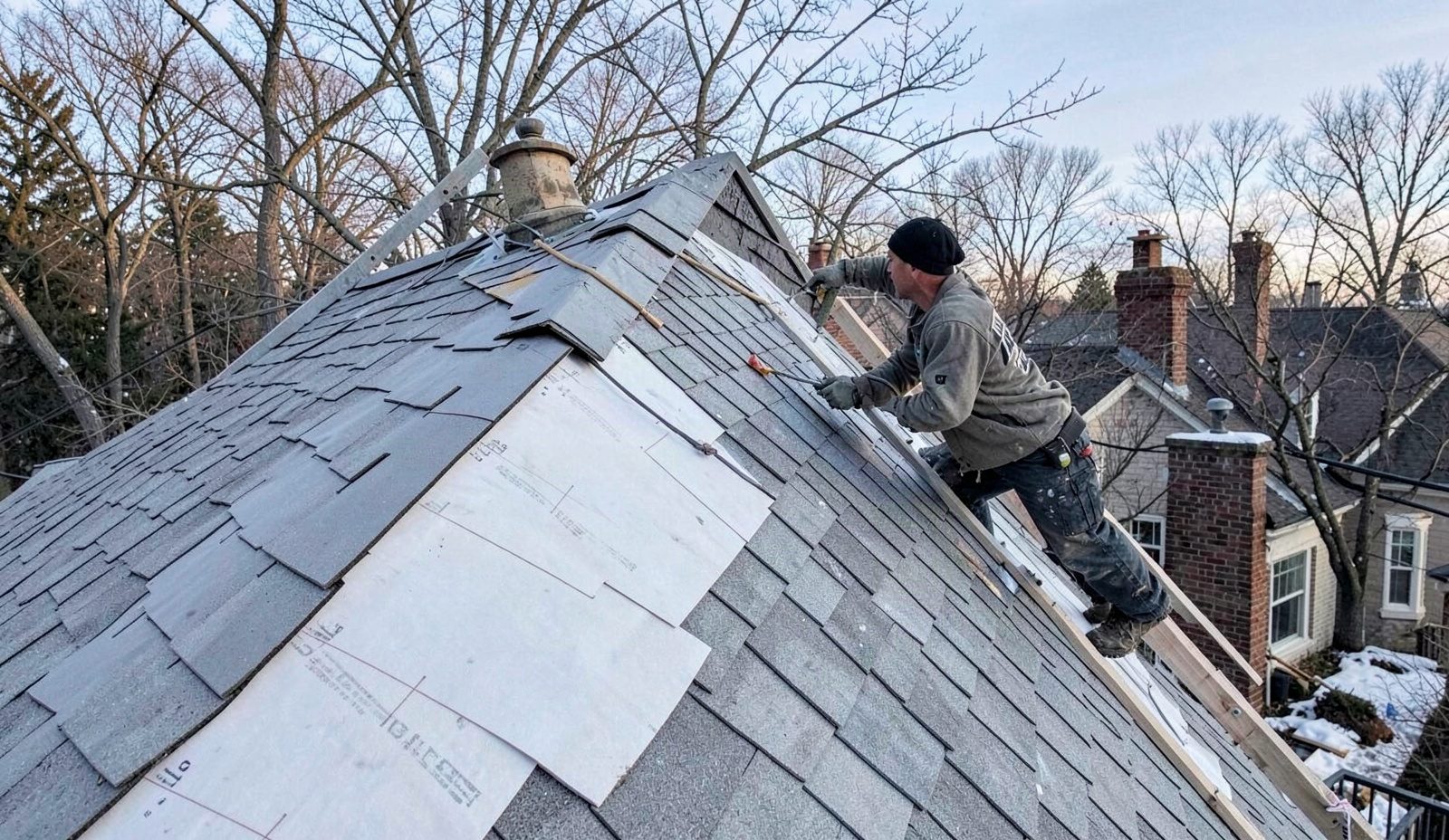
Residential work covers everything from single-slope shingle replacement to full tear-offs on multi-pitch Tudor and Colonial homes. This includes deck repair where original board sheathing has gapped or rotted, step-flashing rebuilds at chimneys and dormers, and full reroofs using architectural laminate shingles rated for high wind uplift. One recent job type: a century-old Tudor with three dormers and two roof pitches converging on a single valley, where the original wood shingles had been covered by two prior layers of asphalt without the flashing underneath ever being replaced. Homeowners call for this when a ceiling stain shows up near a valley or when a home inspection ahead of a sale flags a roof nearing the end of its service life.
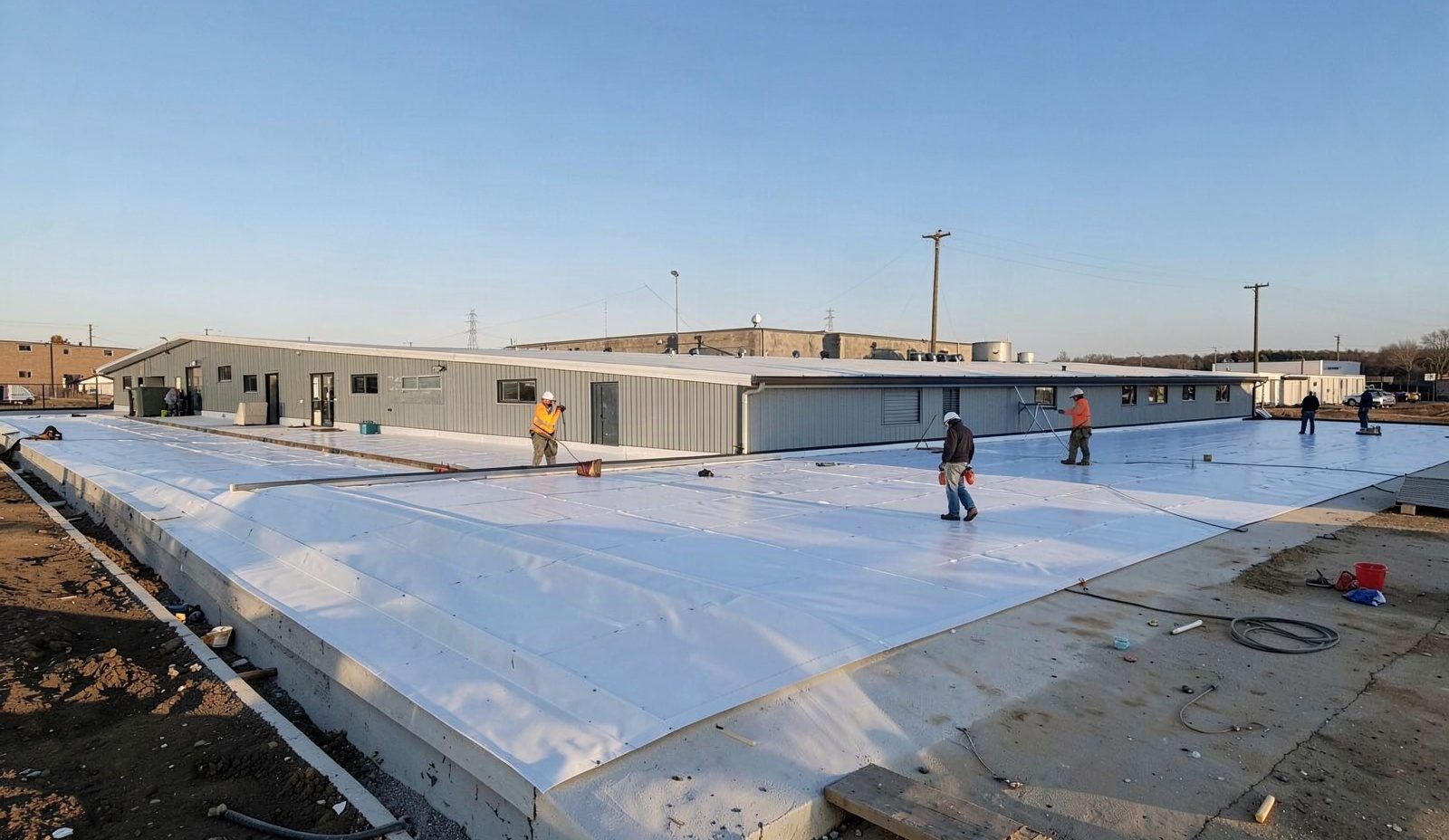
Commercial roofing in Bexley centers on low-slope membrane systems, mostly TPO and EPDM, over office buildings, retail blocks, and mixed-use structures with flat or nearly flat decks. Work includes membrane replacement, seam repair, and rooftop unit curb flashing, scheduled around a tenant's operating hours to avoid shutting down a storefront during business hours. One typical scenario: a multi-tenant retail building with an aging built-up roof showing ponding water near a scupper drain, where a phased membrane replacement keeps half the roof watertight while the other half is under construction. Documentation matters here: photo logs and material specs that a property manager or insurer can file for lease compliance and capital planning.
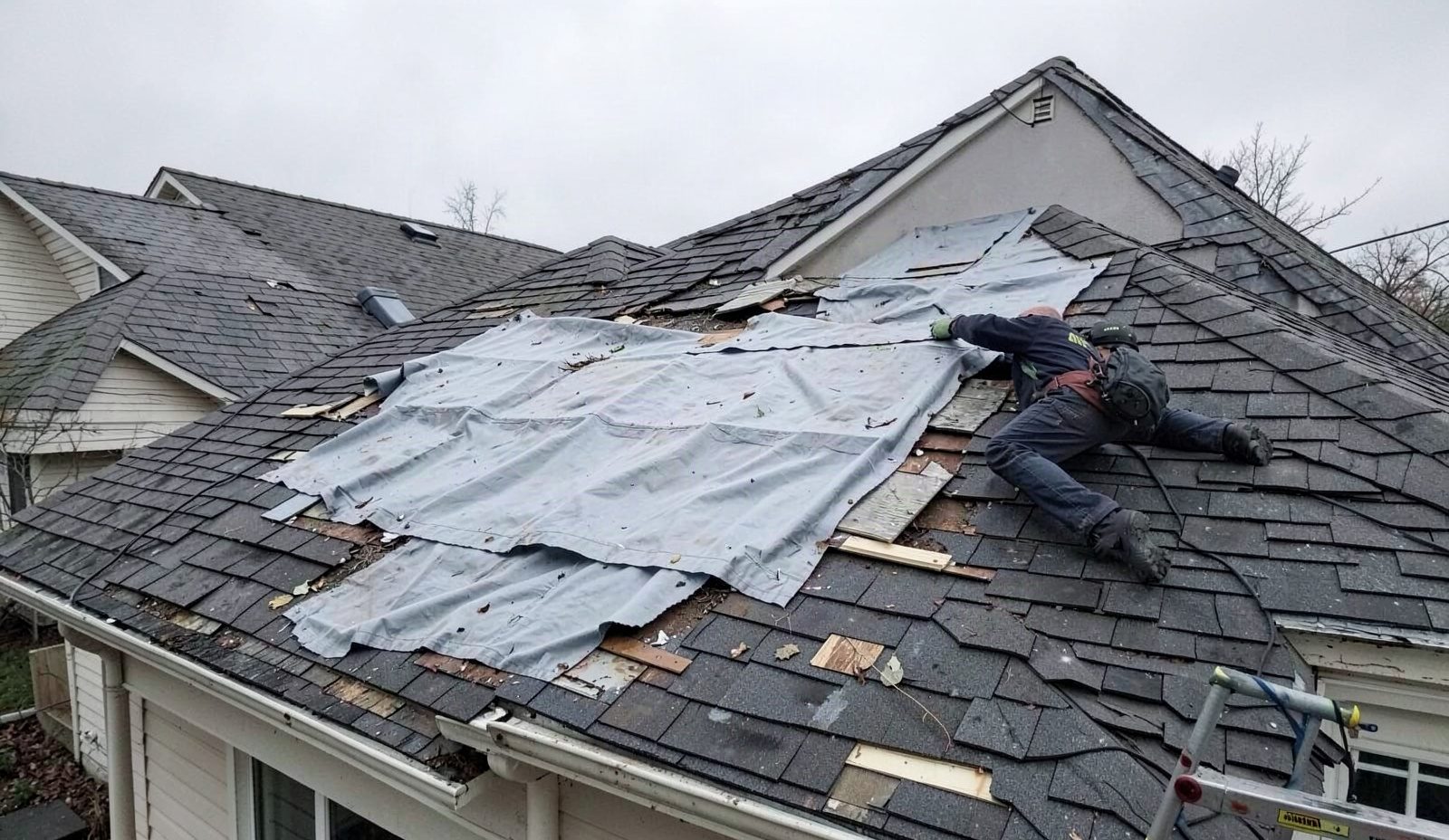
Emergency roofing Bexley calls usually follow a summer thunderstorm that drops hail or straight-line wind hard enough to open a hole in the shingle field or lift a section of ridge cap. Dispatch starts with a phone call: a technician talks through what you're seeing, walks you through immediate containment, and gets a tarp and plywood crew moving the same day when conditions allow. One common scenario: wind peels back three courses of shingle along a ridge during a storm, exposing the underlayment before the next round of rain reaches the area. The crew tarps the exposed field, secures the perimeter with coated screws for wind hold, and documents the damage with photos for the insurance claim before permanent repair is scheduled.
Bexley's roofing problems trace back to two overlapping facts: the climate cycles hard between freeze and thaw, and most of the housing stock predates modern deck and underlayment standards by seventy to a hundred years. That combination means small defects that would sit quietly on a newer roof turn into active leaks faster here.
Catching these early matters more in Bexley than in a subdivision full of identical roofs, because a repair on a century-old steep-slope roof usually touches multiple systems, flashing, decking, and underlayment, at once. A small leak ignored through one winter's freeze-thaw cycles often means replacing a section of decking that a caulk-and-patch job could have avoided a year earlier.
Need something specific? Our new construction roofing page breaks down exactly how we handle it in Bexley.
Central Ohio runs through roughly 40 to 60 freeze-thaw cycles each winter, and that repeated expansion cracks shingle mat and splits flashing sealant at the seams. Add a summer hailstorm that bruises the mat without punching through it, and a roof can look fine from the ground while it loses granules fast. Call when you find granule buildup in the gutters or see cracked, curling shingle edges after a hard freeze.
Homes built before the 1940s often have spaced board decking instead of solid plywood or OSB, and gaps between those boards widen as the wood ages and dries out. Modern shingle nails can miss the board edge entirely on a reroof if the layout isn't checked first, leaving fasteners that back out within a few seasons. Call when a shingle looks properly laid but lifts easily at the tab, a sign the nail never caught solid wood underneath.
Franklin County's clay-heavy soil shifts with seasonal moisture, and older Bexley foundations move enough over decades to rack a roof frame slightly out of square, opening hairline gaps at ridge boards and hip junctions that were tight when the house was built. Aging storm infrastructure along older streets also means downspouts sometimes surcharge during heavy rain, pushing water back up under the drip edge. Call when you notice a new gap at the ridge line or water marks at the fascia after a heavy storm.
Bexley's mature tree canopy drops leaves, seed pods, and small branches into valleys and gutters faster than a newer subdivision with young street trees, and a clogged valley channels water sideways under the shingle edge instead of down to the gutter. Deferred cleaning turns a ten-minute clear-out into a rotted valley board. Call when water sheets off the roof unevenly during rain instead of running straight into the gutter.
A first visit runs about 30 to 45 minutes for a standard residential inspection, longer if the technician needs to check attic ventilation or take moisture readings on multiple sections of decking. The technician starts on the ground, walking the roofline with binoculars to spot obvious flashing or shingle damage before setting a ladder against the house.
Have your address confirmed, note which room shows a stain or leak if there is one, and clear a path to the attic hatch if access is needed. Most Bexley visits also include a quick look at gutter condition and downspout tie-ins, since both feed directly into how the roof drains during a storm.
Roofing permits outside Columbus city limits go through Franklin County Building Services, the county office we coordinate with on suburban jobs.
After you call (614) 707-7333, the office schedules an arrival window and confirms it by phone or text the day before. The assigned technician calls again 20 to 30 minutes out so you can plan your morning around the visit instead of waiting all day. If a hailstorm the night before pushes the schedule, the same technician handling your job calls to reset the window directly.
The technician arrives in a marked vehicle and introduces themselves at the door before walking the property. Ladders get set on standoffs to avoid crushing gutters or landscaping, and a drop cloth or plywood sheet protects flower beds and walkways under the work area. Before touching anything, the technician walks the visible problem area with you, the stain, the missing shingle, the sagging gutter, and explains what they plan to check first and why.
Before the crew packs up, the lead technician walks the finished roofline with you from the ground and, for larger jobs, from a ladder at the eave line so you can see the flashing and ridge work up close. Every job site gets swept for nails with a magnetic roller across the lawn and driveway, and debris goes into a trailer instead of a curbside pile. You receive a written summary of what was found and replaced, along with photos of areas that are no longer visible once shingles cover them.
Every roofing job in Bexley starts with a phone call to (614) 707-7333, because a five-minute conversation about what you're seeing, a stain, a missing shingle, standing water on a flat commercial section, tells the office which technician and equipment to schedule. Most standard inspections get booked within a scheduling window of a few business days, sooner if there's active water intrusion.
From there, the process runs in three stages: diagnosis and a written quote, the work itself performed to Ohio Residential Code standards, and a final verification before the crew leaves. Each stage has a clear handoff so you always know who's doing what and when the next step happens.
Call (614) 707-7333 and describe what you're seeing: location of the leak or damage, roof age if you know it, and whether it's a steep-slope home or a low-slope commercial building. The office logs the details and roof type, schedules a technician suited to that job, such as a drone-equipped inspector for a hard-to-access commercial roof, and gives you a specific arrival window.
The technician inspects the roof, decking, and flashing, takes photos and any needed moisture readings, and builds a written quote that itemizes materials and scope before any work begins. You review and approve that quote. Nothing starts on your roof until you sign off on the scope and materials listed.
The crew completes the work to Ohio Residential Code standards, including proper ice barrier placement and fastening schedules for the local wind zone. The lead technician verifies the finished roof against the approved quote, walks the site with you, and leaves you with photo documentation of the covered work and a summary of what was done.
Bexley operates as a home-rule city with its own building department, though roofing permits for city properties run through the county permitting process and the technical requirements come from the Ohio Residential Code. That code governs everything from fastening schedules to ice barrier placement to flashing details at every roof-wall intersection, and it applies the same way whether the roof sits on a Tudor Revival near downtown or a low-slope commercial building along a major corridor. Local inspectors have seen every shortcut a crew might try, from short-nailing a shingle course to skipping a required underlayment layer at a low-slope transition.
The practical answer shows up in the paperwork left behind: a written scope naming the underlayment type, the shingle wind rating, and the ice barrier coverage, plus photos taken before the roof covering goes down, when the deck and flashing are still visible for verification, since once the shingles go on, only that documentation proves the work was installed to spec.
Full replacements and structural repairs typically require a permit. Minor like-for-like repairs, a handful of replacement shingles or a resealed flashing joint, often do not, and the final call always belongs to the permitting authority handling the request. Compliance gets verified on-site with straightforward checks: a nail gun set to the correct depth so fasteners sit flush without cutting the shingle mat, a flashing lap measured against the manufacturer's minimum overlap, and a wind-rating tag on the shingle wrapper checked against the pitch and exposure of the specific roof. Shingle products used on Bexley reroofs are tested to ASTM wind-resistance standards such as ASTM D3161 and D7158, and the wind classification printed on the wrapper needs to match the exposure category of the site, a corner lot with no windbreak needs a higher rating than a sheltered mid-block lot.
Many Bexley roofs run steeper than an 8:12 pitch, common on Tudor and French Normandy gables, which changes the safety and staging approach entirely. Crews use roof jacks and toe boards rather than walking the field directly, and ladder placement accounts for dormers that break up an otherwise continuous eave line. That access planning affects labor time more than most homeowners expect.
Scope hinges on roof pitch, the number of dormers and valleys, deck condition once the old covering comes off, and how many prior roofing layers need tear-off before new material goes down. A steep multi-valley Tudor roof takes measurably longer per square than a simple gable, and hidden deck rot found mid-tear-off changes the scope on the spot.
A standard residential tear-off and reroof on a moderate-pitch home typically finishes in one to two working days once materials are on site, while steep multi-dormer roofs or full commercial membrane replacements run longer. Quality gets measured at specific checkpoints: nailing pattern, flashing lap length, and ridge vent continuity, checked before and after the final course goes down.
Full tear-off replacements and structural repairs generally need a permit, while a handful of replacement shingles or a resealed flashing joint usually does not. The determination for a specific job rests with the local permitting authority, and that call gets made before work begins.
Cost depends on square footage, pitch, material, and how many layers need tear-off before the new roof goes down. Steep multi-dormer homes, common across Bexley's historic core, take longer per square than a simple ranch gable, which shifts labor higher regardless of material choice. Ask a technician to itemize scope, material, and labor separately on the written quote so you can see exactly what drives the number for your specific roof.
Late fall through winter tends to bring the most schedule flexibility and softer demand. Roofing crews across central Ohio see the heaviest call volume after spring storms and through summer hail season, so booking a non-emergency reroof in the off months often means faster scheduling, even though cold-weather installation needs extra care with shingle sealant strip activation. Ask about outdoor temperature requirements for adhesive seal-down before locking in a winter date.
Cost in Bexley depends heavily on roof pitch and age, since steep Tudor and French Normandy gables take more labor per square than a simple ranch roof. Older homes also add cost drivers newer subdivisions rarely see: multiple tear-off layers, board decking that needs partial replacement, and custom flashing at chimneys and dormers. A technician measures the specific roof and itemizes each cost driver on the written quote instead of quoting a flat rate over the phone.
Estimates start with an on-site measurement rather than a phone quote. A technician walks the roof or flies a drone pass over steep or high sections, measures square footage and pitch, checks deck condition where visible, and builds a written quote itemizing material, labor, and any tear-off layers found. You review that quote before work gets scheduled, and it holds for a set window so you can compare it against other options.
Response time depends on the type of job. Active leaks and storm damage get same-day attention when conditions allow, while standard reroof scheduling typically runs a few business days out. A hailstorm that hits multiple Bexley properties at once can extend that window slightly since active leaks take priority over cosmetic repairs. Call (614) 707-7333 and describe the situation so the office can gauge urgency and slot the right technician.
Full replacements and structural repairs typically need a permit, while minor like-for-like shingle repairs usually don't. Bexley issues roofing permits through its local building process under the Ohio Residential Code, and the final call on any specific project belongs to that permitting authority. Ask your technician whether your scope crosses into permit territory before work starts, since a full tear-off almost always does.
Explore our service area and locate Cornerstone Roofing Columbus with ease. We're proudly local and serve the surrounding neighborhoods with fast response and honest pricing. Use the map to check our coverage area, or call us and we'll confirm in seconds.
Address:
Cornerstone Roofing Columbus, Bexley, OH 43209
How Much Does a Roof Replacement Cost in Columbus? 2026 Pricing Breakdown, practical local guidance from Cornerstone Roofing Columbus, Colum…
Read More
Commercial Roof Maintenance Tips for Columbus Property Managers, practical local guidance from Cornerstone Roofing Columbus, Columbus's trus…
Read More
Skylight Leaks in Victorian Village Homes, Repair or Replace?, practical local guidance from Cornerstone Roofing Columbus, Columbus's truste…
Read More
The Best Time of Year to Replace a Roof in Columbus, practical local guidance from Cornerstone Roofing Columbus, Columbus's trusted roofing …
Read More